AQL Inspection Specs for Custom Promo Products
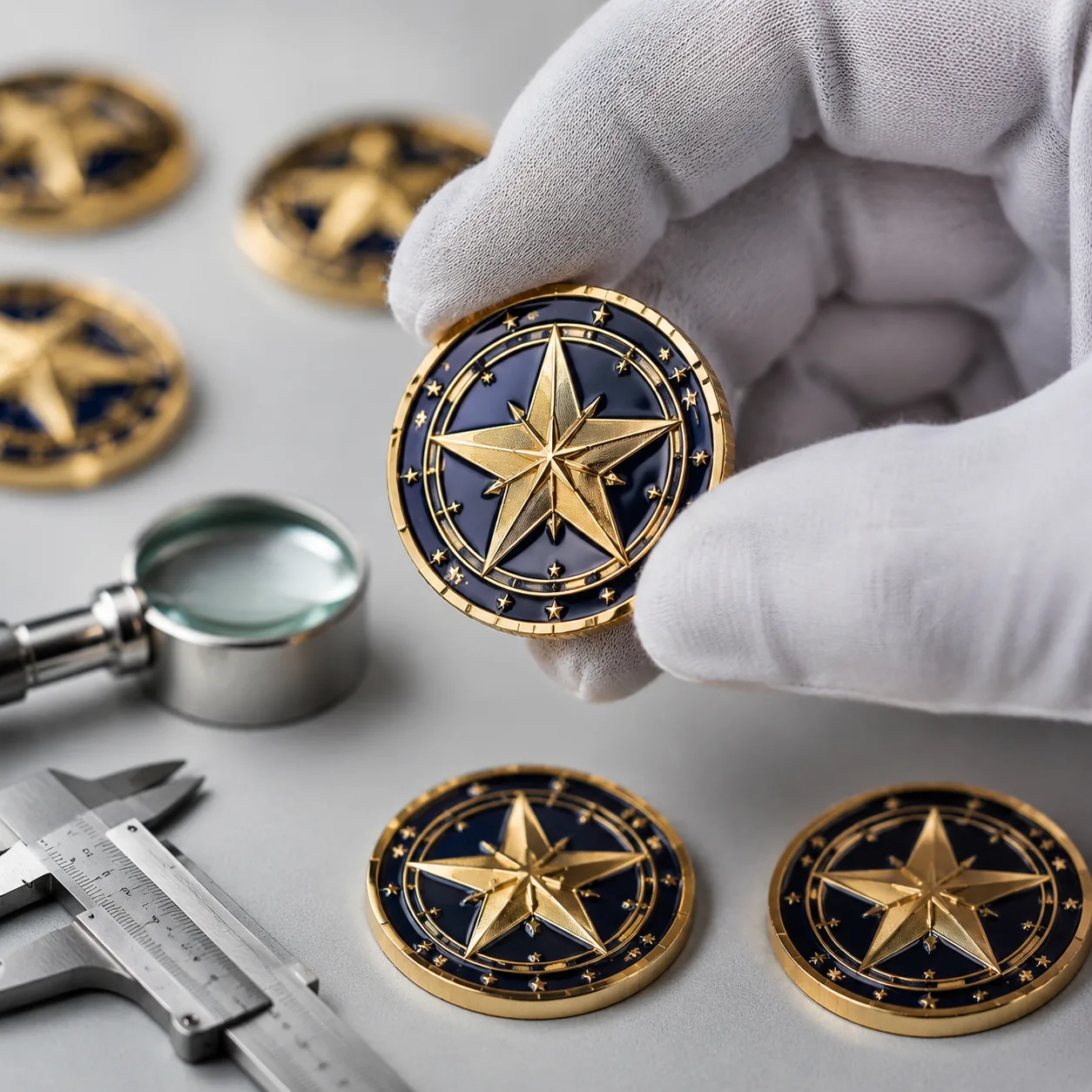
Q: Why do approved samples still become inconsistent bulk goods?
A clean pre-production sample proves that one process path can make one acceptable item. It does not prove that 10,000 pieces will hold the same color, plating, attachment strength, packaging accuracy and carton labeling. The usual failure is not simply carelessness. The purchase order often says “same as approved sample” but never defines how the finished lot will be judged.
For custom metal and textile promotional products, the practical control is an AQL-based inspection plan tied to product-specific checkpoints. AQL means Acceptable Quality Limit, normally applied using ANSI/ASQ Z1.4 or ISO 2859-1 sampling tables. It does not promise zero defects. It gives the buyer, factory and inspector a shared pass/fail rule before shipment.
At ZheCraft, AQL language is most useful on mixed promotional orders: enamel pins on backing cards, challenge coins in capsules, keychains with split rings, embroidered patches with heat-seal backing and lanyards with breakaway buckles. The inspection plan should be agreed during quotation or PO release, not after cartons are sealed. Without AQL levels, defect classes, sample sizes and packaging checks, final inspection becomes a subjective argument.
Q: Which AQL levels fit pins, coins, patches and lanyards?
For most promotional orders, General Inspection Level II is the default because it balances inspection cost and confidence. Under ANSI/ASQ Z1.4, a 5,000 piece order at Level II uses code letter L, which means a 200 piece sample. At AQL 1.5, that sample accepts up to 7 major defects and rejects at 8. At AQL 4.0, it accepts up to 14 minor defects and rejects at 15. These numbers should be visible on the inspection report, not left to the inspector’s judgment.
A balanced specification is AQL 0.65 for critical defects, AQL 1.5 for major defects and AQL 4.0 for minor defects. Critical defects are safety, legality or brand-control failures. Major defects affect function or obvious appearance. Minor defects are small cosmetic issues that do not affect normal use. For low-cost event giveaways under about USD 0.35 FOB, AQL 2.5 major and 4.0 minor may be more realistic, but critical defects should not be relaxed.
| Product or order type | Typical MOQ | FOB range at mid-volume | Lead time after artwork approval | Suggested plan | When to tighten |
|---|---|---|---|---|---|
| Soft or hard enamel pins, 20-40 mm | 100-300 pcs/design | USD 0.45-1.20 | Sample 5-8 days; bulk 12-20 days | Level II; 0.65/1.5/4.0 | Retail launch, VIP gift, strict Pantone color |
| Challenge coins, 40-60 mm | 100-300 pcs/design | USD 1.20-3.80 | Sample 7-10 days; bulk 15-25 days | Level II; 0.65/1.5/2.5 | Mirror plating, serial numbering, gift boxes |
| Metal keychains, 40-70 mm | 300-500 pcs/design | USD 0.55-1.80 | Sample 6-9 days; bulk 14-22 days | Level II; 0.65/1.5/4.0 | Heavy charms over 35 g or rotating hardware |
| Embroidered or woven patches | 100-300 pcs/design | USD 0.25-1.10 | Sample 5-7 days; bulk 12-22 days | Level II; 0.65/2.5/4.0 | Uniform use, heat-seal backing, small text |
| Printed lanyards, 15-25 mm wide | 300-500 pcs/design | USD 0.28-0.85 | Sample 4-7 days; bulk 10-18 days | Level II; 0.65/2.5/4.0 | Access badges, safety breakaway requirement |
| Child-facing items | 500+ pcs depending on fittings | Varies by testing scope | Add 5-15 days for compliance testing | Level II or III; 0.25-0.65/1.0-1.5/2.5-4.0 | Small parts, magnets, sharp points, CPSIA/EN71 risk |
Do not choose an unrealistically strict AQL just to pressure the factory. AQL 0.25 for every defect class on a low-cost lanyard can add sorting cost, delay and rehandling damage without improving the product meaningfully. Tighten the plan when risk justifies it: child safety, retail sell-through, high unit value, expensive packaging, regulated destination markets or a fixed event date with no replacement window.
Q: How should defects be classified?
Defect classification must follow how the product is used. A polishing line on the back of a coin is not the same risk as a sharp burr on a pin post. A slightly scuffed backing card is not the same as the wrong event logo. If the inspection sheet does not define defect classes, two inspectors can examine the same lot and reach different conclusions.
Critical defects should include sharp edges that can cut skin, detached magnets, loose small parts on child-facing goods, broken pin posts, missing safety breakaway buckles where specified, wrong customer logo, missing legal marking and mixed SKU cartons that could ship to the wrong event. Many buyers require automatic rejection if even one critical defect is found in the sample.
Major defects include wrong plating color, front-side enamel outside the metal line, visible color mismatch beyond the approved standard, bent pin posts over 5 degrees, loose jump rings, weak split rings, misaligned epoxy domes, unreadable QR codes, wrong attachment type, wrong backing card and carton shortages. Minor defects include rear-side hairline scratches, tiny plating specks under 0.3 mm outside the main logo area, slight thread fuzz on patch edges or backing-card rub marks not visible in normal presentation.
- Classify safety, legality and wrong-logo errors as critical defects with no compromise.
- Treat visible front-logo defects as major because they affect brand presentation.
- Allow rear-side cosmetic marks only when hidden in use and below the agreed size limit.
- Separate function failures from appearance failures so sorting can target the real issue.
- Attach approved photos of acceptable and unacceptable defects for complex artwork.
- Define packaging defects separately when retail cards, barcodes or carton labels matter.
Q: How many pieces should inspection sample?
Sample size depends on lot quantity and inspection level. At General Level II, a lot of 501-1,200 pieces uses an 80 piece sample, 1,201-3,200 pieces uses 125 pieces, 3,201-10,000 pieces uses 200 pieces and 10,001-35,000 pieces uses 315 pieces. If the order has several SKUs, colors, plating finishes or packaging versions, do not hide all of them inside one pooled sample. Each variation can carry its own defect pattern.
A practical rule is to inspect by SKU when quantities are large enough and by risk group when they are not. If a 6,000 piece order contains three pin designs of 2,000 pieces each, inspect each design separately or require at least 50-80 pieces per design within the total draw. For a promo set containing a pin, patch and lanyard, inspect each component type because stamping, embroidery and webbing print fail in different ways.
In-process checks reduce final surprises. For metal pins and coins, check 10-20 raw stamped or cast blanks before plating, then 20-30 plated pieces before enamel filling, epoxy or pad printing. For lanyards, check 5-10 meters after print setup before full-roll production. For patches, review the first 10-20 stitched pieces for border width, thread density and backing coverage before approving the full run. Final AQL inspection still matters, but catching tooling, plating or print issues mid-process is cheaper than sorting finished stock.
Q: What specs should the inspector measure?
Visual inspection alone is not enough. The inspector should have a digital caliper, coating thickness gauge where plating thickness is specified, pull gauge for posts or attachments, Pantone book or approved color standard, D65 light source where available, barcode or QR scanner and a 0.1 g scale for coins or premium keychains. The measurement list should fit the product rather than become a generic checklist.
For die-struck or enamel pins, measure overall width and height to ±0.2 mm for pieces under 40 mm and ±0.3 mm for larger pieces unless the artwork needs tighter control. Check thickness to ±0.2 mm, pin-post position to ±0.5 mm and post angle within 5 degrees of perpendicular. Clutches should be attached and removed three times on the sampled pieces; loose clutches or posts that rotate by hand should be major or critical depending on use.
Decorative nickel, gold, copper, black nickel and rose gold plating is commonly controlled around 3-8 microns for promotional products. Budget pins may sit near the lower end. Premium coins, keychains or items exposed to frequent handling should specify the higher end and verify raised edges, not only flat areas. If the order needs corrosion resistance, add salt-spray or humidity requirements rather than relying on decorative micron thickness alone.
For challenge coins, check diameter to ±0.2 mm, thickness to ±0.2 mm, weight to ±5%, edge style against the sample and capsule fit if capsules are included. For lanyards, check webbing width to ±1 mm, finished length to ±10 mm, print registration to ±1 mm and hardware function on at least 20 pieces from the sample. For patches, check overall size to ±1 mm, border width to ±0.5 mm, backing coverage without dry corners and heat-seal adhesion if the patch is intended for uniforms.
| Checkpoint | Typical tolerance or test | Major failure example | Minor failure example |
|---|---|---|---|
| Overall size | ±0.2-0.3 mm for metal; ±1 mm for patches | Badge does not fit backing card die-cut | Small deviation not visible in use |
| Plating thickness | 3-8 microns for decorative plating | Base metal visible on front edge | Light rear-side thin spot |
| Pin post angle | Within 5 degrees from perpendicular | Post affects wearing or breaks during handling | Small lean but clutch remains secure |
| Color match | Approved sample or Pantone target under D65 light | Wrong brand color on front logo | Tiny shade variation in non-logo recess |
| Lanyard registration | ±1 mm on repeated logos | Logo cut by sewing or clip fold | Minor drift between repeats |
| Patch border | ±0.5 mm border width | Merrow border covers text | Slight rear-edge thread fuzz |
Q: How should color and plating disputes be controlled?
Color disputes are common because enamel, woven thread, printed polyester and plated metal reflect light differently. A Pantone number is useful, but it is not a complete contract. The approved physical sample should be the master reference, especially for translucent enamel, glitter, metallic ink, antique plating, dyed thread and soft PVC effects.
Specify lighting, viewing distance and priority zones. A practical standard is D65 daylight or a light box, viewed at 30-50 cm, with the front logo area judged more strictly than the back or hidden sides. If ΔE values are used for printed polyester or paper cards, define the instrument, illuminant and substrate. For enamel pins and plated coins, visual matching to the approved sample is usually more realistic than claiming a universal ΔE tolerance.
Plating needs separate controls because color, adhesion and wear are different issues. A gold-tone pin may look correct but fail if coating is thin on raised edges or if polishing compound was not cleaned before plating. For higher-value orders, request tape adhesion checks, 24-hour humidity observation for suspicious finishes and extra handling tests on black nickel, rose gold, antique brass and antique silver, which show process variation more readily than standard nickel.
Q: What should the factory check before third-party inspection?
A third-party inspection should verify a shipment, not become the first serious quality check. Ask the factory for an internal final inspection report showing sample size, defect counts, photos, rework actions and carton quantities before booking the outside inspector. If the factory cannot show its own results, the order is not ready for inspection.
For ZheCraft orders, the normal control path is artwork engineering review, tooling or print setup check, pre-production sample approval, in-line inspection at key production stages and final AQL inspection before carton sealing. This matters most for multi-process items such as hard enamel pins with epoxy, coins with antique plating, keychains with rotating hardware and lanyards with stitched accessories. Each added process creates another chance for a defect after the approved sample looked correct.
- Confirm bulk production is 100% finished and at least 80% packed before final inspection.
- Keep rejected or reworked pieces physically separated from accepted stock.
- Check carton labels against SKU, design code, quantity, gross weight and destination.
- Verify inner packing counts before sealing master cartons.
- Photograph the first sealed carton and packing method before palletizing.
- Do not ship if critical defects are found unless the affected lot is fully sorted and rechecked.
Q: When is 100% inspection worth the cost?
AQL sampling is efficient, but it is still sampling. If one loose post can create a safety complaint, if every item carries a unique serial number or if the product controls access to an event, 100% inspection may be justified. The cost is not only labor. Repeated handling can add scratches, lost polybags, mixed cards and repacking errors if the work is rushed.
Use 100% inspection for critical-function points rather than every cosmetic detail. Check every QR code scan on an access-control badge, every serial number on a coin series, every magnetic closure on a premium badge and every breakaway buckle on a safety lanyard. For ordinary event giveaways, 100% cosmetic inspection is often not economical and can add about USD 0.02-0.08 per small item, depending on packaging complexity and whether cartons must be reopened.
Unit value matters. A USD 0.28 woven patch cannot absorb the same sorting cost as a USD 5.50 boxed challenge coin. As a planning range, a final internal AQL inspection may add USD 80-250 per order, while a third-party inspection commonly costs about USD 180-350 per man-day depending on country and travel. Full manual sorting of packed products can add 1-3 days, and rework requiring replating, reprinting or remaking may add 7-20 days.
Q: What should go into the purchase order?
Convert expectations into a short inspection appendix attached to the RFQ and purchase order. It does not need to be a long legal document. It must identify the product, approved sample, AQL standard, inspection level, defect classes, measurable tolerances, packaging checks and what happens if the lot fails.
For a 3,000 piece enamel pin order, a clear PO line would state: final inspection to ANSI/ASQ Z1.4 General Level II, AQL 0.65 critical, 1.5 major, 4.0 minor; size tolerance ±0.2 mm; thickness ±0.2 mm; decorative nickel or gold plating 3-8 microns as approved; pin post angle within 5 degrees; clutch fit checked by three attach-remove cycles; front logo color matched to approved sample under D65 light; backing card, polybag and carton label checked against SKU.
For a 5,000 piece lanyard order, add webbing width ±1 mm, finished length ±10 mm, print registration ±1 mm, buckle and safety breakaway function tested, barcode or QR scan if used, metal hook closure checked and carton labels verified against destination. If the lanyard is used for school, child, access-control or safety programs, specify any required compliance testing before mass production, not after packing.
- Send one approved sample photo set showing front, back, side, attachment and packaging views.
- Name the AQL standard, inspection level and AQL values instead of writing “strict QC.”
- Define critical, major and minor defects in product-specific language.
- List tolerances for size, thickness, plating, color, print, hardware and packing.
- Require an internal inspection report before shipment booking.
- Agree whether failed lots will be sorted, reworked, replaced, remade or discounted before production starts.
If you are not sure which AQL level fits the order, share the product type, quantity, destination market, user age group, packaging method, FOB target and event deadline before quoting. ZheCraft can build the inspection appendix into the quotation stage, including realistic MOQ tiers, lead times and inspection checkpoints. Clear AQL specs do not make defects impossible, but they make quality decisions faster, fairer and easier to enforce before goods leave the factory.
Have a project? Send your artwork and target quantity and we’ll reply with a detailed quotation within 12 working hours.
Ready to get this made?
Send your sketch, target quantity and ship-date. Detailed quotation in 12 hours.



