AQL Inspection Specs for Custom Pins, Coins and Keychains
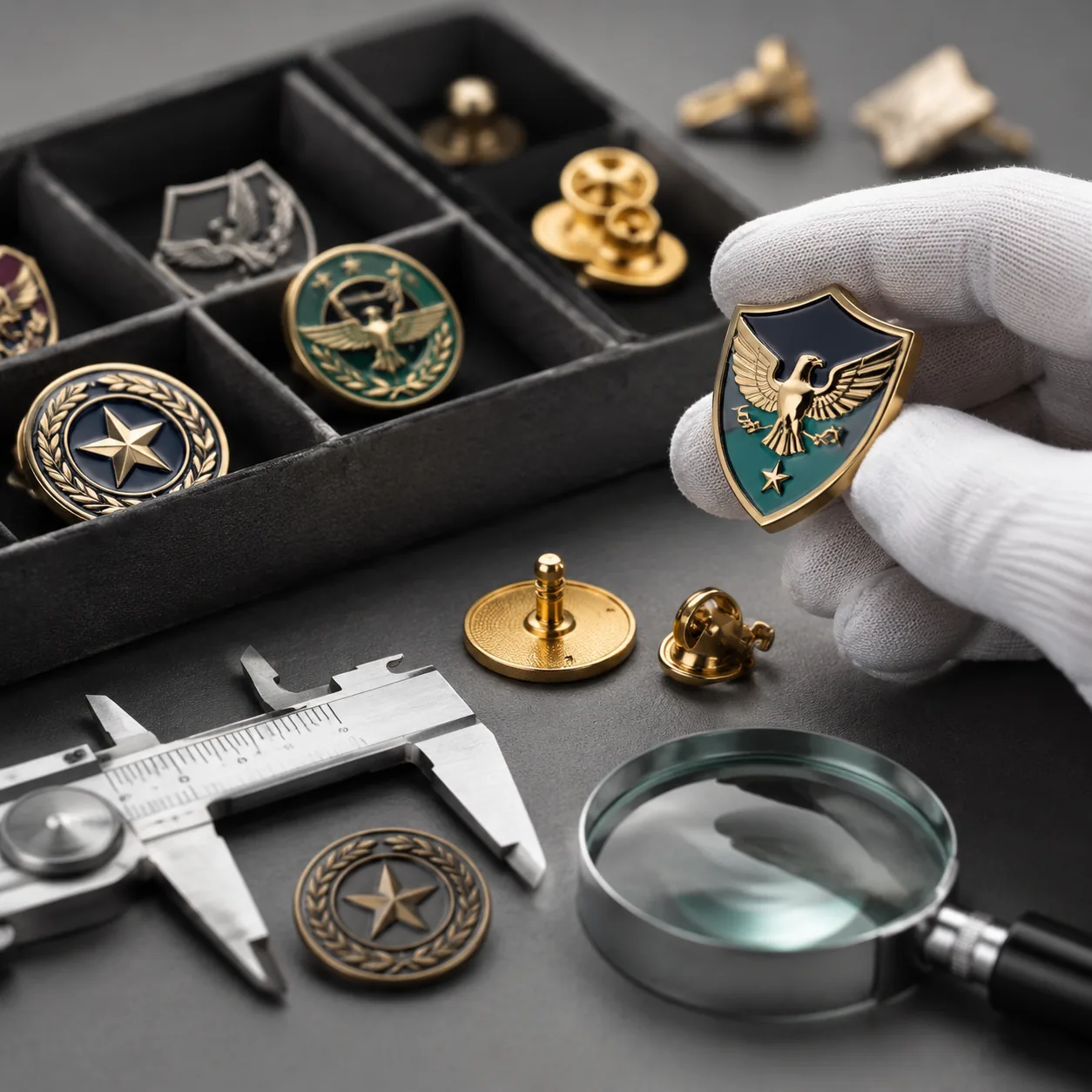
Why an approved sample does not control a production lot
Shipment disputes on custom metal promo items usually come from missing acceptance criteria, not from a factory that ignored the approved sample. Terms such as "good quality," "export standard" or "same as sample" are too vague for a final random inspection. A plating pit on the front face, a 0.4 mm print shift, or a mixed gold/silver inner box may be treated by the factory as normal variation unless the PO tells the inspector exactly how to score it.
For enamel pins, challenge coins, medals, badges and zinc alloy keychains, the QC standard should be written before mass production starts. Attach it to the RFQ or PO together with approved artwork, Pantone references, pre-production sample photos, packaging layout, barcode files and carton marks. That gives the supplier and third-party inspector the same pass/fail rule. It also matters commercially: a 500-piece museum store pin, a 5,000-piece employee recognition medal and a 50,000-piece giveaway keychain do not need the same cosmetic burden, but each still needs a measurable release standard.
A workable spec for these categories should cover six points: sampling plan, defect classification, dimensions and weight, color and finish limits, functional tests, and packaging verification. If one of those is missing, the inspector will fill the gap with personal judgment, which is exactly what creates arguments after goods are packed.
1. Set the sampling plan before production starts
For most custom metal promo goods, use ANSI/ASQ Z1.4 or ISO 2859-1, single sampling, normal inspection, General Inspection Level II. That is the default used by most China-based third-party inspection firms for finished consumer products. If you want a different burden, write it directly. Level III is reasonable for retail launches or licensed merchandise with high brand risk. Special Level S-2 or S-3 works for destructive checks such as pull tests, plating tape tests or dimensional verification on a smaller sub-sample.
A practical default is Critical 0, Major AQL 2.5 and Minor AQL 4.0 for standard promo orders. For museum retail, subscription boxes, paid collectibles or licensed merchandise, tighten to Critical 0, Major 1.5 and Minor 2.5. For low-risk event giveaways where minor cosmetic variation is acceptable, Minor 6.5 may be acceptable, but Critical defects should always remain zero acceptance.
| Lot quantity | General Level II sample size | Standard promo AQL | Retail/collectible AQL | Typical FRI time |
|---|---|---|---|---|
| 501-1,200 pcs | 80 pcs | C=0 / M=2.5 / m=4.0 | C=0 / M=1.5 / m=2.5 | 0.5-1.0 man-day |
| 1,201-3,200 pcs | 125 pcs | C=0 / M=2.5 / m=4.0 | C=0 / M=1.5 / m=2.5 | 1.0 man-day |
| 3,201-10,000 pcs | 200 pcs | C=0 / M=2.5 / m=4.0 | C=0 / M=1.5 / m=2.5 | 1.0 man-day |
| 10,001-35,000 pcs | 315 pcs | C=0 / M=2.5 / m=4.0 | C=0 / M=1.5 / m=2.5 | 1.0-1.5 man-days |
| 35,001-150,000 pcs | 500 pcs | C=0 / M=2.5 / m=4.0 or m=6.5 for low-risk giveaway use | C=0 / M=1.5 / m=2.5 | 1.5-2.0 man-days |
Do not write "100% inspection" as a default cure-all. Full sorting on simple metal items typically adds about USD 0.015-0.08 per piece FOB, depending on whether the goods are loose, carded, bagged or already packed in sets. It is useful after a failed FRI, for premium retail packs, or when a known defect mode such as wrong backing card or mixed plating color can be sorted visually. It does not replace a defined acceptance standard.
2. Make defect classes product-specific and observable
AQL only works if defect categories are concrete. A light scratch on the back of a coin is not equivalent to a loose magnet, incorrect plating color, unreadable barcode or detached split ring. Defect classes should be based on actual commercial risk: user safety, functionality, retail presentation and brand accuracy.
- Critical defect: burr, needle point or exposed edge likely to cut skin; detachable magnet or small part creating child-access risk; hazardous broken pin post; mold, corrosion or chemical contamination; missing legally required warning, age grade or country-of-origin mark where required by destination market.
- Major defect: wrong artwork, wrong SKU, wrong plating finish, missing enamel color, obvious front-face scratch, print misregistration beyond tolerance, unreadable barcode or QR code, failed pull test, dimension outside agreed tolerance, mixed SKU in carton, missing retail package, crushed customer-facing package.
- Minor defect: small back-side scratch, slight enamel underfill within limit, light plating speck not obvious in normal viewing, slight color variation within approved range, small OPP scuff, non-critical carton marking issue that does not affect receipt or retail sale.
Cosmetic criteria should also state the viewing condition. A common commercial standard is 30 cm viewing distance, 600-1,000 lux neutral white light, 5 seconds per side, unaided eye. That is appropriate for most promotional goods. If the item is a mirror-polished collector coin or jewelry-style brooch, say whether hairlines visible only under 2x magnification count as process marks or as defects. Without that rule, cosmetic scoring becomes inconsistent from inspector to inspector.
It is also worth defining which surfaces are customer-facing. On a pin mounted on a backing card, the front face is typically critical, the edge is secondary, and the back can tolerate more process marks. On a double-sided coin in a capsule, both faces and the edge are display surfaces. That distinction should be stated in the spec.
3. Use realistic tolerances for dimensions, weight and alignment
Tolerance has to follow the process. Die-struck brass, copper and iron can hold sharper edges and tighter outlines than spin-cast zinc alloy. Printed areas, epoxy domes, cutouts and high-relief 3D surfaces increase variation. If the drawing shows only nominal size, the inspector has no acceptable range and the dispute turns subjective.
For enamel pins and badges in the 20-50 mm range, a size tolerance of +/-0.30 mm is realistic for die-struck parts and +/-0.50 mm for cast zinc alloy. For challenge coins at 38-60 mm, diameter tolerance of +/-0.30 mm is standard for die-struck iron or brass, while irregular 3D cast silhouettes should allow +/-0.50 mm. Thickness tolerance can usually be set at +/-0.15 mm for 1.2-2.0 mm pins, +/-0.20 mm for 2.5-4.0 mm coins, and +/-0.30 mm for larger cast keychains with raised relief.
Weight is a useful secondary control for wrong thickness, wrong metal or underfilled casting, but it should not be overly tight. Use +/-5% for pins and keychains, and +/-3% for coins when the base metal and nominal thickness are fixed. If the RFQ allows metal substitution, weight and price will move. At 1,000 pcs, a 45 mm die-struck iron coin at 3.0 mm thickness often lands around USD 0.75-1.35 FOB, while a brass version of similar size typically runs USD 1.20-2.40 FOB because of material cost, strike quality and polishing time.
Assembly alignment needs its own tolerance. Pin posts should be centered within +/-1.0 mm unless the design needs an offset for balance. Two-post spacing should match the approved sample within +/-1.0 mm to prevent rotation on garments or bags. Coin back stamps should be aligned within +/-2 degrees. Printed backing cards should keep hang holes centered within +/-1.0 mm so asymmetrical keychains do not appear visually crooked at retail.
4. Define measurable limits for color, enamel, printing and plating
Pantone matching should be checked against a physical Pantone reference or approved production sample under D65 or equivalent neutral light. PDF proofs and phone photos are not acceptance standards. For standard soft and hard enamel, staying within about one Pantone shade step is a practical commercial target when the same enamel type, base metal and plating were approved. Transparent colors, pearl, glitter, glow pigment and printed gradients should always be approved on an actual pre-production sample because the base metal and clear coat thickness change the appearance.
For soft enamel, specify fill depth. A normal target is 0.10-0.30 mm below the raised metal line. For hard enamel imitation, the polished surface should finish nearly flush, typically within +/-0.05-0.10 mm of the metal line. Reject exposed base metal inside color cells, overflow covering raised lines, trapped dust on the front face and bubbles larger than 0.30 mm in visible logo areas. Cells narrower than 0.25 mm are high-risk features and should usually be widened or converted to print during artwork engineering.
Printed details also need hard numbers. Silk-screen or offset registration within +/-0.20 mm is a reasonable target; more than 0.30 mm shift should usually count as major on front-facing artwork. Text below 4 pt on textured metal is risky, and QR codes smaller than about 10 x 10 mm often become unreliable once clear epoxy and surface texture are added. If a scan code matters operationally, require a live scan test during inspection.
| Feature | Standard acceptance | Reject condition | Engineering note |
|---|---|---|---|
| Soft enamel | Recessed 0.10-0.30 mm; clean metal boundaries; no exposed base metal in color field | Missing fill, overflow across metal lines, visible front bubble over 0.30 mm | Cells under 0.25 mm are unstable and often need redesign |
| Hard enamel | Surface flush within +/-0.05-0.10 mm; even polish; no cracks | Wavy finish, color bleeding, polished-away metal lines, cracked enamel | Fine raised detail can soften during polishing |
| Printing | Registration within +/-0.20 mm; artwork and code legible at approved size | Blur, ghosting, unreadable QR/barcode, misregistration over 0.30 mm | Text under 4 pt is high risk on textured metal |
| Plating | Uniform visual color at 30 cm; no peeling, blistering or exposed base metal on front face | Peeling, blistering, green tarnish, heavy water marks, visible pinholes | Higher plating thickness can add 1-3 production days and higher FOB cost |
For decorative plating thickness, flash plating on basic promo pins is often around 0.03-0.08 microns. Better handling resistance typically starts at about 0.10-0.20 microns, depending on undercoat, chemistry and base metal. That matters for keychains and collectible coins that will be handled daily. Mirror black nickel, rose gold and rainbow plating should be specified carefully because they show fingerprints, abrasion and edge rub more easily than standard shiny gold, silver or antique finishes.
5. Functional testing should match the hardware
A metal item can look acceptable and still fail in use. The PO should state the test method, force, duration and sample count for hardware checks, especially for school programs, uniforms, museum stores, paid merchandise and products with magnets or moving parts.
For lapel pins under 30 g, test pin-post strength at 1.0 kg pull for 10 seconds on at least 5 pcs per SKU. For heavier badges, use 1.5 kg. Reject detached posts, cracked solder joints, bent posts that prevent clutch use, or sharp exposed solder points. Butterfly clutches should remain engaged during a light shake test. Rubber clutches are common on low-cost promos, but locking clutches are better for uniforms and resale; typical add-on cost is about USD 0.04-0.12 per piece FOB depending on type and volume.
For magnetic badges, test magnet-to-plate adhesion at minimum 1.0 kg pull for small badges and 1.5-2.0 kg for larger name badges or brooch styles. Any loose magnet should be classified as critical if child access is possible. For keychains, open and close split rings three times and confirm they return to shape without permanent spread. Light charms can use 25-30 mm rings, but heavier zinc alloy pieces usually need 28-32 mm rings with 1.8-2.2 mm wire diameter. Swivels should rotate freely with no plating flakes or rough hinge interference. Bottle-opener keychains should be use-tested on at least 5 sampled units.
For coins and medals, functional checks are simpler but still worth specifying. Edge milling should be complete, no glued inserts should move under thumb pressure, and any acrylic capsule, velvet box or display stand should fit the actual finished diameter. A coin that rattles in its capsule is a retail defect even if the coin itself passes cosmetics.
6. Packaging verification is part of product quality
A large share of failures happen after acceptable parts are produced. Factories may mount pins on the wrong backing card, mix finishes in one inner box, apply the wrong barcode label or overload cartons. For retail, distributor and event-kit shipments, packing accuracy is part of the product, not an extra check.
State unit packing, inner quantity, master carton quantity and maximum carton gross weight. Common pin packing is one pin plus one clutch in an OPP bag, or one pin mounted on a 300-400 gsm backing card and then bagged. Inner boxes commonly hold 50-100 pcs. Master cartons should usually stay below 15 kg gross for hand unloading; heavy coins often need reduced carton counts to avoid split cartons, crushed inner boxes or failed drop handling.
Carton labels should show SKU, PO number, item description, quantity, country of origin where required, carton number and total carton count. Barcodes should be scan-verified, not just checked visually. For mixed sets, inspect completeness at the set level, for example one pin, one coin, one patch and one lanyard per kit. Inspecting components separately will not catch a missing item inside a sealed retail set.
7. Tie QC to MOQ, lead time and release terms
Final random inspection should normally be done when 100% of goods are produced and at least 80% are packed. Earlier inspection can miss mixed cartons, wrong labels and packing damage caused by repacking. For orders above 50,000 pcs, multi-SKU retail programs, or designs with complex plating and multiple enamel fills, add an in-process inspection after plating or after color fill to catch systematic issues before final assembly.
Typical MOQs are 100-300 pcs for simple enamel pins, 300-500 pcs for custom coins and 500-1,000 pcs for cast zinc alloy keychains. Below MOQ, trial runs are possible but unit FOB rises because mold, die and setup cost are spread over fewer pieces. As a practical FOB China range at 1,000 pcs: a 25-30 mm soft enamel pin is often USD 0.35-0.90, a hard enamel pin USD 0.55-1.25, a 45 mm coin USD 0.75-2.40, and a zinc alloy keychain USD 0.60-1.80 depending on metal, thickness, plating, attachment, epoxy and packaging.
Lead time should include QC and potential rework. A realistic schedule is 2-4 days for artwork proofing, 5-8 days for tooling, 7-12 days for pre-production sample approval when required, and 12-25 days for mass production. Add 2-4 days for inspection booking, reporting and corrective sorting if the first inspection fails. Do not book vessel cutoff or airport handover on the same day as FRI. If the lot fails, there is no time left to recover.
The release clause should be explicit. If inspection fails because of factory production or packing error, the factory should sort or rework affected goods, replace non-reworkable major defects and pay reinspection cost. If the root cause is buyer-approved artwork limitations, late design changes or tolerances never agreed before production, cost allocation should be handled case by case. Shipment should release only after a passed inspection report or written buyer waiver.
RFQ/PO QC block to copy into the order
Use a short enforceable QC block rather than a long quality manual. The points below cover most custom metal promo orders and can be tightened for premium retail or safety-sensitive programs.
- Inspection standard: ANSI/ASQ Z1.4 or ISO 2859-1, single sampling, normal inspection, General Level II unless otherwise stated.
- AQL: Critical 0, Major 2.5, Minor 4.0 for standard promo; Major 1.5, Minor 2.5 for retail, licensed or collectible orders.
- Cosmetic check: 30 cm viewing distance, 600-1,000 lux neutral white light, 5 seconds per side, unaided eye; define whether magnification applies.
- Dimensions: die-struck size tolerance +/-0.30 mm; cast zinc alloy +/-0.50 mm; thickness, weight and alignment per approved drawing.
- Color and finish: compare with approved physical sample or Pantone reference under neutral light; reject exposed base metal, peeling plating, front bubbles over 0.30 mm and print shift over agreed limit.
- Function: perform applicable pull, retention, ring-return, magnet adhesion, swivel rotation, fit and scan tests on defined sample counts.
- Packing: verify unit pack, backing card, barcode scan, set completeness, inner quantity, carton labels, carton count and gross weight.
- Release rule: shipment only after passed inspection or written buyer waiver based on the defect report.
Before issuing the next RFQ, decide whether the order is standard promotional, premium retail or safety-sensitive. Then match AQL, tolerances and functional testing to that risk level. A clear inspection spec takes one page to write, but it prevents the expensive situation where buyer, factory and inspector all judge the same shipment by different standards.
Have a project? Send your artwork and target quantity and we’ll reply with a detailed quotation within 12 working hours.
Ready to get this made?
Send your sketch, target quantity and ship-date. Detailed quotation in 12 hours.



