AQL Inspection Specs for Custom Pins, Coins and Keychains
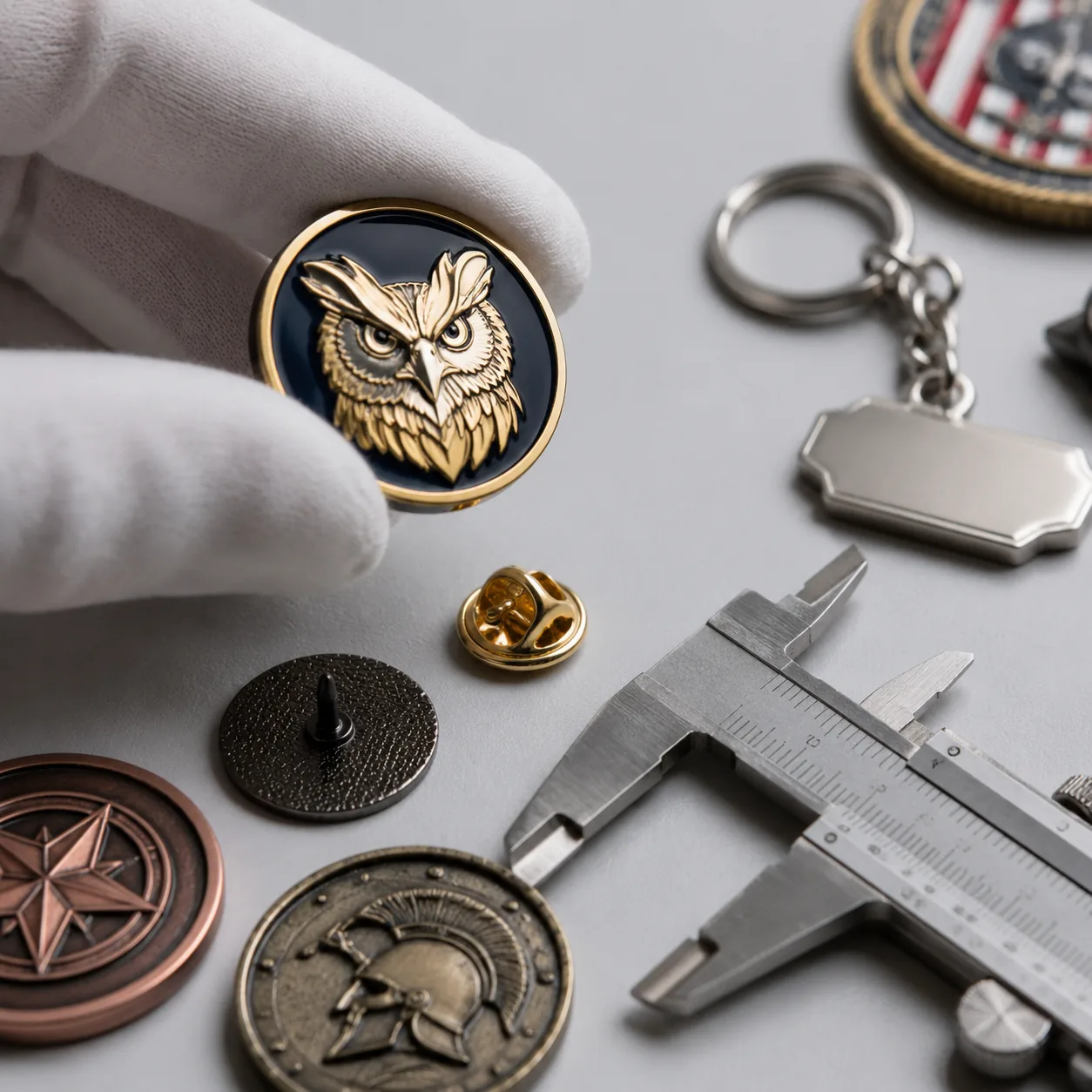
Why a good sample can still become a bad shipment
A pre-production sample proves the artwork, tooling and finish can be made correctly once. It does not prove that 5,000, 20,000 or 50,000 pieces will be consistent after die casting, polishing, plating, enamel filling, assembly and packing. A shipment can look acceptable in a carton-top check and still fail in use because 2 percent of clutches are loose, 1 percent of split rings are open, or several cartons contain the wrong backing card.
For custom metal promotional products, final inspection must cover appearance, dimensions, function, packing and documentation. AQL is the right framework, but only when defect categories are written clearly enough for the factory, buyer and third-party inspector to apply the same rule. “AQL 2.5” alone is not enough. It does not say whether a scratched backstamp, wrong Pantone fill, weak magnet or detached pin post is minor, major or critical.
Inspection criteria should be product-specific. A 25 mm soft enamel pin, a 45 mm die-struck challenge coin, a 60 mm zinc alloy keychain and a fridge magnet have different failure modes. The PO should define the allowed defect rate, the measurement tolerances, the functional tests and the packing standard before mass production starts, not after cartons are sealed.
Set AQL levels by product risk and sales channel
For most B2B promotional orders, a practical baseline is Critical 0, Major 2.5 and Minor 4.0 under ANSI/ASQ Z1.4 normal inspection, General Inspection Level II. Critical 0 means no critical defect is accepted in the sample size. Major defects affect function, safety, brand appearance or saleability. Minor defects are small cosmetic issues that do not affect normal use and are not obvious at arm’s length.
Use tighter limits when the product is sold at retail, licensed by a brand, child-facing, or packed as a premium gift. Major 1.0 and Minor 2.5 usually mean more sorting and a longer release window, but they reduce the risk of visible defects reaching distributors or store shelves. For low-cost event giveaways under about USD 0.35 FOB per piece, Major 2.5 and Minor 4.0 is usually more realistic if the visual standard is specific.
| Order type | Suggested AQL | Typical FOB range | Practical trade-off |
|---|---|---|---|
| Event pins or simple keychains | Critical 0, Major 2.5, Minor 4.0 | USD 0.28–0.85/pc for common 25–40 mm items | Controls functional failures while allowing small cosmetic variation |
| Retail or licensed merchandise | Critical 0, Major 1.0, Minor 2.5 | USD 0.75–2.50/pc depending on size, plating and packaging | Higher sorting cost; better shelf appearance and lower return risk |
| Child-facing programs | Critical 0, Major 1.0, Minor 2.5 | Usually quoted after safety and attachment review | Requires stricter sharp-edge, small-part and packaging checks |
| VIP gift sets or awards | Critical 0, Major 1.5, Minor 2.5 | USD 1.50–6.00/pc for coins, gift-boxed pins or heavy keychains | Tighter cosmetic grading; allow extra days for replacement pieces |
MOQ and lead time also affect inspection planning. Many factories accept 100–300 pieces for sample or rush pin orders, but standard commercial MOQs are often 300–500 pieces per design for pins and keychains, 500 pieces for coins, and 500–1,000 pieces for magnets or printed backing cards. Typical lead time after artwork approval is 7–10 days for tooling and pre-production samples, then 12–20 days for 500–5,000 pieces, 20–30 days for 5,001–30,000 pieces, and 30–45 days for larger multi-SKU programs. Add 1–3 working days for final inspection, sorting and report approval.
Classify defects before production starts
Most inspection disputes come from vague defect language. The same mark may be minor on the back of a pin and major on the center of a white logo. Classify defects by severity, location, size and effect on use. Attach approved sample photos and mark any zones where cosmetic standards are stricter, such as logo faces, retail display fronts and QR-code areas.
For enamel pins, a 0.3 mm dust speck on the back is usually minor. A black dot in the middle of a white logo, missing enamel in a color cell, exposed base metal on the front, or a pin post tilted more than 10 degrees should be major. A sharp burr that can cut skin or snag fabric is critical. For challenge coins, major defects include wrong metal finish, visible plating pits on the face, unreadable edge text, off-center enamel or color fill outside the recessed area.
For keychains, major defects include split ring gaps over 0.5 mm, jump rings not fully closed, weak swivel hooks, plated areas peeling after tape test, logo rotation over 5 degrees for giveaways or over 3 degrees for retail, and hardware assembled on the wrong side. For magnets, major defects include pull force below the agreed value, adhesive failure, reversed polarity on paired sets, or a magnet offset that makes the item rotate or slide on a vertical painted steel panel.
- Critical defects: exposed pin points outside packaging, sharp cutting edges, severe rust, detached small parts on child-facing products, wrong item mixed into the shipment, or contamination that suggests unsafe material handling.
- Major defects: wrong size beyond tolerance, wrong plating finish, incorrect Pantone area, loose attachment, weak magnet, missing epoxy, unreadable QR code, damaged retail packaging, or carton mix-up by SKU.
- Minor defects: tiny back-side scratches, slight plating shade variation within approved sample range, small non-logo specks, minor backing-card scuffs, or small carton label wrinkles that do not affect scanning.
- Not defects if approved in advance: antique plating variation, die-struck relief flow marks, normal enamel meniscus near metal lines, slight fabric texture variation on patches, or glitter density variation within the signed sample range.
Measure dimensions with tolerances and tools
AQL defines how many defects are allowed; it does not define what to measure. The PO should list critical dimensions, tolerances, tools and sample quantities. This is especially important when products must fit backing cards, molded trays, retail boxes, coin capsules, display stands or multi-item kits.
For zinc alloy, iron or brass pins under 40 mm, a normal outside-size tolerance is ±0.2 mm. For larger badges, keychains and coins, ±0.3 mm is more realistic. Thickness tolerance is commonly ±0.15 mm for 1.2–2.0 mm pins and ±0.2 mm for 2.5–4.0 mm challenge coins. Pin post position is usually ±1.0 mm, but tighten to ±0.5 mm when backing card holes are pre-punched. If a coin must fit a 40.6 mm capsule, specify the capsule’s inside diameter and reject pieces that bind or rattle beyond the approved sample.
Textile and flexible products need wider tolerances. Polyester lanyard width is usually ±1.0 mm on a 20 mm strap, and finished length is commonly ±20 mm. Embroidered patch size may vary ±1.5 mm because fabric tension and border stitching change the outline. Rubber PVC keychains may need ±0.5 mm on raised detail and ±1.0 mm on overall flexible dimensions.
| Checkpoint | Practical tolerance | Tool or method | When to tighten |
|---|---|---|---|
| Pin or coin outside size | ±0.2 mm under 40 mm; ±0.3 mm over 40 mm | Digital caliper | Molded trays, capsules or card windows |
| Metal thickness | ±0.15 mm for pins; ±0.2 mm for coins | Digital caliper | Premium weight or stacking height is contractual |
| Pin post position | ±1.0 mm standard; ±0.5 mm for tight cards | Caliper or fixture gauge | Backing card holes are pre-punched |
| Logo rotation | ≤3° for retail; ≤5° for giveaways | Printed angle gauge | Logo alignment affects display |
| Split ring gap | ≤0.3 mm preferred; reject over 0.5 mm | Feeler gauge or visual gauge | Heavy keychains above 35 g |
| Magnet offset | ≤1.0 mm from target center | Caliper or template | Anti-rotation magnets or paired sets |
Test function, not only appearance
Functional failures create more complaints than small cosmetic marks. A keychain that loses its jump ring, a pin that drops from a jacket, or a magnet that slides down a fridge door is commercially worse than a tiny back scratch. Include shop-floor tests that can be performed during final inspection without laboratory equipment.
For pins and brooches, test at least 20 pieces per colorway or per 5,000 pieces, whichever is higher. A butterfly clutch on a normal 25–35 mm pin should resist a straight pull of about 1.0–1.5 kgf. Rubber clutches may test lower, but they should not fall off during a firm shake test. Brooch clasps should open and close for 10 cycles without deformation, binding or loss of spring tension.
For keychains under 30 g, apply a 5 kgf pull for 10 seconds to the ring and connector. For heavier zinc alloy keychains, spinner styles or bottle openers, use 8–10 kgf where the design allows. For magnets, define the holding requirement by finished product weight, not only magnet diameter. A 50 mm metal magnet weighing 28 g often needs a stronger magnet than a flat rubber magnet of similar weight because the rigid body can lever away from a curved or painted surface.
- Check clutch retention, pin post welding and brooch clasps before backing cards are packed.
- Check split rings, jump rings, chains and swivel hooks for pull strength, open gaps and smooth movement.
- Check magnets on a vertical painted steel panel, not only on a flat bare steel plate.
- Check epoxy domes for bubbles over 0.5 mm in the logo area, tacky curing, yellow cast, off-center flow and edge overflow.
- Scan QR codes, barcodes or serial numbers on at least 32 pieces pulled from different cartons.
- Cycle moving parts such as spinners, bottle openers and carabiner clips at least 10 times per tested piece.
Control plating, color and surface standards
Plating should be judged by finish, adhesion and visible coverage, not only by shade. Decorative flash plating on promotional pins and coins is often thin: gold tone may be around 0.03–0.08 microns, while nickel or black nickel may be around 0.05–0.12 microns depending on the process and price point. Orders requiring stronger wear resistance should specify the plating stack, minimum thickness and test method instead of using vague words such as “premium plating.”
A simple tape test can catch poor adhesion. For a hidden or sacrificial area, use a cross-hatch or firm tape pull; flaking, blistering or exposed base metal on visible areas should be major. Antique finishes need a different standard: black fill in recesses should be reasonably even, but raised highlights will vary because polishing pressure changes the final contrast.
Color should be checked against the approved sample and Pantone reference under D65 daylight or a consistent light box. Delta E targets are difficult to enforce on enamel because metal borders, fill depth and gloss affect perception. For brand-critical flat colors, use a signed master sample as the governing standard. Do not demand perfect Pantone matching for transparent enamel, glitter enamel, glow pigment or plated translucent effects; those materials shift with base metal and viewing angle.
| Surface item | Acceptable standard | Reject as major | Technical note |
|---|---|---|---|
| Gold, nickel or black nickel plating | Matches approved sample within normal batch variation | Peeling, blistering, exposed base metal, cloudy patches on logo face | Specify shiny, matte, satin, antique or brushed finish |
| Soft enamel fill | Complete color areas and level consistent with approved sample | Missing enamel, wrong color, trapped dirt in logo area | Slight meniscus beside metal lines is normal |
| Hard enamel polish | Smooth face with clean metal lines | Low spots, over-polished borders, visible color contamination | Fine hairline polish marks may be minor |
| Epoxy coating | Clear, cured, centered and non-tacky | Bubbles over 0.5 mm in logo area, yellowing, overflow | Avoid epoxy when crisp relief detail must remain sharp |
| Printed graphics | Legible, registered and abrasion-resistant per sample | Misregistration over 0.3 mm on small logos, unreadable text | Add rub test for retail or repeated handling |
Inspect packing before release
Packing defects can turn acceptable goods into a rejected delivery. Scratched plating often happens after final assembly when pieces rub in bulk bags, cartons are overfilled, or heavy keychains crush lighter items. The inspection plan should include unit packing, inner cartons, master carton weight, SKU labels, barcode scans and count verification.
For enamel pins on backing cards, confirm the pin point does not pierce the outer polybag and the clutch is fully seated. For coins and heavy keychains, avoid loose bulk packing unless surface scratches are acceptable. Individual OPP bags, tissue wrap or tray separation usually adds about USD 0.01–0.04 per piece, while custom backing cards may add USD 0.03–0.12 per piece depending on size, paper weight, print and MOQ. Retail boxes, velvet pouches or coin capsules can add USD 0.08–0.60 per piece.
Keep carton weights practical for warehouse handling. Small pins usually ship well at 10–15 kg gross weight per master carton. Challenge coins and zinc alloy keychains should normally stay around 12–18 kg to reduce carton crushing and manual-handling issues. Before shipment booking, confirm carton dimensions, gross weight, net weight, pieces per carton, SKU mix, country-of-origin markings and pallet requirements where applicable.
Build inspection time and cost into the PO
Inspection adds time, but rework after arrival is more expensive. For orders under 5,000 pieces with one or two designs, final inspection can often be completed in 0.5 day if packing is finished. For 5,001–20,000 pieces, allow 1 working day. For 20,001–50,000 pieces with multiple SKUs, colors or backing cards, allow 1–2 working days for inspection, reporting and minor sorting. For 50,000+ pieces, consider in-line inspection before final packing so one plating lot or assembly issue does not contaminate the whole order.
Third-party inspection in China commonly costs about USD 180–350 per man-day depending on location, travel, sampling level, reporting detail and special tests. Factory internal QC is part of normal production, but it is not a substitute for a buyer-defined acceptance standard on high-value, retail or brand-sensitive orders. If a third party will inspect at ZheCraft or another supplier, send the checklist before mass production so the factory can build to the same criteria.
| Order size | Typical final inspection time | Common QC approach | Planning note |
|---|---|---|---|
| 300–2,000 pcs | 2–4 hours | Internal QC or buyer sample review | Best for simple pins, magnets or patches with one design |
| 2,001–10,000 pcs | 0.5–1 day | AQL sampling across cartons | Pull samples from different production batches, not only top cartons |
| 10,001–50,000 pcs | 1–2 days | Third-party or buyer-defined final inspection | Allow sorting time if defects cluster by plating lot or color |
| 50,000+ pcs | 2+ days or staged inspections | In-line plus final inspection | Inspect before final packing to avoid large-scale rework |
Use clear factory wording in the PO: “Final inspection to ANSI/ASQ Z1.4 normal inspection, General Level II unless otherwise agreed; Critical 0, Major 2.5, Minor 4.0; defects classified by approved sample and buyer checklist; dimensional, functional and packing checks required before shipment release.” For retail, licensed, child-facing or 20,000+ piece orders, require the factory to confirm the checklist line by line before tooling and sample approval.
Have a project? Send your artwork and target quantity and we’ll reply with a detailed quotation within 12 working hours.
Ready to get this made?
Send your sketch, target quantity and ship-date. Detailed quotation in 12 hours.



