AQL Inspection Specs for Custom Pins, Coins and Keychains
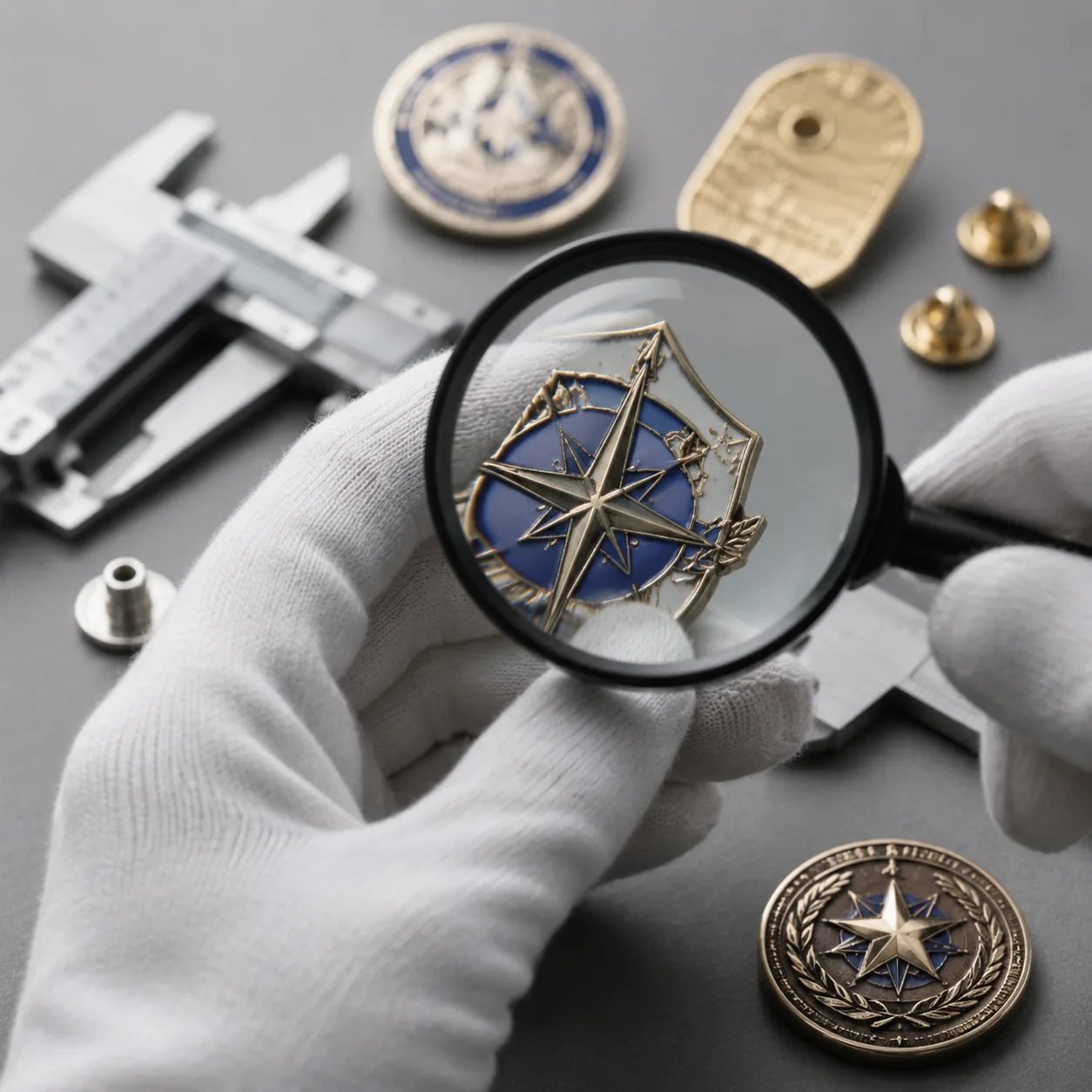
Why AQL inspections fail on small metal goods
Most failed inspections on custom pins, coins and keychains are not caused by the inspector finding defects. They are caused by the buyer, factory and inspector using different definitions of a defect. A purchase order that says “good quality,” “no scratches,” or “match sample” is too vague for a statistical inspection. It does not say how many units to check, how to classify faults, which dimensions matter, or which defect count triggers rejection.
These products have many cosmetic variables, but not every mark has the same commercial risk. A detached pin post, open key ring, cracked magnet or non-scannable QR code can make the item unusable. A 0.15 mm enamel pinhole in a corner, a small rack mark on the back, or a slight polishing line under the clutch may be acceptable if it is not visible in normal use. The inspection plan must separate safety, function, brand appearance and minor workmanship.
Mixed orders need special care. A campaign may include 3,000 soft enamel pins, 1,000 metal keychains, 500 die-struck coins and 2,000 backing cards in one shipment. Each SKU has different failure modes, tooling tolerances and packing risks. A single generic checklist will miss important details. A better file defines AQL by defect class, measurement tolerances by item type, and pass/fail rules before mass production starts.
Choose the inspection level before the AQL limit
AQL is not the defect rate you expect from production. It is the acceptance quality limit used with a sampling table such as ANSI/ASQ Z1.4 or ISO 2859-1. The inspection level determines how many pieces are sampled from the lot. The AQL number determines how many defects are allowed in that sample before the lot fails. These two settings must be chosen together.
For most custom metal promotional products, General Inspection Level II is the normal baseline. Level I can be used for low-risk repeat orders when the same mold, plating, enamel colors, packing method and supplier have already passed previous shipments. Level III is better for first orders, retail launches, tight event deadlines, moving assemblies, child-facing items, premium packaging or high-value shipments. Special levels such as S-2 or S-3 are useful for targeted checks like pull tests, XRF plating readings, carton drop tests or destructive testing, but they should not replace the general visual and functional inspection.
| Inspection setting | Typical use | Sample impact | Avoid when |
|---|---|---|---|
| General Level I | Stable reorder, same mold and finish | Lower sample size and inspection cost | New tooling, new supplier, fixed event date |
| General Level II | Standard pins, coins, keychains, magnets | Balanced risk control for normal orders | Safety-sensitive or premium retail launches |
| General Level III | First production, complex assembly, retail pack | Larger sample and stronger defect detection | Very low-value repeat goods with proven history |
| Special S-2/S-3 | Pull tests, XRF checks, carton tests | Small focused sample for measurable checkpoints | As the only plan for finished-goods inspection |
For example, a 5,000 piece pin order inspected at General Level II usually uses a much larger sample than the same order at Level I. If the buyer changes from Level II to Level III after goods are packed, the factory may need to reopen cartons and repack, adding cost and 1 to 2 days. The level should be printed on the PO and confirmed with the inspection agency before production.
Set practical AQL limits by defect class
A workable default for pins, coins, keychains, badges and magnets is Critical 0.0, Major 2.5 and Minor 4.0 under ANSI/ASQ Z1.4 or ISO 2859-1. Critical 0.0 means no critical defect is accepted in the inspected sample. Major 2.5 controls functional failures, wrong branding and customer-visible defects. Minor 4.0 allows a limited number of small workmanship issues that do not affect safety, use or brand recognition.
Do not set every category to AQL 0 unless the order truly requires 100 percent sorting. AQL 0 on all cosmetic issues is usually not realistic for electroplated, polished or hand-filled enamel products. Full sorting can add 1 to 3 working days and about USD 0.015 to USD 0.06 per piece for simple pins, depending on the number of checkpoints. For complex keychains, epoxy domes or boxed coins, the handling cost can be higher and may introduce new scratches unless trays, gloves and repacking controls are used.
A clear PO clause can be short: “Final inspection: ANSI/ASQ Z1.4, General Level II, AQL Critical 0.0, Major 2.5, Minor 4.0. Dimensions, plating thickness and pull tests checked under Special Level S-2 unless otherwise stated.” That one sentence gives the inspector a sampling basis and prevents the factory from treating every issue as negotiable.
- Critical defects: sharp burrs on user-contact edges, detached pin posts, broken brooch locks, cracked magnets, loose small parts on child-facing goods
- Major defects: wrong plating color, incorrect Pantone family, non-scannable required QR code, weak magnet pull, missing accessory, wrong logo position
- Minor defects: small back-side rack marks, enamel pinholes under 0.20 mm outside focal logo areas, light card scuffs, non-front-facing polishing marks
- Escalation rule: repeated minor defects in a logo area, retail-facing surface or QR zone should be counted as major, not ignored
- Do not classify every cosmetic imperfection as critical; it makes the plan unrealistic and encourages dispute instead of prevention
Define measurable tolerances for size, plating and assemblies
Inspectors need numbers, not adjectives. For stamped iron or brass pins, a common tolerance is ±0.20 mm for overall width or height up to 40 mm, and ±0.30 mm for larger badges up to 70 mm. For die-struck challenge coins, ±0.25 mm on diameter and ±0.20 mm on thickness are normally achievable when tooling, polishing and plating are controlled. For PVC or epoxy-topped items, allow slightly wider visual variation because curing and dome flow can affect edge height.
Plating thickness should match the use case. Standard indoor promotional pins and keychains are often specified at 3 to 5 microns total electroplating. Premium coins, retail keychains and frequently handled badges are safer at 5 to 8 microns. If sweat, rain or outdoor handling is expected, add corrosion testing: 24 hours neutral salt spray for standard nickel, gold or black nickel finishes, and 48 hours for higher-risk retail or outdoor goods. Antique finishes and dyed black finishes need approved shade samples because salt spray and sealing can shift tone.
Attachment strength should also be quantified. Standard lapel pin posts should withstand a 5 kgf pull for 10 seconds without detaching. Heavier brooch backs or military-style badges may need 7 to 10 kgf depending on weight and wear position. Rubber clutches should stay on after 10 attach-detach cycles without falling off under light shake, but should not be so tight that they bend 0.8 to 1.0 mm posts. Split rings for 25 to 30 mm keychains commonly use 1.2 to 1.6 mm wire; open gaps above 0.50 mm should fail for most functional keychains.
| Checkpoint | Practical specification | Inspection method | Typical defect class |
|---|---|---|---|
| Pin size | ±0.20 mm up to 40 mm; ±0.30 mm up to 70 mm | Digital caliper, S-2 sample | Major if outside tolerance |
| Coin thickness | ±0.20 mm from approved sample | Caliper at 3 positions | Major if weight or box fit changes |
| Plating thickness | 3-5 microns standard; 5-8 microns premium | XRF spot check where available | Major if below agreed minimum |
| Pin post pull | 5 kgf for 10 seconds minimum | Pull gauge on sampled units | Critical if post detaches |
| Key ring gap | Below 0.30 mm preferred; reject above 0.50 mm | Feeler gauge or visual gauge | Major or critical by end use |
| Magnet pull | Within ±15% of approved sample | Pull test on steel plate | Major if weak; critical if magnet separates |
| Backing card size | ±1.0 mm for 300-400 gsm cards | Ruler or caliper sample check | Minor or major if retail display is affected |
Apply separate standards to front, back and packaging
The front face carries the brand and should have the tightest visual standard. Inspect it at about 30 cm under normal white light, roughly 600 to 1,000 lux, without magnification unless the issue involves text, QR codes, serial numbers or safety. Front-face major defects include missing enamel, wrong Pantone family, metal lines filled over, plating burns, deep scratches, visible dust trapped under epoxy, or color contamination larger than 0.30 mm in a focal area.
The back side can accept more cosmetic variation, but it is not uncontrolled. Small polishing lines, rack marks or slight plating shade changes on hidden areas can be minor. Rust, green oxidation, sharp burrs, missing backstamp text, wrong mold number, misaligned posts or incomplete plating around the attachment should be major. Any sharp edge likely to cut skin or damage fabric should be critical, even if it appears on the back.
Packaging needs its own inspection rules because a good product in damaged packaging still creates a customer complaint. Backing cards should match approved artwork, hole position and SKU labeling, with a practical die-cut tolerance of ±1.0 mm for most 300 to 400 gsm cards. OPP bags should not be split, cloudy, dirty or too tight around sharp metal edges. Retail boxes should hold the product firmly enough to prevent plating scratches during transport. Barcode, carton mark, country-of-origin label and inner quantity must match the packing list.
For retail orders, add a carton check before shipment. Confirm inner pack quantity, master carton quantity, gross weight tolerance, carton dimensions and drop-test requirement if applicable. A common promotional carton target is 10 to 18 kg gross weight so warehouse handling does not crush boxes or increase courier damage. If cartons exceed the agreed weight or are underfilled, classify it as a packing major defect because it affects freight cost and receiving accuracy.
Match inspection depth to MOQ, value and complexity
Low MOQ orders need a practical risk calculation. A 300 piece pin order may not justify a USD 150 to USD 300 third-party inspection day if the design is simple, the supplier is proven and the delivery date is flexible. In that case, in-line factory checks, clear photos, short videos, counted packing images and a retained golden sample may be more cost-effective. For new suppliers or child-facing products, even a small lot can still justify formal inspection.
For orders above 1,000 pieces, formal final inspection is easier to justify, especially when FOB value exceeds USD 800 to USD 1,500. Typical FOB China price ranges are about USD 0.35 to USD 1.20 for standard enamel pins, USD 0.60 to USD 2.50 for metal keychains, USD 1.20 to USD 4.50 for challenge coins and USD 0.40 to USD 1.80 for fridge magnets. Prices vary with size, base metal, plating, enamel count, epoxy, attachments, packing and order quantity. Air rework or replacement for an event can cost far more than the inspection.
MOQ tiers also affect defect prevention. Many factories quote enamel pins from 100 pieces per design, but stable pricing usually improves at 300, 500 and 1,000 pieces. Custom coins often start at 100 pieces, with better amortized mold cost at 300 or 500 pieces. Keychains with custom molds, spinners or epoxy domes commonly become more efficient at 500 to 1,000 pieces. For very small runs, do not demand the same unit price, plating thickness and sorting depth as a 10,000 piece program without expecting a surcharge.
Lead time should include inspection and possible correction. Standard sampling is usually 7 to 10 calendar days after artwork approval. Mass production for normal pins and keychains is commonly 12 to 20 days after sample approval. Complex coins, multi-part keychains, glitter enamel, translucent enamel, epoxy domes or gift boxes may need 20 to 30 days. Add 1 to 2 working days for final inspection, and reserve another 1 to 3 days if sorting, replacement packing or rework may be needed before shipment.
Build the inspection file before mass production
The inspection file should be complete before the mold is cut or mass production begins. It should include approved artwork, Pantone or CMYK references, size and thickness tolerances, base material, plating finish, minimum plating thickness if required, enamel type, attachment specification, accessory list, packing layout, carton marks, golden sample photos and defect classification rules. If any of these are missing, the inspector will rely on judgment or ask the factory, which weakens independent control.
Photos help, but they do not replace specifications. A golden sample should be sealed or at least documented from front, back, side and packaging views with key measurements recorded. For repeat orders, reference the previous PO number, mold number, plating finish, enamel type, card size, carton quantity, net weight and gross weight per carton. This prevents drift when a supplier changes staff, subcontractors or plating batches.
- Attach approved AI, PDF or CDR artwork plus a flattened PDF for inspector reference
- List exact size, thickness, plating, enamel type, attachment, accessory and packaging requirements
- State AQL level and defect categories on the PO, not only in email or chat messages
- Include golden sample photos showing front, back, side, color reference and packed unit
- Define whether inspection occurs before packing, after retail packing or after full carton sealing
- Reserve 1-2 working days for inspection, report review and possible factory sorting
- Confirm destination requirements such as nickel-free, Prop 65 warning, CPSIA, EN71 or retailer labeling before quoting
The strongest inspection files are short enough to use, but specific enough to enforce. A one-page defect sheet with tolerances, AQL settings and reference photos is usually more effective than a long email chain. Share the same version with the factory, sourcing team and third-party inspector so every party judges the shipment against one standard.
Use AQL as prevention, not a last-minute argument
AQL works best when it is built into the RFQ and PO, not introduced after goods are finished. Start with General Level II and AQL Critical 0.0, Major 2.5 and Minor 4.0 for normal custom pins, coins, magnets and keychains. Tighten to Level III or add special tests for child-facing products, retail launches, QR authentication, outdoor use, moving parts, premium plating or high-value shipments.
Then define the measurable points that matter: ±0.20 to ±0.30 mm size tolerance, 3 to 5 microns standard plating or 5 to 8 microns premium plating, 5 kgf pin-post pull strength, closed key ring gap below 0.30 mm preferred, magnet pull within ±15 percent of the approved sample, and backing card tolerance of ±1.0 mm. These figures give the inspector a concrete basis for acceptance instead of a subjective opinion.
When requesting a quote, send artwork, target quantity, intended use, destination market, packing method, inspection level and any safety or retailer requirements together. A responsible factory can then confirm whether the requested tolerances, plating thickness, pull tests and AQL settings are realistic for the construction and price. That early review is much cheaper than discovering during final inspection that the product was never specified clearly enough to pass.
Have a project? Send your artwork and target quantity and we’ll reply with a detailed quotation within 12 working hours.
Ready to get this made?
Send your sketch, target quantity and ship-date. Detailed quotation in 12 hours.



