AQL Inspection Specs for Custom Pins, Coins and Keychains
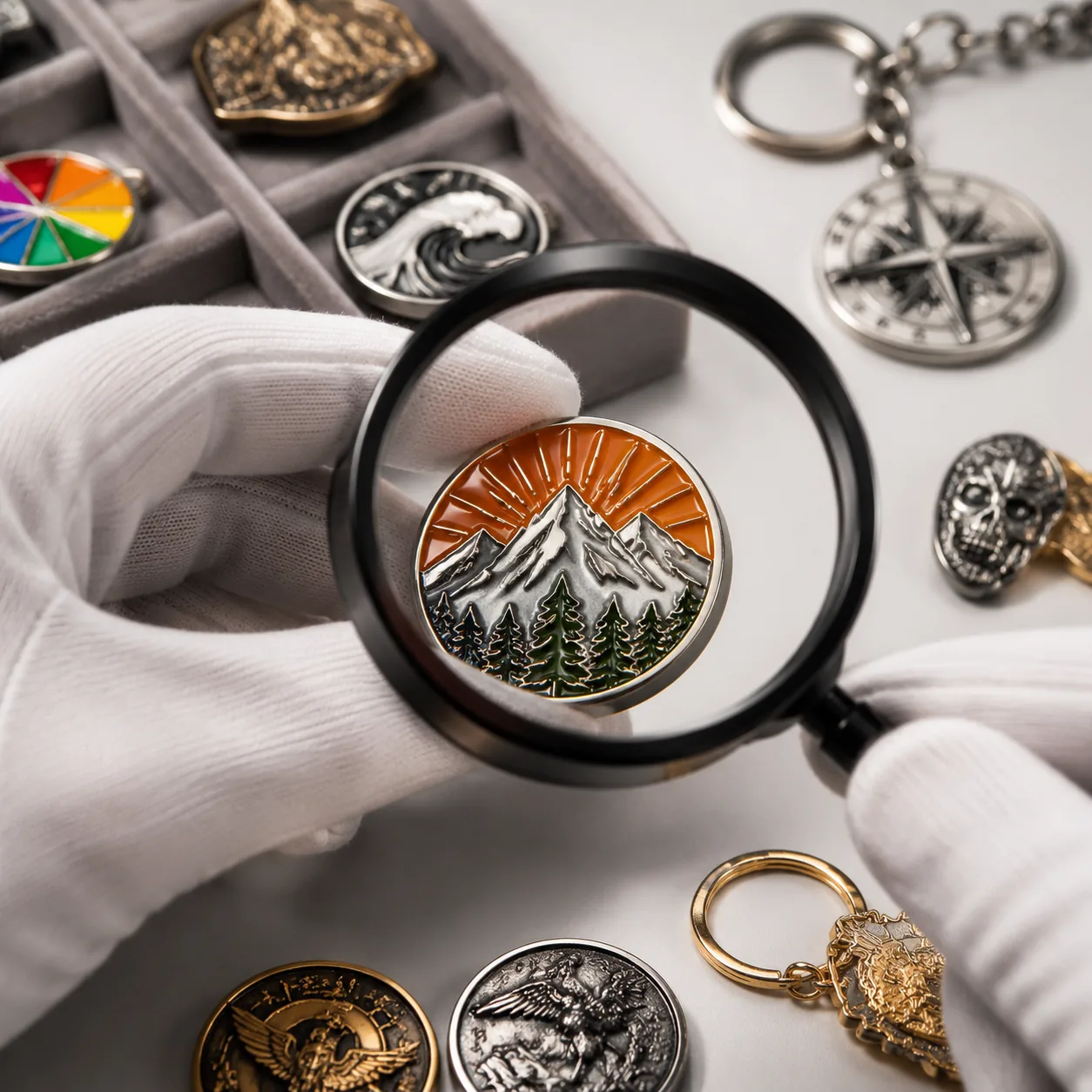
Why Good Photos Still Miss Bad Product
Pre-shipment photos can show clean enamel and bright plating while hiding the defects that create returns after distribution. A carton may look acceptable at arm’s length, yet include loose butterfly clutches, plating wear on raised edges, under-cured epoxy, open jump rings, weak magnets, unreadable QR codes, or color drift between production batches. Those failures are not reliably caught by asking the factory to “send finished goods photos.”
Custom enamel pins, challenge coins, keychains and metal badges need a written inspection plan that defines the lot, sample size, AQL levels, defect classes, measurement tolerances, test methods and acceptance limits. A 0.15 mm plating speck on the back, a 0.8 mm enamel overflow on the front logo, and a pin post bent 8 degrees from vertical are not the same risk. Treating them the same creates arguments at shipment time.
At ZheCraft, we prefer these rules to be agreed before tooling and mass production. The QC plan can then be built into die striking or casting, polishing, plating, enamel filling, printing, assembly and packing. Sorting finished goods at the end is slower, less accurate and usually more expensive than controlling the process step by step.
Use AQL by Defect Severity
AQL means Acceptable Quality Limit. It is not a promise of zero defects; it is a statistical sampling method that defines how many defects may be accepted in a random sample. For most B2B promotional metal orders, a practical default is AQL 0 for critical defects, AQL 1.0 for major defects and AQL 2.5 for minor defects under ISO 2859-1, general inspection level II.
Critical defects create safety, legal, compliance or brand-blocking risk. Examples include sharp burrs above 0.2 mm, exposed broken pin posts, detachable magnets on children’s items, incorrect safety claims, wrong trademark marks, restricted metal content where nickel-free or lead-safe was specified, or any component that can detach and become a small-part hazard. One critical defect in the sample should fail the lot unless the buyer approves a documented corrective action and full reinspection.
Major defects affect function, saleability or brand perception. Typical examples are loose clutches, wrong plating finish, missing enamel in a visible area over 0.5 mm, Pantone mismatch beyond Delta E 2.0 to 3.0 where color control is specified, unreadable QR codes, weak keychain hardware, misaligned backing cards, or retail packaging with the wrong SKU. Minor defects are small cosmetic issues outside the main viewing area, such as light back scratches, tiny polish marks, or isolated plating specks within the agreed size limit.
| Defect class | Suggested AQL | Concrete examples | Shipment decision |
|---|---|---|---|
| Critical | 0 | Sharp burr over 0.2 mm, unsafe detachable magnet, exposed broken pin post, wrong compliance claim | Reject lot or hold for 100% screen plus root-cause approval |
| Major | 1.0 | Loose clutch, wrong plating, missing enamel over 0.5 mm, unreadable QR code, pull-test failure | Reject if defects exceed the AQL acceptance number |
| Minor | 2.5 | Back scratch under limit, small non-logo plating speck, slight OPP bag scuff | Accept only within the AQL limit |
| Measurement drift | 1.0 or tighter | Diameter, thickness, post position, ring wire or card size outside tolerance | Treat as major when fit, function or retail presentation is affected |
Set Lot Size, Sampling and MOQ Tiers
The purchase order should state the inspection standard, inspection level and AQL values. ISO 2859-1 general level II is suitable for most normal-risk pin, coin and keychain orders. For mechanically complex items, child-facing giveaways, magnets, bottle openers, retail packs or high-value VIP coins, use tightened inspection or add 100% checks for the specific risk feature.
Sampling must represent the whole shipment. Do not allow the inspector to check only open-stock pieces placed on a table. Pull cartons across the square root of the carton count, rounded up, and include beginning, middle and end production cartons where batch labels are available. A 36-carton shipment should be sampled from at least 6 cartons; a 64-carton shipment from at least 8. Open different inner bags, trays or sleeves from each selected carton.
Inspect each SKU separately when the finish, size, enamel color, attachment, card, barcode or packing differs. A 5,000-piece order split into five enamel colors is not one uniform lot if each color uses different filling, curing or carding. Mixed sets need two checks: individual item quality and set assembly accuracy.
| Order quantity | Common MOQ and production note | Typical lead time after artwork approval | FOB China reference range |
|---|---|---|---|
| 300-499 pcs | Low MOQ; best for sampling campaigns or VIP drops | 12-18 days plus 2-4 days for pre-production sample | US$0.75-2.20 per enamel pin; US$1.80-4.80 per coin |
| 500-999 pcs | Normal MOQ for custom pins and keychains | 14-22 days depending on plating and packing | US$0.45-1.60 per pin; US$1.20-3.50 per keychain |
| 1,000-4,999 pcs | Best balance of unit price and QC efficiency | 18-28 days; add 3-7 days for epoxy or retail cards | US$0.28-1.10 per pin; US$0.90-2.80 per coin |
| 5,000-20,000 pcs | Bulk promo tier; inspect by SKU and production batch | 25-40 days; split plating lots should be labeled | US$0.18-0.75 per pin; US$0.55-1.80 per keychain |
- State ISO 2859-1, general level II unless a tighter level is agreed.
- Use AQL 0 critical, 1.0 major and 2.5 minor as the default baseline.
- Require random sampling across cartons, inner bags and production batches.
- Inspect each SKU, finish, size, attachment and retail card as a separate lot when risk differs.
- Keep at least three approved golden samples: factory QC, packing line and final inspection.
Define Measurable Cosmetic Limits
Cosmetic standards fail when the specification says only “high quality” or “no visible defects.” Small metal products are reflective, hand-polished and often inspected under different lighting by different people. A usable standard should define viewing conditions: 30 cm viewing distance, 800-1,000 lux neutral white light, unaided normal vision and about 5 seconds per face. Magnification should be used only for measurement or root-cause review, not to create unrealistic rejection criteria.
Front-face limits should be stricter than back-face limits because the front carries the brand. For standard promotional pins, enamel overflow or underfill at a metal line should stay within 0.3 mm; retail or VIP orders can specify 0.2 mm. A color contamination spot over 0.3 mm in the main logo area should be major for promo goods; over 0.2 mm is a reasonable limit for premium goods. Pantone control should be approved against physical enamel or print drawdowns, not only screen proofs.
Plating thickness should be listed in microns. Low-cost decorative plating may be 2-3 microns total, but that is risky for high-touch keychains. Standard indoor pins usually need 3-5 microns. Coins, bottle openers and keychains handled daily should use 5-8 microns, or a sealed antique finish. High-polish gold, black nickel and rose gold show scratches quickly, so packing separation matters as much as plating thickness.
| Inspection point | Standard promotional limit | Retail or VIP limit | Notes |
|---|---|---|---|
| Enamel overflow or underfill | Within 0.3 mm | Within 0.2 mm | Do not over-tighten micro text under 20 mm overall size |
| Color contamination on front | No spot over 0.3 mm | No spot over 0.2 mm | Glitter and translucent enamel need approved boundary samples |
| Front scratch | No scratch over 2.0 mm | No scratch over 1.0 mm | Any scratch crossing the logo should be major |
| Plating pit on front | No pit over 0.3 mm | No pit over 0.2 mm | Recessed antique areas need realistic approved samples |
| Back mark | No mark over 3.0 mm | No mark over 2.0 mm | Looser if covered by card, foam or adhesive pad |
| Decorative plating thickness | 3-5 microns | 5-8 microns | Measure by XRF where available for repeat retail programs |
Control Dimensions, Thickness and Fit
Dimensional inspection matters because small metal products interact with backer cards, foam inserts, split rings, magnets, clutches and retail trays. A coin 0.6 mm too thick may jam in a tray. A badge 1.2 mm wider than the approved drawing may cover printed card text. A pin post 2 mm off position may rotate on fabric even if the face looks perfect.
For die-struck iron, brass or zinc alloy pieces under 50 mm, a practical overall length and width tolerance is ±0.3 mm. For larger challenge coins, bottle opener keychains and cast zinc parts over 50 mm, ±0.5 mm is more realistic. Thickness should normally hold ±0.2 mm for 1.2-3.0 mm badges and ±0.3 mm for 3.5-5.0 mm coins. Raised relief height, recessed enamel depth and edge thickness should be checked when they affect artwork clarity or packaging fit.
Attachment position needs its own tolerance. A single pin post should be within ±1.0 mm of the approved drawing position and within 5 degrees of perpendicular after assembly. Dual posts should hold both spacing and alignment within ±1.0 mm so the badge fits backing cards and does not twist in wear. For keychains, specify split ring outside diameter, wire diameter, chain length, jump ring gauge and clasp opening.
- Measure 10-20 pieces from the inspection sample with calibrated calipers.
- Check maximum length, maximum width, thickness and raised relief where relevant.
- Verify pin post, brooch bar, magnet, jump ring and chain position against the technical drawing.
- Record hardware dimensions, including split ring wire, chain length and clutch diameter.
- Treat card-slot, tray, foam insert and retail pack fit failures as major defects.
Test Hardware Function, Not Just Appearance
Attachments create many field failures because they are stressed after distribution. A pin can have clean enamel and still fail if the clutch slips. A keychain can look good in a photo while the jump ring gap opens in a pocket. These checks should be part of final inspection and, for larger orders, in-process inspection before all units are packed.
For butterfly clutches, test fit, wobble and straight pull. A standard lapel pin should not detach at 1.0-1.5 kgf for 10 seconds, depending on post diameter and badge weight. Heavy pins over 25 g should use two posts, a locking clutch or a stronger backing system. Rubber clutches are comfortable but soften with heat; specify no looseness after 2 hours at 50 °C if they are used on heavier badges or summer outdoor promotions.
For keychains, test assembled hardware rather than each component alone. A normal promotional metal keychain should withstand 5 kgf pull for 10 seconds. Bottle opener keychains, hotel key tags and heavier coins should be specified at 8-10 kgf. Jump ring gaps should be under 0.2 mm after closing. Split ring wire should usually be 0.8-1.2 mm for metal keychains; thinner wire lowers cost but bends and opens faster.
| Hardware | Inspection method | Acceptance limit | Trade-off |
|---|---|---|---|
| Butterfly clutch | Fit, wobble and straight pull | No detachment at 1.0-1.5 kgf for 10 seconds | Higher grip can make removal harder |
| Rubber clutch | Fit after heat exposure | No looseness after 2 hours at 50 °C | Softer feel, lower security on heavy pins |
| Split ring | Wire gauge and opening check | 0.8-1.2 mm wire for most metal keychains | Thicker wire is stronger but harder to use |
| Jump ring | Gap check and pull test | Closed gap under 0.2 mm after assembly | Soldered rings add cost and 2-4 days lead time |
| Magnet | Pull and adhesive bond check | No detachment from body under agreed force | Stronger magnets raise cost and packing risk |
Add Fast Reliability Checks
Final inspection should include simple stress tests that expose weak process control. These are not substitutes for accredited laboratory testing, but they catch common failures before goods leave the factory. Use them for black nickel, antique plating, printed logos, epoxy domes, transparent enamel, QR codes, serialized products and high-touch keychains.
For plating or coating adhesion, use a cross-hatch tape test where the design allows, or a firm tape pull on a non-critical area. No visible flaking or print lift should occur. For handling resistance, rub the front surface 20 cycles with dry white cotton and 20 cycles with cotton lightly dampened with clean water. Obvious color transfer, coating peel, black residue or exposed base metal should be major.
For epoxy domes, inspect bubbles, dust, edge lift, fisheyes and yellowing before bagging. Bubbles over 0.3 mm in the main logo area should be major for standard goods; over 0.2 mm for premium retail goods. For screen or pad printing, registration tolerance is typically ±0.2 mm for small logos and ±0.3 mm for larger keychains. QR codes and serial numbers should be scanned from at least 10 randomly selected finished pieces per SKU under normal indoor light.
- Run tape adhesion checks on plating, printing and epoxy-coated areas where the design allows.
- Rub high-touch surfaces for 20 dry cycles and 20 damp cycles with white cotton.
- Scan QR codes and serial numbers from finished goods, not only from digital proofs.
- Check epoxy for bubbles, edge lift, dust and yellowing before individual bagging.
- Keep failed pieces labeled by carton, SKU and production date for traceability.
Tie Inspection Results to Shipment Decisions
Good products can still arrive damaged if packing is vague. Final inspection should verify the product, unit packing, retail card, barcode, inner carton, master carton and pallet marks where applicable. For pins and badges, individual OPP bags, tissue separation, foam trays or backing cards reduce front-to-front abrasion. Bulk loose packing is suitable only for low-risk items with matte surfaces and no delicate plating.
Carton weight should normally stay below 15 kg for pins and small keychains, and below 18 kg for heavier challenge coins unless the importer’s warehouse standard allows more. Inner cartons should prevent metal-on-metal pressure, especially for antique coins, epoxy keychains and mirror-polished finishes. If abrasion is found before shipment, the answer is repacking and reinspection, not blaming the courier later.
The inspection report should result in one clear decision: pass, fail, hold for sorting, or conditional release after corrective action. Sorting can save a shipment when defects are visual and objectively separable, such as wrong backer cards or isolated enamel contamination. Sorting should not be used to accept structural problems such as weak solder, poor plating adhesion, unsafe sharp edges, wrong base material or pull-test failure.
| Finding | Best decision | Reason |
|---|---|---|
| Minor defects within AQL | Release shipment | Defect level is within the agreed commercial tolerance |
| Major defects exceed AQL but are visually sortable | Hold and 100% screen | Shipment may be saved if sorting criteria are objective |
| Wrong plating or wrong base material | Reject or remake | Sorting cannot correct the specification error |
| Weak keychain hardware | Reject or rework hardware | Failure is likely after distribution |
| Packing abrasion before shipment | Repack and re-inspect | Good product can be damaged in transit if packing is unchanged |
Put the Rules in the RFQ
The best time to control inspection is before quotation. Ask the supplier to price the order against the actual AQL levels, tolerances, plating thickness, hardware tests and packing method. If one quote is far lower than the others, check whether the supplier reduced plating thickness, split ring gauge, clutch grade, epoxy curing time, individual packing, carton strength or inspection time.
A complete RFQ for custom pins, coins or keychains should include artwork with dimensions, a technical specification sheet and an inspection checklist. The specification should state base material, item size, thickness, plating type and microns, enamel or printing method, color references, attachment type, pull-test requirement, packing method, carton limits, dimensional tolerances and approved sample reference. For repeat orders, keep the same physical golden sample and production notes so the next batch is judged against a real standard, not an old email thread.
For a normal promotional order, start with AQL 0 critical, 1.0 major and 2.5 minor under ISO 2859-1 general level II. Add measurable limits for enamel overflow, scratches, pits, plating thickness, dimensions, post position and hardware pull strength. Require separate inspection for each SKU, finish and attachment type. Reject unsafe or structural failures instead of relying on last-minute sorting.
Have a project? Send your artwork and target quantity and we’ll reply with a detailed quotation within 12 working hours.
Ready to get this made?
Send your sketch, target quantity and ship-date. Detailed quotation in 12 hours.



