AQL Inspection Specs for Custom Pins and Keychains
Why a 3% Defect Rate Can Break a Launch
A 20,000 piece enamel pin order with a 3% defect rate means 600 questionable units. If the defects are tiny backside polish marks, the shipment may still be usable. If they are loose posts, wrong plating, mixed artwork versions or unreadable retail barcodes, the same 600 pieces can stop warehouse receiving, delay a launch and create manual sorting costs that exceed the inspection fee.
Many purchase orders still say “good quality,” “factory standard” or “100% checked.” Those phrases do not define what passes. AQL, or Acceptable Quality Limit, gives the buyer, factory and third-party inspector one measurable sampling system. It does not authorize defects; it defines how many defects in a random sample trigger rejection, rework or reinspection.
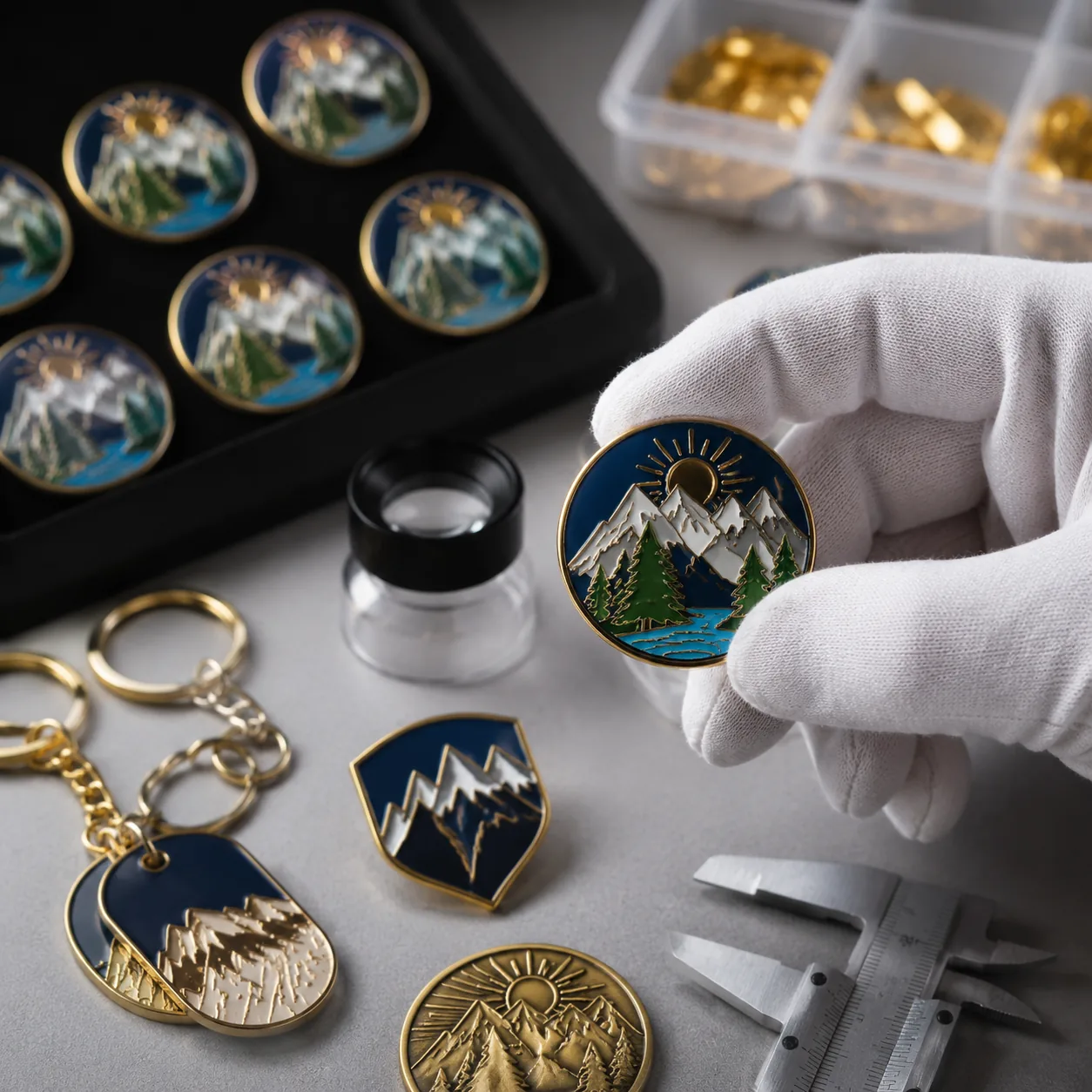
For custom metal promotional products, the inspection plan must reflect the item’s risk and construction. A simple 25 mm soft enamel giveaway pin is not the same as a retail keychain with a swivel clasp, barcode card and licensed artwork. ZheCraft applies inline checks, final random inspection and buyer-approved golden samples for enamel pins, coins, keychains, fridge magnets, brooches, patches and lanyards. The strongest results come when the RFQ and purchase order define the standard before tooling starts.
Classify Defects Before Setting AQL
Do not start by applying “AQL 1.5” to every issue. AQL only works when defects are grouped by severity. A pin with a 0.25 mm dust dot outside the logo area is not the same commercial risk as a broken post, an exposed sharp point or a wrong trademark color.
Use three defect classes: critical, major and minor. Critical defects affect safety, legal compliance or essential function. Major defects make the product unsuitable for sale, distribution or the approved brand presentation. Minor defects are visible but do not prevent normal use. Put these definitions in the quality agreement before mass production; otherwise every borderline issue becomes a shipment dispute.
A clear classification also prevents over-rejection. Die-struck metal, cast zinc alloy, polishing, plating and enamel filling are physical processes. Very small backside polishing marks or minor antique-plating variation may be normal, while loose magnets, sharp burrs and incorrect safety attachments should never be accepted.
| Defect class | Typical examples | Recommended AQL | Required action |
|---|---|---|---|
| Critical | Sharp burr over 0.10 mm, exposed pin point through packaging, detachable small magnet on child-facing item, lead/cadmium failure, wrong safety attachment | 0.0 | Reject lot; segregate stock; 100% sort, rework or remake affected pieces |
| Major | Wrong artwork version, plating mismatch against golden sample, broken post, loose split ring, enamel missing over 1.0 mm, unreadable barcode or QR code | 1.0 or 1.5 | Reject lot if sample fails; rework and reinspect before shipment |
| Minor | Dust dot under epoxy below 0.30 mm outside logo area, slight low enamel within approved range, small backside polishing mark, noncritical carton mark skew | 2.5 or 4.0 | Accept if within limit; record trend for process improvement |
Set AQL by Product Risk and Sales Channel
AQL 2.5 for major defects and 4.0 for minor defects is common for low-risk promotional giveaways, but it is not suitable for every order. Retail pins, museum merchandise, licensed sports items and paid fan products need tighter visual and packing control because customers inspect them closely and returns are expensive. Products with moving parts, magnets, sharp attachments, child-facing use or outdoor exposure also need stricter function checks.
For standard custom enamel pins and keychains, a balanced starting point is critical 0.0, major 1.5 and minor 4.0. For retail and licensed merchandise, tighten to major 1.0 and minor 2.5. For simple internal giveaways, major 2.5 and minor 4.0 may be acceptable if all safety and function issues remain critical 0.0.
State the inspection level as well as the AQL number. General Inspection Level II under ANSI/ASQ Z1.4 or ISO 2859-1 is the normal final random inspection default. Use Level III for first orders, new suppliers, high-value shipments, mixed-SKU programs or products with moving mechanisms. Level I reduces inspection time but is weak for new tooling, complex enamel fills or retail packaging.
- Critical defects: AQL 0.0 for every order, including free giveaways
- Major defects: AQL 1.0 for retail/licensed goods, 1.5 for standard B2B orders, 2.5 only for low-risk giveaways
- Minor defects: AQL 2.5 for retail presentation, 4.0 for standard promotional distribution
- Inspection level: General Level II by default, Level III for new suppliers or complex mixed orders
- Sampling plan: single normal sampling unless the buyer specifies tightened inspection after repeated failures
Define Measurable Product Specifications
A final inspection fails when the inspector only checks appearance. Custom metal goods need measurable checkpoints: size, thickness, weight, plating shade, plating thickness, attachment strength, logo position, color matching, barcode scanability, carton quantity and packing sequence. These checkpoints should reference the signed artwork and golden sample, not only a quotation or proforma invoice.
For enamel pins, practical dimensional tolerances are ±0.20 mm for overall length and width up to 40 mm, ±0.30 mm above 40 mm and ±0.10 mm for stamped brass or iron thickness. Post position should stay within ±0.50 mm of the approved drawing, especially when the backing card is punched or when two posts prevent rotation. Soft enamel should not overflow above the metal lines. Hard enamel should polish flat without obvious dish, wave or pinhole visible at normal viewing distance.
For keychains and coins, weight tolerance affects both perceived value and freight. A 32 g zinc alloy keychain should normally stay within ±8%. A die-struck brass coin can often hold ±5% if diameter and thickness are controlled. Split rings, jump rings and swivel clasps should be checked for plating coverage, gap opening and spring-back after deformation.
| Checkpoint | Suggested tolerance or test | Applies to |
|---|---|---|
| Overall size | ±0.20 mm up to 40 mm; ±0.30 mm above 40 mm | Pins, coins, keychains, magnets |
| Metal thickness | ±0.10 mm for stamped brass/iron; ±0.15 mm for cast zinc alloy | Pins, coins, keychains |
| Plating thickness | Flash 0.05-0.10 micron; standard decorative 0.10-0.25 micron; heavy handling 0.25-0.50 micron | Pins, coins, keychains |
| Pantone enamel color | Visual match under D65 light; production must stay within signed sample boundary | Pins, badges, keychains |
| Attachment pull strength | Pin post minimum 3 kgf; split ring or chain minimum 8 kgf; magnet bond minimum 2 kgf | Pins, keychains, magnets |
| Backstamp, barcode or QR | Position ±0.50 mm; barcode/QR scan rate 100% within inspected sample | Retail pins, coins, keychains |
Use Realistic Appearance Standards
Cosmetic standards should protect the brand without pretending that metal products are printed pixels. If a buyer requires microscope-level perfection on a 20 mm pin at a giveaway price, the factory must either raise the unit cost, slow the line or reject usable production. The standard should match the sales channel, price point and viewing conditions.
A practical visual rule is normal eyesight at 30 to 40 cm under 600 to 1000 lux white light for 5 to 8 seconds per piece. Defects not visible under those conditions are usually ignored or classified as minor unless they affect safety, scanning, text legibility or function. For retail products, inspect the front logo area more strictly because customers examine paid merchandise at close range.
Use millimeter limits wherever possible. A dust dot under epoxy below 0.30 mm outside the main logo may be minor. A black spot over 0.50 mm on a white enamel logo should be major. On polished gold, nickel or black nickel, backside hairlines shorter than 2 mm are commonly minor, while front scratches over 1 mm through the logo area are usually major. Antique plating must be judged against a signed reference because shade variation is part of the finish, not automatically a plating defect.
- Inspect at 30 to 40 cm under 600 to 1000 lux white light
- Spend 5 to 8 seconds per sampled piece, then inspect closer only when a visible issue appears
- Apply stricter limits to front logo areas than backside handling surfaces
- Classify sharp burrs, exposed wire ends, loose magnets and detachable small parts as critical
- Approve antique finish range separately from wrong plating color
Match Sampling to MOQ, SKU Mix and Lead Time
Sampling becomes risky when one purchase order contains many designs, colors or attachments. If 10,000 pins include 20 designs of 500 pieces each, treating the whole shipment as one lot can hide a defect concentrated in one SKU. The lot may statistically pass while one carton contains wrong backstamps or the wrong backing card.
Define whether inspection is by total lot, SKU or product family. If each design has different artwork, color fill, backstamp or packaging, sample every SKU visually even if the formal AQL lot is combined to control inspection cost. For glow enamel, transparent enamel, spinners, sliders, magnets or special clasps, keep separate inspection records because the process risks differ.
MOQ and lead time also matter. A typical custom enamel pin MOQ is 100 pieces per design, but economical pricing usually starts at 300 to 500 pieces. Standard production lead time is often 12 to 18 days after artwork and pre-production sample approval; complex plating, epoxy doming, retail cards or mixed-SKU packing can add 3 to 7 days. Final inspection should occur only after 100% packing, with inline inspection at 20% to 30% output for orders above 5,000 pieces.
| Order tier | Typical FOB China price range | Recommended inspection approach |
|---|---|---|
| 100-299 pcs, one design | US$1.20-2.80/pc for standard soft enamel pin | 100% visual check plus full count; AQL sample is too small to be useful |
| 300-999 pcs, one design | US$0.65-1.60/pc depending on size, plating and backing | Final random inspection at Level II plus carton quantity check |
| 1,000-4,999 pcs | US$0.38-0.95/pc for 25-35 mm pins; keychains often US$0.70-1.80/pc | Final AQL with function checks on attachments and packaging |
| 5,000+ pcs | US$0.25-0.70/pc for simple pins; lower only with simple art and bulk packing | Inline check at 20-30% output plus final AQL after packing |
| Mixed SKUs | Price varies by mold count, color count and packing labor | AQL by family plus visual sample from every SKU |
Control the Process Before Final Inspection
Final inspection is a filter, not a production method. If the die, mold, plating bath, enamel viscosity or soldering process is unstable, AQL only confirms the problem after days of work have been lost. The best system combines material checks, first-article approval, inline QC and final random inspection.
The most important early checkpoint is the first finished piece from mass-production tooling, not a digital mockup. Check metal line width, enamel separation, plating shade, edge feel, post or ring location and packaging fit before the factory completes the lot. If the first 50 to 100 pieces show enamel bleeding, weak soldering or card misalignment, stop the process and correct it before the defect repeats across thousands of units.
ZheCraft separates tool approval, pre-production sample approval, inline QC and final QC records for repeatable projects. For reorders, we compare against the locked golden sample and previous order sheet, including Pantone numbers, plating finish, metal thickness, backing type, packaging, carton weight and carton mark format. This is especially important for distributors managing annual programs where the client expects the same pin or keychain every season.
- Approve production artwork with exact dimensions, Pantone colors, plating finish and attachment type
- Keep one signed golden sample with the buyer and one with the factory
- Check first mass-production pieces before 30% of the order is completed
- Record inspection results by SKU, carton number, defect type and rework status
- Do not ship mixed approved and reworked stock without a new random inspection
Put Inspection Terms in the Purchase Order
Quality terms belong in the purchase order or quality appendix, not only in email threads. Inspectors need a short, enforceable document stating the sampling standard, AQL levels, defect definitions, tolerances, packaging checks, lead-time assumptions and failure handling. Without it, the factory may inspect to its internal standard while the buyer expects a retail standard.
A strong PO clause for custom pins can read: final inspection to ANSI/ASQ Z1.4, General Inspection Level II, single normal sampling; AQL critical 0.0, major 1.5, minor 4.0; dimensions to approved drawing with ±0.20 mm tolerance for parts up to 40 mm; front cosmetic defects judged at 30 to 40 cm under 600 to 1000 lux white light; all QR codes and barcodes in inspected sample must scan; carton quantity tolerance 0; packaging to approved reference sample.
Also define who pays for reinspection and schedule impact. A fair standard is that factory-caused failure requires the factory to pay for sorting, rework and one reinspection at the factory. If the buyer changes the standard after production, requests new packaging after approval or rejects goods for issues outside agreed criteria, the cost and added lead time should be negotiated separately.
| PO item | Recommended wording | Common mistake to avoid |
|---|---|---|
| Sampling standard | ANSI/ASQ Z1.4 or ISO 2859-1, General Level II, single normal sampling | Writing only “random inspection” |
| AQL levels | Critical 0.0, major 1.5, minor 4.0 unless otherwise agreed | Using one AQL number for all defects |
| Reference sample | Inspect against signed artwork and approved golden sample | Approving sample photos only |
| Packing | Carton quantity tolerance 0; barcode, SKU, carton marks and mixed-SKU sequence checked | Ignoring carton labels until warehouse receiving |
| Failure handling | Factory-caused failure requires segregation, rework and reinspection before shipment | Allowing partial rework without new inspection |
Prepare the QC Sheet Before the Next Order
Before placing a custom pin, coin, keychain or magnet order, define how the product will be used. Retail, licensed, child-facing, outdoor and high-handling products need tighter standards than a one-day internal giveaway. Share that use case with the supplier so the inspection plan matches the real risk and price level.
Attach a one-page inspection sheet to the RFQ. Include artwork, dimensions, Pantone colors, plating finish, backing type, MOQ, target FOB range, lead time in days, AQL levels, defect classes, tolerances, packaging checks and functional tests such as pull strength, magnet adhesion, QR scanning or lanyard breakaway testing. Ask which checks are performed inline and which are performed only at final inspection.
If the limits are not yet clear, start with critical 0.0, major 1.5 and minor 4.0 at General Level II, then tighten or relax based on product risk, sales channel and budget. For first orders, mixed-SKU shipments or retail programs, ask ZheCraft to review the artwork and prepare a product-specific QC checklist before tooling. One clear inspection sheet prevents more disputes than a long email chain after cartons are packed.
Have a project? Send your artwork and target quantity and we’ll reply with a detailed quotation within 12 working hours.
Ready to get this made?
Send your sketch, target quantity and ship-date. Detailed quotation in 12 hours.



