AQL Inspection Specs for Custom Pins and Keychains
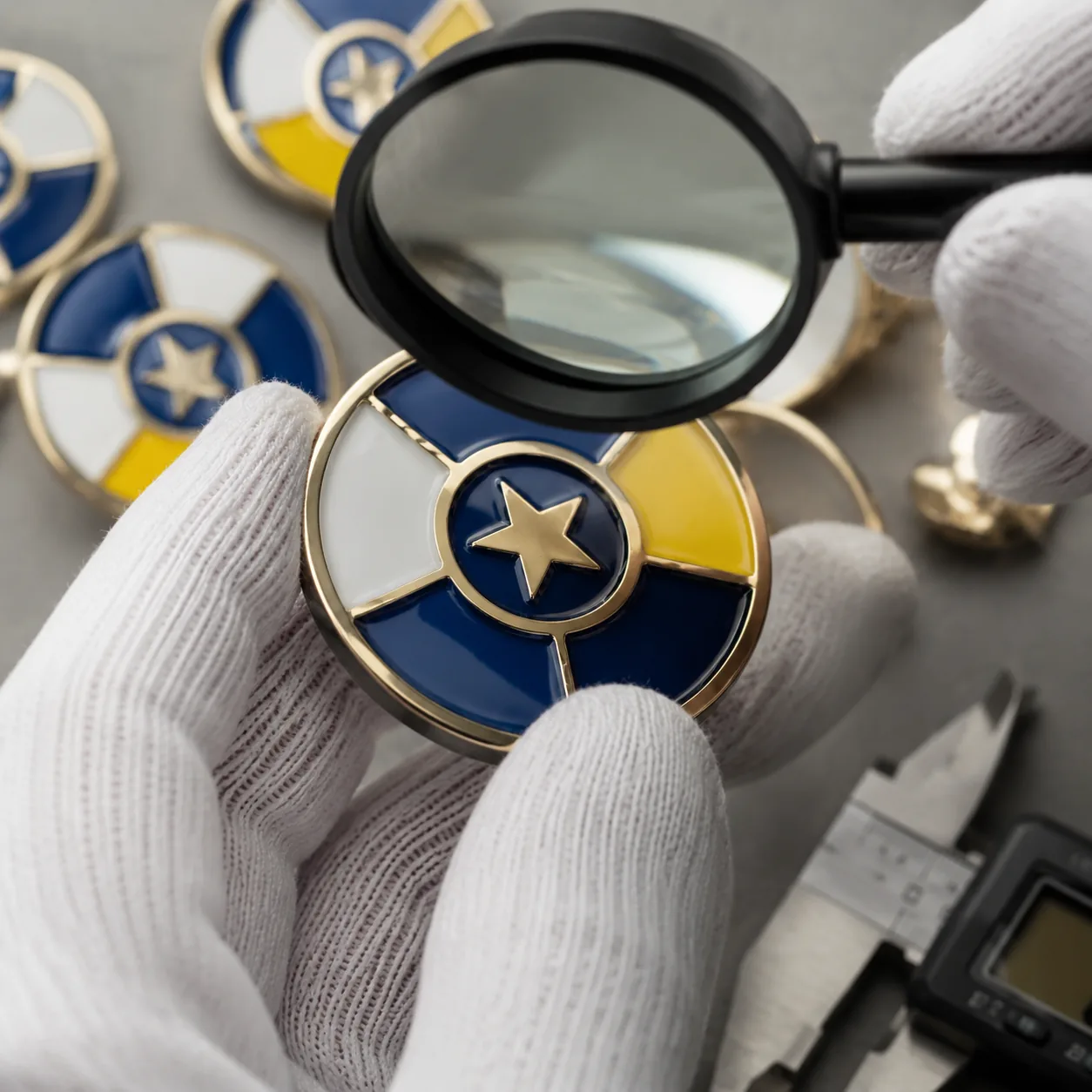
Build the Inspection Plan Before Tooling Starts
The most expensive quality dispute usually starts with a vague purchase order. A pre-production sample looks correct, but the shipment arrives with mixed gold plating, loose butterfly clutches, underfilled enamel, scratched faces, bent posts, or split rings that open after a few pulls. If the PO only says “inspect before shipment,” the factory and third-party inspector must guess which defects stop shipment and which are acceptable handmade variation.
For custom enamel pins, brooches, challenge coins, metal keychains, and bag charms, the inspection plan should be frozen before mass production. It needs AQL levels, defect classes, measurement tolerances, functional tests, packing requirements, and clear acceptance limits. The approved artwork and golden sample are not enough; the inspector also needs a written standard for judging size, color, plating, hardware strength, carton labels, and retail packaging.
For most promotional metal items, use ANSI/ASQ Z1.4 or ISO 2859-1, general inspection level II, with AQL 0 for critical defects, AQL 1.5 for major defects, and AQL 4.0 for minor defects. For retail programs, child-facing campaigns, amusement parks, schools, safety promotions, or licensed brands, tighten the plan to AQL 0 critical, AQL 1.0 major, and AQL 2.5 minor. This may add sorting labor and 1-3 production days, but it reduces the risk of paying for air freight on goods that need rework after arrival.
| Order quantity | Typical MOQ context | General level II sample size | Critical defects | Major defects at AQL 1.5 | Minor defects at AQL 4.0 |
|---|---|---|---|---|---|
| 100-280 pcs | Trial run, VIP gift, small club order | 32 pcs | 0 allowed | 1 accept, 2 reject | 3 accept, 4 reject |
| 281-500 pcs | Small event or distributor reorder | 50 pcs | 0 allowed | 2 accept, 3 reject | 5 accept, 6 reject |
| 501-1,200 pcs | Common promotional order | 80 pcs | 0 allowed | 3 accept, 4 reject | 7 accept, 8 reject |
| 1,201-3,200 pcs | Campaign drop or retail launch | 125 pcs | 0 allowed | 5 accept, 6 reject | 10 accept, 11 reject |
| 3,201-10,000 pcs | National program or chain retail order | 200 pcs | 0 allowed | 7 accept, 8 reject | 14 accept, 15 reject |
Classify Defects So QC Decisions Are Consistent
Defect classification must be written into the PO, artwork approval, or QC sheet. Without it, a buyer may call a visible flaw unacceptable while the factory calls it normal process variation. At ZheCraft, this classification is attached to production orders so the mold room, stamping or casting team, enamel department, plating line, assembly team, and final QC staff inspect against the same standard.
Critical defects are zero tolerance because they create safety, legal, or serious use-risk issues. Examples include exposed sharp burrs above 0.20 mm on a wearable item, pin posts that detach under a 5 kg pull test, loose magnets on child-facing products, wrong logo ownership marks, mixed customer designs, missing choking-warning labels where required, or any product different from the approved artwork. A critical defect should normally stop shipment until the lot is sorted or remade.
Major defects affect saleability, brand presentation, fit, or function. These include wrong Pantone color beyond Delta E 3.0 on solid enamel, plating shade outside the approved sample range, missing backstamp, wrong attachment, weak split ring, enamel missing from a visible area, logo distortion, incorrect dimension above tolerance, or packing that causes product damage. Minor defects are visible but limited: a dust speck under epoxy below 0.30 mm outside the logo focal area, light rear-side polishing marks, a faint hairline visible only at close distance, or small carton label placement errors.
- Critical: sharp burrs over 0.20 mm, detached hardware, wrong design, unsafe magnet, missing mandatory warning, or mixed customer artwork.
- Major: wrong size beyond tolerance, wrong plating finish, missing color fill, loose clutch, weak keyring, distorted logo, or failed retail backing card fit.
- Minor: speck below 0.30 mm, slight enamel meniscus, faint polishing line, small rear-side plating variation, or label placement that does not affect scanning.
- Not a defect: split-ring seam, hand-filled enamel level within ±0.10 mm, minor back-side polishing marks, or shade variation within the approved golden sample range.
Use Process-Realistic Measurement Tolerances
Custom metal promotional goods are not CNC-machined parts. Tolerances must reflect stamping, die casting, trimming, polishing, plating, enamel fill, and manual assembly. For iron or brass stamped pins, ±0.20 mm on overall width and height is practical when the outline is simple and the mold is clean. For zinc alloy die-cast keychains, use ±0.30 mm up to 50 mm and ±0.50 mm above 50 mm. Thin openwork, long narrow shapes, or highly polished edges may need wider tolerance.
Thickness should be measured away from raised enamel or epoxy domes. A 1.2 mm iron soft enamel pin commonly finishes at 1.20-1.40 mm after plating and color fill. A 2.0 mm zinc alloy keychain commonly finishes at 2.00-2.30 mm before packaging. Standard promotional plating is often flash plating around 0.08-0.15 microns. For retail keychains, bag charms, and frequent-handling items, specify 0.30-0.50 microns for nickel, brass, imitation gold, or rose-gold plating where the budget allows. Thicker plating improves wear resistance but can soften fine recessed detail and increase unit cost.
Flatness and hardware position deserve separate checks. For pins under 35 mm, allow maximum bow of 0.30 mm across the face. For 40-60 mm coins, medallions, or badges, allow up to 0.50 mm unless the product sits in a fitted tray. Pin post location should be within ±0.80 mm from the approved drawing, and dual-post spacing should be within ±1.00 mm so backing cards, foam inserts, and presentation boxes still fit.
| Checkpoint | Recommended tolerance | Inspection method | Tighten for |
|---|---|---|---|
| Overall width and height | ±0.20 mm stamped, ±0.30 mm cast up to 50 mm | Digital caliper on 10-20 pcs from the sample | Retail sets, fitted trays, paired badges |
| Metal thickness | +0.20 mm / -0.10 mm for most pins | Caliper at edge, away from enamel dome | Coins, premium badges, weight-sensitive mailers |
| Enamel fill level | ±0.10 mm against raised metal rim | Visual check plus fingertip pass | Hard enamel, large flat color blocks |
| Pin post position | ±0.80 mm from drawing | Measure from top and side edges | Backing cards with punched holes |
| Split-ring wire diameter | ±0.05 mm | Caliper on wire cross-section | Keychains above 25 g |
| Carton gross weight | ±1.0 kg from packing list | Scale check per carton or sampled cartons | Air freight, courier, marketplace receiving |
Test Function, Not Only Appearance
A pin or keychain can pass visual inspection and still fail during use. For butterfly clutch pins, test at least 20 pieces from the inspection sample by attaching and removing the clutch three times. The clutch should not crack, slide off when the pin is inverted, or expose a sharp post burr. For rubber clutches, confirm that the hole grips 1.0 mm or 1.2 mm posts without tearing.
For keychains, the weak points are the jump ring, split ring, swivel, lobster clasp, and connection loop. For promotional keychains under 30 g, specify a 5 kg pull test for 10 seconds with no opening, detachment, or permanent deformation. For heavier metal keychains, bottle-opener keychains, or bag charms, specify 8 kg for 10 seconds and use a 1.2-1.5 mm split-ring wire diameter instead of the 0.8-1.0 mm rings used on budget giveaways.
Magnets require both bond and holding checks. A 30 mm round magnet at 2 mm thickness may hold a postcard on painted steel, but it may not perform on stainless steel, thick paper, or powder-coated surfaces. If a magnet is glued to a metal badge, use a 3 kg pull test for 10 seconds on a 10-piece sample. Glue failure should be major for decorative magnets and critical for child-facing products where a detached small part creates a safety risk.
- Cycle test: open and close lobster clasps 20 times on at least 10 pcs, with no sticking spring or visible gap.
- Pull test: apply 5 kg for 10 seconds on light keychains and 8 kg for 10 seconds on heavier keychains or bag charms.
- Drop test: drop 10 finished keychains from 1 m onto plywood; no detached charm, broken enamel, or opened ring.
- Magnet bond test: apply 3 kg for 10 seconds on glued magnets unless the magnet is purely non-load-bearing decoration.
- Pin clutch test: attach and remove three cycles; reject clutches that slide off when inverted or under light finger pressure.
Connect AQL to MOQ, FOB Price, and Lead Time
Inspection strictness affects cost even when the quotation does not show a separate QC line. A 25 mm soft enamel iron pin at 1,000 pcs may quote around FOB USD 0.45-0.85 depending on plating, color count, attachment, and packaging. The same design with hard enamel polishing, 0.30-0.50 micron premium plating, individual backing card, barcode label, and tighter cosmetic sorting may land around FOB USD 0.75-1.35. If a supplier accepts the stricter standard at the cheaper price without comment, ask how they will cover sorting labor and remake risk.
MOQ changes the inspection approach. At 100-300 pcs, tooling and setup dominate the cost, so many factories visually inspect every piece but charge a higher unit price. At 500-1,000 pcs, line QC plus final random AQL inspection is usually practical. At 5,000 pcs and above, add in-process checks after stamping or casting, after polishing, after plating, after enamel fill, and before final packing. Waiting until final inspection at that volume creates too much rework risk.
Lead time should include inspection and correction time. Normal production after artwork and sample approval is often 12-18 days for soft enamel pins, 15-22 days for hard enamel pins, 14-22 days for metal keychains, and 18-25 days for challenge coins. Add 1-2 days for internal final QC, 1 day for third-party inspection in Yiwu or nearby Zhejiang cities, and 3-5 days for sorting, rework, or partial remake. Rush orders are possible, but tight AQL, custom packaging, and last-minute air-freight relabeling do not combine well.
| Item type | Typical MOQ | FOB range at 1,000 pcs | Normal lead time after approval | QC focus |
|---|---|---|---|---|
| 25-30 mm soft enamel pin | 100 pcs, better at 300+ | USD 0.45-0.85 | 12-18 days | Enamel underfill, post strength, plating shade |
| 30-40 mm hard enamel pin | 100 pcs, better at 500+ | USD 0.75-1.35 | 15-22 days | Over-polishing, line thinning, color flatness |
| 40-55 mm metal keychain | 100 pcs, better at 500+ | USD 0.85-1.80 | 14-22 days | Jump-ring pull test, split-ring wire diameter |
| 50 mm challenge coin | 100 pcs, better at 300+ | USD 1.60-3.20 | 18-25 days | Edge text alignment, plating consistency, weight |
| 70-90 mm embroidered patch | 100 pcs, better at 500+ | USD 0.55-1.40 | 10-18 days | Border density, thread color, adhesive backing |
Control Color, Plating, and Surface Standards
Color approval should not depend on a phone photo. For enamel pins and painted keychains, specify Pantone Solid Coated references and use Delta E 3.0 for most brand colors. For strict corporate programs with enough budget for adjustment, use Delta E 2.0. Transparent enamel, glitter, glow pigment, pearl effects, and epoxy domes are harder to measure, so approve them against a physical sample rather than only a Pantone code.
Plating variation is a frequent dispute because gold, rose gold, antique brass, and black nickel shift with bath chemistry, polishing pressure, base metal, and rack position. For standard promotional items, judge shade against the approved sample under D65-equivalent white light, viewed at 30-50 cm. For retail programs, keep one approved plating chip or golden sample at the factory and one with the buyer, and do not allow mixed plating lots in the same shipment unless the shade range is approved in advance.
Surface inspection distance should be part of the standard. A practical rule is normal corrected vision at 30 cm for 5 seconds per piece under 800-1,000 lux white light. If a scratch, pit, or stain is not visible under that condition, it should usually be minor or not counted. If it is visible on the front logo area, classify it by size and location. Do not inspect low-cost promotional pins with magnifiers unless the PO defines the item as jewelry-grade.
- Front focal area: reject scratches over 1.0 mm, stains over 0.5 mm, or plating pits visible at 30 cm.
- Back side: allow light polishing marks unless they reduce backstamp readability or weaken the attachment.
- Epoxy dome: reject trapped hair, lifting edge, yellowing, or bubbles over 0.5 mm in the logo area.
- Antique finish: approve contrast on a physical sample because recess darkness changes with wiping pressure.
- Hard enamel: reject over-polished metal lines if line width falls below 0.15 mm or small text becomes distorted.
Inspect Packing With the Same Discipline
Many claims are caused by packing rather than production. Pins arrive with bent posts when they are bulk packed too tightly, and polished keychains scratch when they rub together during trucking or sea freight. For individual polybags, use 0.03-0.05 mm OPP for light pins and 0.05-0.08 mm OPP for heavier keychains, coins, or bottle openers. For retail backing cards, specify 300-400 gsm card stock and hole position tolerance of ±1.00 mm.
Cartons should match the freight method and the receiving warehouse. For small metal items, keep export cartons below 15 kg where possible; 10-12 kg is easier for event teams and reduces crushing risk. Common carton sizes are about 35 x 25 x 25 cm for pins and 40 x 30 x 25 cm for heavier keychains, but the final size should come from a packing test. If cartons exceed 18 kg, use double-wall board and confirm the forwarder accepts the weight.
Label checks belong in final QC. Each carton should show item code, PO number, SKU, quantity, gross weight, net weight, carton number, and country-of-origin wording if required. For mixed-SKU kits, inspect inner labels too; one wrong variant in a carton can create more operational cost than a small cosmetic flaw. ZheCraft recommends a packed-carton photo set, carton weight record, and final packing list review before shipment release for multi-item orders.
| Packing point | Recommended spec | Inspection method | Defect class |
|---|---|---|---|
| Individual bag | 0.03-0.05 mm OPP for pins, 0.05-0.08 mm for keychains | Visual check plus thickness check if needed | Minor, or major if damage risk exists |
| Backing card | 300-400 gsm, hole tolerance ±1.00 mm | Measure 10 pcs and test display fit | Major if retail display fails |
| Carton weight | Prefer under 15 kg; confirm above 18 kg | Scale each carton or sampled cartons | Major if freight limit is exceeded |
| Inner quantity | Exact count per bag, tray, or inner box | Count sampled cartons and compare to packing list | Major |
| Carton label | PO, SKU, quantity, carton number, gross/net weight | Compare against PO and packing list | Major for wrong SKU or quantity |
Freeze the QC Sheet Before You Place the PO
Before issuing the PO, decide whether the order needs standard promotional QC or retail-grade QC. For most event giveaways, use AQL 0 critical, 1.5 major, and 4.0 minor with general inspection level II and the tolerances shown on the approved drawing. For retail, child-facing, licensed, or high-visibility brand programs, tighten major defects to AQL 1.0, minor defects to AQL 2.5, and require in-process photos or staged inspections.
Send one inspection sheet with the artwork approval, not after production is finished. It should include size tolerance, metal thickness, plating target in microns, attachment type, pull-test requirement, Pantone references, Delta E limit, surface inspection distance, packing method, carton weight limit, barcode or label content, and defect classification. Ask the supplier which checks are included in the quoted FOB price and which require extra sorting cost or longer lead time.
For China sourcing, the best QC plan matches the real factory process. ZheCraft can help convert drawings, brand guides, and distributor RFQs into production-ready QC sheets for pins, brooches, keychains, magnets, challenge coins, patches, lanyards, and retail packaging. The practical sequence is simple: approve artwork, make a pre-production sample, approve one golden sample, freeze the AQL and tolerance sheet, then release mass production.
- Attach the QC sheet to the PO and artwork approval instead of leaving standards in email threads.
- Define AQL levels: 0 critical, 1.5 major, and 4.0 minor for standard promotional orders.
- Set measurable limits for dimensions, thickness, post position, pull strength, color, plating, carton weight, and labels.
- Keep one approved golden sample at the factory and one with the buyer, distributor, or inspection company.
- Reserve 1-2 days for final QC and 3-5 days for sorting or rework if inspection finds a correctable issue.
Have a project? Send your artwork and target quantity and we’ll reply with a detailed quotation within 12 working hours.
Ready to get this made?
Send your sketch, target quantity and ship-date. Detailed quotation in 12 hours.



