AQL Inspection Specs for Custom Metal Promo Products
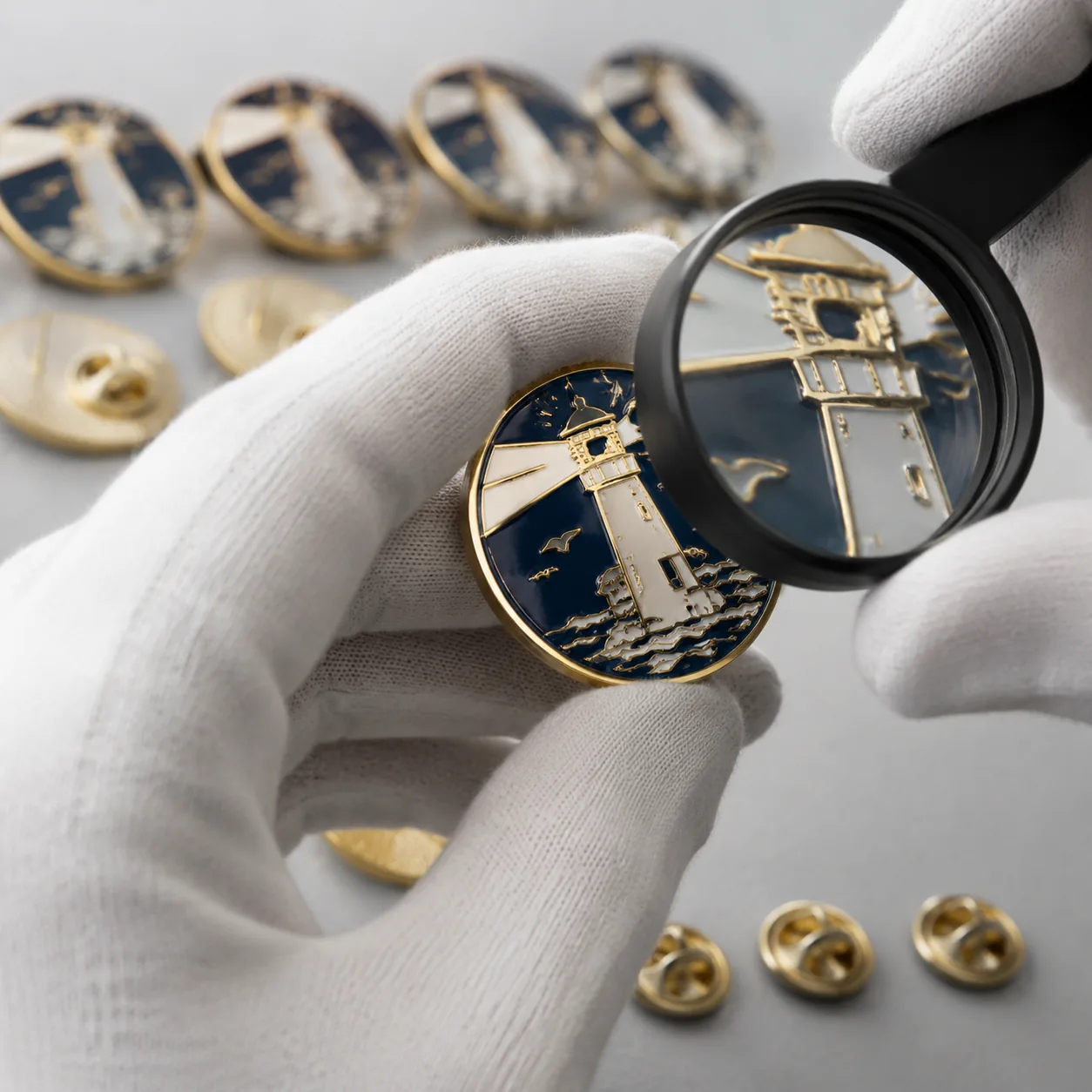
Why a 2 Percent Defect Rate Can Still Break an Order
Most failed promo shipments are not 100 percent bad. The costly scenario is a mixed lot: 94 cartons are acceptable, six cartons contain scratched plating, loose pin posts, wrong backing cards, weak magnets, or mixed SKUs. Once the goods reach a distributor warehouse or event venue, replacement by air can cost more than the original FOB margin.
A written AQL inspection spec prevents that dispute before production starts. It defines the sample size, critical, major and minor defects, function tests, packaging checks and failed-lot procedure. For custom enamel pins, challenge coins, keychains, fridge magnets, medals, patches and lanyards, inspection should be treated as production control, not as a final negotiation after cartons are sealed.
This guide assumes the buyer already has artwork, dimensions, material, plating, attachment, packaging and carton quantity roughly defined. The goal is to turn those expectations into measurable inspection language that a factory, trading company or third-party inspector can apply consistently.
Set Practical AQL Levels and Sample Sizes
For most non-life-safety promotional metal products, a practical default is AQL 0.0 for critical defects, AQL 2.5 for major defects and AQL 4.0 for minor defects, using ANSI/ASQ Z1.4 or ISO 2859-1 single sampling at general inspection level II. For premium retail, museum shops, licensed brands or VIP gifts, major defects are often tightened to AQL 1.5. Critical defects should remain zero acceptance.
Do not specify AQL 0.65 for a low-cost 500-piece badge order unless the budget supports slower sorting, higher reject risk and possible remake time. AQL is a risk control method, not a guarantee that every unit is perfect. Tighter limits make sense when the retail price, brand exposure or replacement risk justifies the extra inspection effort.
| Lot size | Level II sample size | Critical AQL | Major AQL | Minor AQL | Typical use |
|---|---|---|---|---|---|
| 500 pcs | 50 pcs | 0.0 | 2.5 | 4.0 | Small event pins, simple keychains |
| 1,000 pcs | 80 pcs | 0.0 | 2.5 | 4.0 | Standard promotional reorder |
| 3,000 pcs | 125 pcs | 0.0 | 2.5 | 4.0 | Corporate giveaway or campaign run |
| 5,000 pcs | 200 pcs | 0.0 | 1.5 to 2.5 | 4.0 | Licensed or retail-facing product |
| 10,000 pcs | 315 pcs | 0.0 | 1.5 to 2.5 | 2.5 to 4.0 | Multi-carton retail or distributor shipment |
For lots below 300 pieces, 100 percent visual inspection is often more useful than statistical sampling, especially for complex brooches, antique-finish coins and gift sets. For larger lots, combine in-line checks with final AQL inspection so problems are caught before thousands of pieces are bagged and cartoned.
Classify Defects With Measurable Limits
AQL only works when defect categories are clear. A critical defect is anything that creates a safety risk, violates a restricted-material requirement, or makes the item unusable. Examples include exposed burrs over 0.2 mm on handled edges, detached pin posts, broken split rings, magnets small enough to detach and be swallowed, or a product that fails a declared lead, nickel or CPSIA requirement.
Major defects are problems a normal customer would reject: wrong logo, wrong plating color, missing enamel in a visible area, unreadable QR code, severe scratch over 3 mm on the front face, incorrect backing card, failed attachment, or a Pantone mismatch beyond the approved tolerance. Minor defects are small cosmetic issues that do not affect normal use, such as a 0.3 mm dust dot near an edge, a light hairline on the back, or slight plating shade variation within the approved sample range.
- Classify sharp burrs, detached pin posts, loose magnets, broken rings and restricted-material failures as critical defects with zero acceptance.
- Classify wrong artwork, wrong Pantone beyond tolerance, missing enamel, major plating pits, failed pull tests and unreadable barcodes as major defects.
- Classify tiny back-side scratches, small epoxy dust dots and slight card corner rubs as minor defects when not visible at normal viewing distance.
- Define viewing conditions as 500 to 700 lux light, 30 to 40 cm distance and unaided eye unless a gauge, caliper or scan test is specified.
- Use the approved pre-production sample or sealed golden sample as the visual reference, not only the digital artwork.
Add tolerances to the defect list. For die-struck pins and coins, overall length or diameter tolerance of ±0.2 mm is realistic for most shapes; thickness tolerance is commonly ±0.15 mm for 1.2 to 3.0 mm items. For rubber clutches, accept only parts that fit the specified post diameter without wobble or excessive force. For printed lanyards, cut length tolerance of ±10 mm is normal; for woven patches, ±1 mm on border width is usually achievable.
Specify Product Checks by Item Type
One generic checklist is not enough because each product fails differently. Enamel pins need checks for enamel fill, plating coverage, pin post location, clutch fit and face appearance. Keychains need split ring closure, chain link seam, swivel function and pull strength. Challenge coins need diameter, thickness, edge detail, antique wash, color fill and weight consistency.
For soft enamel pins, specify enamel recess of 0.1 to 0.3 mm below the metal lines unless the approved sample shows otherwise. For hard enamel pins, the surface should be near flush after polishing, with no over-polished low spots that remove plating from raised lines. Standard decorative plating is often 3 to 5 microns for nickel, gold, brass or black nickel; 5 to 8 microns is more suitable when the buyer needs better wear resistance or retail handling durability.
For pin posts, position tolerance should normally be within ±0.5 mm of the approved location. A 25 mm lapel pin may use one 8 mm post, while pins above 35 to 40 mm often need two posts or a brooch bar to prevent rotation. If the pin is worn on uniforms or bags, test the actual backing style instead of assuming a rubber clutch performs like a butterfly clutch.
For challenge coins, a common specification is 40 to 50 mm diameter, 3.0 mm thickness and ±0.15 mm thickness tolerance. Zinc alloy is economical for complex relief and color fill; brass costs more but gives a denser feel and sharper premium positioning. For fridge magnets, specify pull force on the intended surface: a light 30 mm PVC magnet may pass at 80 to 120 g, while a metal bottle opener magnet may need 300 to 500 g so it does not slide on a refrigerator door.
Inspect Before Final Carton Sealing
Final random inspection after packing is useful, but it should not be the first quality control point. Plating shade, enamel color, solder strength and hardware defects are cheaper to correct before individual bagging, backing cards and export cartons are completed. Late discovery often turns a simple rework into unpacking, sorting, repacking and reinspection.
For metal pins and coins, the inspection sequence should include first-article approval after mold or die trial, color approval before bulk enamel filling or printing, in-process review after polishing or plating, and final AQL when production is complete and at least 80 percent packed. For lanyards and patches, print, weave and length approval must happen before bulk cutting. For keychains, hardware should be tested before final assembly so weak rings or clasps are not trapped inside sealed bags.
| Stage | Timing | Checks | Decision |
|---|---|---|---|
| First article | After mold or die trial | Size, relief, cutouts, line clarity, attachment position | Approve, adjust tooling or remake die |
| Color approval | Before bulk fill or print | Pantone match, enamel effect, print sharpness, epoxy gloss | Approve bulk color or revise formula |
| In-process check | 20 to 50 percent complete | Plating, polishing, solder, ring closure, magnet bonding | Continue, sort or stop production |
| Final AQL | 100 percent complete and at least 80 percent packed | Appearance, function, packaging, carton marks | Ship, repair, sort or reinspect |
Avoid approving critical color and finish points only through low-resolution phone photos. Factory lighting changes the appearance of gold, antique brass, black nickel and translucent enamel. For orders above 3,000 USD FOB or event-critical launches, keep one sealed golden sample at the factory and one with the buyer or inspector.
Write Function Tests With Pass Criteria
Appearance defects create complaints, but function failures create returns. A clutch that falls off, a split ring that stays open, or a magnet that cannot hold its own weight is a product failure, not a cosmetic issue. The inspection spec should include simple pass/fail tests that can be repeated on the sample.
For standard lapel pin posts, a practical pull test is 2.0 to 3.0 kgf depending on post diameter and solder area. For larger brooch bars, require 10 open-close cycles with no bending, detached hinge or loose safety catch. For keychains, the split ring should return with no visible gap over 0.2 mm after manual opening, and chain links should show no open seam under firm hand pull.
For epoxy-coated pins, keychains and badges, check bubbles, yellowing, edge coverage and dust. A bubble under 0.5 mm near the back edge may be minor; a bubble over a logo, face, QR code or light background should be major. For QR codes, serial numbers and retail barcodes, scan at least 20 pieces from the inspection sample using a normal smartphone at 20 to 30 cm, not only a scanner app under perfect lighting.
For magnets, test against the actual intended surface if possible. Stainless steel, painted steel, whiteboards and refrigerators can produce different results. If the product is a bottle opener magnet, check both opening function and magnetic hold after use because the opener action can stress the adhesive or embedded magnet.
Control Packaging, Cartons and Label Accuracy
Many failed inspections are packaging failures rather than product failures. Common issues include wrong backing cards, missing barcodes, mixed SKUs, weak cartons, wet cartons, incorrect carton marks or missing pieces in a kit. If the shipment is for a conference, retail launch or subscription box, one missing lanyard or wrong pin color can make the whole set unusable.
Define the packaging bill of materials with size, material and tolerance. A typical pin card might be 55 x 85 mm, 300 gsm white card, ±1 mm, one pin mounted through two holes, packed in a 60 x 90 mm OPP bag. A carton might use five-ply corrugated board, gross weight below 12 to 15 kg and enough inner-box fit to prevent movement without crushing the cards.
- Confirm quantity per polybag, backing card, inner box and export carton against the packing list.
- Check carton marks for PO number, SKU, item name, quantity, gross weight, net weight, country of origin and carton number.
- Scan barcode or QR labels on at least 10 cartons when warehouse receiving depends on label accuracy.
- Avoid mixed cartons unless the carton mark lists every SKU and quantity inside.
- Reject cartons with visible water stains, crushed corners, mold smell, open seams or tape failure.
- For heavy coins or metal keychains shipped by courier, drop-test one packed carton from 60 cm on one corner, three edges and six faces.
Packaging cost should be visible in the FOB quote. Standard OPP bagging often adds 0.01 to 0.03 USD per piece; backing card plus bag commonly adds 0.04 to 0.12 USD; rigid gift boxes can add 0.35 to 1.20 USD depending on size, insert and print. If the packaging carries the brand experience, inspect it with the same seriousness as the metal item.
Plan Cost, Lead Time and Failed-Lot Rules
Inspection has a cost, but vague inspection costs more. For a 1,000 to 5,000 piece custom metal order, normal factory inspection is usually included in the FOB price. A third-party final inspection in China often costs 180 to 350 USD per man-day, depending on city, travel distance, product complexity and report requirements. Reinspection after a failed lot may add another man-day plus sorting labor.
Lead time must include inspection time. A typical custom enamel pin order may need 7 to 10 days for tooling and pre-production sample, 10 to 18 days for mass production, and 1 to 3 days for final inspection and packing release. If using third-party inspection, reserve 2 to 4 additional calendar days for booking, inspection, report review and corrective action. For urgent event orders, that buffer is often the difference between ocean, express courier and missed delivery.
MOQ and price also affect the inspection plan. Simple zinc alloy enamel pins often start around 300 to 500 pcs per design, with FOB prices around 0.45 to 1.20 USD for 25 to 35 mm sizes depending on plating, colors and backing card. Challenge coins often start at 100 to 300 pcs, with 40 to 50 mm coins commonly around 1.80 to 4.80 USD FOB. Metal keychains may start at 300 to 500 pcs and range from 0.80 to 2.50 USD FOB. These ranges change with material, die charge, finish, packaging and current metal cost, so the inspection strictness should match the commercial risk.
The purchase order should state who pays for sorting, rework and reinspection when failure is caused by factory-controlled defects. It should also state what happens when the buyer changes artwork, barcode files, packaging or shipping marks after production starts. Lock the inspection checklist before mass production; late changes create disputes that no AQL table can solve fairly.
Build a One-Page Inspection Appendix
Before placing the order, convert quality expectations into a one-page inspection appendix. Start with the drawing, approved artwork, Pantone colors, material, plating, dimensions, attachment, packaging and carton plan. Then add AQL levels, defect classifications, function tests, packaging checks and the rule for failed inspection.
For most standard promo orders, use critical AQL 0.0, major AQL 2.5 and minor AQL 4.0 at general inspection level II. Tighten major defects to AQL 1.5 for premium retail, licensed goods, high-visibility launches or orders where replacement is impossible before an event. Do not tighten every category automatically; spend inspection effort where users will notice defects or where failure creates safety, brand or logistics risk.
- Ask the supplier to confirm the AQL standard, inspection level, sample size and accept-reject numbers before production starts.
- Send a defect classification sheet with photos from previous failures if available.
- Keep one approved pre-production sample with the buyer and one sealed sample at the factory.
- Book third-party inspection before the planned ex-factory date, not after cartons are already waiting.
- Require written corrective action and reinspection when critical defects appear or major defects exceed the agreed limit.
When sourcing pins, coins, keychains, magnets, patches and lanyards from one supplier, use one shared inspection framework with product-specific checklists underneath. That keeps quality language consistent while respecting the different failure modes of metal, textile, PVC, acrylic and packaging components. The result is fewer subjective arguments and a shipment that can be accepted, rejected or corrected based on measurable facts.
Have a project? Send your artwork and target quantity and we’ll reply with a detailed quotation within 12 working hours.
Ready to get this made?
Send your sketch, target quantity and ship-date. Detailed quotation in 12 hours.



