AQL Inspection Plans for Custom Pins, Coins and Keychains
Start With the Release Risk, Not the Cartons
A distributor has a national retailer launch in 24 days: 10,000 soft enamel pins for staff uniforms, 5,000 zinc alloy keychains for giveaways, and 3,000 challenge coins for VIP packs. The retailer asks for inspection before shipment but does not define sample sizes, AQL limits, defect classes, measurement tolerances, or who can release the goods. That gap becomes expensive when cartons are sealed and the parties disagree about a 0.4 mm enamel void, a split ring with a 0.35 mm visible gap, or a logo stamped 0.6 mm off center.
For custom metal goods, 100% inspection is not the default answer. It can add 2 to 6 working days on a mixed-SKU order, increase handling marks, and still fail if the inspector has no approved standard. AQL inspection is more useful because it defines how many pieces are checked, what counts as critical, major, and minor, and when a lot passes, fails, or must be sorted before release.
At ZheCraft, AQL planning is most useful for orders above 3,000 pieces, retail-bound shipments, mixed plating programs, and repeat production where the golden sample is already approved. It should be written into the purchase order or pre-production approval sheet before mass production starts. If AQL is discussed only after packing, the buyer is no longer managing quality; they are negotiating defects against a freight deadline.
Define Lots by SKU, Finish and Production Batch
The 18,000-piece order should not be treated as one combined inspection lot. Pins, keychains, and coins use different tooling, plating, polishing, filling, assembly, and packing steps. Combining them can hide a serious defect in one SKU because the total shipment still appears acceptable. A lot should be uniform enough that one sample result reasonably represents the balance.
Define one inspection lot per SKU, then split again when the process risk changes. The 10,000 pins can be one lot if they use the same mold, iron thickness, plating finish, enamel colors, backing, and packing. If the 5,000 keychains include 3,000 nickel-plated pieces and 2,000 antique brass pieces, inspect them as two lots because plating shade, oxidation, ring hardware, and rework risks differ. If production is split across two casting days or two subcontracted plating lines, split by batch as well.
MOQ and timing affect how strict the plan can be without delaying the shipment. Soft enamel pins are often quoted from 100 pieces per design, but stable mass-production pricing usually starts at 500 to 1,000 pieces. Zinc alloy keychains and challenge coins commonly start at 300 to 500 pieces because mold, casting, polishing, and plating setup are heavier. Normal lead time after sample approval is 10 to 18 days for pins, 14 to 22 days for keychains, and 16 to 25 days for coins, excluding peak season, lab testing, and international freight.
| SKU | Order Quantity | Inspection Lot | Risk Focus |
|---|---|---|---|
| 25 mm soft enamel pin, 1.5 mm iron | 10,000 pcs | One lot if same mold, plating, enamel colors, backing and packing | Enamel voids, plating coverage, pin post strength, clutch fit, front scratches |
| 45 mm zinc alloy keychain, 2.5 mm thick | 5,000 pcs | Split by plating color, hardware batch, casting date or chain supplier | Casting pits, ring gap, swivel failure, weak jump rings, chain pull strength |
| 50 mm challenge coin, 3.0 mm zinc alloy | 3,000 pcs | One lot if same mold, plating bath, edge type, color fill and capsule | Edge dents, relief clarity, color placement, thickness variance, capsule rub marks |
Approve a Measurable Golden Standard
AQL only works when the approved standard is physical and measurable. PDF artwork is not enough because polishing radius, enamel meniscus, relief sharpness, plating shade, epoxy height, and hardware feel are production results, not flat artwork properties. The buyer should approve one signed golden sample per SKU, keep dated photos, and mark measurement points on the drawing before mass production starts.
For enamel pins, define outside width and height, base metal thickness before attachment, post location, plating finish, enamel colors, backstamp location, backing type, and carding method. A normal 25 to 35 mm soft enamel pin is usually 1.2 to 1.8 mm thick. Outer dimension tolerance is commonly ±0.30 mm for small pins and ±0.40 mm for larger badges after polishing and plating. Pin post location should normally be within ±0.80 mm of the marked datum; tighter placement can require a jig and should be priced before approval.
For plating, avoid terms such as good gold or standard nickel. Decorative nickel base layers for promotional goods are commonly controlled around 3 to 5 microns. Flash gold-tone finishes may be only 0.03 to 0.08 microns unless a thicker premium finish is specified. If the item will be handled daily, sold at retail, or used outdoors, define adhesion, salt-spray expectations, and acceptable shade drift against the golden sample under 600 to 1,000 lux white light.
For keychains, the functional standard is as important as the front appearance. A 30 mm split ring should close without a visible gap above 0.30 mm, and the jump ring should be fully closed or welded if the charm is heavy. A standard promotional keychain should resist a 5 kg static pull for 10 seconds without the ring, chain, or swivel opening. Coins require diameter, thickness, edge type, relief height, color-fill area, capsule fit, and pouch or box clearance to be defined before inspection.
- Approve one signed golden sample per SKU before mass production.
- Mark caliper measurement points on the drawing instead of relying on email descriptions.
- Specify plating finish, target thickness, and acceptable shade variation against the sample.
- Use practical tolerances: ±0.30 mm for small pins, ±0.40 mm for coins, and ±0.15 to ±0.20 mm on thickness.
- Define hardware tests for clutches, split rings, jump rings, magnets, spinners and moving parts.
- Confirm whether inspection happens before individual retail packing or after sealed packing, because sealed packs slow checking and sorting.
Set AQL Levels and Defect Classes
For most promotional metal goods, a balanced plan is ANSI/ASQ Z1.4 or ISO 2859-1, single sampling, normal inspection, General Inspection Level II, with critical defects at AQL 0, major defects at AQL 2.5, and minor defects at AQL 4.0. This is stricter than casual factory spot-checking and less disruptive than 100% inspection. Tighten the plan for child-facing items, wearable products with sharp points, magnets, safety claims, QR codes, serialized packaging, or premium boxed sets.
Critical defects have zero tolerance because they can injure the user, violate the order, or make the goods unusable. Examples include sharp burrs above 0.10 mm on an accessible edge, detached pin posts, exposed needle points outside the backing, loose magnets, broken split rings, wrong logo, wrong plating finish, mixed SKU cartons, or missing legal warning labels. Any critical finding should stop release until the factory isolates the lot and proposes sorting, rework, or remake.
Major defects are visible or functional problems a reasonable buyer would reject. Typical limits include missing enamel larger than 0.50 mm in a front color area, plating blistering, exposed base metal on a visible edge, front scratches longer than 3.0 mm, print or epoxy misregistration above 0.50 mm, loose clutches, weak jump rings, and barcode failures. Minor defects are small non-functional deviations, such as faint back-side polishing lines under 1.0 mm, slight enamel meniscus variation, or tiny color specks away from the logo.
| Defect Class | Recommended AQL | Concrete Examples | Release Rule |
|---|---|---|---|
| Critical | 0 | Sharp burr above 0.10 mm, wrong logo, detached post, loose magnet, broken ring, unsafe needle point | Any finding fails the lot until contained and rechecked |
| Major | 2.5 | Missing enamel over 0.50 mm, plating blister, front scratch over 3.0 mm, off-center print over 0.50 mm, weak clutch | Pass or fail by the accept and reject number for the sample size |
| Minor | 4.0 | Small back scratch, slight shade drift within approved range, tiny non-logo speck, minor polishing wave | Track separately and fail only when the count exceeds the agreed limit |
Sample Sizes and Inspection Methods
Inspection should start with carton selection, not loose pieces handed over by the packing team. The inspector should confirm finished quantity, carton count, carton marks, packing method, gross weight, and whether the order is fully packed. Samples must be drawn randomly across cartons. If the 10,000-piece pin lot is packed 500 pieces per carton, it has 20 cartons; sampling should cover multiple cartons across the stack, not only the top carton near the door.
Under General Inspection Level II, a 10,000-piece lot typically uses code letter L and a 200-piece sample. A 5,000-piece lot also commonly uses 200 pieces. A 3,000-piece lot typically uses code letter K and a 125-piece sample. Exact accept and reject numbers depend on the selected AQL table and should be written before inspection. For reference, at AQL 2.5 a 200-piece sample commonly allows up to 10 major defects and rejects at 11; a 125-piece sample commonly allows up to 7 and rejects at 8. At AQL 4.0, a 200-piece sample commonly allows up to 14 minor defects and rejects at 15.
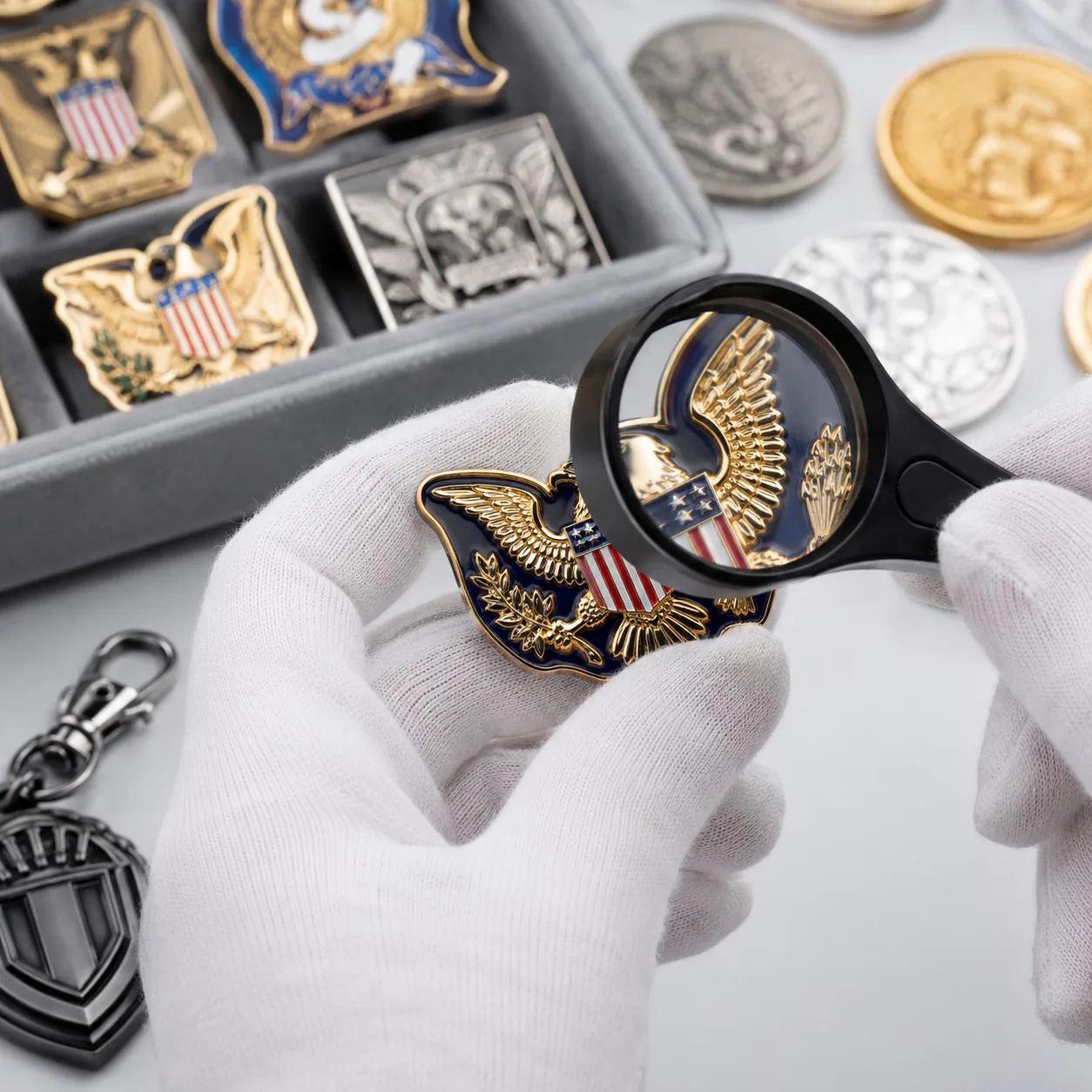
Appearance checks should be performed under controlled light, usually 600 to 1,000 lux white light, with the front face viewed from about 30 to 40 cm for 3 to 5 seconds per side. Magnification should be reserved for defined checks such as QR code readability, micro text, suspected plating contamination, or customer-specified artwork detail. If every piece is judged under a loupe, the standard becomes stricter than normal retail use and creates avoidable disputes.
Dimensional checks require calibrated digital calipers with 0.01 mm resolution, not a ruler. Measure outside width, height or diameter, thickness, hole location, post position, ring diameter, wire diameter, chain length, and ring gap where applicable. Functional checks should include clutch fit, ring closure, swivel movement, magnet hold, spinner rotation, epoxy adhesion where used, and static pull tests on assembled hardware.
| Check Area | Tool or Method | Common Acceptable Limit | Tighten When |
|---|---|---|---|
| Outer dimensions | Digital caliper | ±0.30 mm for pins; ±0.40 mm for coins | Interlocking sets, fitted trays or premium retail packs |
| Thickness | Digital caliper | ±0.15 mm for small pins; ±0.20 mm for coins | Weight-sensitive sets, coin capsules or display stands |
| Pin post position | Caliper from marked datum | ±0.80 mm | Small badges, anti-rotation layouts or paired pins |
| Front scratches | Visual check at 30 to 40 cm | No obvious front scratch over 3.0 mm | Clear-window retail packaging |
| Plating coverage | Visual check plus tape or adhesion test if specified | No exposed base metal on front or edge | Outdoor use, high-touch items or premium finishes |
| Hardware pull | Static pull for 10 seconds | 5 kg for keychains; 2 kg for pin posts | Heavy charms, luggage tags or child-use products |
Budget the Cost and Time Impact
AQL inspection adds time even when performed inside the factory. For a 3,000 to 10,000 piece custom metal order, internal final inspection normally adds 0.5 to 1.5 working days after packing. A third-party inspection usually needs booking 2 to 4 working days in advance, one inspection day on site, and another 0.5 to 1 working day for report review and shipment release. Rush inspections are possible, but they reduce the time available for sorting or replacement.
Factory internal AQL inspection is normally included in ZheCraft’s export process for standard orders, but buyer-specific requirements can add labor. Examples include 100% barcode scanning, carton-by-carton photo records, destructive pull testing, individual pouch opening, rebagging after inspection, or separate reports for each retail store allocation. If inspection must happen after sealed retail packing, allow extra labor and keep spare packaging available.
As FOB reference ranges at 1,000 pieces, custom soft enamel pins often fall around USD 0.45 to 1.20 each depending on size, color count, plating, backing, carding, and epoxy. Zinc alloy keychains commonly range from USD 0.80 to 2.20 each, and challenge coins from USD 1.40 to 4.50 each depending on diameter, thickness, edge style, color fill, plating, capsule, and box. At 5,000 to 10,000 pieces, unit prices usually improve, but tooling, rush production, premium plating, and retail packing can offset the gain.
Third-party inspection in Zhejiang, Guangdong, or nearby production areas is usually charged by man-day, not by piece. Buyers should budget roughly USD 180 to 350 per inspector day, with higher charges for remote factories, bilingual reports, lab coordination, weekend work, or same-day booking. For a retail shipment, that cost is small compared with air freight, chargebacks, or a missed launch caused by preventable defects.
- Do not request 100% inspection for low-risk minor marks unless the retail standard truly requires it.
- Do require 100% sorting if a critical defect appears, such as sharp burrs, loose posts or broken rings.
- Keep at least one working day between final inspection and vessel or air pickup.
- Hold 1% to 2% unpacked spare quantity for replacement when retail packs are strict.
- State who pays for re-inspection, sorting labor and replacement packaging if the first lot fails.
Respond to Failed Lots With Containment Rules
A failed AQL result should trigger a controlled decision, not a debate at the loading dock. First isolate the failed lot and determine whether the problem is random, batch-related, or systematic. Plating blisters across many cartons suggest a process failure. Three scratched pieces in one carton may point to packing damage. The response should match the defect pattern, the remaining schedule, and the buyer’s release requirements.
Sorting works when defects are visible and separable, such as enamel overflow, missing clutches, mixed finishes, front scratches, or incorrect backing cards. Rework is practical for replacing hardware, closing jump rings, polishing minor burrs, relabeling cartons, or repacking into corrected polybags. Remake is usually required when the mold detail is wrong, the logo relief is incorrect, the base thickness is outside tolerance, the wrong plating was applied, or adhesion fails after testing.
Before approving release after rework, request a short corrective action note. It should state what failed, how many pieces were checked, how many were rejected, what standard was used for sorting, how replacements were added, and what process change prevents repeat failure. For repeat programs, add these points to the reorder specification so the same defect is not rediscovered next season.
| Failure Type | Best Response | Typical Time Impact | Buyer Decision Needed |
|---|---|---|---|
| Missing clutches or wrong backs | Sort and replace hardware | 0.5 to 1 day | Confirm approved backing type |
| Front enamel defects above limit | Sort defects and produce replacements if short | 1 to 4 days | Accept shortage, wait for replacements or use spare stock |
| Plating blister or peeling | Stop shipment; strip and replate if feasible or remake | 4 to 10 days | Approve delay and re-inspection |
| Wrong mold detail or logo shape | Remake affected SKU | 7 to 18 days | Confirm corrected sample or accept deviation |
| Carton mark or barcode error | Relabel cartons and recheck scan data | 0.5 to 1 day | Approve corrected label layout |
Put Release Clauses in the Purchase Order
The purchase order should contain a short AQL clause and attach the detailed checklist. For the scenario order, state that each SKU, plating color, and production batch is inspected separately under ANSI/ASQ Z1.4 or ISO 2859-1, single sampling, normal inspection, General Level II, with critical defects at AQL 0, major defects at AQL 2.5, and minor defects at AQL 4.0. Also state whether the buyer accepts factory inspection photos, requires live video review, or needs a third-party report before balance payment.
Connect AQL to the golden sample and tolerance sheet. Mass production must match approved sample is too broad unless the measurable points are named: outer dimensions, thickness, post or hole location, plating finish and target thickness, Pantone references, enamel or epoxy placement, hardware pull strength, packing count, carton weight, and carton label format. For normal export handling, keep cartons under 18 kg gross weight; for event teams or hand-carried distribution, 15 kg is more practical.
Before booking freight, ask for the final packing date and inspect only after all SKUs are finished. Do not inspect the first completed item and assume the rest will match. Send the checklist, artwork, golden sample photos, and defect examples at least 3 working days before inspection. If using a third-party inspector, brief them on custom metal goods so they do not over-focus on harmless micro marks while missing weak split rings, loose posts, or mixed retail labels.
- Inspection lot: one lot per SKU, plating color and production batch.
- Sampling plan: ANSI/ASQ Z1.4 or ISO 2859-1, single sampling, normal inspection, General Level II unless otherwise agreed.
- AQL limits: critical 0, major 2.5 and minor 4.0 for standard promotional use.
- Tolerance sheet: dimensions, thickness, attachment location, color references, plating target and packing count.
- Functional tests: clutch fit, ring closure, pull strength, magnet hold, spinner movement and barcode scan where applicable.
- Release rule: shipment holds if any critical defect appears or if major or minor defects exceed the agreed AQL limit.
If you are buying pins, coins, keychains, magnets, brooches, patches or lanyards from ZheCraft, ask for the AQL checklist at quotation or sample stage. We can align the checklist with mold drawings, plating specifications, Pantone references, hardware tests and carton packing before production starts. Early agreement prevents a preventable shipment hold two days before the launch.
Have a project? Send your artwork and target quantity and we’ll reply with a detailed quotation within 12 working hours.
Ready to get this made?
Send your sketch, target quantity and ship-date. Detailed quotation in 12 hours.



