AQL Inspection Plans for Custom Pins, Coins and Keychains
Start with a written defect standard, not “good quality”
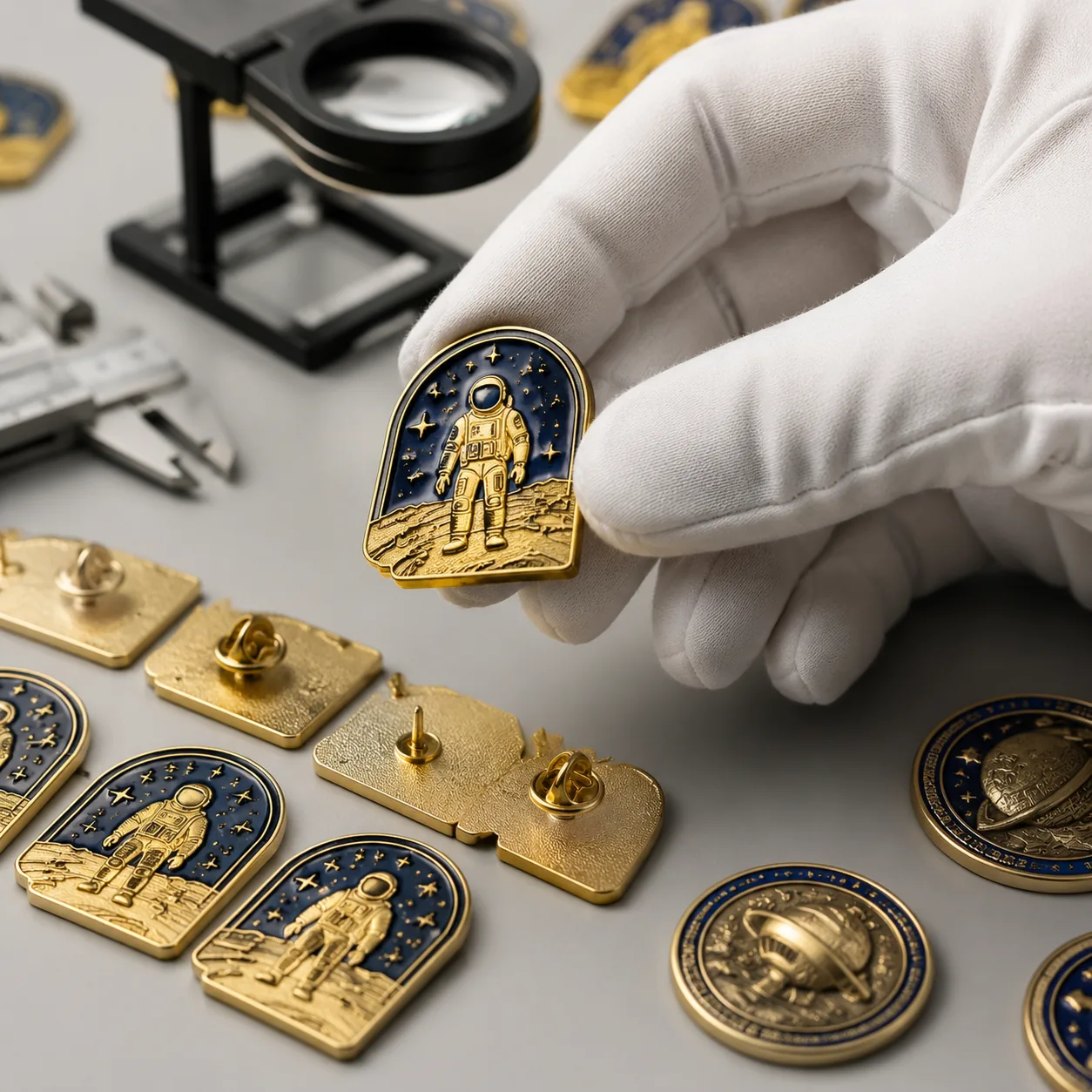
A distributor orders 5,000 soft enamel pins for a conference and approves a pre-production sample by photo. Air freight is booked for delivery ten days before the event. At final inspection, the shipment fails because 14 sampled pins have enamel specks near the plated border, two have loose posts and several backing cards are rotated. The factory calls the specks normal hand-finished variation; the buyer calls them brand damage. The real failure is not the speck itself. It is the missing inspection plan.
For custom metal promotional products, AQL is the acceptance rule that decides how many pieces are checked, which defects count as critical, major or minor, and whether the shipment can be released. AQL does not replace factory process control. It gives the buyer and factory a common pass/fail language before cartons are sealed.
Pins, coins, medals, magnets, keychains and brooches are small products with visible surfaces, plated finishes and assembled hardware. A tiny enamel pinhole may be acceptable on the back edge of a free event pin but unacceptable on the front logo of a $12 retail pin. A weak post weld, sharp burr or non-compliant material is not a cosmetic discussion at all; it is a zero-tolerance defect.
A practical AQL plan should fit the item value, end use and production method. At ZheCraft in Yiwu, typical FOB ranges for custom metal items are about $0.28 to $0.85 for basic soft enamel pins at 1,000 to 5,000 pieces, $0.75 to $2.20 for 40 to 50 mm challenge coins, and $0.45 to $1.60 for metal keychains depending on size, plating, enamel area and packaging. Retail programs justify tighter sorting than low-cost handouts because the buyer pays for fewer complaints, cleaner display and lower replacement risk.
Set AQL levels by risk and order value
Many purchase orders copy the same line: critical 0, major 2.5, minor 4.0 under general inspection level II. That is a workable default for many B2B promotional orders, but it should not be automatic. A child-facing keychain, a magnetic brooch worn on fabric, a collector coin and a low-cost trade show giveaway have different risk profiles.
Critical defects should normally be AQL 0, meaning any critical defect found in the sample can fail the lot. Examples include sharp burrs that cut skin, broken posts, loose magnets on child-facing items, banned material non-compliance, exposed rust, mold contamination, incorrect safety warning labels or hardware that detaches during a specified pull test. Major defects are failures that affect use, brand identity or saleability. Minor defects are small workmanship variations that do not affect function and are not obvious under the agreed viewing conditions.
For retail pins, boxed coins and paid merchandise, use critical 0, major 1.0 and minor 2.5. For corporate giveaways, critical 0, major 2.5 and minor 4.0 is usually balanced. For very low-cost event items below roughly $0.35 FOB, critical 0, major 2.5 and minor 6.5 may be commercially realistic, but only if the buyer accepts more cosmetic variation and keeps safety failures at zero tolerance.
| Use case | Suggested AQL | Inspection level | Typical FOB context |
|---|---|---|---|
| Retail enamel pin, coin or boxed gift | Critical 0, major 1.0, minor 2.5 | General level II with tighter cosmetic definitions | $0.80 to $3.50 per unit; rework buffer 3 to 7 days |
| Corporate giveaway pin or metal keychain | Critical 0, major 2.5, minor 4.0 | General level II | $0.35 to $1.50 per unit; normal rework buffer 2 to 4 days |
| Mass event handout under tight budget | Critical 0, major 2.5, minor 6.5 | General level I or II by buyer risk | $0.28 to $0.60 per unit; avoid premium finish requirements |
| Mixed kit with pins, patches, lanyards and cards | Critical 0, major 1.5 to 2.5, minor 4.0 | Inspect by SKU plus kit assembly audit | FOB varies; do not pool unlike components into one result |
Use ISO 2859 sample sizes correctly
Most buyers use ANSI/ASQ Z1.4 or ISO 2859-1 single sampling plans. The inspector first selects a sample size code from the lot quantity and inspection level, then applies the AQL accept/reject number. Buyers do not need to memorize the tables, but they should know the scale so the plan is not misunderstood.
For a 1,000-piece order under general inspection level II, the common sample size is 80 pieces. For 5,000 pieces, it is 200 pieces. For 20,000 pieces, it is 315 pieces. These samples are pulled randomly from finished, packed goods across cartons and SKUs. They are not a replacement for factory in-process checks during stamping, casting, polishing, plating, enamel filling, epoxy doming, assembly and packing.
| Lot size | Common sample size at general level II | Reject at AQL 2.5 major | Reject at AQL 4.0 minor |
|---|---|---|---|
| 501 to 1,200 pcs | 80 pcs | 6 or more major defects | 8 or more minor defects |
| 1,201 to 3,200 pcs | 125 pcs | 8 or more major defects | 11 or more minor defects |
| 3,201 to 10,000 pcs | 200 pcs | 11 or more major defects | 15 or more minor defects |
| 10,001 to 35,000 pcs | 315 pcs | 15 or more major defects | 22 or more minor defects |
Mixed orders need stronger rules. If an order contains 1,000 gold-plated pins, 1,000 nickel-plated pins and 1,000 black nickel pins, sampling only from the combined 3,000-piece lot can hide a plating-specific problem. A safer plan is to sample each finish separately or set a minimum of 50 to 80 pieces per SKU for visual, hardware and packaging checks. For kits, inspect both individual components and final assembly ratio; a perfect pin is still a defect if packed with the wrong backing card or lanyard.
Define measurable cosmetic and dimensional limits
AQL fails when defect descriptions are vague. “Bad plating,” “poor enamel” and “acceptable color” create arguments. Use measurable limits tied to viewing distance, lighting, location and severity. For most front-face cosmetic checks, specify 30 cm viewing distance under D65 or cool white 6000K to 6500K light. For carton and outer packaging checks, 50 cm is usually enough. Avoid mixed yellow warehouse light because it changes the appearance of gold plating, black nickel and transparent enamel.
For enamel pins and badges, major defects should include wrong attachment, missing or loose post, wrong plating color, enamel missing in any cavity, visible base metal on the front face, incorrect logo, unreadable text at 30 cm, or Pantone color outside the approved sample under the agreed light. Minor defects may include one polishing hairline under 3 mm outside the logo area, one enamel pinhole under 0.25 mm away from text, or enamel underfill within 0.15 mm that does not expose metal. A front-face black spot over 0.3 mm should normally be major on retail goods and minor only on low-cost giveaways if it is outside the logo area.
For coins and medals, define diameter, thickness and edge tolerances. Die-struck brass or iron coins are commonly held to ±0.20 mm diameter and ±0.15 mm thickness for 2 to 4 mm products. Die-cast zinc alloy keychains may need looser dimensional tolerance, such as ±0.30 mm on outline, because casting shrinkage and polishing remove material unevenly. Plating thickness for promotional items is often in the 3 to 8 micron range for nickel, brass or imitation gold finishes, while premium anti-tarnish or real gold plating should be specified separately because cost changes sharply.
- Confirm viewing distance: 30 cm for front faces, 50 cm for packaging and carton marks.
- Confirm lighting: D65 or 6000K to 6500K cool white, not mixed warehouse light.
- Separate front-face, back-face and edge criteria because users notice them differently.
- Set hard limits for pinholes, scratches, exposed metal, color deviation and unreadable text.
- Attach approved artwork, Pantone codes, plating finish, packaging dieline and golden sample photos.
- Do not average safety or functional failures into cosmetic AQL results.
Add functional tests for hardware and safety
Many claims on pins, coins and keychains are caused by hardware failure rather than appearance. A pin can pass a front-face cosmetic check and still fail because the post snaps off. A keychain can look clean but open at the jump ring after one week. Functional checks should be written as pass/fail tests with sample quantities stated separately from the visual AQL sample.
For lapel pins, specify a post pull test of 2 kg for 10 seconds on standard posts when the design allows it. Heavy brooch bars or large badges may require 3 kg, but small cast designs with thin walls should be reviewed during sampling so the test does not destroy an otherwise suitable design. Butterfly clutches should close without bent wings, rubber clutches should grip without sliding off under finger pressure, and safety pins should not have exposed sharp tips when locked.
For keychains, test split rings, jump rings, chains, lobster clasps and swivels. A practical factory test is 5 kg static pull for 10 seconds on metal keychains above 30 mm, and 3 kg for small acrylic, PVC or lightweight attachments. Split ring gaps after flexing should be under 0.3 mm; jump rings should have no visible opening over 0.2 mm. Swivels should rotate freely without jamming or plating flakes.
For magnets and magnetic brooches, check polarity, adhesive bond and holding force on a standard painted steel plate or a defined fabric thickness such as 1.0 to 1.5 mm cotton/polyester. Do not test only on bare workshop machinery, which can make weak magnets appear stronger than they are. Any magnet that detaches during normal handling should be treated as a major defect, and as critical if the item is child-facing or the destination market requires small-parts controls.
Schedule inspection before cartons are sealed
Inspection timing should be written into the purchase order before production starts. Final random inspection is usually performed when 100% of goods are produced and at least 80% are packed in export cartons. If inspection happens before packing, the inspector cannot verify carton marks, inner quantity, backing card orientation, barcode placement or mixed-SKU ratio. If inspection happens after cartons are sealed and palletized, opening and reworking cartons can add 1 to 3 days.
A realistic schedule for enamel pins and die-struck coins is sample approval on day 7 to 12, bulk production from day 12 to 25 for common 1,000 to 5,000 piece orders, final inspection 2 to 4 days before pickup, and shipment release after any corrective action. Die-cast keychains, epoxy doming, spinning parts, serial numbering, gift boxes or mixed kits may add 3 to 7 days. Large orders above 20,000 pieces often need staged production and inspection by SKU or by finish.
Rush orders should not remove inspection completely. If the event date cannot move, use a reduced but targeted plan: verify critical defects, hardware strength, quantity, logo color, carton marks and packaging ratio. ZheCraft can usually reserve an internal final QC slot with 3 working days of notice after production timing is confirmed. Third-party inspections in Yiwu, Ningbo, Hangzhou or nearby Zhejiang cities often need 3 to 5 working days of booking time, plus one day for report issue.
Inspect packaging with the same discipline as the product
Packaging errors create warehouse problems even when the item is acceptable. Wrong backing cards, missing barcodes, mixed colors, weak cartons or incorrect inner quantities can delay receiving and create repacking costs in the destination country. The inspection plan should cover unit packing, inner packing, master cartons and shipping marks.
For individual packaging, define material, orientation and count. Standard giveaway polybags are often 0.03 to 0.05 mm OPP. Retail bags may need 0.06 mm or thicker material, resealable adhesive, printed suffocation warnings or country-specific labeling. Backing cards are commonly 250 to 300 gsm for event pins and 300 to 400 gsm for retail pins. A pin mounted on a card should sit within ±5 degrees of the approved orientation unless the artwork specifies an intentional angle.
For cartons, use 5-ply corrugated board for most metal goods. Keep gross weight under 15 kg for courier parcels where possible; use 20 kg only if the buyer accepts heavier handling and stronger cartons. Carton dimension tolerance of ±10 mm is usually practical, while inner quantity should be exact unless a written over/under allowance is approved. Carton drop testing is useful for heavy coins, magnets and boxed kits: one corner, three edges and six faces from 60 cm for cartons under 10 kg is a practical check. If retail boxes, acrylic windows or epoxy domes are used, inspect scuffing and crushed corners after the drop.
Budget for tighter QC and rework time
Stricter inspection affects cost and schedule. AQL 1.0 major and 2.5 minor requires more sorting than AQL 2.5 and 4.0. For a 5,000-piece enamel pin order, tighter front-face cosmetic sorting can add 1 to 2 production days and about $0.01 to $0.04 per piece when the design has mirror gold, large polished areas, transparent enamel or high-contrast black plating. Third-party inspection in Zhejiang commonly costs about $180 to $320 per man-day FOB-side, depending on agency, location, checklist depth and photo reporting.
Rework has a bigger schedule impact than inspection. Replacing weak pin posts may take 2 to 4 days for 5,000 pieces if spare hardware is available. Repacking wrong backing cards may take 1 to 2 days if cards are printed and in stock. Replating is serious: stripping and replating can add 5 to 10 days, and it may soften detail, darken recesses or damage enamel. The best control is early checking after plating and before enamel filling or final assembly.
The purchase order should include a one-page QC appendix covering product specification, golden sample reference, AQL levels, defect definitions, functional tests, packaging checks, inspection timing, reinspection cost responsibility and release authority. Ask the factory to comment before tooling or sample approval. If a requirement is unrealistic, such as zero micro-scratches on mirror nickel or ±0.05 mm thickness on a die-cast zinc keychain, it is better to resolve the limit before production than during final inspection.
For ZheCraft orders, the most useful inputs are quantity by SKU, target FOB, destination country, retail or giveaway use, packaging plan, safety requirements and any nickel-free or lead/cadmium limits. With those details fixed, AQL becomes a controlled part of production instead of a last-minute argument at the loading dock.
Have a project? Send your artwork and target quantity and we’ll reply with a detailed quotation within 12 working hours.
Ready to get this made?
Send your sketch, target quantity and ship-date. Detailed quotation in 12 hours.



