AQL Inspection for Custom Pins: Buyer Scenario and Factory Rules
Buyer scenario: 20,000 event pins with no recovery window
A European event organizer orders 20,000 soft enamel lapel pins for a three-day conference. The specification is clear: 30 mm wide, iron stamped, 1.5 mm base thickness, black nickel plating, six Pantone enamel colors, one butterfly clutch, one custom backing card and one OPP bag per piece. The supplier has 24 calendar days for production, 3 days for final inspection and consolidation, then air freight to the venue.
The commercial risk is not a completely failed batch. The more common risk is 2% to 5% visible or functional defects: enamel dust in the logo, loose clutches, scratched black nickel, tilted backing cards, short counts or mixed cartons. At 20,000 pieces, a 2% defect rate means 400 problem units. That is enough to slow registration desks, create complaints and force staff to sort pins during the event.
The buyer should not write only “good quality before shipment” in the purchase order. That phrase gives the factory and inspector no measurable decision rule. A workable order defines the inspection lot, AQL levels, defect classes, dimensional tolerances, packaging checks and rework rules before mass production starts.
Lot setup and sampling level
The first decision is whether the 20,000 pieces are inspected as one lot or split by design, finish or packing method. In this case there is one design, one plating finish, one card and one attachment, so one inspection lot is reasonable. If the same purchase order covered 10 designs at 2,000 pieces each, each design should be treated as a separate lot because mold wear, enamel filling and plating defects do not spread evenly across designs.
Most third-party inspectors in China use ANSI/ASQ Z1.4 or ISO 2859-1 logic for this type of promotional metal product. A normal setting is General Inspection Level II for visual and functional checks. For a 20,000-piece lot, code letter M commonly gives a 315-piece sample under normal inspection. The buyer then applies agreed AQL limits to that sample.
Dimensional checks should be separated from visual checks. It is practical to inspect 315 pieces for appearance, attachment and packing, but measure only 20 to 50 pieces with calipers for width, thickness, pin post position and card size. Measuring all 315 units adds time without changing most pass/fail decisions.
| Order situation | Recommended lot setup | Inspection reason |
|---|---|---|
| 20,000 pieces, one design and one packing method | One inspection lot | Fast sampling with one clear pass/fail result |
| 5 designs at 4,000 pieces each | Five inspection lots | Prevents one bad mold or enamel batch from being hidden in the total average |
| Same design, gold and black nickel finishes | Separate lots by plating finish | Gold, nickel and black nickel show different scratch, tone and rack-mark risks |
| Pin, coin, patch and lanyard in one order | Separate lots by item type | Metal, textile and cord products need different defect definitions |
| Reorder from approved tooling | Same lot rules plus golden sample comparison | Confirms drift in plating tone, enamel level, thickness and attachment strength |
Defect classes and AQL numbers
Defect classes must be written before inspection. For custom pins, a critical defect is a safety, legal or brand-blocking issue. A major defect affects use, appearance or saleability. A minor defect is noticeable but unlikely to cause rejection by the end user during normal handling.
For this event order, critical defects include sharp burrs over 0.2 mm on a touchable edge, exposed needle-like metal, pin posts that detach under light pull, mold contamination embedded in the front enamel, wrong logo, wrong event name or offensive artwork. Major defects include missing enamel, wrong attachment, plating peel, deep front scratches longer than 3 mm, color outside the approved standard, reversed card orientation or carton/SKU mix-up. Minor defects include small rear-side plating marks, slight card corner pressure or isolated enamel specks under 0.3 mm outside the main logo area.
A realistic AQL setting for B2B promotional pins is critical 0.0, major 2.5 and minor 4.0 under General Inspection Level II. For a 315-piece sample, many Z1.4 tables give acceptance numbers around 14 major defects at AQL 2.5 and 21 minor defects at AQL 4.0, with rejection at the next number. Buyers should confirm the exact accept/reject numbers with the inspection agency because tables vary by standard edition and inspection severity.
- Use critical AQL 0.0 for unsafe edges, wrong artwork, detached posts, contaminated surfaces or banned-material risks.
- Use major AQL 2.5 for most event and promotional pins where visible brand defects cannot be accepted.
- Use major AQL 1.5 for retail, museum, licensed or premium merchandise with stricter shelf appearance requirements.
- Use minor AQL 4.0 for acceptable cosmetic variation such as small rear marks or light card pressure.
- Do not downgrade a safety defect to major only because the shipment is urgent.
Golden sample, tolerances and material limits
The approved pre-production sample anchors the inspection. It should match the final mold, base metal, plating finish, enamel type, epoxy choice if any, attachment, backstamp, backing card, barcode and polybag. Photo approval helps speed communication, but it cannot verify plating tone, enamel height, edge feel, clutch tension or total weight.
For the 30 mm iron soft enamel pin, the buyer approves measurable tolerances: overall width 30.0 mm ±0.3 mm, base metal thickness 1.5 mm ±0.15 mm, pin post position ±1.0 mm from the drawing, card size ±1.0 mm, and total finished weight ±8% against the golden sample. Quantity per export carton has zero tolerance for short shipment. If the carton says 200 pieces, it must contain 200 sellable packed units.
Decorative black nickel on promotional pins is normally a thin finish, often around 0.05 to 0.10 microns over a prepared base layer. That is suitable for indoor events, awards and giveaways, but it is not a corrosion-resistant outdoor coating. If the pin must meet stronger wear or salt-spray expectations, the buyer should specify the test condition, such as 24-hour neutral salt spray, and expect higher cost, longer lead time and possible color differences.
Color approval also needs boundaries. Pantone enamel should be checked under D65 daylight or a controlled light box, not under yellow warehouse lighting. For flat solid enamel colors, a visual tolerance similar to Delta E 2 to 3 is often achievable, but metallic plating reflection and enamel curing behavior make the physical golden sample the final reference.
In-process checks before final inspection
Final inspection should not be the first serious quality check. For a 20,000-piece batch, the factory should check stamped blanks, polishing, plating, enamel filling, soldering and packing before calling the inspector. A pin with torn edges or broken text should not wait until it has already been plated, filled, carded and bagged.
Stamping control matters because small metal lines define the enamel areas. For a 30 mm iron pin, the outside profile should usually stay within ±0.2 to ±0.3 mm if the shape is not highly complex. Raised metal borders should be at least 0.3 mm wide for standard soft enamel. Thinner lines can break during stamping, lose definition during polishing or allow enamel bleed.
Soft enamel should sit slightly below the raised metal rim, typically 0.05 to 0.20 mm lower. Hard enamel is polished flush and is less forgiving because over-polishing can flatten detail or expose uneven plating. Black nickel also shows fingerprints, water marks and front scratches more readily than bright nickel, so rack handling and drying need tighter control.
| Checkpoint | Typical factory sample | Acceptable target | Reject trigger |
|---|---|---|---|
| Stamped blank | 30 to 50 pieces per press setup | Outline within ±0.3 mm; no torn edges | Bent shape, broken text or burr over 0.2 mm |
| Polishing | 30 pieces per polishing batch | Smooth front with fine detail retained | Rounded logo lines or uneven shine |
| Plating | 50 pieces per rack batch | Consistent tone; no front peel, bubbles or water stains | Rack marks on the front face or plating lift |
| Enamel filling | 50 pieces per color batch | Correct color, clean border, no overflow | Wrong Pantone, missing fill or dust in main logo |
| Attachment soldering | 50 pieces per solder batch | Post within ±1.0 mm and secure under light pull | Loose, tilted or off-center post |
| Packing line | First 100 pieces, then hourly | Correct card, orientation, bag and carton count | Mixed SKU, reversed card or short carton |
Final inspection: cartons, lighting and functional checks
When production and packing are complete, the inspector should select cartons randomly across the finished lot, not only from cartons near the loading door. If the order is packed 200 pieces per export carton, there are 100 cartons. A practical inspection may open 8 to 13 cartons and pull units from the top, middle and bottom of selected cartons to avoid sampling only the best-packed layer.
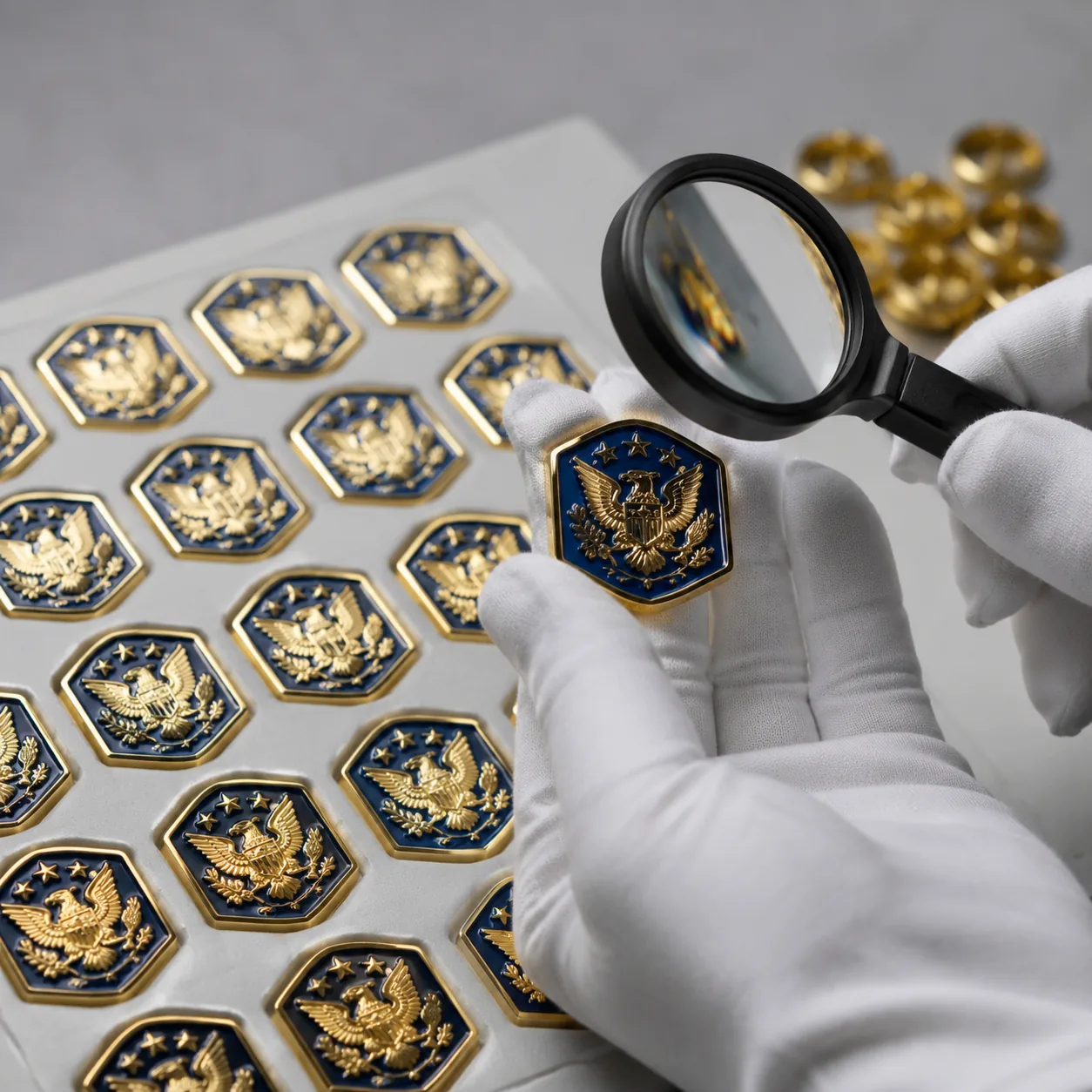
Cosmetic inspection should use stable lighting, ideally 600 to 1,000 lux, with the pin viewed from about 30 to 40 cm. Magnifiers are useful to confirm a suspected defect, not to create unrealistic standards. Decorative metal pins have microscopic pores and polishing marks; the inspection standard should focus on defects visible during normal customer use.
Functional checks are essential. The inspector should attach and remove the butterfly clutch several times, confirm that it grips the 0.9 to 1.0 mm post securely, and check that normal removal does not detach the post or bend the card. For double-post pins, both posts must align with the card holes and the pin should not rotate excessively.
Carton checks should include export carton marking, gross weight, carton dimensions, inner quantity, moisture damage, barcode or SKU label, and packed orientation. For event shipments, mixed cartons and short counts are often more damaging than small cosmetic defects because they are discovered only when volunteers open cartons at the venue.
Rework decisions without losing the shipment
Assume the inspector checks 315 pins and finds zero critical defects, six major defects and ten minor defects. Under a typical critical 0.0, major 2.5 and minor 4.0 plan, that result would usually pass. If the same sample contains one sharp exposed burr or one wrong logo, the lot fails regardless of the major and minor totals.
The buyer should follow the agreed AQL result, then look at defect distribution. If the major defects are concentrated in loose clutches from one packing shift, the factory can replace clutches and recheck that portion. If the wrong enamel color appears across the whole lot, sorting will not solve the issue; the realistic choices are remake, discount with written concession or rejection.
Rework timing must be realistic. Manual sorting for card orientation, polybag damage or mixed clutches may take 1 to 2 working days for 20,000 pieces. Clutch replacement and retesting may take 2 to 4 days. Stripping and replating can take 5 to 10 days and may damage fine details, so it is not always recommended. Remaking from existing stamped blanks may take 7 to 12 days; remaking from new tooling can take 15 to 25 days depending on mold complexity and plating queue.
- Accept the lot when defects are within agreed AQL and no safety, legal or brand-critical issue is present.
- Sort and replace when defects are limited to clutches, cards, polybags, cartons or one identifiable production shift.
- Reject or remake when the defect affects the logo, mold, size, plating finish or user safety.
- Avoid hand rework that creates worse damage, such as scraping enamel overflow or over-polishing black nickel.
- Record every concession in writing so the same defect is not treated as approved quality on the next reorder.
Cost, MOQ tiers and RFQ wording
Inspection has a cost, but failed distribution is usually more expensive. Factory internal final inspection is normally built into the FOB unit price. A third-party inspection in China often costs about USD 180 to 350 per inspector-day, depending on city, travel, report format and product complexity. For a 20,000-piece order, one inspector-day adds roughly USD 0.01 to 0.02 per pin.
Typical FOB pricing for 25 to 35 mm iron soft enamel pins ranges from about USD 0.45 to 1.20 per piece at 1,000 to 10,000 pieces, depending on size, plating, number of colors, epoxy, attachments and packing. At 20,000 pieces, a simple event pin may fall near USD 0.38 to 0.75 FOB China if tooling is not unusually complex. Hard enamel, zinc alloy casting, double posts, serial numbering, custom retail cards or FSC paper packaging can move the range above USD 0.80 to 1.60.
MOQs vary by factory, but common production tiers are 100 to 300 pieces for sample or rush orders, 500 pieces for economical custom production, 1,000 pieces for better unit pricing, and 5,000 to 20,000 pieces for stable batch production and cartonized export packing. Normal lead time is often 7 to 10 days for artwork and sample approval, 12 to 18 days for mass production of soft enamel pins, and 2 to 4 days for final inspection, sorting and export preparation. Complex plating, hard enamel polishing or retail packaging can add 5 to 10 days.
The RFQ should include a one-page inspection appendix: lot structure, AQL levels, defect classes, golden sample requirement, tolerances, lighting condition, carton checks, rework rules and shipment deadline. For this order, the starting point is critical AQL 0.0, major AQL 2.5, minor AQL 4.0, General Inspection Level II, width ±0.3 mm, thickness ±0.15 mm, post location ±1.0 mm and zero tolerance for carton short count.
Send the supplier the artwork, quantity, required delivery date, packing method, destination country and product use case: event giveaway, retail item, uniform badge or children’s product. A vertically integrated manufacturer such as ZheCraft can then align tooling, plating, enamel, attachment, packing and internal QC around the same written standard. The goal is not to reject more goods; it is to make pass, fail and rework decisions predictable before the pins leave China.
Have a project? Send your artwork and target quantity and we’ll reply with a detailed quotation within 12 working hours.
Ready to get this made?
Send your sketch, target quantity and ship-date. Detailed quotation in 12 hours.



