Anti-Rotation Specs for Pins, Coins and Magnets
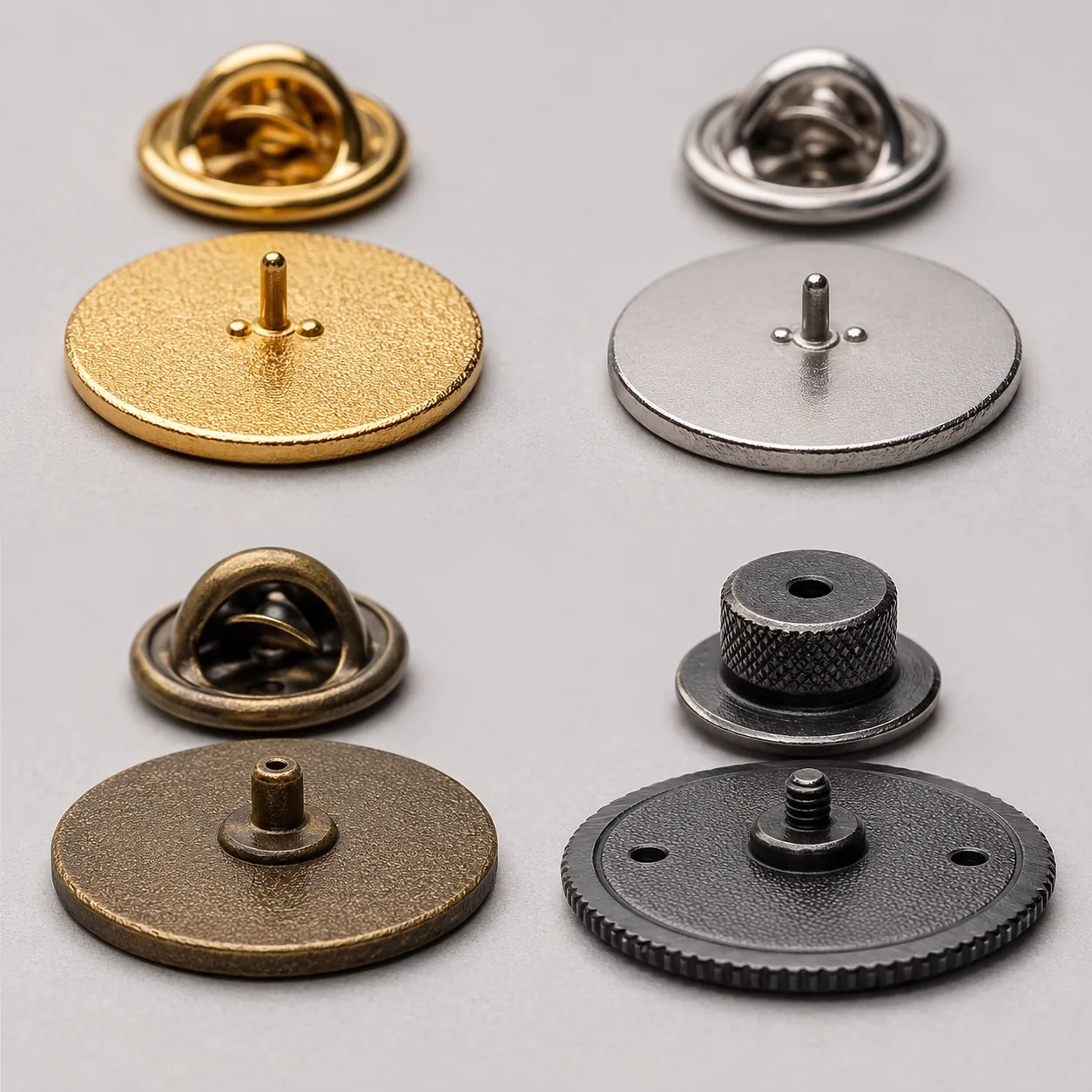
The Failure Mode: Correct Product, Wrong Orientation
A pin, badge, coin charm or magnet can pass artwork, plating, color and packaging inspection but still fail in use because it rotates. The common cases are vertical logos, shield shapes, flags, character pins with heavy heads, long keychains, bottle-opener charms and magnets with off-center mass. This is rarely a casting or stamping defect. It is usually a balance, attachment and inspection-spec defect that was not fixed before tooling.
The end user judges the item while wearing or mounting it, not while it lies flat on an inspection table. A 35 mm enamel pin that rotates 25 to 30 degrees on a blazer looks careless even if the enamel fill is clean. A 60 mm × 40 mm fridge magnet with the magnetic sheet placed 5 mm above the true balance point may hold on a steel plate but tilt on a powder-coated refrigerator door.
Factory-ready anti-rotation specs define the attachment layout, balance point, hardware dimensions, tolerances, pull or holding requirements, MOQ impact and inspection method. For ZheCraft production reviews, these details are checked before mold cutting because moving posts, loops or magnet cavities after sampling can require a revised mold, new soldering fixture or additional adhesive process.
Use the Center of Gravity, Not the Artwork Center
The artwork center is the midpoint of the drawing. The center of gravity is where the finished item balances after metal thickness, enamel, cutouts, epoxy, plating and hardware are included. On a 40 mm product, a mascot head, waving flag, asymmetric shield or large cutout can shift the balance point by 3 mm to 12 mm. That shift is enough to make a visually centered post behave like a pivot.
For stamped iron, brass or zinc alloy pins from 25 mm to 45 mm, one post can be stable when it sits within ±1.5 mm of the measured balance point and the finished weight is below about 8 g. From 40 mm upward, or above 10 to 12 g, the design should be reviewed for two posts, a bar magnet or a wider backing. Above 45 mm or 14 g, two fixation points should be the default unless the shape is symmetric and worn only on thick fabric.
The RFQ should not say only “standard pin back.” A usable instruction is: “Supplier to mark proposed post position on proof based on balance point; post location tolerance ±1.0 mm from approved proof; front top and back top orientation to be marked.” This forces the factory to solve orientation before tooling instead of placing posts where soldering is easiest.
Attachment Layouts That Stop Rotation
A single round fixing point holds the product on the garment or surface, but it does not stop rotation. Anti-rotation comes from two fixing points, a larger contact area, a non-round magnetic footprint, a shaped backing, friction, or a mechanical stop. The right choice depends on product size, finished weight, fabric thickness, safety requirements and unit price target.
For enamel pins, two posts are the most reliable layout for vertical logos, flags, awards and asymmetrical badges from 35 mm to 70 mm. Common post diameter is 1.0 mm to 1.2 mm, with 7 mm to 8 mm usable post length. Center-to-center spacing should normally be 16 mm to 28 mm. Spacing under 12 mm gives weak anti-rotation leverage; spacing over 32 mm can be uncomfortable on curved clothing and harder for users to align.
Magnetic backs reduce fabric damage but are not automatically anti-rotation. One round magnet allows spinning. For brooches, specify two disc magnets, one rectangular bar magnet, or a magnetic plate. Disc magnets are often 10 mm to 15 mm diameter and 2 mm to 3 mm thick; bar magnets are commonly 25 mm to 35 mm long and 2 mm to 3 mm thick. For fridge magnets, coverage area and placement usually matter more than headline magnet strength.
| Product type | Weak anti-rotation spec | Factory-ready anti-rotation spec | Typical FOB impact |
|---|---|---|---|
| 30 mm enamel pin | One post at visual center | One 1.0 mm post within ±1.0 mm of balance point | USD 0.00 to 0.02 |
| 45 mm enamel pin | One post with butterfly clutch | Two 1.0 mm posts, 18 to 24 mm spacing | USD 0.04 to 0.08 |
| 55 mm brooch | Single round magnet | Two 12 mm × 2 mm disc magnets or one 30 mm bar magnet | USD 0.12 to 0.28 |
| 60 mm fridge magnet | One 20 mm round magnet | Full-back 0.5 mm to 0.8 mm magnetic sheet, centered to outline | USD 0.08 to 0.22 |
| PVC patch | Plain sew-on edge only | Hook backing plus top orientation mark and merrowed or heat-cut edge | USD 0.05 to 0.15 |
Pin, Brooch and Badge Specs to Lock
For enamel pins and badges, lock post count, post position, clutch type, post dimensions and finished weight. A 25 mm soft enamel pin weighing 3 g to 5 g can normally use one post. A 40 mm hard enamel pin weighing 8 g to 12 g needs balance review, especially when the top half carries more metal. A 50 mm badge with epoxy can gain 1 g to 3 g after doming, so rotation should be tested after epoxy cure, not before.
Post position tolerance should be ±1.0 mm for normal promotional production. Use ±0.5 mm only when a fixture, molded recess or paired hole requires it. Tighter than ±0.5 mm is not practical for most hand-soldered pins at commercial pricing. Post perpendicularity should be controlled as well: reject posts leaning more than 5 degrees, posts with incomplete solder around more than one-third of the base, or posts that detach under a 2 kg straight pull test unless a different buyer standard is agreed.
Clutch choice affects rotation and loss rate. Butterfly clutches are economical at about USD 0.03 to 0.06 each FOB but can loosen on thin fabric. Rubber clutches add friction and wearer comfort at about USD 0.04 to 0.08 each, though they may look less formal. Locking clutches reduce loss on uniforms and event wear, usually USD 0.18 to 0.35 each, but take longer to attach when staff distribute hundreds of pieces.
- Specify finished size in millimeters and expected finished weight in grams.
- Mark front top, back top and readable-logo direction on the proof.
- Require post, magnet or loop positions on the digital proof before tooling.
- Use two posts for asymmetrical pins above 35 mm wide or above 12 g.
- Set post location tolerance at ±1.0 mm unless a mating fixture requires ±0.5 mm.
- Request wear photos on 1 mm to 2 mm fabric, not only flat desk photos.
- Confirm clutch type, post diameter, post length and spare clutch percentage in the PO.
Fridge Magnets: Control Sliding and Tilting Separately
A fridge magnet can slide down or tilt out of level. Sliding means holding force is too low for the product weight and surface. Tilting means the magnetic footprint is too small, off-center or too far from the product edges. A stronger small magnet may still tilt if it is placed near the top of a tall design.
For souvenir and promotional magnets from 50 mm to 80 mm, a full-back flexible magnetic sheet is usually more stable than one or two small inserted magnets. Typical sheet thickness is 0.5 mm for paper, thin acrylic or PVC magnets; 0.7 mm for resin or soft PVC; and 0.8 mm to 1.0 mm for heavier zinc alloy or multi-layer acrylic designs. For a 65 mm zinc alloy magnet weighing 35 g to 45 g, one or two 10 mm disc magnets are high risk unless they are placed near the balance point and supported by a wide backing.
Define the test surface instead of accepting “strong magnet” as a claim. A practical factory method is to place the sample on a vertical painted steel plate for 24 hours at 20 °C to 25 °C, then tap the plate three times and check for sliding or rotation. For heavier products, specify no visible slide greater than 2 mm and no rotation greater than 10 degrees. Stainless-look, powder-coated and curved surfaces should be treated as risk surfaces because they reduce real holding performance.
Keychains, Lanyards and Coin Charms
Keychains rotate because the attachment point acts as a pivot. If the loop is centered visually but not mechanically, the item hangs crooked from the split ring, lobster clasp or short chain. This is common on hotel tags, brand mascots, medals, bottle openers and challenge coins converted into wearable charms.
For metal keychains, the hole or loop should sit on the true hanging axis, verified by suspending the pre-production sample from the final hardware. Hole diameter is commonly 2.0 mm to 3.0 mm for small jump rings and 3.5 mm to 5.0 mm for heavier fittings. Minimum edge distance should normally be 1.2 mm for zinc alloy and 1.5 mm for iron or brass; thinner walls can crack, deform or wear through during assembly.
For lanyard badges and PVC charms, one top-center hole works only when the shape is balanced. Wide badges should use two holes spaced 40 mm to 70 mm apart and connect to a double-ended lanyard or two hooks. The added hardware typically costs USD 0.05 to 0.18 per set, but it prevents flipping on staff credentials, VIP passes and sponsor-logo badges where front-facing orientation is part of the product requirement.
| Item | Recommended anti-rotation layout | Tolerance to specify | Avoid when |
|---|---|---|---|
| Small keychain under 35 mm | Single top loop on verified hanging axis | Loop position ±0.8 mm | Shape is strongly asymmetrical |
| Large keychain 45 to 70 mm | Offset loop adjusted after balance review | Loop position ±1.0 mm | Brand requires a visual-center loop |
| Event badge 80 to 100 mm wide | Two-hole lanyard attachment | Hole spacing ±1.5 mm | Users need one quick single-clip point |
| Soft PVC charm | Molded loop with 2.5 mm to 4.0 mm hole | Hole diameter ±0.3 mm | Loop wall is under 1.5 mm |
| Metal bottle opener | Integrated loop tested under hanging and opening load | Functional opening tolerance ±0.2 mm | Loop is decorative and not load-tested |
Sampling and QC Tests That Catch Rotation
Anti-rotation cannot be approved from a flat product photo. Pins must be tested on fabric with the final clutch. Magnets must be tested on a vertical metal surface. Keychains must hang from the actual ring, chain and clasp. Patches must be checked on the intended garment, hook panel or sew line.
For incoming inspection, use AQL 2.5 for major defects and AQL 4.0 for minor cosmetic defects, unless the buyer requires a stricter plan. Treat rotation as major when brand orientation is affected. On pin lots, inspect post count, post position, post straightness, solder coverage and clutch fit. On magnet lots, inspect magnet thickness, placement, adhesive coverage, cure time and vertical holding performance.
Adhesive-cured magnet products should not be packed immediately after gluing. Depending on adhesive and room temperature, allow 12 to 24 hours before vertical hold testing. Epoxy-coated items should be rotation-tested after full cure because final weight and surface friction can change. Keep a signed pre-production sample at the factory and one with the buyer so inspectors can compare orientation, hardware and balance point during production.
- Hang-test pins on 1 mm to 2 mm woven fabric for at least 30 minutes.
- Reject pins that rotate more than 15 degrees from vertical during normal handling.
- Test magnets on a vertical painted steel plate for 24 hours before packing.
- Check keychains with final split ring, chain length and clasp, not substitute hardware.
- Measure two-post spacing with calipers on at least five pieces per inspection lot.
- Record front and back orientation photos for the approved sample file.
- Hold adhesive magnet assemblies 12 to 24 hours before final vertical testing.
Cost, MOQ and Lead-Time Trade-Offs
Anti-rotation features add cost, but the increase is usually smaller than rework, air freight or customer returns. Moving a single post before tooling is often free. Adding a second post and clutch typically adds USD 0.04 to 0.08 per unit. Changing from small disc magnets to full-back magnetic sheet can add USD 0.08 to 0.22 per piece depending on size, thickness and lamination method.
MOQ affects the economics. Custom metal pins often start at 100 pieces per design, but hardware upgrades are more efficient at 500 or 1,000 pieces. Full-back magnetic sheet is usually more cost-effective from 300 to 500 pieces because die cutting and lamination setup are spread across more units. Double-hook lanyard badge assemblies normally become efficient around 500 pieces.
Lead time changes most when the anti-rotation solution alters the mold. Normal sample lead time for metal pins and keychains is about 7 to 10 days after artwork approval, with mass production around 12 to 20 days depending on quantity, plating and enamel process. Moving posts, loops or magnet cavities after sample approval can add 3 to 7 days plus tooling charges. Rush orders should avoid experimental hidden magnets, hinges or unusual cavities unless the buyer accepts higher QC risk.
| Anti-rotation change | FOB unit cost range | MOQ impact | Lead-time impact |
|---|---|---|---|
| Move single pin post before tooling | USD 0.00 to 0.02 | No MOQ change | No delay at proof stage |
| Add second pin post and clutch | USD 0.04 to 0.08 | Works from 100 pcs | 0 to 1 extra day |
| Upgrade to locking clutch | USD 0.18 to 0.35 | Often from 100 pcs | Usually no tooling delay |
| Use full-back magnetic sheet | USD 0.08 to 0.22 | Best from 300 to 500 pcs | 1 to 3 extra days |
| Add two-hole lanyard badge setup | USD 0.05 to 0.18 | Best from 500 pcs | 1 to 2 extra days |
| Revise loop or cavity after sampling | Depends on mold change | MOQ unchanged, tooling may apply | 3 to 7 extra days |
Approve the Mold Only After Orientation Is Proven
Before approving any custom item that must face a fixed direction, add an orientation section to the RFQ, artwork proof and purchase order. Do not leave post placement, magnet size or loop position to “factory standard” unless the product is symmetric, lightweight and low risk. A clear requirement is: “Supplier must propose anti-rotation attachment layout on proof and confirm performance with physical sample test.”
Ask for three quotation-stage details: proposed attachment drawing, expected finished weight and recommended anti-rotation method with cost difference. For a 40 mm asymmetrical enamel pin, compare one post against two posts before sampling. For a 70 mm fridge magnet, compare disc magnets against 0.7 mm or 0.8 mm full-back magnetic sheet. For a hanging keychain, request a short video of the sample suspended from final hardware.
When ordering from ZheCraft, send front artwork, target size, expected use, attachment preference, garment or surface type and packaging limits. The engineering team can mark balance points, post positions, magnet coverage and hole locations on the production proof before tooling. The cheapest time to prevent rotation is before the first mold is cut; after sampling, every correction costs time, money or visual compromise.
Have a project? Send your artwork and target quantity and we’ll reply with a detailed quotation within 12 working hours.
Ready to get this made?
Send your sketch, target quantity and ship-date. Detailed quotation in 12 hours.



