Air vs Sea Shipping Failures in Custom Metal Orders
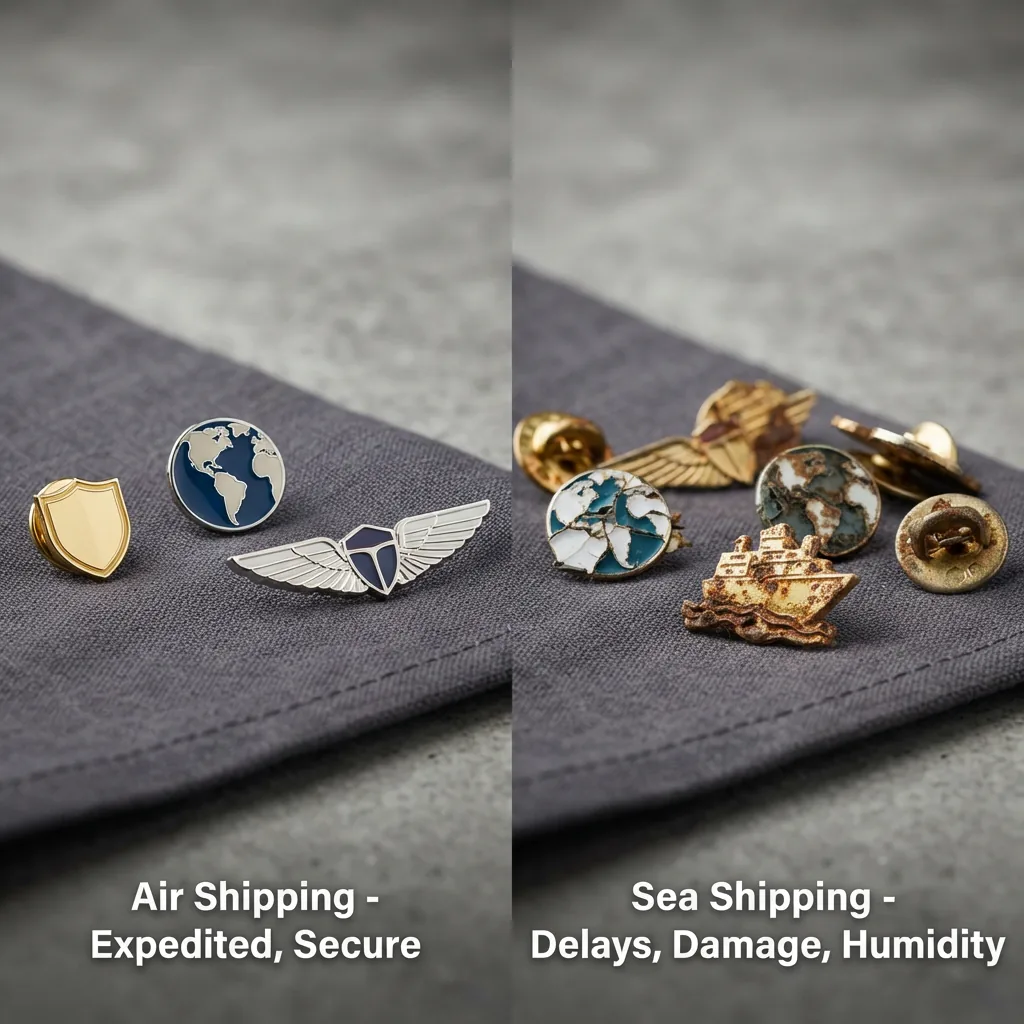
Lock freight mode at PO stage because it changes product spec, packing spec, and schedule math
Air versus sea is not a booking choice to leave until after sample approval. In custom pins, keychains, challenge coins, fridge magnets, medals, and mixed badge sets, freight mode changes the correct carton spec, inner-pack quantity, moisture protection, acceptable finish choice, labeling, documentation flow, and the amount of real process buffer the factory has. If buyers decide the lane after goods are finished, the factory often compensates with bad trade-offs: overfilled cartons, thinner bags, shortened cure times, rushed export documents, and invoices prepared to the wrong Incoterm or declaration logic.
The timing math is usually clear enough to decide at PO stage. A normal custom metal order needs about 12 to 18 calendar days for production after pre-production sample approval at 500 to 3,000 pcs, and 18 to 25 days at 3,000 to 10,000 pcs if there are multiple finishes, backing cards, gift boxes, or hand assembly steps. Add 2 to 4 days for packing and final inspection, plus 2 to 5 days for export documents and cargo handoff. Express air typically adds 3 to 7 days door-to-door on major lanes, standard air 5 to 10 days, and ocean freight 18 to 35 days port-to-port, with another 5 to 12 days commonly lost to customs, port handling, devanning, and final delivery.
That means buyers should plan for about 28 to 35 total days for air programs and 45 to 65 days for sea programs if they want usable buffer instead of a best-case schedule. As a practical rule, if fewer than 35 calendar days remain from final artwork approval to required in-hand date, sea freight is usually high risk unless the order is small enough for a partial air backup. If 45 to 60 days are available, ocean freight is usually the lower landed-cost option, but only if the goods are designed and packed for long transit from the beginning.
Freight mode also changes economics. A 500-piece executive coin program with 50 mm zinc-alloy coins in velvet boxes may still make sense by air at roughly USD 1.40 to 2.80 FOB per coin plus box, because the event value is high and the total cube is manageable. The same spec can become inefficient by sea when moisture exposure, box crush risk, and freight cube are included. By contrast, a 30 mm soft enamel iron pin in OPP bag plus backing card, priced around USD 0.18 to 0.40 FOB at 5,000 pcs, usually works by either lane if carton gross weight and inner-pack counts are controlled before production starts.
Failure mode 1: plating tarnish, micro-scratches, and cosmetic loss in transit
A factory can pass line-end inspection and still deliver a shipping failure. Decorative plating on iron and zinc alloy is appearance-oriented, not a corrosion-resistant engineering finish. Bright gold, bright nickel, rose gold, and black nickel are the finishes most often exposed during 20 to 45 days of humid sea transit, container sweating, and warehouse dwell. Tarnish complaints usually trace to a combination of light decorative thickness, poor rinsing after plating, incomplete drying, or unit-to-unit rubbing during vibration.
For promotional metal products, decorative plating thickness is commonly about 0.03 to 0.08 micron for bright finishes, with premium programs sometimes targeting 0.08 to 0.12 micron. Buyers should not read those numbers as long-term corrosion protection. If the goods will be in retail stock or distributor inventory for 3 to 6 months, the PO should state the finish target and the protection method after plating. At minimum, require the supplier to confirm plating type, target decorative thickness range, final rinse control, drying time before packing, and whether an anti-tarnish bag, clear lacquer, or protective topcoat is used.
Surface style matters as much as plating thickness. Mirror-polished faces show hairlines, edge knocks, and haze first. Antique brass, antique nickel, matte nickel, sandblasted recesses, and stippled backgrounds are much more tolerant in freight. A 45 mm x 3.0 mm antique brass challenge coin in a sealed OPP bag usually arrives with a wider cosmetic acceptance window than a bright gold mirror coin separated only by tissue. Tissue can reduce dust transfer, but it does not stop moisture ingress or metal-on-metal friction.
- For sea freight, require sealed polybags of at least 0.04 mm thickness; for polished coins, badges, and jewelry-like keychains, 0.06 mm is safer.
- Use 1 to 2 g desiccant per unit box or per small inner group of 10 to 25 units, depending on climate, transit days, and pack density.
- For high-polish coins and gift sets, specify anti-tarnish bags, PET trays, or EVA/foam cavities rather than loose bulk bagging.
- Define the cosmetic standard in writing: no visible scratch, plating haze, or rub mark on the front-facing logo area at 30 cm under 800 to 1,000 lux indoor light.
- For black nickel or bright gold on zinc alloy, request packing-trial photos and confirm units are fully cooled and dry before bag sealing.
If the supplier cannot explain how the finish survives a 25 to 40 day ocean lane, the risk is not controlled. Air freight often hides weak post-plating discipline because the goods move quickly; sea freight exposes it.
Failure mode 2: cartons pass factory QC but fail under ocean stacking, humidity, and rehandling
Dense metal items are frequently packed by piece count instead of by gross weight, compression load, and carton geometry. That is where sea damage starts. A 45 to 50 mm die-cast challenge coin at 3.0 mm thickness often weighs 35 to 55 g. A zinc-alloy keychain with ring and short chain often weighs 20 to 35 g. A magnet with ferrite or rubber magnetic backing can reach 25 to 60 g. At those weights, export cartons become vulnerable to seam split, panel bulge, corner crush, and inner-pack collapse, especially in LCL cargo where cartons are handled more times and stacked under mixed freight.
For sea shipments, carton design should be based on transport stress, not factory convenience. As a baseline, 5-ply corrugated outer cartons are usually acceptable for lighter pin programs, while 7-ply cartons are safer for dense coins, magnets, keychains, and premium gift boxes. Gross carton weight should generally stay at or below 12 kg for boxed goods and 15 kg for bulk-packed metal items. Above that range, manual handling damage, seam failure, and retail-pack crush rise sharply. For very heavy programs, smaller cartons are almost always safer than maximizing pieces per carton.
| Product type | Typical unit weight | Safer sea carton spec | Common failure if underspecified |
|---|---|---|---|
| Soft enamel pin, 30 mm, iron, butterfly clutch | 8 to 12 g | 5-ply outer carton, 50 to 100 pcs per inner bag, gross weight <=12 kg | Backing cards curl, pin posts mark adjacent units, polybags burst |
| Keychain, 50 mm body with split ring | 18 to 35 g | 5-ply to 7-ply carton, partitioned or foam-assisted inner packs, gross weight <=15 kg | Hardware rub marks, ring deformation, seam split |
| Challenge coin, 45 mm x 3.0 mm, zinc alloy | 35 to 55 g | 7-ply carton, shrink groups or small inner boxes, gross weight <=15 kg | Outer carton crush, edge knocking, gift box denting |
| Fridge magnet, metal plus ferrite or rubber magnet | 20 to 60 g | 7-ply carton, layered packing with orientation control, gross weight <=14 kg | Magnet shift, carton wall bulge, scratching from movement |
Ask the supplier to confirm board grade or burst strength when the route is long or the order is heavy. Common export references are 5-ply cartons around 200 to 250 lb burst strength and 7-ply around 275 lb or higher, but the paper claim matters less than loaded-carton performance. For boxed sets, require packed-condition photos, estimated gross weight per carton, dimensions, and a simple stack test such as no visible deformation after 24 hours under an equivalent double-stack load. Also specify carton edge crush or burst only if the supplier can document it; otherwise use performance criteria that can be verified visually in the factory.
Failure mode 3: customs holds and carrier rejections caused by weak declarations
A shipment can finish on time and still miss the launch because the cargo profile was declared badly. The usual triggers are vague invoice descriptions such as "metal crafts," inconsistent carton marks, mixed-material kits with no agreed declaration logic, or magnet and battery items booked like standard badges. These are document failures, and correcting them after palletization often costs 2 to 5 days plus extra handling risk.
The declaration structure should be fixed before packing starts. If a promo kit contains a metal pin, woven patch, polyester lanyard, and printed insert card, the supplier and buyer need one clear logic for SKU split, commercial description, quantity statement, and carton labeling. If the goods will be declared as a retail set, the invoice and packing list should reflect that consistently. If they will be declared by separate components, inner packs and carton records need to match that structure exactly.
Magnets need special attention. Fridge magnets and badge magnets are common freight items, but air carriers may still ask about magnetic field strength at the outer package. Before mass production, ask whether the magnet size, quantity per carton, and polarity orientation fit the planned air lane. Small changes such as alternating polarity, reducing units per carton, or adding spacing layers can prevent a late booking rejection. Sea freight is more forgiving, but declaration still has to be accurate.
Any item with button cells, flashing modules, sound chips, or light-up functions is a different shipping category. Request the battery chemistry, whether cells are installed or packed separately, required dangerous-goods declaration, and carrier acceptance check before production starts. A light-up badge or LED keychain should never be treated as a standard metal order at dispatch stage.
Failure mode 4: rushed air shipments hide incomplete cure, epoxy sink, and adhesive drift
Air freight protects the calendar, but it can hide factory shortcuts. When courier pickup is already booked, suppliers sometimes compress resting time after screen printing, UV printing, epoxy doming, sticker lamination, or pressure-sensitive adhesive application. The goods may pass immediate inspection and still fail several days later with epoxy sink, print ghosting, adhesive edge lift, trapped odor, or film shift in the destination warehouse.
The risk is highest on printed keychains, epoxy-covered badges, sticker-backed magnets, layered name badges, and mixed-material gift items. Buyers should define a minimum post-finish resting time before final packing. In practice, 24 hours is only a minimum for fast print jobs; 48 hours is materially safer for epoxy doming, laminated print surfaces, and adhesive-backed assemblies; 72 hours is reasonable for thick doming or humid-season production where cure is slower. If large solid print areas or heavy adhesive components are involved, ask the factory to record the finish-complete timestamp and packing timestamp.
Inspection timing matters as much as production timing. Appearance checks should happen after the specified rest period, not immediately at line end. A practical packaged-goods standard is AQL 2.5 for major defects and AQL 4.0 for minor defects, with zero tolerance for wrong SKU, wrong plating, wrong backing, missing attachment, missing insert, or mixed finishes in one carton. For retail-carded or boxed goods, quantity tolerance should be zero. For bulk inner bags, plus or minus 1 piece can be acceptable only if it is written into the PO and confirmed in final count records.
When the deadline is fixed, the better move is often a split shipment. For example, air 500 to 1,000 priority units for a launch event or distributor meeting, then ship the balance of 4,000 to 9,000 units by sea. That usually costs less than forcing the full order through compressed production and lowers the risk that a rushed finish defect affects the entire quantity.
Failure mode 5: sea-freight savings disappear in rework, recounting, and receiving inefficiency
A sea quote can be cheaper by USD 300 to 1,500 and still lose money after arrival. The hidden cost is destination labor. When packing is optimized only for outbound cube, the buyer pays later through relabeling, recounting, rebagging, resorting, and replacement of damaged retail packs. For importers and distributors shipping to multiple locations, those receiving costs can erase the freight saving quickly.
The pack spec should match the receiving workflow. If the destination needs barcode labels, SKU-separated inners, carton sequence numbering, exact inner packs of 25, 50, or 100, or retail-ready bagging, those requirements belong in the PO. A loose bulk bag of 1,000 pins may be acceptable for direct event use, but it is inefficient if the warehouse later has to scan, card, and split stock across locations.
Tolerance matters in packing as much as in metal dimensions. For decorative metal goods, a workable reference is often +/-0.2 mm on overall size and +/-10% on thickness, unless clasp fit, insert fit, or component matching needs tighter control. Packing tolerances should be stricter: exact quantities for retail sets, no mixed SKUs in a carton unless approved, and attachment orientation controlled enough to prevent tangling or face-to-face marking in transit.
Pricing should be planned by tier, not by one sample quote. A 30 mm soft enamel iron pin may run about USD 0.28 to 0.65 FOB at 1,000 pcs, around USD 0.18 to 0.40 at 5,000 pcs, and around USD 0.15 to 0.32 at 10,000 pcs depending on colors, plating, and backing card work. A 45 mm zinc-alloy challenge coin may run roughly USD 0.90 to 2.20 FOB at 500 pcs, around USD 0.75 to 1.80 at 1,000 pcs, and around USD 0.62 to 1.45 at 3,000 pcs depending on two-sided detail, edge treatment, and packaging. Premium gift boxes, capsules, barcode labels, trays, and retail sorting add cost, but they often save more than they cost if the alternative is manual destination rework.
2026 freight economics: choose the build that fits the lane, MOQ, and value of the program
In 2026, freight volatility still affects low-unit-value custom goods enough that product design should be reviewed with logistics in mind. The question is not simply whether air or sea is cheaper. It is whether the original build still makes sense once weight, cube, moisture sensitivity, and handling risk are included. Buyers who negotiate freight without revisiting product spec often keep avoidable logistics cost embedded in the item itself.
The trade-offs are usually straightforward. A 2.0 mm stamped iron pin can preserve the intended look while reducing unit weight and plating risk versus a thicker cast zinc-alloy badge. A 40 mm coin in an OPP bag can meet a campaign objective at a lower landed cost than the same coin in a velvet box, especially when the box adds more cube than brand value. In some programs, a woven patch or PVC patch outperforms a polished metal badge entirely because it tolerates distribution better and needs less protective packing.
MOQ planning follows the same logic. Many suppliers quote pins from 100 pcs, coins and keychains from 100 to 300 pcs, and mixed kits with separate MOQs by component. But the minimum MOQ is rarely the best operating point. Pricing, plating consistency, and carton efficiency usually improve at 500, 1,000, and 3,000+ piece tiers. Those are also the tiers where buyers can justify stronger cartons, trays, custom inserts, or split-shipment strategies without distorting unit economics.
Lead times should be quoted by tier as well. A 100 to 300 piece rush run may ship in 10 to 15 days because the line can slot it in quickly. A 1,000 to 3,000 piece order commonly needs 12 to 18 days. A 3,000 to 10,000 piece order often needs 15 to 25 days depending on mold count, plating color changes, backing-card assembly, and packing complexity. Buyers should ask for ranges in calendar days, not one optimistic promise date.
What to lock into the PO before production starts
Most freight-driven disputes happen because size, plating, and logo were specified, but shipping mode, packing structure, and transit acceptance criteria were left implicit. If buyers want fewer surprises, the PO has to define logistics quality as clearly as product quality.
- Freight mode assumption: express air, standard air, sea LCL, sea FCL, or split shipment, with target in-hand date and destination city.
- Incoterm: EXW, FOB, CIF, DDP, or other agreed basis, aligned to booking responsibility, invoice format, and customs data.
- Production and dispatch timeline: sample approval date, production days, QC day, pack day, and cargo handoff window.
- Outer carton spec: 5-ply or 7-ply, gross weight limit, max dimensions, board grade or burst strength if needed, and carton mark format.
- Inner packing: polybag thickness, desiccant use, tray or foam separation, gift box or backing card requirement, and exact inner-pack counts.
- Finish protection: plating type, decorative thickness target where relevant, individual bagging requirement, and acceptable micro-scratch standard.
- QC standard: AQL level, count tolerance, minimum rest time after epoxy or adhesive application, and packaged-condition inspection photos before dispatch.
- Customs data: commercial description, declaration logic for sets versus separate items, barcode labels, and any magnetic or battery-related notes.
Before mass production, ask for one approval pack that includes unit-packing photos, inner-carton layout, outer-carton specification, estimated gross weight, carton dimensions, and written confirmation of any sea-specific anti-tarnish or anti-crush controls. That single review step catches a large share of failures that otherwise appear only after cargo arrival, when the cheapest problem to fix has already become the most expensive one.
Have a project? Send your artwork and target quantity and we’ll reply with a detailed quotation within 12 working hours.
Ready to get this made?
Send your sketch, target quantity and ship-date. Detailed quotation in 12 hours.



