Air vs Sea Freight for Custom Metal Giveaways
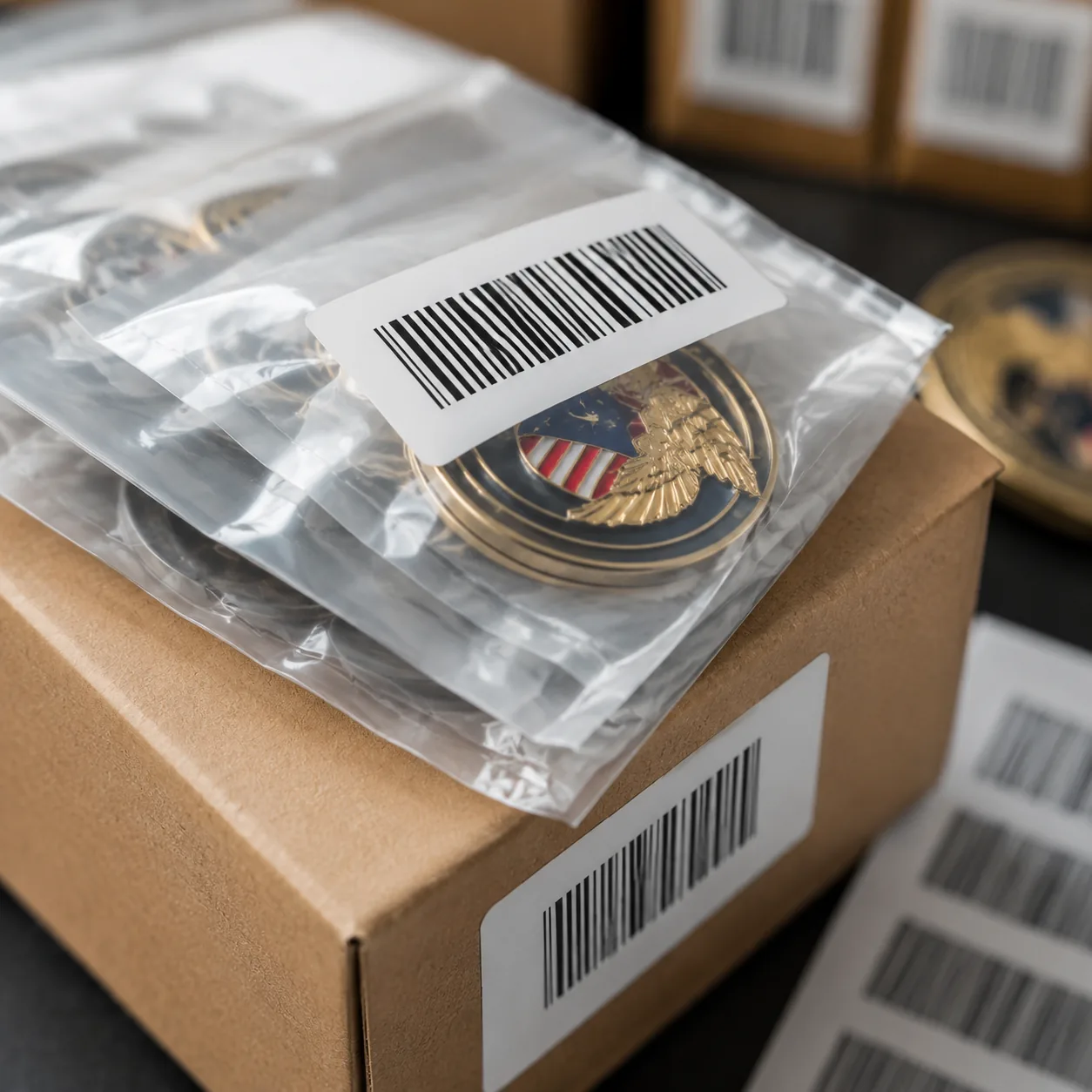
Freight Risk Starts Before Production Ends
A custom metal giveaway can be produced correctly and still miss the commercial objective if the freight plan is built too late. The real question is not simply whether air or sea is cheaper. It is whether the order can pass inspection, export, customs clearance and final delivery before the launch date without turning a USD 0.85 pin into a USD 2.20 landed item.
Pins, coins, keychains and metal badges are dense products. A 40 mm soft enamel pin usually weighs 12–18 g before retail packaging. A 50 mm zinc alloy keychain with split ring often weighs 35–55 g. A 45 mm iron or zinc challenge coin can reach 38–65 g depending on thickness, plating and enamel fill. One carton that looks small on a packing list can exceed 20 kg gross, which changes courier billing, warehouse handling and pallet requirements.
At ZheCraft in Yiwu, most quotations are prepared on FOB Ningbo or FOB Shanghai unless the buyer requests EXW, courier DAP, or DDP service. Typical FOB product ranges are USD 0.45–1.20 for 25–35 mm enamel pins at 1,000–5,000 pcs, USD 0.75–1.80 for zinc alloy or iron keychains at 1,000–3,000 pcs, and USD 1.20–3.80 for 40–60 mm challenge coins depending on diameter, thickness, plating, mold complexity and color count. Freight should be checked after the unit weight, packaging style and required ship date are known, not estimated from artwork alone.
Plan From Ship Date, Not Event Date
Buyers often ask for the fastest freight only after mass production is already late. A safer method is to work backward from the in-hands date and separate the schedule into artwork proofing, tooling, sampling, mass production, inspection, export handling, main transit, import clearance and final-mile delivery. Each step needs a buffer because premium freight cannot recover time lost to late artwork approval or failed inspection.
For most custom metal giveaways, a realistic factory timeline is 2–3 working days for digital artwork proofing, 5–7 days for mold cutting after deposit and artwork approval, 5–7 days for a pre-production sample if required, and 12–20 days for mass production after sample approval for 1,000–10,000 pcs. Double-sided molds, 3D relief, spinner parts, epoxy domes, chain assembly, individual barcodes, backing cards or retail boxes can add 3–8 days. Standard decorative flash plating for nickel, gold, black nickel or copper is often about 0.03–0.08 microns and rarely controls the schedule, but antique finishing, dual plating, nickel-free sealing or extra salt-spray requirements can add 2–4 days.
If goods must be in the buyer’s warehouse by a fixed date, set the factory ex-works target at least 10–14 days before that date for express courier, 18–25 days before for air freight through a forwarder, and 45–60 days before for ocean LCL. For retail launches, trade shows, sports events and campaign kits, the purchase order should state a ship-no-later date as well as the event date. A five-day delay at the factory can force the whole order from sea to air and erase the saving from unit-price negotiation.
Compare Freight Modes by Weight and Deadline
Courier, air freight, sea freight and rail each solve a different problem. The correct option depends on gross weight, carton count, deadline, customs capability, destination and whether the buyer can accept split delivery. For metal promotional products, the practical breakpoints are often 21 kg, 100 kg, 300 kg and one cubic meter.
| Method | Best order profile | Typical transit after pickup | Cost and control notes |
|---|---|---|---|
| Express courier | Samples, urgent cartons, 1–100 kg gross | 3–8 days | Fastest door-to-door option; billed by actual or volumetric weight, with fuel and remote-area surcharges common above 80–100 kg. |
| Air freight forwarder | Dense cargo around 100–800 kg gross | 7–14 days | Often cheaper than courier for heavy cartons; buyer or broker must manage import clearance and local delivery. |
| Sea LCL | 1–10 cbm or 300–3,000 kg | 28–50 days | Lowest freight per piece for planned stock; destination terminal, document and delivery charges must be confirmed. |
| Sea FCL | 10 cbm+ or consolidated programs | 25–45 days | Best for repeat distributors combining many SKUs; requires pallet plan, loading list and warehouse receiving capacity. |
| Rail to Europe | 300 kg+ where service is stable | 22–35 days | Middle-speed option for Europe; route availability, customs handling and seasonal capacity vary. |
Courier is usually the cleanest method for samples, urgent 500–2,000 pc pin orders and high-value replacement parts. It is not always sensible for 10,000 coins because a dense 20-carton shipment can trigger high per-kilo rates, fuel surcharges and warehouse receiving issues. Sea LCL is attractive for replenishment orders, but it is risky for first-time importers who have not budgeted local port, terminal, document and trucking charges.
Rail is mainly relevant for selected European destinations and stable forwarder routes. It can be useful when sea freight is too slow and air freight is too expensive, but it should not be treated as a guaranteed middle option for every country or season. Confirm cutoff date, departure schedule, customs responsibility and final delivery terms before using it for event-critical merchandise.
Carton Data Controls the Freight Quote
Freight quotes become unreliable when a supplier provides only piece count. A proper shipping estimate needs unit net weight, packed unit weight, carton quantity, carton dimensions, carton gross weight and total cubic meters. For pins, keychains and coins, we normally keep export cartons within 10–18 kg gross for manual handling. Dense coin cartons may reach 20–22 kg only when the buyer approves the handling risk.
Common carton sizes are 32 x 24 x 22 cm for small pin orders, 38 x 28 x 26 cm for pins on backing cards, and 40 x 30 x 24 cm for coins or heavier keychains. A practical carton-dimension tolerance is ±10 mm because corrugated board, inner bags and protective layers vary. Standard export cartons use 5-ply corrugated board around 6–7 mm thick. For sea LCL, strapping, corner protection and palletization should be considered when cartons will be stacked with unrelated cargo.
Packaging can double volume even when product weight barely changes. A loose polybagged 30 mm pin may fit 1,000 pcs in one 14–16 kg carton. The same pin on a 90 x 55 mm backing card with OPP bag may require two cartons at 9–11 kg each. A velvet pouch for a coin adds roughly 8–15 g per piece and increases volume sharply. Recalculate freight after packaging approval, especially when changing from bulk polybags to retail cards, clamshells, PVC pouches or gift boxes.
Landed-Cost Breakpoints to Check
A simple landed-cost check prevents bad decisions. Suppose a 3,000 pc 35 mm soft enamel pin order is priced at USD 0.78 FOB, giving a product value of USD 2,340. If packed weight is 55 kg and courier is USD 6.50 per kg, freight adds about USD 0.12 per pin before duty, tax and local receiving cost. If an urgent surcharge pushes courier to USD 11.00 per kg, freight becomes about USD 0.20 per pin.
For heavier items, freight can overtake the decoration cost. A 5,000 pc 50 mm die-cast keychain at USD 1.35 FOB may weigh 240–300 kg packed. Air freight at USD 4.20–7.50 per kg adds roughly USD 0.20–0.45 per piece. Sea LCL may reduce freight per piece materially, but it can require an extra 25–40 days and separate destination charges. A 10,000 pc challenge coin order can exceed 600 kg packed, making sea freight or split shipment the usual economic choice.
MOQ also affects freight efficiency. At 300–500 pcs, mold fees and courier minimum charges make the landed unit cost high, so freight may add USD 0.25–0.80 per piece. At 1,000–3,000 pcs, cartons become dense enough to obtain better courier or air rates. Above 5,000 pcs for pins or 3,000 pcs for coins, compare at least two options: full courier versus air freight plus local delivery, or partial air with the balance by sea.
Use Split Shipments When Timing Is Mixed
Split shipment is useful when the buyer needs launch stock quickly but not the full order immediately. A common structure is 10–30 percent by courier or air and the balance by sea LCL. This works well for conference pins, retail replenishment, distributor catalog launches, sports programs and campaign kits where VIP stock or opening inventory must arrive first.
The main risk is inconsistency if the split is handled casually. The air portion and sea portion should come from the same inspected production lot whenever possible. If production must be separated into two batches, enamel color should be controlled against the same approved Pantone reference, with practical solid-color variation held around Delta E 2–3 where measurable. Metal thickness tolerance should be stated in the PO; ±0.2 mm is practical for many badges and coins, while thinner stamped items may need a tighter drawing-based tolerance.
Split shipments should be packed at the factory, not improvised at the forwarder warehouse. For example, cartons A1–A3 can be marked for air and cartons S1–S18 for sea, with matching PO number, SKU, quantity, gross weight, carton dimensions and destination reference. This avoids opening cartons, mixing labels and increasing scratch or shortage risk.
Release Freight Only After QC Is Clear
Do not book final freight until the shipment has passed inspection or reached a defined release point. For custom metal promotional products, we commonly use general inspection level II with AQL critical 0, major 2.5 and minor 4.0 unless the buyer specifies another plan. Critical defects include unsafe sharp edges, broken pin posts, loose magnets, missing required child-safety features, wrong logo, wrong plating or incorrect item count.
Inspection should confirm finished dimensions, plating appearance, enamel fill, attachment strength and packaging. For pin posts, a practical bend or pull check is often 5–8 kgf depending on post diameter and solder area. For keychain split rings, the check should include opening deformation and attachment security, not only visual appearance. For coins and badges, confirm diameter and thickness against the approved drawing; common production tolerance is ±0.2 mm unless the design requires tighter control.
- Confirm packed weight, carton count and dimensions before paying freight.
- Approve a golden sample, production sample or clear production photos before release.
- State AQL level, critical defects and acceptance rules in the purchase order.
- Require carton marks with PO number, SKU, quantity, gross weight, dimensions and origin text if needed.
- Separate air and sea cartons during factory packing, not at the forwarder warehouse.
- Keep 1–2 percent spare units or agreed replacements for event-critical orders.
- Recheck freight after any packaging change, including cards, pouches, barcodes or gift boxes.
For sea shipments, moisture control matters more than speed. If cartons will sit in humid ports or shared LCL warehouses, specify dry inner bags, silica gel where appropriate and clean separation between metal items and paper cards. Nickel, gold, black nickel and antique finishes can show spotting if packed damp. Finished goods should be fully dry after plating, enamel baking and epoxy curing before final sealing.
Build the Shipping Brief Before Quoting
Before asking for a freight quote, send the supplier a practical shipping brief, not only artwork. Include product type, size, thickness, quantity, packaging style, destination city and postal code, required in-hands date, importer name and preferred incoterm. If the order has multiple SKUs, list each one separately because one heavy coin or gift box can distort the freight estimate for the whole shipment.
Ask for three numbers with the product quotation: estimated unit weight, estimated carton plan and estimated production ex-works date. After the pre-production sample is approved, ask the factory to update the packed weight using the real sample and final packaging. For large or deadline-sensitive orders, request two freight options: the fastest practical method and the lowest reasonable landed-cost method.
If the deadline is tight, decide early whether to reduce packaging volume, approve split shipment, or move only the first release quantity by air. Do not wait until mass production is complete to make that decision. A freight plan written into the PO can save more money and risk than negotiating another USD 0.02 off the unit price.
Have a project? Send your artwork and target quantity and we’ll reply with a detailed quotation within 12 working hours.
Ready to get this made?
Send your sketch, target quantity and ship-date. Detailed quotation in 12 hours.



