Air, Sea or Rail? Shipping Custom Pins Without Rush Fees
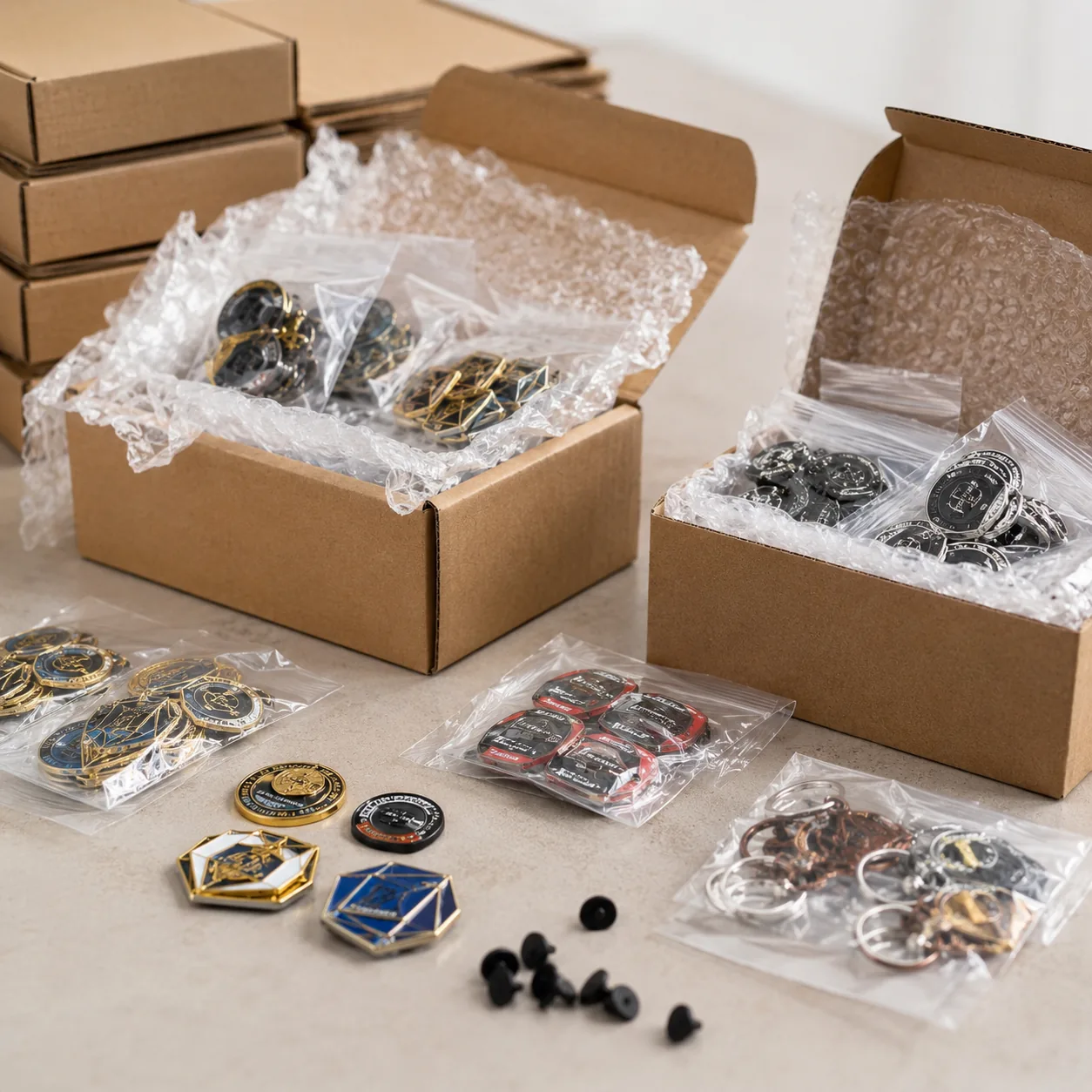
Scenario: 12,000 promo pieces for a fixed 20 September launch in Germany
A distributor is placing one coordinated launch order for Germany: 5,000 soft enamel pins, 3,000 zinc alloy keychains, 2,000 embroidered patches, and 2,000 polyester lanyards. The event date is fixed at 20 September, retail packing is approved, and stock arriving after the launch has sharply reduced value. In this type of program, freight mode is not an admin detail. It changes margin, inventory usability, and the likelihood of paying for last-minute air upgrades.
Assume one factory group in East China manages the project, with metal items made in Zhejiang and textile items sourced nearby for consolidated export. At these volumes, realistic 2026 FOB pricing is roughly: 35 mm iron soft enamel pins, 1.2 mm thick, butterfly clutch, individual card + OPP bag, USD 0.22-0.38/pc FOB; 50 mm die-cast zinc alloy keychains, 3.0 mm thick, nickel plating, split ring + 25 mm chain, USD 0.75-1.45/pc FOB; 75 mm embroidered patches with merrow border and heat-seal backing, USD 0.28-0.60/pc FOB; 20 x 900 mm heat-transfer polyester lanyards with safety breakaway, detachable buckle, and metal hook, USD 0.32-0.68/pc FOB. Typical MOQ tiers are 100-300 pcs/design for patches, 500 pcs/design for lanyards and keychains, and 1,000 pcs/design for standard stamped pins. Tooling is normally extra: pins USD 45-90/design and keychains USD 80-150/design, with pre-production sample charges often credited on bulk orders.
For a basket like this, freight can equal roughly 12-30% of goods value depending on mode, packaging density, and whether destination charges are included. The right method is to work backward from the in-hands date, confirm ex-works readiness, verify packed dimensions by SKU, and separate day-one critical items from nice-to-have items. For fixed-date launches, the lowest-risk answer is often a split shipment rather than forcing one mode across the full PO.
Work backward from warehouse receipt, not from the factory ship date
If the event is 20 September, a prudent warehouse receipt target in Germany is 1 September. That leaves about 14-19 calendar days for import receipt, put-away, destination QC if required, kitting, labeling, allocation to field teams, and contingency. For standard B2B imports into Germany, customs clearance often takes 2-5 working days if documents are clean. Local drayage or parcel transfer from airport, rail terminal, or deconsolidation warehouse usually adds another 1-3 working days.
That means the practical in-country arrival target is about 25 August. Working backward again, usable 2026 planning windows from East China to Western Europe are wider than pure linehaul transit. Air may move in 3-7 days airport-to-airport, but the realistic door planning range is 7-12 days once booking, cargo cut-off, export customs, security screening, destination handling, and final delivery are included. Rail may show 18-30 days terminal-to-terminal, but a safer operating range is 24-38 days. Sea LCL may publish 30-45 days port-to-port, yet 38-55 days is the more practical planning window once CFS cut-offs, transshipment, deconsolidation, and local delivery are counted.
Production timing is just as important as transit. For this product mix, standard bulk lead times after approved artwork and deposit are usually: soft enamel pins 10-15 calendar days, die-cast keychains 12-18 days, embroidered patches 7-12 days, and heat-transfer lanyards 7-10 days. Add 3-5 working days if physical pre-production samples must be approved, plus 1-2 days if revised tooling or color corrections are needed. In a coordinated mixed order, cargo-ready status is typically 18-24 calendar days after final approval when artwork is clean and tooling is simple. If artwork is approved by 20 July, an ex-works date around 12-16 August is realistic. If approvals slip to 1-5 August, sea becomes high-risk and even rail becomes tight unless only part of the order needs to land before the event.
This is why experienced buyers ask for two numbers first: a firm cargo-ready date and final packed data by SKU. Freight quotes taken before the factory confirms readiness and carton specs often create false savings on paper and expensive corrections later.
Shipment physics: packed weight, CBM, and dimensional weight decide the mode
For custom pins and promo items, freight cost is driven more by packed profile than by net product weight. A 35 mm iron soft enamel pin with 300 gsm backing card and OPP bag typically exports at 12-16 g/unit gross. A 50 mm zinc alloy keychain with card and polybag often lands at 38-52 g/unit. A 75 mm embroidered patch with card and bag is usually 4-7 g/unit. A 20 x 900 mm lanyard with breakaway, buckle, lobster clasp, and polybag is often 20-28 g/unit.
At the quantities in this scenario, total export-packed gross weight is likely around 335-385 kg, and total packed volume around 1.20-1.55 CBM if packaging stays flat. A reasonable planning split is: pins about 65-80 kg and 0.24-0.32 CBM; keychains about 125-155 kg and 0.38-0.50 CBM; patches about 10-15 kg and 0.12-0.18 CBM; lanyards about 45-60 kg and 0.28-0.40 CBM. If the buyer adds rigid gift boxes, EVA foam inserts, or oversized display cards, total volume can rise above 2.0 CBM quickly, especially on pins and lanyards.
This matters because air freight bills the higher of actual and dimensional weight. Under the common formula L x W x H in cm divided by 6,000, a 50 x 40 x 35 cm carton equals 11.7 kg chargeable. If the actual gross weight is 8.5 kg, the shipper still pays 11.7 kg. For dense zinc alloy keychains, actual weight usually drives the bill. For patches, boxed pins, and lanyards, cubic volume can become the cost driver even when the goods themselves are light.
| SKU | Typical packed unit weight | Typical MOQ | Suggested carton gross weight | Freight planning notes |
|---|---|---|---|---|
| 35 mm soft enamel pin, iron, carded | 12-16 g | 1,000 pcs/design | 12-16 kg | Good for air if packed flat; avoid presentation boxes |
| 50 mm zinc alloy keychain, carded | 38-52 g | 500-1,000 pcs/design | 14-18 kg | Dense and heavy; usually better by rail or sea |
| 75 mm embroidered patch, carded | 4-7 g | 100-300 pcs/design | 8-12 kg | Very air-efficient if kept flat and dry |
| 20 x 900 mm polyester lanyard, bagged | 20-28 g | 500-1,000 pcs/design | 10-14 kg | Light but can cube out if breakaway and buckle packing is bulky |
For carton engineering, mixed promo goods commonly use export masters around 45 x 35 x 30 cm or 50 x 40 x 35 cm. For manual handling and lower damage risk, metal-heavy cartons should usually stay below 16-18 kg gross. Once cartons exceed about 13 kg gross, 5-ply double-wall corrugate is usually worth the small extra cost. A burst strength around 200-275 psi or edge crush of 44 ECT is a practical baseline for heavier cartons in export handling.
2026 freight economics: compare all-in landed cost, not just the origin rate
Indicative 2026 lane economics from East China to Western Europe for this shipment profile are broadly: standard air freight at USD 6.50-12.00/kg chargeable; rail LCL at about USD 180-320/CBM; sea LCL at around USD 60-140/CBM origin linehaul. Those numbers are not directly comparable unless the quote includes origin terminal charges, export docs, customs clearance, security fees, destination handling, deconsolidation, and final delivery. Sea LCL in particular is often under-budgeted because the low origin linehaul rate hides destination CFS and local handling costs.
For this exact order, a realistic planning model is: full shipment at roughly 360 kg gross and 1.45 CBM. All-air may price on 390-460 kg chargeable depending on carton dimensions, leading to about USD 2,535-5,520 before destination local charges and VAT/duty outlays. Rail LCL on 1.45 CBM may show only USD 260-460 linehaul, but all-in landed freight is more likely USD 900-1,500. Sea LCL may quote just USD 90-200 at origin, yet all-in landed freight can still end up around USD 700-1,300 after destination CFS, document, security, and local delivery fees are added.
The cost decision should also include failure risk. Missing a fixed launch can trigger emergency courier replenishment, local substitute merchandise, rush event kitting, or internal labor to rework incomplete sets. Those costs do not appear on a forwarder quote, but they are real. The useful comparison is total landed cost adjusted for on-time probability, not the cheapest rate per kg or per CBM.
Best-fit strategy: air the visible day-one items, rail the rest
For this scenario, the strongest split is by event function rather than by sending 30% of every SKU. A practical first wave is 2,000 pins plus 2,000 lanyards by air. Those items cover staff wear, registration, VIP packs, and visible launch-day branding. A second wave can carry the remaining 3,000 pins, all 3,000 keychains, and 2,000 patches by rail. If approvals finish unusually early and there is a genuine 6-8 week buffer after cargo-ready date, sea LCL can be considered for the second wave, but rail is usually the safer Europe compromise.
This structure improves both economics and warehouse usability. The first arrival is a complete event subset that can be deployed immediately, rather than partial cartons across every SKU that still leave the destination team waiting. It also avoids paying air rates on the heaviest, least urgent item. In mixed promo programs, keychains often represent one-third to almost one-half of total shipment weight while contributing much less to day-one event function than lanyards or wearable pins.
As a planning number, 2,000 pins plus 2,000 lanyards often pack to around 80-105 kg gross and 0.32-0.46 CBM. Depending on carton geometry, chargeable air weight may land around 95-130 kg, which is materially cheaper than lifting the full order by air. The second-wave rail lot may then sit around 245-285 kg gross and 0.88-1.10 CBM, a much better fit for rail pricing and terminal handling.
- Use air for launch-critical items with visible day-one function
- Use rail for Europe-bound second-wave goods when you still have at least 4-5 weeks after cargo-ready date
- Use sea LCL only when approvals are complete and there is a genuine 6-8 week schedule buffer
- Split by usable SKU groups, not random carton percentages
- Push back on rigid boxes, foam inserts, and oversized backing cards before packaging is frozen
- Ask the supplier for final packed dimensions, gross weight, and carton count by SKU before booking freight
QC, tolerances, and carton controls must be locked before any split dispatch
Split shipping only works when inspection and lot control are disciplined. Final inspection should be done against the approved golden sample before cartons are assigned to AIR, RAIL, or SEA. For general promo goods, a common standard is ANSI/ASQ Z1.4 single sampling, General Inspection Level II, with AQL 2.5 major and 4.0 minor. For appearance-sensitive launch goods, many buyers tighten to AQL 1.5 major and 2.5 minor, especially on enamel fill quality, plating scratches, epoxy bubbles, lanyard print registration, and visible loose threads on patches.
Tolerance language should be explicit on the PO and inspection checklist. Practical production tolerances are typically ±0.2-0.3 mm on stamped pin dimensions, ±0.5 mm on larger die-cast keychains, ±2 mm on embroidered patch size, and ±5-10 mm on finished lanyard length depending on accessory assembly. Enamel color should be checked against the approved sample or Pantone target under D65 or equivalent daylight conditions, with the buyer acknowledging that small batch variation is normal. For soft enamel, define whether underfill deeper than about 0.15 mm below metal lines, visible pinholes, missing plating spots, or clutch attachment defects count as major or minor defects.
Carton controls matter just as much as product QC. Carton marks should show SKU, PO number, lot number, carton sequence, packed quantity, net weight, gross weight, dimensions, country of origin, and assigned mode. Mixed-mode cartons are a common source of dispatch error, so the split should happen by sealed carton, not by loose re-sorting at the warehouse door. Packed quantity variance on split lots should ideally be zero. Carton dimension tolerance after sealing should remain within about ±1 cm, and total shipment gross weight variance within 3-5% of booking data. Larger variance can trigger rebooking, added fees, or missed cut-offs.
Mode-by-mode fit for pins, keychains, patches, and lanyards
Pins are compact and often air-friendly if retail packing stays flat. A 30-40 mm pin on a 90 x 55 mm card in OPP is efficient. The same pin in a foam-lined gift box can multiply cubic volume by 3-5x. If the commercial use is event distribution rather than premium gifting, flat carded packing is usually the rational choice. For stamped iron soft enamel pins, a normal thickness range is 1.0-1.5 mm before clutch hardware, and keeping card dimensions tight does more for freight cost than shaving a few grams off the metal.
Die-cast zinc alloy keychains are usually the classic rail-or-sea SKU. Their packed weight is high relative to unit value, and thicker relief, spinners, bottle-openers, or moving parts increase weight further. Rail is often the best middle ground for Europe when sea feels too exposed and all-air is hard to justify. If any design includes embedded magnets or magnetic gift-box closures, routing needs checking early because some carriers require magnetized cargo testing or special acceptance.
Patches and lanyards are the flexible SKUs. Their low unit weight means a partial air shipment is often affordable, especially when they are worn by staff or handed out at registration. Patches should be packed with moisture protection if sea is considered, because humid transit and poor deconsolidation handling can curl backing cards or soften adhesive layers. Lanyards should be checked for print registration tolerance, clasp plating consistency, and breakaway function before dispatch. For launch planning, prioritize by event function, not by unit count: a delayed commemorative keychain is usually less harmful than missing staff lanyards or wearable badge items.
| Mode | Usable planning window | Best fit in this scenario | Main risks | Indicative 2026 economics |
|---|---|---|---|---|
| Air | 7-12 days | 2,000 pins + 2,000 lanyards first wave | Highest cost, dimensional-weight exposure, peak-season capacity spikes | USD 6.50-12.00/kg chargeable + local handling |
| Rail | 24-38 days | Second-wave pins, keychains, and patches to Europe | Terminal delays, service volatility, less flexible inland coverage than air | USD 180-320/CBM + local charges |
| Sea LCL | 38-55 days | Heavy non-urgent replenishment only if approvals finish early | Rollover risk, more handoffs, destination CFS fees, greater damage exposure | USD 60-140/CBM origin freight + destination/deconsolidation |
| Sea FCL | 35-50 days | Repeat programs at much larger volume | Needs scale; poor fit for small split lots | Lower unit cost than LCL when container utilization is high |
Use one dispatch sheet for both factory and forwarder sign-off
Many freight failures come from weak handoff data rather than weak suppliers. Before production closes, request one dispatch sheet listing: SKU, description, exporter HS code, unit pack style, units per inner, inners per carton, final carton dimensions, net weight, gross weight, carton count, total CBM, and exact lot allocation by mode. If lanyards include detachable buckles, badge reels, PVC holders, or oversized breakaways, note those accessories because they change packing density. If any item contains magnets, declare that before booking.
Request final carton data 2-3 working days before the cargo-ready date, not when the truck is already waiting. That gives time to validate quantity, carton dimensions, and whether the booking still matches reality. On urgent air lots, one misstated carton measurement can move the shipment into a higher chargeable band. On rail or sea lots, understated volume can trigger booking mismatch, warehouse rejection, extra destination handling, or roll to the next departure.
For this 12,000-piece order, the practical buying step is straightforward: ask the supplier or forwarder to quote three scenarios in one sheet: full air, full rail or sea, and split mode. Each quote should show total landed freight, planning days, included charges, assumptions, and confidence level. In most cases like this, the balanced answer is to air the launch-critical pins and lanyards, rail the rest, and use sea only if approvals finish early enough to preserve a real buffer. That is how buyers avoid paying rush fees on the full weight while still protecting the event date.
Have a project? Send your artwork and target quantity and we’ll reply with a detailed quotation within 12 working hours.
Ready to get this made?
Send your sketch, target quantity and ship-date. Detailed quotation in 12 hours.



