Air, Sea or Rail? Shipping Custom Pins Without Missing Launch
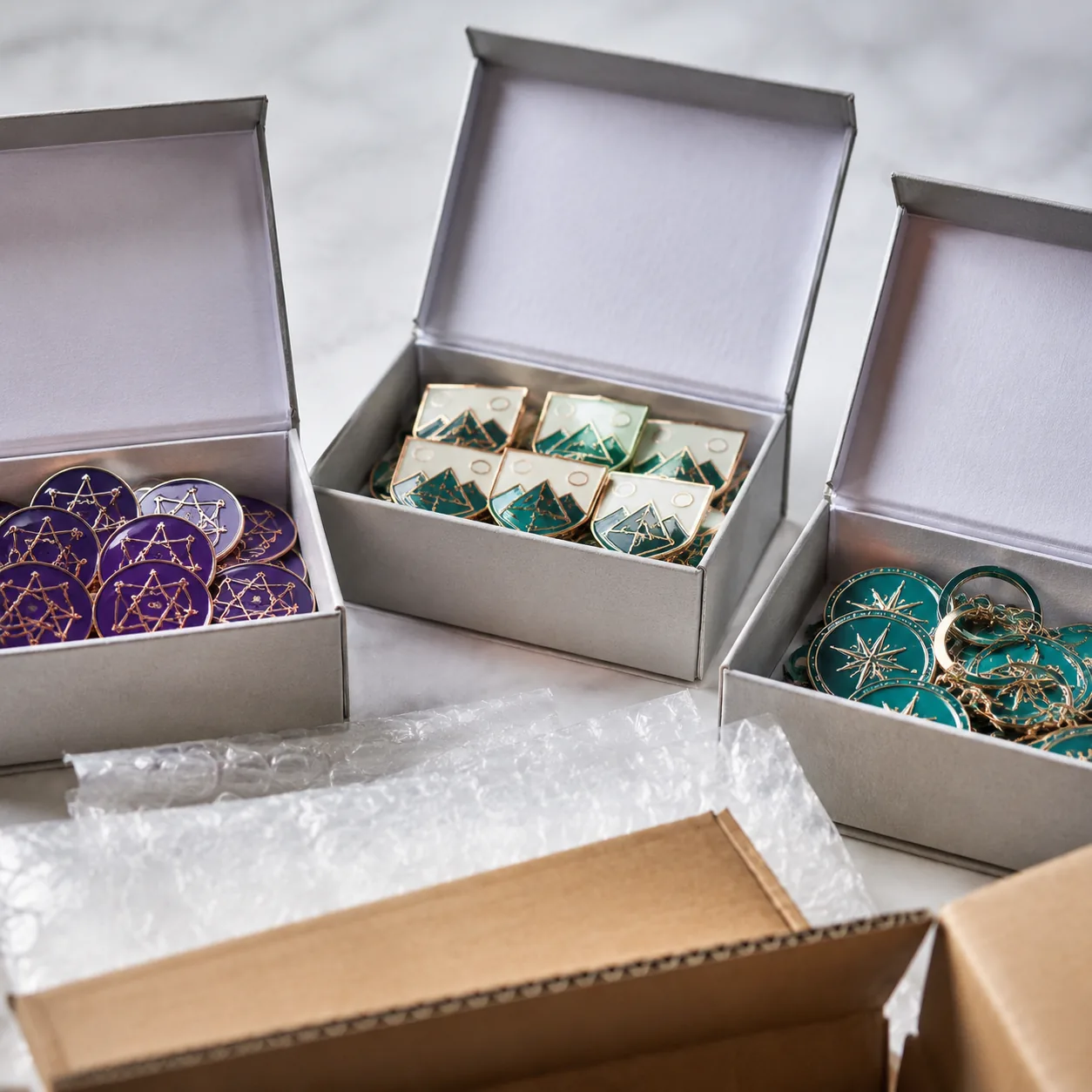
Freight mode, not stamping speed, usually decides whether the launch survives
A European promotional-products distributor wins a 12,000-piece custom pin order tied to a fixed film-release retail date. The specification is typical but fully retail-ready: 35 mm soft enamel pin, stamped iron, 1.5 mm thickness, black nickel finish, 4 enamel colors, 2 butterfly clutches, 300 gsm printed backing card, individual clear OPP bag, and export cartons for warehouse distribution. For one design with standard tooling, many China factories can complete a pre-production sample in 3 to 5 calendar days after approved artwork, then finish mass production in about 12 to 15 days after sample approval and deposit.
The factory lead time is not the main commercial risk. The real risk is missing the on-shelf date because the freight plan was chosen too late or based on guessed packing data. At 12,000 pieces, a standard FOB China quote for this specification usually lands around USD 0.33 to 0.52 per piece, or about USD 3,960 to 6,240 FOB total, depending on die charge treatment, plating yield, and final packaging labor. A poor logistics decision can add USD 800 to 3,500 in avoidable freight and clearance cost, but the larger loss is schedule failure: a 7 to 18 day miss can destroy the value of a launch-tied order.
That is why experienced buyers decide the freight logic before approving mass production. Once the sample is signed off, the order becomes a schedule-control job: lock the pack-out, confirm carton count, dimensions, gross and volumetric weight, define QC and AQL, verify consignee and customs data, and pre-authorize what happens if ex-factory slips. Waiting until final inspection to ask whether goods should move by air, rail, or sea is usually too late.
Lock pack-out early because packaging drives both freight cost and usable lead time
On custom pins, packaging changes the freight economics far more than the metal part changes. A 35 mm pin packed loose in bulk polybags might fit roughly 2,500 to 3,000 pieces per export carton. The same pin mounted on a 300 gsm backing card and sealed in an OPP bag often drops to around 1,400 to 1,700 pieces per carton, depending on card size and whether clutches are pre-attached. If the buyer upgrades to a rigid gift box with EVA insert, cube can jump 3 to 4 times while net metal weight barely moves.
For retail-ready programs, the supplier should provide provisional packed data before tooling release. Practical carton sizes for carded pins are commonly 38 x 26 x 20 cm, 40 x 30 x 25 cm, or 45 x 30 x 25 cm. Gross weight is usually controlled at 10 to 12.5 kg per carton. Keeping cartons near 12 kg is not arbitrary: it reduces split-carton risk in consolidation warehouses, keeps manual handling manageable, and avoids the damage pattern seen when small cartons become unusually dense because of metal content.
Packing also affects lead time. Card insertion, barcode labeling, lot stickers, suffocation-warning bag print, carton sequence labeling, and destination-specific assorting usually add 1 to 3 days after the pins themselves are complete. In peak periods, hand-packing can add 3 to 4 days. That extra time matters because it comes at the end of the production cycle, exactly when buyers are most tempted to rush freight decisions.
MOQ changes by presentation format as well. The pin itself may have a workable MOQ of 100 to 300 pieces per design, but custom backing cards are more efficient from 500 pieces upward, printed OPP bags often from 1,000 pieces, and rigid gift boxes commonly from 500 to 1,000 pieces per variant. If only 600 units need premium influencer packaging, making that a separate SKU is usually cheaper and faster than forcing all 12,000 units into a high-cube retail pack.
Compare air, rail, and sea using door-to-door days, not best-case transit promises
| Mode | Typical door-to-door time | Best fit shipment size | Indicative cost basis | Main schedule risk | Practical buyer note |
|---|---|---|---|---|---|
| Express courier | 4 to 7 days | Samples, replacements, or urgent launch partials under about 150 kg chargeable | Chargeable weight, fuel surcharge, brokerage, remote-area fee | Customs hold, oversize carton limits, destination reclassification | Fastest for small launch tranches, but expensive once carton count rises |
| Air freight | 6 to 10 days | Dense metal cargo from about 80 kg upward | Per chargeable kg plus origin terminal, destination handling, clearance, delivery | Flight rollover, cut-off miss, customs delay | Often viable for pins because gross weight usually exceeds volumetric weight |
| Rail | 18 to 28 days to continental Europe | Mid-urgency replenishment or split-shipment balance cargo | Lane rate, terminal handling, customs transfer, local delivery | Terminal congestion, route disruption, service instability | Useful bridge between sea and air when the lane is currently stable |
| Sea LCL | 30 to 42 days | Non-urgent cargo under about 2 CBM | Per CBM plus CFS, deconsolidation, customs, local delivery | Cut-off miss, consolidation delay, deconsolidation lag | Cheap on paper, but schedule variability is usually highest |
| Sea FCL | 22 to 35 days | Repeat high-volume programs filling a material share of a container | Container rate, drayage, port charges, local delivery | Port congestion and lower flexibility if production slips | Best unit economics, but rarely justified for a single 12,000-pin order |
The common mistake is comparing quotes only by rate per kilogram or by the line-haul leg. What matters is when saleable stock is booked into the destination warehouse after customs clearance and local delivery. Pins are dense metal goods, so they behave differently from plush toys, caps, or gift boxes: air freight often charges on gross weight rather than inflated volumetric weight, which makes air more competitive than many buyers assume.
Rail matters mainly on China-to-Europe lanes. In stable periods it can save 8 to 15 days versus sea LCL at a fraction of air cost. In unstable periods, terminal congestion or routing changes can erase that advantage quickly. Buyers should therefore ask for transit as a realistic range, such as 20 to 26 days door-to-door, rather than a single best-case promise like 18 days.
Run the carton math first, because dense pin orders can justify air
Assume the 12,000 pins are packed on backing cards in OPP bags and loaded into 8 export cartons, each at about 40 x 30 x 25 cm and 11.8 to 12.2 kg gross. Total shipment weight is roughly 96 kg gross. Using the standard air volumetric formula of L x W x H / 6000, each carton equals 5.0 kg volumetric weight. Because the actual gross weight is about 12 kg, the cargo rates on gross, not volume. That single calculation often changes the decision.
Plan A is full air. A realistic timeline from artwork approval is about 21 to 28 days total: 3 to 5 days for sample, 12 to 15 days for mass production, 1 to 2 days for final packing and carton marking, 1 day for export handover, and 6 to 10 days for air transit, customs, and final delivery. On major China-Europe lanes, dense cargo of this type may move at roughly USD 7.00 to 11.50 per chargeable kg all-in airport-to-door, putting freight around USD 670 to 1,100 before duty and VAT.
Plan B is split mode. If 2,500 pins ship by air and 9,500 by rail, the air tranche may fit into 2 cartons at about 24 to 26 kg gross total, with an all-in air cost around USD 220 to 380 on many lanes. The remaining 6 cartons move by rail in around 20 to 30 days door-to-door. Commercially, this is often the strongest answer: launch-week stock arrives on time, while the majority of the order avoids full-air cost.
Plan C is sea LCL. Eight cartons at these dimensions occupy about 0.60 to 0.75 CBM. The freight quote may look low ex-China, but once CFS cut-off, origin consolidation, deconsolidation, customs, and local delivery are added, the practical timeline is usually 30 to 42 days after handover. If the project has less than 10 to 14 days of schedule buffer beyond expected arrival, sea LCL is usually too risky for a launch-driven pin order.
The discipline is simple: use identical packed data across all quotes. Same carton count, same dimensions, same gross weight, same destination terms. If the air quote is based on confirmed cartons but the sea quote is based on guessed CBM, the comparison is not commercially reliable.
Set QC targets that match promotional metal goods and retail packing reality
Freight planning only works if the shipment passes inspection without rework, holdbacks, or emergency repacking. For a 35 mm stamped iron soft enamel pin, workable commercial tolerances are usually +/-0.15 mm on finished size and +/-0.10 mm on 1.5 mm thickness. For decorative black nickel plating, a nominal deposit of about 0.03 to 0.05 micron is common on promotional-grade goods; buyers should treat appearance consistency, not laboratory thickness perfection, as the practical control point unless a premium plated specification has been contracted.
Inspection has to cover both product and presentation pack. On the pin itself, check enamel fill level, exposed base metal where it should not show, plating pits, color mismatch against the approved sample, sharp edges, bent posts, and clutch fit. On the card, a print registration tolerance within +/-1.0 mm is a reasonable target, with no upside-down insertion, no major color drift, and no barcode obstruction. On the retail pack, verify count accuracy, bag seal quality, warning text placement where required, and that the pin sits centered and straight on the backing card.
AQL should be agreed before final inspection, not argued on inspection day. A practical standard for this category is General Inspection Level II with AQL 2.5 for major defects and AQL 4.0 for minor defects. Major defects usually include missing clutch, detached post, wrong plating color, wrong artwork, severe enamel voids, wrong barcode, or mixed quantities per pack. Minor defects usually include light bag scuffing, small card offset, slight plating haze, or cosmetic marks that are not obvious at normal retail viewing distance of roughly 50 to 70 cm.
Export packaging needs its own QC points because transport damage creates delay as well as cost. Double-wall outer cartons, often equivalent to K=A strength, are advisable for 10 to 12 kg dense loads. Cartons should be dry, square, fully taped, and free from crush. If gift boxes are used, add drop and compression checks because presentation packs can collapse internally even when the metal pin remains undamaged.
Documentation and carton marks decide whether fast freight actually stays fast
Air and courier only save time when the documents are exact. The commercial invoice should use a clear description such as custom metal lapel pins, iron base, soft enamel decoration, for promotional resale or promotional distribution. Vague wording like gift item, accessory, or sample goods often creates unnecessary broker questions. The packing list must match the physical cargo exactly: carton count, quantity per carton, net weight, gross weight, and carton dimensions.
Consignee data should be verified before production finishes, not after the cargo reaches the airport. Confirm the legal entity name, delivery address, VAT or tax number, EORI where required, broker contact, warehouse receiving hours, appointment rules, and whether loose cartons or pallets are accepted. A one-line consignee error can easily cost 2 to 4 days in customs or final-mile rebooking, which defeats the point of paying for air.
Carton marks should support receiving efficiency. Each carton should show PO number, item code or SKU, country of origin if requested, carton dimensions, gross and net weight, and sequence numbering such as 1 of 8. For split shipments, separate prefixes like AIR 1 of 2 and RAIL 1 of 6 reduce cross-dock mistakes and let the warehouse receive the launch tranche immediately instead of recounting the full order.
If the shipment includes mixed accessories such as magnets, wooden display parts, batteries in a presentation box, or combined kits, classification complexity increases sharply. The buyer should provide the forwarder with the full bill of materials for the shipset, not only the base pin description, because the accessory pack may change screening, declaration, or documentation requirements.
Split shipments only work if the first tranche is immediately saleable
- Approve split shipment in the purchase order when the launch date is fixed and the first-arriving quantity can be sold or distributed on its own.
- Define a clear trigger, such as automatically authorizing 20% to 25% by air if ex-factory readiness slips beyond Day 16 after artwork approval.
- Require carton-level packing lists before dispatch so the destination warehouse can receive partials by carton count without opening every box.
- Segregate air cartons during final packing and final inspection to avoid post-QC repacking and misrouting risk.
- Do not split if stores need complete multi-item kits, compliance bundles, or full assortments before any stock can ship onward.
- Check whether extra broker fees, relabeling, or multiple delivery appointments erase the savings from the lower-cost leg.
A partial shipment only helps when the early quantity has standalone value. For a single-SKU pin launch, 2,000 to 3,000 pieces arriving first can cover key accounts, PR drops, cinema lobby displays, or the first e-commerce release. For a coordinated gift set that also needs a lanyard, patch, and coin, flying only the pins may create fast-moving dead stock rather than usable inventory.
The right question is not whether split mode is cheaper than full air. The right question is whether the first tranche can generate revenue or fulfill the launch objective immediately, with no manual resorting, relabeling, or kit rebuilding after arrival.
A practical decision model for a 12,000-piece launch order
For this scenario, the best plan is usually hybrid. The factory produces all 12,000 pieces in one lot to keep plating tone, enamel fill, and card print consistent. After final random inspection, 2,500 pieces move by air for launch-week retail and media commitments, while 9,500 pieces move by rail to the continental European distribution center, where timing after the first on-shelf date is less critical.
The specification should be frozen in writing: 35 mm finished size, +/-0.15 mm tolerance, 1.5 mm thickness, stamped iron, soft enamel, black nickel decorative plating, 2 butterfly clutches, 300 gsm backing card, and clear OPP bag. Export cartons stay capped near 12 kg gross, with 8 cartons total for the standard retail pack. Final inspection covers enamel appearance, plating consistency, post alignment, clutch security, card orientation, barcode position, quantity accuracy, and carton labeling.
Indicative FOB pricing for one-design soft enamel iron pins usually follows broad volume tiers such as USD 0.48 to 0.78 at 1,000 pieces, USD 0.36 to 0.58 at 5,000 pieces, and USD 0.33 to 0.52 at 10,000 pieces and above. Common adders include glitter enamel, transparent colors, epoxy dome, cutouts, laser serial numbering, rubber clutch upgrades, custom-shaped backing cards, and rigid gift boxes. Knowing those tiers helps buyers judge whether spending an extra USD 300 to 900 on split freight is sensible insurance for a much larger retail opportunity.
Before releasing production, ask for five things in writing: confirmed production lead time in calendar days, packed carton count, packed carton dimensions, estimated gross and volumetric weight by pack style, and MOQ by pack variant. Then have the forwarder quote at least two freight modes using that exact same data. Finally, write fallback rules into the PO, for example: if ex-factory readiness slips beyond Day 16 after artwork approval, authorize 20% to 25% by air and move the balance by rail. That turns a schedule problem into a predefined commercial response instead of a last-minute argument.
The best shipping plan is not the absolute cheapest shipment. It is the lowest-risk landed plan that protects the selling date first, then optimizes logistics spend within that deadline. On custom pins, those decisions are usually won or lost before the first piece is stamped.
Have a project? Send your artwork and target quantity and we’ll reply with a detailed quotation within 12 working hours.
Ready to get this made?
Send your sketch, target quantity and ship-date. Detailed quotation in 12 hours.



