Air, Sea or Rail for Custom Pins in 2026: Cost and Lead-Time
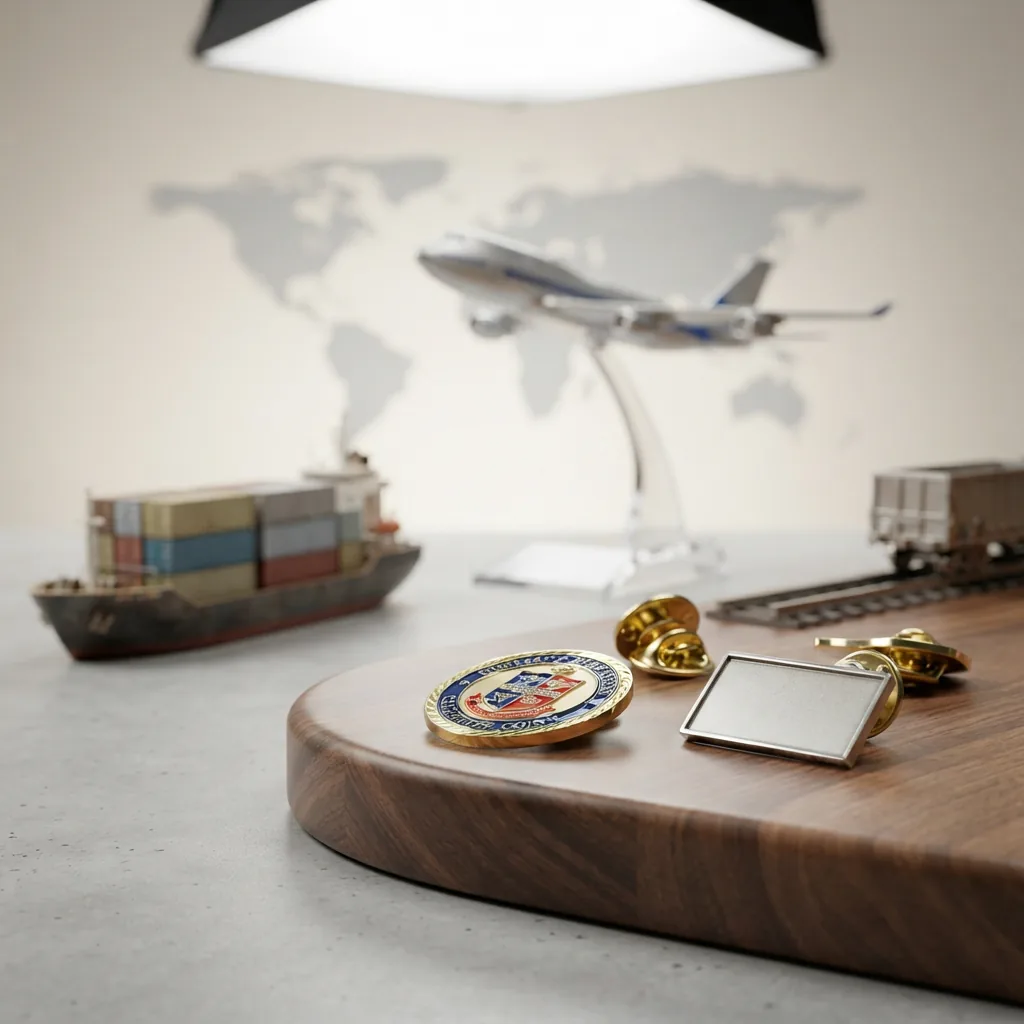
When freight is chosen after sampling, the unit cost usually explodes
A common buyer problem is this: the factory quote looks acceptable at sample stage, but once mass production is approved, the shipment has to move by air because the event date is too close. On a 50 mm custom enamel pin order, freight can shift from a minor line item to 25% to 45% of landed cost if the schedule slips by even 7 to 10 days. That is why freight mode should be decided before tooling is cut, not after sample approval.
For 2026 planning, the practical question is not only which freight mode is cheapest. It is which combination of build spec, MOQ, packing density and transit buffer gives the lowest real cost per usable unit delivered on time. At ZheCraft, we usually see buyers focus heavily on mold and unit price, then lose more money later through oversized gift-box packing, split shipments or last-minute courier upgrades.
The fastest way to estimate freight impact is by order size and packed volume
For standard die-struck or soft enamel iron pins, a typical piece size is 25 to 40 mm, thickness 1.2 to 1.5 mm, with butterfly clutch and individual polybag. Net pin weight is often 8 to 18 g depending on size and back hardware, but packed shipment weight is what matters more. A practical export planning figure is 12 to 20 kg per 1,000 pcs for simple polybag packing, and 25 to 45 kg per 1,000 pcs if each pin is mounted on a backing card and packed in a paper gift box.
MOQ also changes freight logic. At 100 to 300 pcs, courier or air express usually wins because the total carton count is low and sea handling charges can exceed the goods value. At 500 to 2,000 pcs, the right answer depends on whether the product is packed flat in master cartons or presentation-packed for retail. At 3,000 pcs and above, sea freight or rail usually starts to make economic sense unless the delivery window is under 20 calendar days from ex-factory date.
| Order size and pack style | Typical packed weight | Freight mode that usually makes sense | FOB product range | Freight risk note |
|---|---|---|---|---|
| 100 to 300 pcs, polybag | 3 to 6 kg | Courier or air express | USD 0.45 to 1.20 per pc | Sea charges usually disproportionate |
| 500 to 1,000 pcs, backing card | 8 to 18 kg | Air cargo or courier | USD 0.38 to 1.00 per pc | Watch volumetric weight if cards are large |
| 1,000 to 3,000 pcs, polybag | 12 to 45 kg | Air cargo, rail, or sea LCL | USD 0.30 to 0.85 per pc | Best range for comparing all modes |
| 3,000 to 10,000 pcs, mixed retail pack | 60 to 300 kg | Rail or sea | USD 0.26 to 0.78 per pc | Carton cube becomes the main cost driver |
| 10,000 pcs and above, bulk promo pack | 120 kg and above | Sea FCL or dense LCL | USD 0.22 to 0.60 per pc | Book early around peak shipping periods |
The manufacturing clock and the shipping clock need to be quoted together
A standard custom pin order is not one lead time. It is four linked stages: artwork proofing, mold making, pre-production sample if required, and mass production. For a normal stamped iron or zinc alloy pin, artwork and line drawing confirmation usually takes 1 to 3 working days, tooling 2 to 4 days, sample 3 to 5 days, and mass production 7 to 15 days after approval depending on quantity, plating complexity and packing method.
If the item includes hard enamel polishing, transparent colors, glitter fill, sliding parts, custom backing cards or barcoded retail sets, add 2 to 6 more production days. Plating queues also matter. Bright gold, nickel and black nickel are usually straightforward, but antique finishes, dual plating or strict nickel-free runs may need tighter segregation and extra inspection. A realistic AQL target for appearance on pins is often AQL 2.5 major and 4.0 minor, but if you specify premium gift or collector use, the inspection threshold should be agreed before production because it affects both time and labor cost.
At factory level, dimensional tolerance on stamped pins is commonly plus or minus 0.15 mm to 0.25 mm on overall size, with thickness tolerance around plus or minus 0.10 mm on a 1.5 mm spec. Those tolerances are normal. If a buyer asks for unusually tight edge consistency, mirror polish on hard enamel, and exact card alignment, the added sorting time can push the shipment out more than the metalworking itself.
Air is not just expensive; it is often the cheapest late-stage decision
Air freight makes sense when the calendar cost of missing a launch, show, school intake or corporate event is higher than the transport premium. In 2026 budgeting, a practical planning number for airport-to-airport air cargo on small promo metal goods is often around USD 4 to 8 per kg before local handling, while courier door-to-door can be materially higher on low-weight shipments. For 500 pcs of 30 mm pins packed on cards, that can add roughly USD 0.08 to 0.30 per piece depending on destination and carton dimensions.
The main benefit is time compression. After ex-factory release, air cargo may land within 3 to 7 days, and courier can be similar or slightly faster for small lots. The trade-off is that bulky retail packaging gets punished twice: first through higher carton cube, then through dimensional weight billing. If the item is a low-value giveaway under about USD 0.40 FOB per piece, air can destroy margin unless the order is small or the event deadline is fixed.
Air also suits split-shipment planning. A buyer can move the first 300 to 1,000 pcs by air for an event, with the balance by sea if the factory can hold plating and color consistency. That only works if the golden sample, plating bath standard and packing spec are locked. Otherwise, the second batch can look slightly different even when the Pantone callout is unchanged.
Sea freight wins on large orders, but only when packaging discipline is good
Sea freight usually gives the lowest unit logistics cost once packed weight and volume climb, especially above 3,000 pcs. For dense bulk-packed pins, sea can reduce freight cost to a few cents per piece, while air may still sit many times higher. But buyers often miss the hidden issue: sea rewards compact export packing, not premium presentation packing with empty space.
A simple example: a 35 mm soft enamel pin in polybag might ship 1,000 pcs in a relatively compact master carton, while the same pin in a rigid paper box may require two to four times the cube. If you are shipping LCL, that extra volume can cost more than upgrading the pin itself from iron to zinc alloy. Before approving gift packaging, ask for packed carton dimensions, gross weight, net weight and pieces per carton. Without that data, you are approving freight cost blind.
Sea also needs more schedule protection. Port congestion, transshipment delays and customs timing can easily move the delivered date by 7 to 14 days. If your campaign has no buffer, sea is the wrong choice even if the spreadsheet says it is cheapest.
Rail sits in the middle, but it only works for certain lanes and planning styles
For some Europe-bound shipments, rail can be a useful middle option in 2026. In broad terms, transit may be around 18 to 30 days depending on route, consolidation and customs handoff, which is often materially faster than sea and cheaper than air. For 1,000 to 5,000 pcs of pins or mixed metal promo goods, rail can balance budget and timing well when the destination market supports predictable inland distribution from the arrival hub.
The limitation is not product compatibility. It is network suitability. Rail is less attractive for urgent low-volume orders, for destinations far from rail-linked entry points, or for projects with fragile delivery sequencing where one missed handoff affects the whole campaign. Buyers should also confirm whether the quote is station-to-station, DAP or door-delivered, because inland charges can narrow the apparent savings quickly.
| Freight mode | Typical transit after ex-factory release | Best MOQ range | Typical use case | Main drawback |
|---|---|---|---|---|
| Courier | 3 to 6 days | 100 to 500 pcs | Urgent samples, low-volume launch packs | Highest cost per kg |
| Air cargo | 3 to 7 days | 500 to 3,000 pcs | Event deadlines, split shipments | Sensitive to volumetric weight |
| Rail | 18 to 30 days | 1,000 to 5,000 pcs | Europe programs with moderate urgency | Lane-dependent and less flexible |
| Sea LCL/FCL | 25 to 45 days | 3,000 pcs and above | Large promo runs with stable schedule | Largest timing variability |
Small spec decisions change landed cost more than many buyers expect
Two pins with the same face size can ship at very different total cost. Zinc alloy is useful for cutouts, 3D shapes and complex outlines, but the part often weighs more than a plain stamped iron pin of similar dimensions. A 1.8 mm thick zinc alloy build with deluxe clutch and backing card may carry both higher FOB cost and higher freight cost than a 1.2 mm iron pin with butterfly clutch and polybag, even before customs duty is considered.
Plating thickness and finish control also influence economics. Decorative plating on promo metal items is typically thin, often around 0.03 to 0.10 microns for standard fashion-use surfaces depending on finish system and substrate preparation. If you need improved corrosion resistance for humid storage, marine gifting or long shelf time, the solution is not simply to ask for thicker plating without context. You may need better base polishing, protective topcoat, sealed polybagging, desiccant in master cartons, or a different finish choice altogether, all of which add cost and sometimes one or two production days.
Packing choices are equally powerful. Backing cards larger than needed, thick EVA inserts, acrylic lids and low fill-rate cartons raise cube fast. In many cases, trimming a card from 90 x 140 mm to 70 x 100 mm, or switching from rigid box to foldable paper card, saves more total budget than negotiating another few cents off the unit FOB price.
Use this checklist before approving the order, not after the deposit is paid
- Ask for a combined schedule showing proofing days, tooling days, sample days, production days and estimated transit days by air, sea and rail.
- Request packed carton data: pieces per carton, carton size in cm, gross weight, net weight and whether dimensional weight applies.
- Confirm MOQ tiers at 100, 300, 500, 1,000 and 3,000 pcs because unit price and freight logic often change at each break.
- Lock the product spec in writing: size in mm, thickness, base metal grade, plating finish, attachment type, packing method and accepted tolerance.
- Set the inspection standard before production, such as AQL 2.5 major and 4.0 minor, and define what counts as a major visual defect.
- If the schedule is tight, ask whether a split shipment is possible and whether plating and enamel color can be held consistent across batches.
- For retail packing, request a freight estimate using actual packed cube, not only product weight.
- Add a buffer of at least 7 days for sea and 3 days for air around fixed event dates.
What to do next if you are costing a 2026 pin program
Start by costing three versions of the same project, not one. Version A should be the ideal product spec, Version B should reduce packing volume, and Version C should preserve the design but simplify material or hardware. Then ask for each version with three freight assumptions: air, rail if relevant, and sea. That is the fastest way to see which decision actually drives landed cost.
For most buyers, the best result is not the lowest FOB quote. It is the version that keeps total delivered cost stable while protecting the event date. If your order is between 500 and 3,000 pcs, that usually means comparing at least two packing methods and two freight modes before approving tooling. ZheCraft can quote this as a matrix with size, thickness, packing and shipment assumptions separated, which makes it easier to decide before lead time gets compressed.
If you already have artwork, the practical next step is to prepare a short RFQ with size, quantity tiers, required in-hands date, destination country, packing style and whether partial air shipment is acceptable. That information is enough to test whether the project should be built around sea economics, air timing, or a hybrid plan. Make that decision first, and the rest of the cost structure usually becomes much easier to control.
Have a project? Send your artwork and target quantity and we’ll reply with a detailed quotation within 12 working hours.
Ready to get this made?
Send your sketch, target quantity and ship-date. Detailed quotation in 12 hours.



