Air Freight vs Sea Freight for Custom Metal Promo Orders
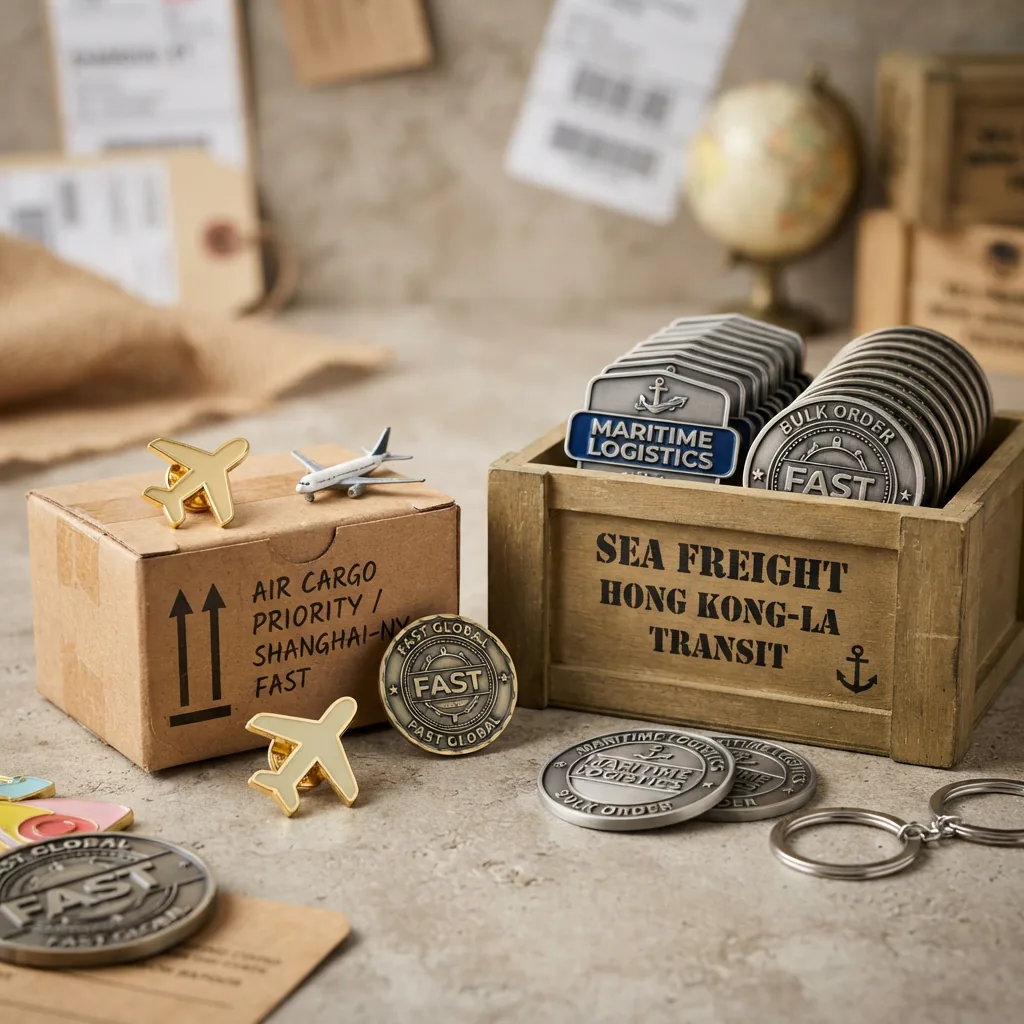
Set the freight decision before production and packing are locked
Many importers finalize artwork, mold layout, plating color, and pre-production samples first, then ask about freight after goods are packed. By then, the real cost drivers are already fixed: retail packaging size, units per carton, carton gross weight, and total cubic volume. The buyer is left with only one remaining lever, which is paying more for speed.
That timing error is expensive on custom metal promo goods such as soft enamel pins, die-struck badges, die-cast keychains, challenge coins, medals, and bottle openers. FOB factory cost may be only USD 0.35 to 2.80 per piece, but freight can still move landed cost by 12 to 45 percent. The effect is strongest on low-value items packed in rigid gift boxes, acrylic display cases, EVA insert sets, or mixed event kits where cube rises much faster than product value.
For most small and mid-volume orders, the useful comparison is not simply air is fast and sea is cheap. The correct decision depends on gross weight, cubic volume, chargeable weight, packaging density, destination handling charges, customs assumptions, and how many calendar days the buyer can realistically give the shipment. The gray zone is where mistakes happen: roughly 3 to 30 cartons, 50 to 400 kg gross, and 0.5 to 5.0 cbm.
A competent supplier in Zhejiang, Ningbo, Wenzhou, or Yiwu should provide provisional cartonization before deposit once retail packaging is frozen. At quotation stage, packed-weight accuracy is usually within plus or minus 10 percent. After a packing test on a finished master carton, that should narrow to plus or minus 3 to 5 percent for both gross weight and cbm. If the factory cannot state units per carton, master carton dimensions, carton board grade, and estimated gross weight before production, the freight mode is being chosen without usable data.
Compare the full logistics stack, not the headline freight rate
Buyers should request side-by-side air, sea LCL, and, where volume justifies it, sea FCL pricing before approving production. The figures below are planning ranges for exports from eastern China to the US and EU for custom metal promo goods. They are budgeting anchors rather than live quotes, but they are realistic for 2026 sourcing plans.
| Decision point | Air freight | Sea freight LCL | Sea freight FCL |
|---|---|---|---|
| Typical shipment profile | 1 to 8 cartons; 30 to 300 kg gross; 0.2 to 2.0 cbm | 8 to 80 cartons; 1.0 to 12.0 cbm | Usually 12.0 cbm and above, or mixed programs where container control matters |
| Factory to export handoff | 1 to 3 days | 3 to 7 days | 3 to 7 days |
| Main transit, China to US/EU | 3 to 8 days airport-to-airport | 24 to 42 days port-to-port | 18 to 35 days port-to-port |
| Typical door-to-door planning range | 7 to 14 days | 32 to 55 days | 28 to 45 days |
| Budget range | USD 4.80 to 9.50 per chargeable kg | USD 75 to 165 per cbm plus origin and destination charges | Usually the lowest per-unit cost once fill rate improves |
| Primary cost driver | Actual kg versus volumetric kg | Cubic volume, CFS fees, destination handling, minimum charges | Container utilization, drayage, port fees, and inland delivery |
| Best use case | Urgent launch orders, compact dense cargo, partial dispatch | Mid-volume orders with stable schedule | Large repeat programs, retailer replenishment, mixed SKUs |
| Main commercial risk | Margin loss on bulky retail packaging | Longer timeline, more cargo handoffs, fixed local charges | Paying for unused container capacity |
For air freight, chargeable weight is based on actual weight or volumetric weight, whichever is higher. A common formula is length x width x height in cm divided by 6000. A carton measuring 50 x 40 x 35 cm converts to 11.7 chargeable kg even if actual weight is only 8.5 kg. That difference is why presentation boxes, foam inserts, and rigid paper packs quickly make air uneconomic.
Sea LCL is usually more forgiving on low-density cargo, but buyers often underestimate fixed charges. A lane quoted at USD 95 per cbm can still become costly after origin documentation, CFS receiving, destination deconsolidation, terminal handling, customs brokerage, and final delivery are spread over only 2,000 or 3,000 units. The working metric should be freight cost per sellable piece and freight as a percentage of FOB value, not the base lane rate alone.
Know how the product and packaging affect weight, cube, and damage risk
Different metal promo items behave very differently in freight costing. A standard 30 to 40 mm soft enamel iron pin, 1.2 to 1.5 mm thick, with one butterfly clutch, paper backing card, and OPP bag often ships at 12 to 20 g packed. A 50 mm die-cast zinc alloy keychain with split ring and short chain more often lands at 35 to 55 g packed. A 45 mm challenge coin at 3.0 mm thickness usually ships at 40 to 70 g packed in a PVC sleeve, but 90 to 160 g packed once it is put into a velvet box, acrylic capsule, or rigid gift pack.
Cube can change even faster than weight. A retail box that adds only USD 0.18 to 0.65 to factory cost can increase freightable volume by 50 to 200 percent. If a boxed pin set changes from 90 x 90 x 25 mm to 110 x 110 x 30 mm, unit box volume rises from 202.5 cubic cm to 363 cubic cm, an increase of about 79 percent. The product value barely changes, but the air chargeable weight and sea cbm do.
Finish and transit protection also affect the freight decision. Polished nickel, imitation gold, black nickel, antique silver, and dual-plated surfaces can mark or rub during transit if units are packed too tightly. Pins should be checked so posts do not puncture adjacent cards or bags under compression. Coins and medals need enough separation to avoid edge-to-face abrasion. For sea freight, especially in humid months, plated items should usually ship with sealed inner bags, a poly liner, and desiccant. A 5 g to 10 g desiccant sachet per inner carton is a low-cost control on tarnish, damp cards, and odor pickup.
Before deposit, buyers should ask for four packing numbers for each SKU: packed unit weight, units per inner pack, master carton dimensions, and gross carton weight. Add one more if the order is mixed: total cbm by SKU. Without those figures, there is no reliable basis for choosing air, sea, or a split dispatch.
Use realistic break-even bands by SKU, MOQ, and shipment size
There is no single air-versus-sea break-even point, but there are useful planning bands. For dense, compact pin orders packed on card and in bag, air often remains commercially acceptable up to about 150 to 250 kg gross when the buyer has fewer than 28 calendar days from ex-factory completion to in-hands delivery. For heavier products such as challenge coins, zinc alloy keychains, medals, and bottle openers, sea LCL often starts to outperform air from roughly 120 to 180 kg gross, especially when the schedule allows 35 to 50 total days.
MOQ structure changes the answer. Standard custom programs often quote at these tiers: soft enamel pins from 100 pieces per design, die-cast keychains from 100 to 300 pieces, challenge coins from 100 to 200 pieces, and medals from 100 to 300 pieces. At those low MOQ levels, air is often simpler because LCL destination charges can be disproportionate to order value. Once combined quantities move into 2,000 to 5,000 pieces across multiple designs and carton count rises, sea becomes more attractive if packaging density is controlled.
| Example order | Approx packed cargo | Typical FOB unit price | Likely better mode | Why |
|---|---|---|---|---|
| 3,000 soft enamel pins, 35 mm, card + polybag | 4 to 5 cartons; 70 to 110 kg; 0.6 to 1.0 cbm | USD 0.38 to 0.72 each | Air if deadline is under 4 weeks; sea if over 6 weeks | Dense cargo, moderate cube, manageable air cost |
| 2,000 zinc alloy keychains, 50 mm, card + polybag | 5 to 7 cartons; 90 to 140 kg; 0.8 to 1.4 cbm | USD 0.85 to 1.65 each | Either mode depending on date and destination charges | Higher weight but still moderate volume |
| 5,000 challenge coins, 45 mm x 3.0 mm, PVC sleeve | 8 to 12 cartons; 220 to 350 kg; 1.2 to 2.2 cbm | USD 0.78 to 1.55 each | Sea LCL | Weight is high enough that air usually erodes margin |
| 1,500 gift-boxed pin sets | 6 to 10 cartons; 60 to 120 kg; 1.5 to 3.0 cbm | USD 1.20 to 2.90 each | Sea often wins | Cube rises faster than product value, so air bills on volume |
| Mixed event kit: lanyard, patch, pin, keychain | 10 to 20 cartons; 150 to 300 kg; 2.0 to 5.0 cbm | Varies by SKU mix | Sea if schedule allows; split if not | Kitting increases cube, handling steps, and repack risk |
A practical control is to compare total freight with FOB order value. If logistics is trending toward 25 to 35 percent of FOB, buyers should immediately recheck packaging density, ask for bulk-pack versus retail-pack options, or model a split shipment. In many real cases, the best answer is 15 to 30 percent of launch quantity by air and the balance by sea.
Carton specification and QC discipline matter as much as transit time
Transit risk is not only about how long cargo is moving. Sea LCL typically involves more touchpoints than direct air freight: factory loading, CFS receiving, consolidation, port handling, destination deconsolidation, and local delivery. Each handoff increases the chance of crushed gift boxes, split inners, moisture exposure, barcode scuffing, and mixed-SKU errors. Air shortens transit, but it can create a different problem: factories may over-densify cartons or reduce void fill to lower volumetric weight.
For metal promo goods, carton standards should be written directly into the purchase order. A practical baseline is 5-ply export cartons for lighter air shipments and 5-ply to 7-ply cartons for dense sea shipments. Outer carton burst strength is often specified in the 175 to 250 lb range depending on cargo density and lane severity. Pins and badges are usually safer at 8 to 12 kg gross per master carton. Coins, medals, and zinc keychains should generally stay under 15 kg gross. Pushing dense cartons toward 18 kg may reduce carton count, but it materially increases crush and seam-failure risk during LCL handling.
QC for packing should use measurable standards, not general wording. Finished-goods inspection commonly uses AQL 2.5 for major defects and AQL 4.0 for minor defects. Packing inspection should separately verify count accuracy, SKU segregation, inner-pack labeling, carton label legibility, anti-rub protection, moisture barrier, barcode scan readability, and carton drop resistance. For retailer-ready packs, a simple drop test from 60 to 80 cm on corners and edges is a practical pre-shipment check.
Tolerance also needs to be controlled. Packed unit weight should usually hold within plus or minus 3 percent after mass production is stable, while master carton gross weight should stay within plus or minus 5 percent of the approved packing spec. Those tolerances matter because a small shift in carton size or packed weight can push the shipment into a different air chargeable bracket or change LCL cbm enough to affect the landed unit cost.
Watch the hidden charges and schedule gaps that distort the comparison
The biggest budgeting mistakes are usually outside the FOB quote. Air shipments may carry security screening, fuel surcharge, terminal handling, airline documentation, remote-area delivery, and dimensional-weight penalties. Sea LCL may include origin documentation, CFS receiving, destination terminal fees, deconsolidation, customs exam risk, storage if clearance is delayed, and local truck delivery. On small promo orders, these fixed charges can change the landed economics more than the lane rate itself.
A simple example shows the distortion. A USD 2,800 FOB order can absorb another USD 400 to 900 in logistics add-ons without anything unusual happening. A USD 5,500 FOB shipment moving LCL can still become inefficient if destination charges land in the USD 350 to 600 range and total cargo is only 1.0 to 1.5 cbm. That is why all comparisons should be presented in the same structure: EXW value, FOB value, total cartons, carton dimensions, gross and net weight, total cbm, freight estimate, known destination charge estimate, customs assumptions, and final delivery terms.
Lead time also needs to be split into process stages. For standard custom metal goods, pre-production sample approval often takes 7 to 10 days, mass production 10 to 18 days on routine quantities, and final packing plus export handoff another 2 to 4 days. New molds, multiple plating finishes, epoxy doming, laser numbering, or custom retail boxes can add 5 to 10 more days. A buyer who loses a week on packaging approval can wipe out the savings from sea freight and end up moving the whole order by air under time pressure.
Build schedule buffers into the plan rather than treating quoted transit as in-hands transit. For air, a practical buffer is 7 to 10 calendar days beyond the quoted delivery range. For sea LCL, add 14 to 21 days. That extra time covers booking rollovers, customs holds, deconsolidation queues, and final-mile scheduling.
Checklist: what buyers should confirm before choosing air or sea
- Get provisional carton specs before mass production: carton dimensions, gross weight, net weight, units per carton, carton board grade, and estimated cbm.
- Approve retail packaging at the same time as artwork, mold layout, and plating approval; late box changes distort the freight decision.
- Ask for two packing scenarios when margin is tight: bulk pack versus retail-ready pack, each with its own weight and cube estimate.
- Build the schedule backward from the in-hands date, including sample approval, production, packing, booking buffer, transit, customs, and final delivery.
- Set carton weight limits in the PO: typically 12 kg max for pins and badges, and 15 kg max for coins, medals, or keychains unless approved otherwise.
- For plated goods moving by sea, specify anti-rub packing, sealed inner bags, poly liner, and desiccant requirements in writing.
- Use one comparison template across suppliers so air and sea quotes are based on the same assumptions and delivery terms.
- If the shipment sits near the break-even zone, request an actual packing test on one finished master carton before locking the freight mode.
What to do on the next order
On the next custom pin, keychain, coin, medal, or mixed promo order, ask for an air and sea comparison as soon as packaging is defined and before deposit is paid. The minimum decision set is packed unit weight, units per carton, master carton dimensions, gross carton weight, carton count, total cbm, planned completion date, and FOB value. That is enough to identify whether the order is naturally air-friendly, sea-friendly, or better handled as a split shipment.
If the event date is fixed, price the partial-air option early while the factory can still separate SKUs cleanly, assign launch quantities, and cartonize without repacking. A common pattern is to air freight only the first 20 to 30 percent of the order for event or launch coverage, then move the balance by sea. That approach often protects the date while avoiding the full margin hit of air on the entire production run.
For buyers sourcing from Zhejiang and nearby manufacturing clusters, this is a manageable decision when the supplier controls both production and packing details. The objective is straightforward: decide freight while there is still time to change packaging, tighten carton limits, and split dispatch if needed. Done early, that step protects margin, reduces avoidable logistics risk, and keeps a routine promo order from turning into an expensive rush shipment.
Have a project? Send your artwork and target quantity and we’ll reply with a detailed quotation within 12 working hours.
Ready to get this made?
Send your sketch, target quantity and ship-date. Detailed quotation in 12 hours.



