Acrylic Printed Pins vs Enamel Pins: Spec-by-Spec Comparison
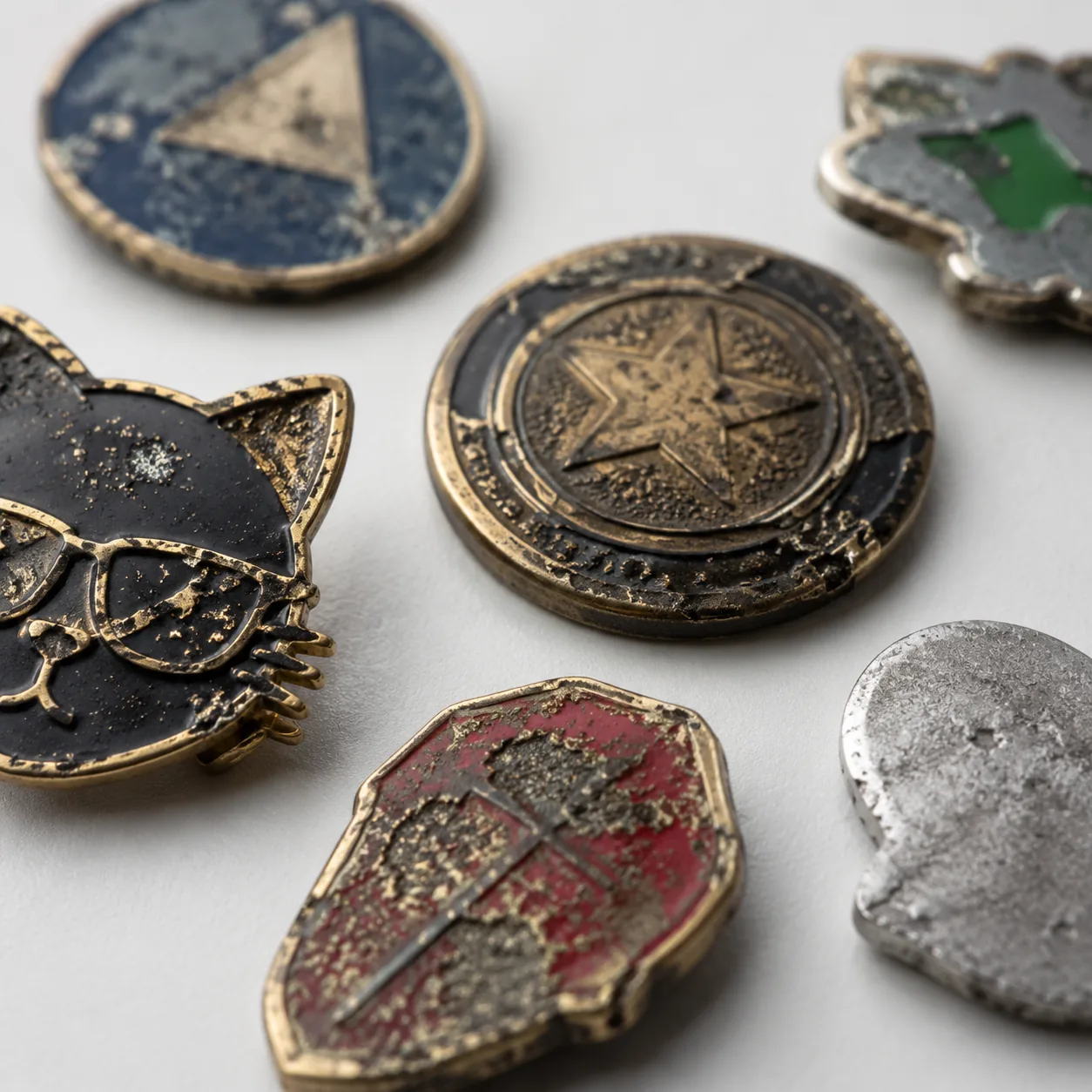
The buyer problem: cheap pin today, brand complaint later
A marketing team often asks for the lowest-cost pin for a conference, fan drop, museum shop or staff campaign, then discovers too late that the product has to survive jackets, backpacks, humidity and rough handling. Acrylic printed pins and metal enamel pins can both be made at 25 to 35 mm, packed on backing cards, and delivered in 12 to 30 days, but they fail in different ways. Acrylic pins usually fail by surface scratching, print chipping or pin back adhesive separation; enamel pins usually fail by plating defects, enamel overflow, sharp edges or weak clutch fit.
At ZheCraft, we make both printed acrylic items and metal enamel badges, so the recommendation is not automatically to push buyers toward the more expensive option. For a 5-day event giveaway, a 2 mm clear acrylic pin with UV print and epoxy top coat may be the correct decision. For a retail item, employee recognition badge or brand collectible expected to last 1 to 3 years, a 1.5 to 2.0 mm iron, brass or zinc alloy enamel pin is usually safer.
Spec table: acrylic printed pins vs enamel pins
The fastest way to choose is not by appearance but by the specifications you are willing to accept. The table below compares typical factory ranges for a 25 to 35 mm custom pin with 1 to 5 colors, packed individually in an OPP bag or mounted on a simple backing card. FOB prices vary with shape complexity, print area, plating finish, packaging, exchange rate and order timing, so treat these as planning ranges, not fixed quotes.
| Spec item | Acrylic printed pin | Metal enamel pin |
|---|---|---|
| Typical size range | 20 to 50 mm; 25 to 35 mm is most common | 15 to 45 mm; 20 to 35 mm is most common |
| Common thickness | 2.0 mm or 3.0 mm acrylic sheet | 1.2 to 2.0 mm metal body; 1.5 mm common |
| Material | Clear, white or colored PMMA acrylic | Iron, brass, zinc alloy or stainless steel depending on design |
| Decoration | UV print, screen print, offset print, optional epoxy dome | Soft enamel, hard enamel, printed enamel effect, optional epoxy |
| Minimum practical line | 0.25 to 0.35 mm printed line; no raised metal separation | 0.15 to 0.20 mm raised metal line for enamel separation |
| Color control | CMYK or spot print; Pantone simulation possible | Pantone enamel matching; metallic lines affect perceived color |
| MOQ planning tier | 100 to 300 pcs for simple UV print | 100 to 300 pcs for standard enamel; lower is possible but inefficient |
| Typical FOB price at 500 pcs | USD 0.35 to 0.85 each | USD 0.75 to 1.80 each |
| Typical FOB price at 2,000 pcs | USD 0.22 to 0.55 each | USD 0.45 to 1.20 each |
| Tooling or setup | Usually USD 15 to 60 for print setup or cutting file | Usually USD 40 to 120 for mold, depending on size and 2D or 3D detail |
| Normal production lead time | 7 to 14 days after artwork approval | 12 to 22 days after artwork approval; hard enamel often 18 to 28 days |
| Rush feasibility | Good if print file is clean and stock sheet is available | Limited by mold, plating and enamel drying steps |
| Attachment | Glue-on pin back, rubber clutch, safety pin, magnet option | Soldered or riveted nail, butterfly clutch, rubber clutch, magnet option |
| Durability expectation | Short to medium promotional use; 1 to 6 months in rough daily wear | Medium to long use; 1 to 3 years if plating and attachment are specified correctly |
| QC focus | Print registration, scratches, edge chips, glue strength | Plating thickness, enamel fill, burrs, clutch fit, color consistency |
| Recommended AQL | AQL 2.5 major, 4.0 minor for promotional orders | AQL 1.5 or 2.5 major, 4.0 minor depending on retail risk |
For a purely visual social-media campaign, acrylic gives more graphic freedom because gradients, shadows and photographic details are easier to print. For a tactile brand object, enamel wins because raised metal ridges, plated edges and weight make the item feel more permanent. If your buyer will compare the pin beside coins, medals or premium keychains, acrylic may look too lightweight even when the artwork is attractive.
Where acrylic pins beat enamel pins
Acrylic wins when the artwork has thin outlines, full-color illustrations, gradients, small text or character art that would be expensive or impossible to separate into enamel cells. A 30 mm acrylic pin can hold 0.8 to 1.0 mm high printed micro text if the file is sharp, although we usually recommend 1.2 mm minimum text height for reliable inspection. For enamel, the same small text may require raised metal strokes of at least 0.15 mm and recessed enamel cavities wide enough to fill cleanly, which changes the look of the art.
Acrylic is also faster because there is no metal mold, plating bath or enamel baking cycle. For 500 to 1,000 pieces with clean vector cutting lines and UV print, 7 to 10 production days is realistic after proof approval; carton packing and export handling usually add 1 to 3 days before pickup. This makes acrylic a practical choice when an event date is inside 3 weeks and air freight is already planned.
The cost advantage is real at small and medium quantities. A 30 mm 2 mm-thick acrylic pin with one-side UV print, epoxy face and rubber clutch may sit around USD 0.35 to 0.65 FOB at 500 pieces, while a 30 mm soft enamel pin with custom plating may be USD 0.85 to 1.50. The trade-off is that acrylic feels lighter, edges can chip if dropped, and the printed surface needs more protection than fired enamel.
Where enamel pins beat acrylic pins
Enamel pins win when perceived value, wear resistance and gift longevity matter more than the lowest unit price. A 30 mm soft enamel pin in 1.5 mm iron with 5 enamel colors, nickel plating at 5 to 8 microns and a soldered 8 mm nail usually feels more substantial than a 2 mm acrylic pin. Hard enamel raises the cost further but gives a polished surface closer to jewelry, with enamel and metal nearly level after grinding and polishing.
Metal also gives better attachment security when the back is soldered, riveted or cast as part of the body. For enamel pins, a standard nail is typically 0.9 to 1.0 mm diameter and 8 to 10 mm long, with clutch pull resistance commonly checked around 2.0 to 3.0 kgf depending on backing type. Acrylic pin backs are usually glued or bonded, so the adhesive area, curing time and surface preparation become critical; for heavy use we ask for a minimum 8 to 10 mm round glue pad and 24-hour cure before packing.
Enamel is the safer option for retail and recognition programs because defects are easier to define in measurable terms. You can specify plating thickness, burr limits, enamel fill level, backstamp clarity and clutch fit. Acrylic defects such as acceptable hairline scratches or slight print banding are more subjective unless the buyer approves a detailed golden sample and viewing-distance standard.
Cost comparison that procurement can actually use
The cheapest line on a quote is not always the cheapest delivered program. Acrylic often has lower tooling and lower unit cost, but it may need protective film removal, epoxy coating, thicker backing cards or replacement allowance if the item is handled as merchandise. Enamel has higher upfront mold cost but better reorder stability if the mold is stored and the plating, color and attachment specs are locked.
For a 1,000-piece order, a simple 30 mm acrylic printed pin might total USD 300 to 700 FOB including basic setup, while a comparable soft enamel pin might total USD 700 to 1,600 FOB including mold. At 5,000 pieces, acrylic may drop to USD 0.18 to 0.45 each, while soft enamel may drop to USD 0.35 to 0.95 depending on plating, number of colors and packaging. Hard enamel, transparent enamel, glitter, backstamp, double pin posts, premium carding or individual barcode labels can push the metal pin above USD 1.20 even at larger runs.
Freight can narrow the gap but usually does not reverse it. Acrylic is lighter, typically 2 to 5 g per 30 mm pin before packaging, while a similar enamel pin may be 5 to 12 g depending on thickness and base metal. However, if both are packed on 300 gsm backing cards in individual bags, the packaging may weigh more than the pin itself, so ask for gross carton weight before final budget approval.
Durability and safety: different risks, different tests
Acrylic pins should be tested for scratch resistance, print adhesion, edge smoothness and pin-back bonding. For a practical factory test, use a 3M tape pull on the print or epoxy area, 20 cycles of light rub with dry cotton cloth, and a simple drop test from 80 to 100 cm onto a hard surface for edge chipping. For children’s events, avoid sharp acrylic corners below a 1.0 mm radius and confirm that the pin back choice is appropriate for the age group and market regulations.
Enamel pins need a different inspection plan. Check plating coverage at recesses and edges, visible scratches under normal light at 30 to 40 cm viewing distance, enamel overflow beyond raised metal lines, exposed base metal, burrs, and clutch retention. For export promotional orders, we commonly see AQL 2.5 for major defects and 4.0 for minor defects; for retail, AQL 1.5 major is more suitable if the buyer has strict shelf standards.
Neither product should be accepted without an approved pre-production sample or a clear digital proof plus material reference for repeat orders. For acrylic, the approved sample should lock sheet thickness, print side, epoxy use, edge finish and attachment glue area. For enamel, it should lock mold shape, plating color, enamel colors, backstamp, thickness tolerance, attachment position and acceptable surface level.
Artwork decision: the same design should not be built the same way
Acrylic tolerates complex artwork better, but it still needs production discipline. Use vector cutting lines with at least 1.5 mm distance from artwork to outer edge where possible, and keep holes, narrow necks or antenna-like shapes wider than 2.0 mm to reduce breakage. If using transparent acrylic, remember that white ink underprint is needed under light colors, otherwise red, yellow and pastel tones may look weak against clothing.
Enamel requires artwork to be translated into physical metal ridges and recessed color fields. Avoid isolated enamel islands smaller than 0.5 mm, color channels narrower than 0.3 mm, and raised metal lines that disappear into sharp corners. A design with watercolor gradients, tiny facial details or photographic branding should be simplified before quoting enamel, not after the mold is cut.
For mixed campaigns, we sometimes advise buyers to use acrylic for the detailed character or event art and enamel for the main logo badge. This keeps the collectible artwork affordable while preserving a premium metal item for VIPs, staff or retail bundles. The key is to decide this before the RFQ, because the same 30 mm artwork can require completely different dielines, color callouts and inspection criteria.
Decision checklist: choose the build before asking for quotes
Before sending an RFQ, answer the practical questions below. They will prevent suppliers from quoting different assumptions and making the comparison useless. If two factories quote the same artwork but one assumes 2 mm acrylic with print only and the other assumes 1.5 mm soft enamel with nickel plating and backing card, the price gap tells you nothing.
- Choose acrylic printed pins if the artwork has gradients, photographs, comic-style shading or text below 1.2 mm high.
- Choose acrylic if the required production window is 7 to 14 days and the event date cannot move.
- Choose acrylic for budget giveaways where a 1 to 6 month useful life is acceptable.
- Choose enamel if the item is sold, collected, awarded or worn repeatedly on uniforms, jackets or bags.
- Choose enamel if the brand needs metallic outlines, plating finish, heavier hand feel or long reorder consistency.
- Avoid acrylic for very sharp shapes, thin protruding parts below 2.0 mm, or premium retail programs with high scratch complaints.
- Avoid enamel when the artwork depends on gradients, transparent shadows, fine photographs or many tiny separated colors.
- For both options, specify AQL level, approved sample control, packing method and attachment pull requirement before deposit.
What to do next: send one RFQ with two controlled options
The cleanest sourcing method is to ask for acrylic and enamel as two controlled alternatives in the same RFQ. Use the same size, quantity, packing and delivery term, then define the build separately: for example, Option A as 30 mm, 2 mm clear acrylic, one-side UV print with white underprint, epoxy front, rubber clutch, OPP bag; Option B as 30 mm, 1.5 mm iron soft enamel, 5 colors, nickel plating 5 to 8 microns, single 8 mm nail, rubber clutch, OPP bag. This lets procurement compare real differences instead of comparing supplier assumptions.
Ask the factory to state MOQ, mold or setup cost, unit price at 300, 500, 1,000 and 2,000 pieces, sample lead time, mass production lead time, carton quantity, gross weight and inspection standard. Also request one risk note from the supplier for each option; a serious factory should tell you if a thin acrylic part may break or if an enamel detail is below the filling limit. ZheCraft’s engineering team can review both versions from the same artwork and mark the areas that need widening, simplifying or changing before a sample is made.
If the deadline is tight, approve acrylic only after seeing a printed color proof or physical sample because CMYK output can shift more than buyers expect. If the product must feel permanent, approve enamel only after checking plating, enamel fill, attachment position and clutch fit on the pre-production sample. The right choice is not acrylic or enamel in general; it is the build that matches the item’s use, complaint risk, delivery date and budget ceiling.
Have a project? Send your artwork and target quantity and we’ll reply with a detailed quotation within 12 working hours.
Ready to get this made?
Send your sketch, target quantity and ship-date. Detailed quotation in 12 hours.



