A Retail Store Launch Using Custom Giveaways, Done Right
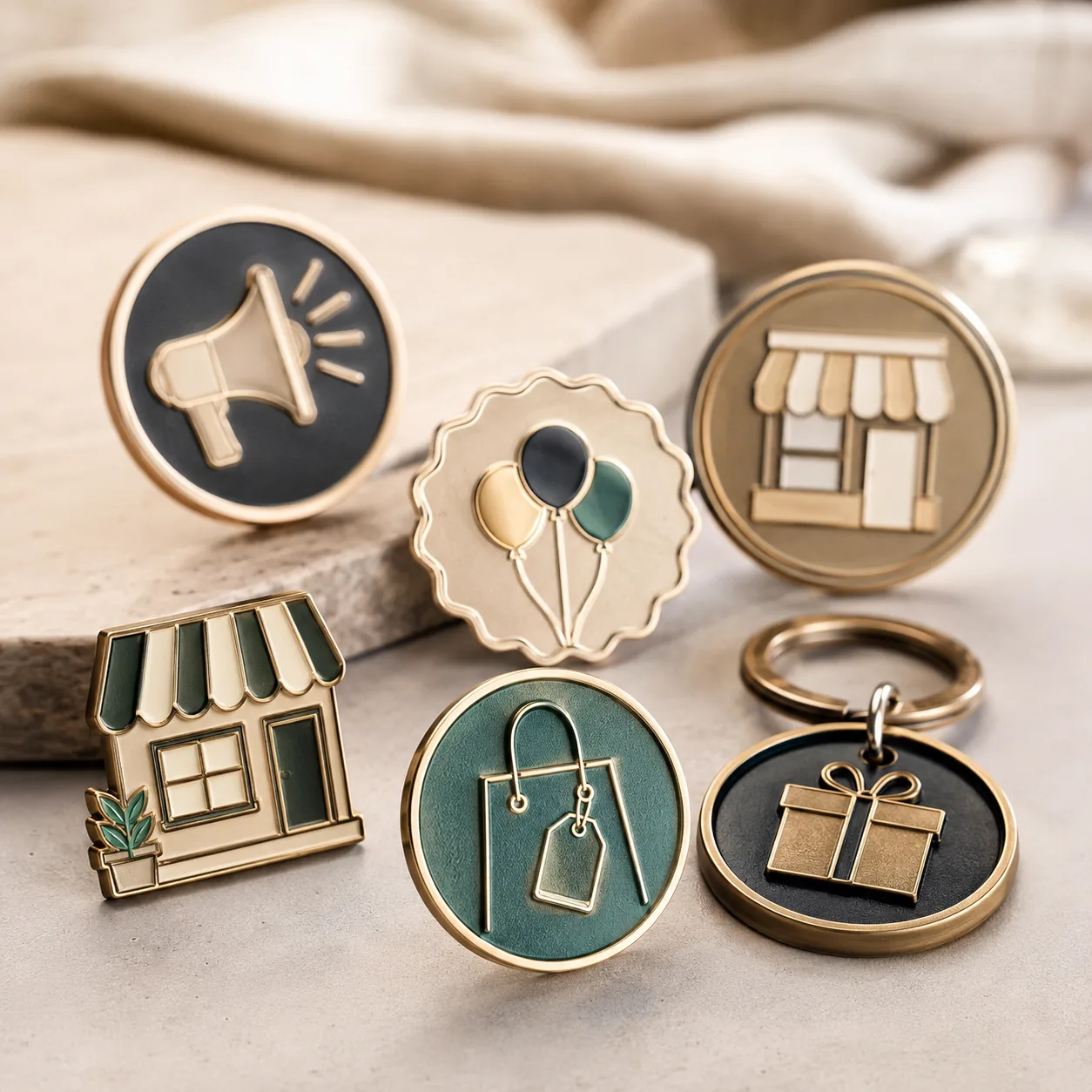
The brief: one launch, four giveaway types, one spec sheet
A retailer opening three new locations wants a coordinated launch kit that feels intentional, not bulk-produced. The set includes enamel pins for VIP invites, keychains for checkout gifts, fridge magnets for local mailers, and lanyards for staff and media badges. The challenge is not product selection; it is keeping color, finish, thickness, and packing consistent across four SKUs without forcing repeated sample rounds.
The fastest way to reduce rework is to define the program as a system before quoting. For a practical first pass, use pins at 25-30 mm, keychains at 35-45 mm, magnets at 50-70 mm, and lanyards at 15-20 mm wide. Typical metal builds are brass or iron with 0.8-1.2 mm thickness for pins and 1.5-2.0 mm for keychains. For decorative metal finishes, nickel or black nickel plating is usually specified by layer thickness in the 0.03-0.05 micron range on the visible finish stack, with the exact stack depending on factory process and base metal.
Set the commercial frame early as well: a common MOQ tier is 300 pcs per design for pins and magnets, 500 pcs for keychains, and 100-200 pcs for lanyards if the print is simple. First samples generally take 5-8 days, production 12-18 days for metal items and 7-12 days for lanyards after approval. FOB pricing is usually most useful in tiers, not a single number, because tooling, finish, and packing change the economics quickly.
Assign one job to each item
The easiest way to overpay is to make every item do every job. A pin should carry brand signal and collectability, but it should not be expected to survive daily abrasion like a keychain. A magnet is inexpensive and visible, but it cannot deliver the perceived value of a hard enamel pin. A lanyard is functional signage first; if it is treated like a premium gift, cost rises faster than customer value.
Assign one primary purpose to each SKU, then spec it to that purpose. Use pins for retention and prestige, keychains for daily carry, magnets for home or office visibility, and lanyards for access control and staff identification. Once that role is fixed, you can set the correct durability target, attachment choice, and packaging level. This also makes supplier comparisons cleaner, because you are comparing one job against one build instead of mixing premium and utility requirements.
- VIP pin: plated metal, tight color control, backing card, presentation-first
- Checkout keychain: durable construction, simple shape, strong split ring or lobster clasp
- Mailer magnet: flat back, light weight, low carton damage, reliable magnetic hold
- Staff lanyard: readable print, comfortable width, reinforced neck strap and clip
Freeze the visual system before quoting
Most mixed promo sets fail because the visual system drifts. The logo may be correct on each item individually, yet the red varies slightly, the metallic tone changes from piece to piece, and thin linework disappears on the smallest format. The fix is to define the color target, minimum line width, and plating family once, then apply those rules across the full set.
For enamel items, a minimum line width of 0.25-0.30 mm is realistic for clean fill and durable borders. Tiny type below about 4 pt is risky on metal and often becomes illegible once plated and filled. For printed lanyards, 6 pt is a safer floor for primary text, while fine subtext should be avoided unless the construction is woven or sublimated and the artwork is simplified. A factory should adapt the art per product while preserving hierarchy; it should not copy-paste the same file until the smallest item is unreadable.
| Item | Typical spec choice | Indicative FOB range | When to avoid it |
|---|---|---|---|
| Pin | Hard enamel, 25-30 mm, 0.8-1.2 mm thick | USD 0.85-1.80/pc at 300-1,000 pcs | Avoid if the art has gradients or tiny text |
| Keychain | Soft enamel, 35-45 mm, 1.5-2.0 mm thick | USD 1.10-2.60/pc at 500-1,000 pcs | Avoid if the buyer needs a fully flush surface |
| Fridge magnet | Printed or soft enamel, 50-70 mm | USD 0.45-1.25/pc at 1,000 pcs | Avoid if the item must be ultra-thin for mailing |
| Lanyard | 15-20 mm polyester or sublimated webbing | USD 0.35-1.10/pc at 500-2,000 pcs | Avoid if the brand needs rigid woven-edge detail |
Choose specs that fit the budget, not the mood board
A launch kit has a cost ceiling, and each item carries its own tooling, finishing, and packing cost. Metal pieces add mold charges, plating setup, and edge QC. Printed soft goods add color setup and textile waste. Magnets add assembly and carton volume. The practical answer is to spend on perceived value where the customer will notice it and simplify where the value is mostly invisible.
A 1,000-piece launch run may justify a hard enamel pin with butterfly clutch and backing card, while the matching keychain can stay soft enamel or printed metal if the art is simple. A magnet is often best as a single-piece printed die-cut with a paper insert, because freight cost is driven more by volume than by the item itself. For lanyards, a standard polyester strap with one-color screen print or sublimation is usually the most economical choice when the goal is visibility, not luxury feel.
Tight tolerances help prevent dispute later. A normal dimensional tolerance for small metal promo items is about ±0.2 mm on fine features and ±0.3-0.5 mm on overall size, depending on shape and process. Color should be matched to a named Pantone reference, not to a photo on a phone screen. For soft enamel, a fill-level tolerance that keeps color below the metal border line by roughly 0.1-0.2 mm is common and helps avoid overflow at the edges.
Compare supplier quotes on the same basis
Factory quotes are often incomparable unless the buyer normalizes the assumptions. One supplier may include tooling; another may not. One may quote nickel plating; another black nickel. One may inspect to AQL 2.5 for major defects, while another checks only final packing. If you do not standardize the quote, the lowest number is often just the least complete number.
A useful comparison sheet should show unit price at multiple quantities, tooling charge, sample fee, production lead time, packing method, and QC standard. Ask whether mold ownership transfers, whether the tooling is reusable for reorders, and what the color acceptance method is. For most retail launch programs, a straightforward comparison at 300, 500, and 1,000 pieces exposes real MOQ behavior and prevents surprise cost jumps after the sample is approved.
| Quote field | What to ask | Why it matters |
|---|---|---|
| Unit price | Price at 300, 500, 1,000 pcs | Shows real MOQ behavior, not just a headline number |
| Tooling | Is the mold charge separate and reusable? | Protects reorder economics and ownership |
| Lead time | Sample days and mass-production days | Keeps the launch date realistic |
| QC standard | AQL level and defect definition | Avoids disputes over visible flaws |
| Packing | Bulk, polybag, backing card, gift box | Affects freight, damage rate, and presentation |
Sample as if you were checking the shelf
A sample is not only for approval; it is a stress test for how the set looks in a mailer, on a shelf, and in a customer’s hand. Check every item under the same lighting and on the same background, then compare edge finish, color tone, and branding density. A pin that looks balanced at 30 cm can feel too small beside a large box insert, while a magnet can disappear if the print contrast is weak. The review should include the entire set, not just the hero item.
For metal goods, inspect plating coverage on edges and recesses, enamel flushness, and attachment strength. For lanyards, check print legibility, cut-end sealing, and stitching around the hardware. If the item has moving parts, ask for functional testing before approval. Useful acceptance targets include no burrs above 0.1 mm, no visible color bleed, no loose hardware after a manual pull test, and no carton crush after simulated transit handling.
- Inspect the full set together, not one sample at a time
- Approve the Pantone target, plating tone, and backing format
- Test pull strength, clasp closure, and clip rotation
- Photograph samples beside the approved art and packaging mockup
Pack for the channel that actually receives it
Retail launch goods do not all travel the same route. Some go to stores in master cartons, some to an event venue, and some directly into consumer mailers or PR kits. Packing should match the channel because the same item can fail in one format and perform well in another. A keychain that is fine in bulk may scratch if mixed loosely with magnets; a lanyard that is acceptable in a polybag may wrinkle if over-compressed inside a gift box.
The carton spec should reflect the weakest item in the set, not the strongest. For mixed promo kits, double-wall export cartons are common for heavier sets, with inner polybags, trays, or partition cards to stop metal-on-metal rub. For plated items, simple paper wraps or divider cards often reduce scuffing more effectively than adding heavier outer packaging. When goods are split across stores and media kits, the packing list must be exact enough that the warehouse can assemble the correct mix without reopening cartons to verify counts.
Lock the order before PO
Before issuing the PO, freeze the artwork version, quantity per SKU, Pantone target, plating family, and packing format in one approval sheet. Then ask the supplier to confirm tooling ownership, sample timetable, mass-production lead time, inspection standard, and FOB basis in writing. If the launch date is fixed, build in buffer for sample revision and outer-carton rework, because those are the steps that usually move a schedule by days, not hours.
For a mixed retail promo program, the most reliable next move is to compare every quote against the same checklist and reject any supplier that cannot explain its assumptions clearly. That single discipline prevents most launch-day failures: mismatched colors, missing hardware, bad pack-out, and late freight. The right factory partner does not just make the items; it keeps the whole rollout aligned from first sample to final carton.
- Freeze one approval sheet for art, quantities, Pantone, and packing
- Confirm MOQ, tooling, sample lead time, and mass-production lead time in days
- Request FOB pricing at 300, 500, and 1,000 pcs
- Ask for QC standard, ideally AQL 2.5 for major defects unless the product needs tighter control
- Approve the full set together before production release
Have a project? Send your artwork and target quantity and we’ll reply with a detailed quotation within 12 working hours.
Ready to get this made?
Send your sketch, target quantity and ship-date. Detailed quotation in 12 hours.



