A Buyer’s Walkthrough: From Brief to Shipped Promo Set
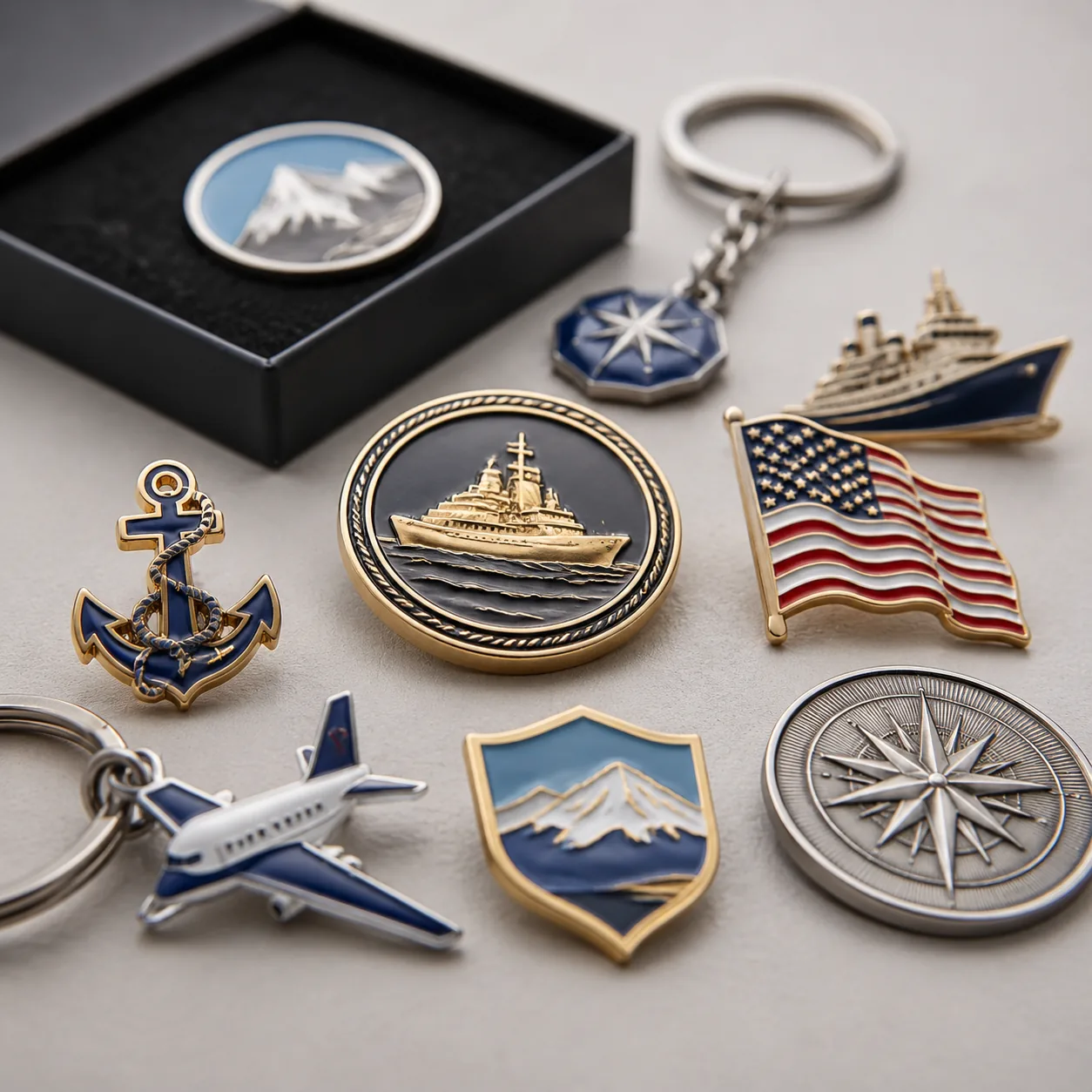
Start with one campaign system, not five disconnected products
The most common failure in multi-item promo programs is not weak artwork; it is strong artwork pushed through the wrong production logic. Marketing teams often want enamel pins, challenge coins, woven patches, lanyards, and fridge magnets to launch together, but each item has different limits for line weight, relief, color control, tooling, and pack-out. If you do not define the order as one system, you end up with one logo rendered five different ways, with drift in Pantone tone, edge sharpness, gloss level, and delivery date.
The right starting point is the buyer outcome: one campaign set that arrives on time, looks like one brand family, and can be reordered later without redesign. For Chinese factories, that means locking the shared brand standards first, then translating them into each SKU’s process constraints. At ZheCraft, we usually ask buyers to confirm the master visual, the hero item, the target quantity split, and the acceptable trade-offs before quoting individual items.
A practical campaign brief should specify the product mix, whether the items are for retail, internal recognition, or event giveaway, and whether the set must be sold or handed out as one unit. That distinction affects everything from finish selection to bagging method. A VIP gift set can justify thicker plating and presentation boxes; an internal event pack may need faster lead time and simpler packaging.
Use one order logic for the whole set: one visual standard, one delivery date, one packaging plan, and one approval path. The more separate the instructions become, the more likely you are to get different shades, different tolerances, and different interpretations of what “match” means.
Define the campaign architecture before you ask for price
A usable RFQ for a promo set should describe how the items will be used, not just what they are. Are the pins for staff badges, the coins for VIP handouts, the patches for uniforms, and the lanyards for event credentials? The use case determines acceptable weight, attachment style, surface durability, and packaging. If the set is for a conference, a plain PVC card or printed insert may be fine, but a badge-facing lanyard with poor print clarity will fail immediately.
Before requesting quotes, decide which item is the hero and which items are supporting SKUs. The hero item usually gets the tightest tolerance, the best finish, and the most approval rounds; the supporting items should match visually without copying every feature. This keeps the budget where attendees will actually notice it and avoids over-engineering lower-value pieces.
A clear brief should also state whether the whole program must ship in one lot or can be split by SKU. Split shipments can reduce schedule risk, but if you need a launch-day kit, the factory must treat assembly as part of the production scope, not an afterthought. For mixed sets, the quote should show item pricing, pack-out pricing, and any service charge for split cartons or rush scheduling.
- State the campaign purpose in one line: retail, event giveaway, internal recognition, or VIP gift
- Identify the hero SKU and the supporting SKUs
- Confirm whether all items must ship in one carton lot or can be split by SKU
- Set the required delivery window in calendar days, not just a month
- Decide whether reorder consistency matters more than the lowest first-order price
Build one brand master, then translate it by product type
The fastest way to create inconsistency is to send each factory team a slightly different logo file. A campaign set should use one master brand file with fixed Pantone references, approved line weights, and a note on which elements can be simplified. For example, a 0.25 mm line that works on a printed lanyard may need to become 0.4 mm or disappear entirely on a soft enamel pin. The artwork should be treated as one master, then adapted per process.
Color matching also needs translation, because the same Pantone number does not behave identically across hard enamel, soft enamel, woven thread, screen print, sublimation, and offset print. We recommend buyers designate one color hierarchy: must-match colors, close-match colors, and flexible colors. That lets the factory protect the brand-critical shades while avoiding endless revision cycles over minor background tones.
For metal items, provide vector artwork with text converted to outlines and specify minimum line width and smallest negative space. As a rule of thumb, 0.25 to 0.3 mm is the lower practical limit for many promotional pin details, while woven and printed products can carry finer artwork only if the process supports it. If a logo includes microtype or thin diagonal strokes, plan to simplify it early rather than force a weak production result later.
A clean artwork package should include AI, PDF, and SVG files, Pantone callouts, and one annotated reference sheet that states what can and cannot move. If the file set lacks that hierarchy, revisions tend to be driven by opinion rather than production reality.
| Item | Typical production constraint | Buyer risk if ignored |
|---|---|---|
| Soft enamel pin | Min line width about 0.3 mm; recessed fill can vary slightly | Tiny text fills in or looks muddy |
| Challenge coin | Detail holds better, but raised/recessed contrast matters | Busy artwork loses legibility |
| Woven patch | Thread limits fine gradients and micro text | Logo edges blur or simplify |
| Sublimated lanyard | Good for full color, less tactile depth than woven | Brand looks flat if expecting texture |
| Fridge magnet | Face graphics can be broad, but magnet strength must match size | Looks good but fails in use |
Price the set as a system, not as isolated SKUs
A low per-piece quote can be misleading if it excludes tooling, color revisions, or separate packing. For mixed promo sets, factories price each item differently because setup costs are different: die tooling for metal goods, stitch setup for patches, print setup for lanyards, and assembly for magnets or kit packing. If you compare only unit price, you may select a quote that becomes expensive once packaging, kitting, and rework are added.
As a working FOB China reference for small-to-mid custom runs, enamel pins often fall around USD 0.35 to 1.80 per piece depending on size, plating, and back stamp; challenge coins around USD 1.20 to 4.50; woven patches around USD 0.18 to 0.85; printed or sublimated lanyards around USD 0.25 to 1.10; fridge magnets around USD 0.30 to 1.40. Typical MOQs are 100 to 300 pieces for pins and magnets, 100 to 500 for coins, and 200 to 500 for patches and lanyards. If the order needs custom backing cards, individual polybags, or mixed set assembly, expect the MOQ and unit cost to rise.
A practical way to quote the project is to separate recurring unit price from one-time setup cost. Tooling, film, setup, and sample fees should be transparent. For many buyers, a clean quote shows the production unit price, a one-time mold or setup charge, and optional assembly cost per set. That makes it possible to compare vendors without hiding labor inside a deceptively low item price.
Lead time should be quoted by stage: sample approval in 5 to 10 days, production in 10 to 20 days for simpler items, and 15 to 30 days for mixed or kitted orders. If a supplier promises the whole set in a week, they are likely using stock items or skipping proper approvals. Budget time for one sample round and one production run, not two or three rescue rounds.
| SKU | Typical FOB China price range | Typical MOQ | Common setup cost driver | Realistic lead time |
|---|---|---|---|---|
| Enamel pin | USD 0.35–1.80/pc | 100–300 pcs | Die/mold, plating, soft enamel fill | Sample 5–10 days; production 10–20 days |
| Challenge coin | USD 1.20–4.50/pc | 100–500 pcs | Coin mold, edge text, antique plating | Sample 6–10 days; production 12–22 days |
| Woven patch | USD 0.18–0.85/pc | 200–500 pcs | Stitch program, border style | Sample 4–8 days; production 10–18 days |
| Printed/sublimated lanyard | USD 0.25–1.10/pc | 200–500 pcs | Print setup, hardware attachment | Sample 3–7 days; production 10–15 days |
| Fridge magnet | USD 0.30–1.40/pc | 100–300 pcs | Cut line, substrate, lamination | Sample 5–9 days; production 10–18 days |
Choose the right specs for each item, not one universal standard
A campaign set works best when each item has a spec that matches its function. Pins need plating thickness and clasp control; coins need rim and relief consistency; patches need stitch density and border style; lanyards need print method and hardware choice; magnets need magnetic force and face durability. Forcing one spec template onto all items usually creates overpayment in some areas and underperformance in others.
For metal items, ask for plating thickness in microns where relevant. A practical commercial range is around 0.1 to 0.3 microns for decorative plating on promotional goods, with better wear performance toward the higher end if the base process supports it. For soft enamel pins, a typical size tolerance of ±0.2 mm is reasonable on promotional work; for coins, critical features often hold within ±0.15 to ±0.25 mm. The more delicate the artwork, the more you must protect line width and corner radii.
For soft goods, shift the spec language to the process. Woven patches usually need a thread resolution that supports the artwork, often with simplified gradients and restrained microtype. Printed lanyards should state width, print side, attachment hardware, and fabric feel. For 20 mm lanyards, a width tolerance of around ±2 mm is common; for patches, size tolerance around ±2 mm is generally acceptable if the border and sew line remain clean. Magnets should define substrate thickness, face coating, and pull strength rather than just artwork size.
If you need a more durable promotional finish, specify it plainly: for example, soft enamel with epoxy dome, antique nickel plating, or woven patch with heat-cut edge. Ambiguous phrases like “premium” or “high quality” do not help production; measurable details do.
| SKU | Key buyer spec | Typical tolerance / range |
|---|---|---|
| Enamel pin | Plating, fill level, clasp type | ±0.2 mm size; 0.1-0.3 micron decorative plating |
| Challenge coin | Rim width, relief depth, edge text | ±0.15 to 0.25 mm on critical features |
| Patches | Merrowed border or laser cut, thread density | Size tolerance around ±2 mm |
| Lanyards | Print method, width, attachment hardware | Width tolerance around ±2 mm |
| Magnets | Magnet type, pull strength, face coating | Size tolerance around ±1 to 2 mm |
Ask for the sample that proves the risky part
One polished pre-production sample can still hide the order’s real risk. If the hard part is a two-color enamel fill, a dense woven logo, or a secure swivel clasp, the sample should be built around that failure point. The purpose of sampling is not to admire the product; it is to force the factory to prove the feature most likely to fail in mass production. For mixed sets, that usually means approving one sample per process family, not necessarily one per SKU if the logic is shared.
When reviewing samples, use a simple pass/fail list. Check color against the master, attachment security, plating evenness, edge burrs, print registration, and packaging fit. If a sample is cosmetically good but the clasp rotates, the magnet slips, or the patch border curls, do not move forward yet. Cosmetic approval without functional approval is a common cause of returns.
If the order includes presentation packaging, approve the packed sample, not just the loose product. A pin that looks right on the bench can shift in a backing card, and a magnet that is sized correctly may still fail if the carton insert compresses it or the blister size is off.
For example, if your hero item is a 30 mm soft enamel pin with black nickel plating and a butterfly clutch, test the clutch pull, confirm the epoxy or fill surface is level, and verify the logo text remains readable at arm’s length. That is more useful than approving a perfect-looking but irrelevant blank sample.
- Confirm the sample matches the final material, not just the final artwork
- Check critical dimensions with a ruler or caliper, not by eye
- Test closures, hooks, magnets, and backing cards by hand
- Compare the sample under daylight and indoor light
- Approve only after writing down the exact revision points
Set QA rules that match the mix of products in the set
Quality control for a promo set should not be a vague promise of “AQL acceptable.” It should name the defect classes and the inspection depth. For decorative promotional goods, a practical approach is AQL 2.5 for major defects and AQL 4.0 for minor defects, with major defects defined in functional terms: broken attachment, missing part, wrong color family, missing magnet, or unusable print. Minor defects can include tiny surface marks, small plating specks, or slight thread variation if they do not affect display or function.
Mixed orders also need pack-out control. A pin, coin, patch, and lanyard that are all correct individually can still fail as a campaign if the quantities inside each gift set are wrong. The factory should verify unit counts, insert cards, OPP bags, tray separators, carton marks, and master carton labels. If you are kitting multiple SKUs, insist on one final count sheet before shipment, especially when the order is split across different production lines.
At ZheCraft, we treat mixed sets like a mini assembly project. That means one master packing list, one approved set photo, and a carton-level check for each SKU and each inner pack. It is more work than a simple single-item order, but it prevents the classic problem of receiving 4,980 good pieces and 20 missing parts that no one can trace after arrival.
For high-value programs, ask for an inspection report that records sample size, defect categories, and carton count. If the order is 1,000 sets, you should know how many were checked, how many defects were found, and whether any rework was done before loading. A useful factory report should also show the accepted quantity by SKU, not just the total order result.
One practical target is a light-to-standard random inspection on the packed lot before shipment, then a final photo record of outer cartons and one sample inner carton. That gives the buyer enough evidence to release the cargo without overcomplicating a small program.
Use the right shipment plan so the whole set arrives usable
A buyer often discovers too late that shipping format affects usability. If your coins arrive in bulk but your pins are carded, the set may look inconsistent on display. If the lanyards are packed separately from badge holders, the event team spends time sorting instead of distributing. The shipment plan should therefore be written alongside the product specs, not after production is done.
For event programs, one practical strategy is to ask for kitting by end-user unit if the factory can control it accurately. That may mean one enamel pin, one patch, one lanyard, and one magnet packed together in a single polybag or box with one insert card. The trade-off is higher labor cost, usually adding about USD 0.03 to 0.25 per set depending on complexity, but it can save hours of handling on your side. If the set is for retail resale, individual SKU packing is usually the better choice.
Before shipment, confirm Incoterms, carton dimensions, gross weight, and whether you need a mixed lot or separate cartons by SKU. FOB terms are usually simplest for international buyers who already have a forwarder, while DDP can be attractive for small event deadlines but requires tighter cost visibility. Either way, make the factory responsible for a defined pack-out standard and you responsible for a defined receiving standard.
A concrete shipment plan might specify 50 sets per inner carton, 10 inner cartons per master carton, carton size in centimeters, and gross weight limit below 15 to 18 kg for easier handling. That level of detail reduces damage, avoids overpacked cartons, and makes warehouse receiving faster. If the set is retail-facing, request consistent face orientation and barcode placement so the cartons can be scanned without opening.
Lock the brief, then move to production without rework
If you are planning a multi-item campaign, do not start by requesting five separate quotes from five separate suppliers. Start by building one master brief with the use case, hero SKU, color hierarchy, target quantities, packaging style, and delivery date. Then ask for process-specific quotes for each item, plus one combined pack-out option if you need sets assembled. That gives you a real comparison between unit cost, setup cost, and handling cost.
Your next move should be to lock three things before mass production: the master artwork, the risky-feature sample, and the final packing plan. If those three are fixed, the factory can usually produce the rest with far fewer surprises. If you want a single supplier to manage the mix across pins, coins, patches, lanyards, magnets, and related promo goods, ZheCraft can quote the set as one coordinated order so the visual standard, production timing, and packing logic all stay aligned.
For buyers managing a launch calendar, the cleanest process is: brief, quote, sample, revise once, approve, produce, inspect, ship. Any extra loop usually comes from an unclear spec or a missing pack-out decision, not from the factory itself. Keep the approval trail tight, and the whole campaign behaves like one product instead of five separate emergencies.
Have a project? Send your artwork and target quantity and we’ll reply with a detailed quotation within 12 working hours.
Ready to get this made?
Send your sketch, target quantity and ship-date. Detailed quotation in 12 hours.



