A 2026 Tariff-Era Sourcing Plan for Custom Metal Giveaways
Focus on landed cost, not the headline FOB quote
A realistic 2026 sourcing brief is a US distributor supplying a museum-store launch with three SKUs: a 1.25 inch soft enamel pin, a 2.00 inch zinc alloy keychain, and a 1.75 inch commemorative coin. In that situation, FOB is only the factory starting point. Margin is actually determined by landed cost after duty, customs brokerage, merchandise processing fee, harbor maintenance fee where applicable to ocean entries, origin handling, carton inefficiency, domestic drayage, and the occasional air shipment required when approvals slip.
That distinction matters because low- to mid-value custom metal products do not have much room to absorb avoidable cost. A pin quoted at USD 0.31 to 0.42 FOB can easily gain another USD 0.08 to 0.22 per unit after retail carding, polybagging, third-party inspection, brokerage allocation, and freight allocation. Heavier SKUs such as coins and keychains are even more sensitive because changes in thickness, attachments, and packaging alter both customs value and shipping density. A cheaper piece price can become the more expensive program once packed weight and cubic volume are included.
The common error is optimizing too late. After artwork approval and tool cutting, a buyer can still reduce a coin from 4.0 mm to 3.0 mm, remove a decorative connector from a keychain, or replace a rigid gift box with an OPP bag, but the biggest savings usually come earlier through material choice, standard finish selection, and carton planning. Serious buyers therefore move the discussion away from unit price alone and toward the true cost drivers before sampling starts: alloy, thickness, unit weight, plating route, attachment count, packaging type, inspection level, and shipment timing.
Run the whole program from one commercial control sheet
Assume the launch needs 3,000 pins, 2,000 keychains, and 1,000 coins for delivery before a May floor set, with final art nearly approved and only plus or minus 2 mm size flexibility. If each SKU is quoted as a separate mini-project, cost leakage shows up quickly: one supplier samples antique brass, another sends matte gold, the pin uses one barcode placement, the coin uses another, and the cartons all arrive with different dimensions and fill rates. None of that improves sales, but all of it increases approval time and operating friction.
A better approach is one buyer-side control sheet covering every shared variable. Lock the plating family, barcode format, retail language, carton marking format, export carton gross-weight cap, inspection standard, and approval path at the program level. Then allow only construction, size, and functional hardware to vary by SKU. A practical specification would be one antique-brass appearance across all items, one AQL of 2.5 major and 4.0 minor, one master-carton cap of 13.5 kg gross, and one label placement rule across the program.
This is not paperwork for its own sake. Mixed plating tones create expensive shade disputes. Mixed bag and card specifications increase purchasing complexity. Mixed carton sizes reduce pallet efficiency and add warehouse touches. In many promotional-metal programs, those inconsistencies destroy more margin than a small movement in factory price.
Select construction that reduces weight and labor before changing appearance
When tariffs rise, buyers often ask for something visibly cheaper. That is usually the wrong lever. The better move is to preserve the front-facing look while cutting metal mass, secondary assembly, and package bulk. Those changes reduce factory cost, freight cost, and the customs-value base without making the item look obviously downgraded at retail.
For a 1.75 inch coin, brass die-struck construction at 4.0 mm remains the premium standard when the design requires sharp edge text, mirror fields, or crisp military-style relief. But that build is metal-intensive and heavy. A zinc alloy die-cast coin at 3.0 mm typically cuts unit weight by about 20 to 28 percent, depending on relief coverage and whether the edge is plain, rope, or reeded. On a 1,000-piece run, that often lowers FOB by USD 0.20 to 0.45 per piece. The trade-off is that die-cast zinc does not reproduce fine mirror areas or edge lettering as cleanly as die-struck brass, especially below roughly 0.30 mm line width.
For a 2.00 inch keychain, cost is often driven more by parts count than by shape alone. A stamped multi-part brass build with a custom connector, spinner, or layered insert can look premium, but it adds assembly labor, reject points, and plated surfaces that all need color consistency. A 2.5 to 3.0 mm zinc alloy die-cast body paired with one standard 25 mm split ring and one 8 to 10 mm jump ring is usually the more stable platform. Consolidating two decorative metal parts into one body plus standard hardware can save USD 0.12 to 0.30 per unit at 2,000 pieces while also reducing defect exposure at the connector.
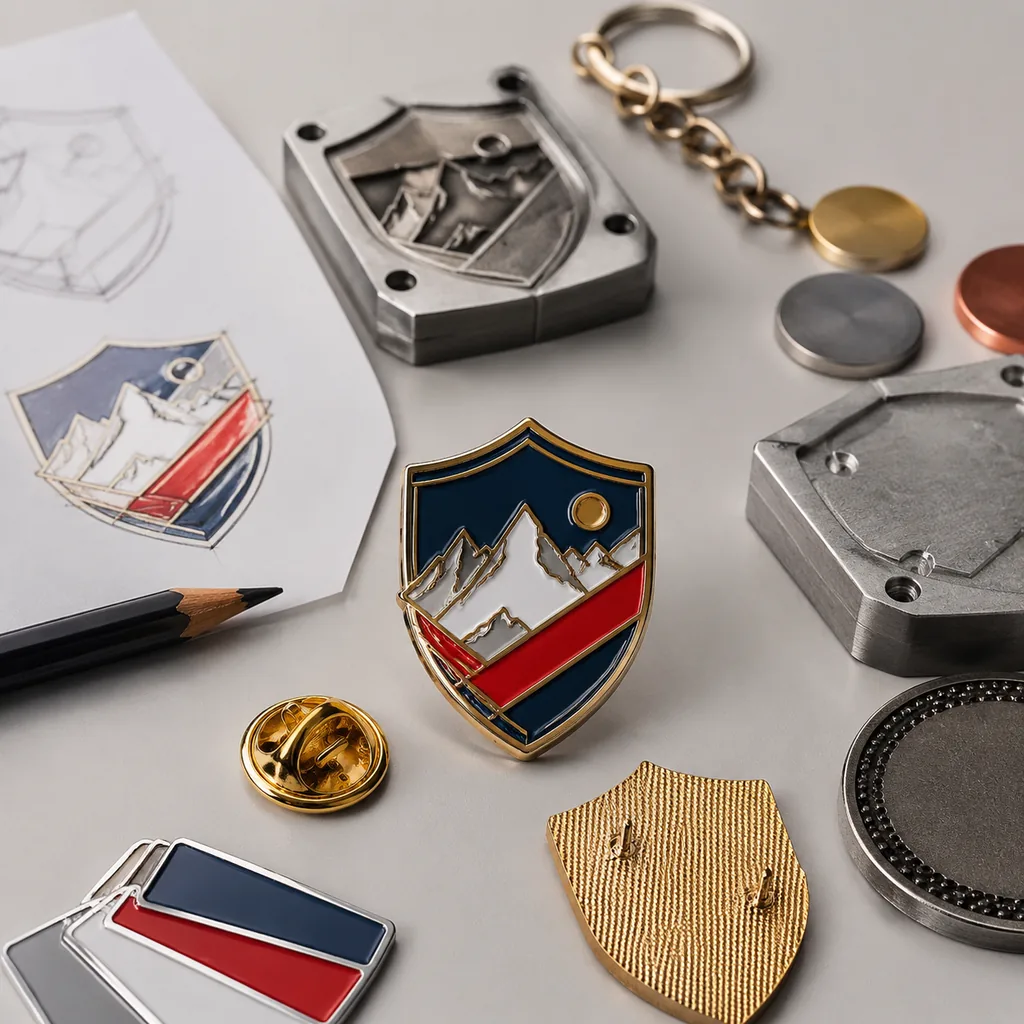
For a 1.25 inch pin, iron with soft enamel at 1.5 to 1.8 mm thickness remains one of the most cost-effective constructions for museum, event, and gift-shop programs. Common MOQs start around 100 to 300 pieces depending on factory and finish. At 3,000 pieces, a straightforward iron soft enamel pin with one post and butterfly clutch is often in the USD 0.27 to 0.50 FOB range before retail packaging. Brass or copper with imitation hard enamel, offset print plus epoxy, or true hard enamel should be chosen when the retail position justifies the upgrade, not by default.
| SKU | Premium build | Cost-control build | Typical MOQ and FOB tiers | When not to downgrade |
|---|---|---|---|---|
| 1.25 inch pin | Brass or copper, imitation hard enamel or hard enamel, 2.0 mm, 2 posts | Iron, soft enamel, 1.5-1.8 mm, 1 post if balance allows | MOQ 100-300 pcs; 500 pcs: USD 0.46-0.90; 3,000 pcs: USD 0.27-0.50; 5,000 pcs: USD 0.23-0.43 | Keep premium if the item is jewelry-positioned, has fine printed detail under 0.20 mm, or needs higher gloss retention |
| 2.00 inch keychain | Stamped brass or steel, layered parts, spinner or custom connector | Zinc alloy die-cast body, 2.5-3.0 mm, standard jump ring plus 25 mm split ring | MOQ 300-500 pcs; 500 pcs: USD 1.00-1.75; 2,000 pcs: USD 0.72-1.20; 5,000 pcs: USD 0.60-1.00 | Do not simplify if motion, layered depth, or a signature connector is central to the concept |
| 1.75 inch coin | Brass die-struck, 4.0 mm, polished edge, higher relief | Zinc alloy die-cast, 3.0 mm, antique finish, standard edge | MOQ 100-300 pcs; 300 pcs: USD 2.00-3.10; 1,000 pcs: USD 1.15-2.00; 3,000 pcs: USD 0.92-1.65 | Keep brass if the coin is an award piece, uses mirror fields, or needs sharp edge text below 0.30 mm line width |
Lock finish, plating, and quality metrics before sampling
Finish discipline matters because every extra plating family creates setup cost, visual ambiguity, and rework risk. Buyers often approve one sample in antique brass, one in antique gold, and one in matte gold because each looks acceptable by itself. In production, that creates three different shade standards and a much higher chance of disputes at final inspection.
A stronger specification defines one finish family and one measurable route. If antique brass meets the visual goal, specify a nickel underplate with antique-brass top finish and a clear electrophoretic or lacquer topcoat where abrasion is a concern. For promotional metal, a decorative top-finish target of about 0.03 to 0.08 microns is commercially realistic. That is not jewelry plating, but it is a normal production range for pins, coins, and keychains and is far more actionable than simply writing antique brass.
Quality language should also be numeric. Major dimensions can usually hold to plus or minus 0.15 mm to 0.30 mm depending on process and feature type. Thickness tolerance is often plus or minus 0.10 mm to 0.20 mm. Soft enamel fill should appear even from a normal viewing distance of 30 cm, with no obvious underfill, overflow, or contamination. If offset or screen print is used, specify at least 0.15 mm minimum positive line width and plus or minus 0.10 mm print registration. For incoming or pre-shipment inspection, AQL 2.5 major and 4.0 minor is a practical default; tighten only on functional points such as clutch fit, split-ring closure, or coin capsule sizing.
For high-handling items such as keychains, abrasion language should be explicit. Instead of only naming the finish, specify that there must be no peeling, exposed base metal on front-facing surfaces, or obvious plating voids after normal bulk packing, carton transit, and manual handling. The sealed approved sample should remain the visual master standard, supported by measurable tolerances rather than a vague promise of a similar antique tone.
Treat packaging density as a cost and duty lever
Under tariff pressure, packaging is not just presentation. It affects unit cost, freight cost, and in many cases the declared customs value. On inexpensive metal items, unmanaged packaging can equal 20 to 40 percent of factory product value. A thick zip bag, printed sleeve, and oversized master carton can erase the savings from an otherwise competitive quote.
For the museum example, the densest practical structure is usually best. The pin can be mounted on a 300 to 350 gsm backing card in a self-seal OPP bag around 40 to 50 microns thick. The keychain can ship in one clear OPP or PE bag if it is sold loose or from a bin display. The coin can use a PVC sleeve, PE bag, or a low-profile capsule only if scratch protection or display requirements justify it. Velvet boxes, rigid paper boxes, and acrylic cases should be quoted as separate options, not treated as default packaging.
Carton planning should be written into the RFQ and purchase order. A practical export target is a master carton length of 40 to 45 cm, gross weight below 14 kg, and packed counts that minimize dead space. If inner cartons are used, require inner-pack quantity, master-pack quantity, carton dimensions, and net and gross carton weight before mass production starts. A USD 0.02 unit saving on factory price is meaningless if packaging decisions add more than that back through poor freight density and extra warehouse handling.
- Request packed quantity per inner and master carton on every quote
- Set a maximum master-carton gross weight of 12-14 kg
- Use one packaging material family across SKUs unless retail display requires exceptions
- Verify carton dimensions against pallet efficiency before approving sleeves, inserts, or gift boxes
- Quote rigid boxes, velvet boxes, acrylic cases, and capsules as separate ROI decisions
The economics are usually straightforward. A simple coin capsule can add about USD 0.08 to 0.18 per unit. A velvet box often adds USD 0.45 to 1.20 and also lowers carton density enough to increase freight cost. If the coin retails at USD 14.99 to 19.99 as a keepsake, that packaging may be justified. If it is a commemorative giveaway or event premium, dense protective packaging is usually the better commercial choice.
Stage technical commitment before volume commitment
A common tariff-era mistake is rushing full production because of headlines rather than confirmed demand or final logistics timing. That can leave the buyer holding excess inventory imported at the wrong landed-cost basis. A safer pattern is to separate technical commitment from volume commitment.
Stage one should cover final artwork, tooling, one pre-production sample per SKU, finish approval, package approval, and deposit for the first release quantity only. Stage two should define the reorder framework: tooling ownership, locked construction specifications, approved packaging method, and a validity window for quoted metal and plating assumptions. In practice, FOB validity is often 15 to 30 days, especially when zinc, copper, and plating chemistry costs are moving.
For the example program, the buyer might release 60 to 70 percent of forecast for the first shipment and hold the remaining 30 to 40 percent for a second release once launch timing, sell-through, and import conditions are clearer. That is especially useful where coins and keychains tie up more inventory value than pins. The objective is not delay for its own sake; it is avoiding tariff-inflated landed cost on stock that does not need to enter immediately.
Typical lead times support this structure. Pre-production samples usually take 7 to 10 calendar days after final art approval and deposit receipt. Mass production commonly runs 12 to 18 days for standard soft enamel pins, 15 to 22 days for zinc alloy keychains, and 15 to 25 days for coins depending on relief depth, plating load, and packing complexity. Add inspection, booking, port handling, and transit separately. Buyers should also ask whether plating, assembly, and packing run in-line or sit in separate queues, because queue structure often explains real lead-time variation better than the advertised production window.
Write RFQs that expose the real cost drivers
A tariff-era RFQ has to force comparability. If the buyer only asks for a lower price, suppliers can respond with vague reassurances instead of useful trade-offs. Request at least two or three construction versions per SKU: one baseline build closest to the desired retail appearance, one weight-saving option, and, where relevant, one packaging-light option. Require MOQ, tooling charge, sample charge, sample lead time, production lead time, FOB by quantity tier, packed quantity per carton, carton dimensions, and estimated net and gross carton weights.
Useful quantity breaks are usually 300, 500, 1,000, 3,000, and 5,000 pieces, even if only one tier will be ordered now. Those breaks reveal where tooling amortization fades and where raw material, plating, or assembly labor becomes the main driver. A capable supplier should also explain what causes each saving scenario: thinner base metal, lower unit weight, one post instead of two, a standard ring replacing a custom connector, one less assembly step, or denser packaging.
The RFQ should ask for measurable controls rather than soft language. State plating family, decorative finish thickness target, base material thickness, attachment count, tolerances, AQL level, carton weight limit, and rework responsibility for finish mismatch, hardware defects, or packing errors. If a supplier returns only a one-line price with no construction breakdown, the quote is not strong enough for a tariff-sensitive sourcing decision.
A practical checklist for a 2026 launch
Rebuild the next sourcing round around landed cost rather than headline FOB. Start with non-negotiables: launch date, target retail presentation, finish family, attachment and safety requirements, carton weight limit, inspection level, and whether the goods must ship in one release or can be split. Then require each supplier to quote one baseline build and one cost-control build for every SKU before samples are approved.
For mixed programs covering pins, keychains, coins, medals, or similar metal giveaways, keep one master specification sheet and one approval path for shared details such as plating tone, barcode format, packaging rules, and acceptance criteria. That reduces preventable variation and makes later decisions faster when freight, duty, or demand assumptions move.
Most importantly, decide in advance which lever will be pulled first if landed cost rises by 8 to 12 percent. In most programs, the best sequence is to simplify packaging first, reduce secondary attachments second, trim thickness or weight third, and split shipment timing before compromising the visible front-face design. Once goods are sampled, tooled, plated, and packed, every correction becomes slower, more expensive, and harder to negotiate.
Have a project? Send your artwork and target quantity and we’ll reply with a detailed quotation within 12 working hours.
Ready to get this made?
Send your sketch, target quantity and ship-date. Detailed quotation in 12 hours.



