8 QC Failure Modes That Ruin Custom Promo Orders
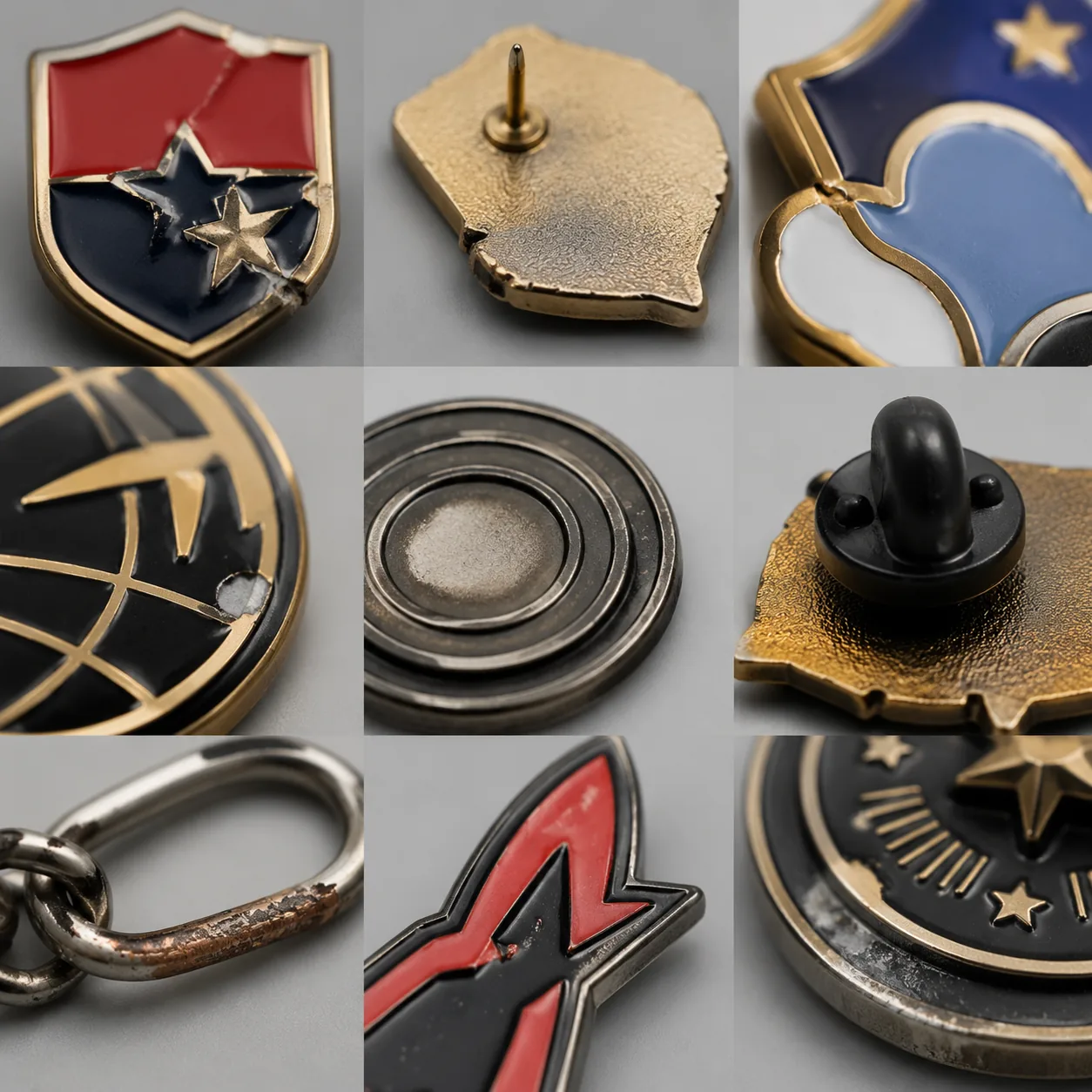
Why good artwork still fails on the line
Most promo product rework does not start with bad design. It starts when a workable design is translated into a build that the factory cannot hold at scale: a 0.18 mm line disappears in tooling, a recess is too shallow for enamel to level, or a plating choice changes how the finished surface reads under light. Buyers often approve a clean render and then discover that the process has less detail, more shrinkage, and different color behavior than the mockup implied.
The right way to prevent this is to spec for failure modes, not just appearance. For custom enamel pins, challenge coins, medallions, keychains, woven patches, PVC patches, and lanyards, the real question is what can drift during tooling, filling, finishing, packing, and transit. At ZheCraft, the same pattern repeats: when the buyer locks tolerance, thickness, plating, and inspection standard up front, the factory can control the process; when they do not, the quote may look fine but the output becomes a string of small defects that add up to a rejected order.
For context, common factory pricing for standard promo items is not exotic: soft enamel pins in the 1.0-1.5 inch range often land around USD 0.45-1.80 FOB at 300-500 pieces, custom challenge coins around USD 1.20-4.80 FOB at 100-300 pieces, woven patches around USD 0.18-0.65 FOB at 500-1,000 pieces, and printed polyester lanyards around USD 0.16-0.75 FOB at 100-500 pieces. Lead times typically run 7-14 days for samples and 12-25 days for production, depending on plating, mold count, and packing complexity.
Failure mode 1: detail collapse in tooling
The first failure happens before production even begins. If a design contains thin bridges, shallow recesses, tiny cutouts, or sharp internal corners, the die or mold may lose definition and the final item will look soft or partially filled. This is common in soft enamel pins, stamped badges, cast coins, and small metal keychains where the manufacturer must choose between preserving detail and keeping the piece manufacturable.
A useful rule is to specify the minimum line width, minimum gap, and minimum relief height instead of assuming the artwork can be scaled down indefinitely. For standard metal promo products, a practical starting point is 0.30 mm minimum line width for bold graphics, 0.20 mm minimum raised or recessed separation, 0.25-0.30 mm minimum wall thickness around open areas, and at least 0.15 mm depth difference between metal and fill if you want the edge to read clearly after polishing. If the design is more decorative than functional, a cleaner silhouette usually produces a better part than a hyper-detailed but muddy one.
This is also where MOQ and construction matter. A 2D soft enamel pin can often be produced at 100-300 pcs, but a fully cut-out hard enamel piece or a multi-die coin may need 300-1,000 pcs to spread tool cost. As a rule of thumb, each extra cutout, layered relief, or moving element adds setup risk and can add 3-7 days to tooling and sampling.
Failure mode 2: color loss after curing or polishing
Enamel and printed colors fail in a few predictable ways: underfill leaves a slight valley, overfill domes too high, and polishing changes the visible tone by altering the surrounding metal reflectivity. Buyers often think the Pantone is wrong when the deeper issue is finish interaction: a bright mirror plating makes red look richer, while matte plating can flatten the same pigment. Epoxy topcoats can also shift visual depth, especially on small logos or dense text.
The safest spec is to separate color intent from surface finish. State the Pantone target, acceptable delta range, fill level, and whether an epoxy dome is allowed; for example, a buyer can require flush fill within -0.10 mm to +0.20 mm relative to the metal edge and a color match judged under D65 light. For printed patches or lanyard panels, specify a color tolerance such as Delta E <= 2.5 for key brand colors, and define whether edge softening is acceptable after heat cutting or ultrasonic cutting.
For higher-end orders, define one master reference sample and reject any quote that treats color as “close enough” without a measurable standard. If the product includes multiple brand colors, list them by Pantone code and priority: primary logo colors usually need tighter control than background fills. A good factory will also tell you whether the selected ink, enamel, or thread is stock or custom mixed, because custom mixing often adds 2-4 days and increases MOQ to 300-500 units or more.
Failure mode 3: plating and coating defects
Plating issues are often invisible in the quote stage and obvious on arrival. Common defects include thin plating that wears quickly, poor adhesion that blisters near edges, uneven coverage inside recesses, and black spotting after humid transit. For promotional orders that need shelf life or repeated handling, the buyer should care less about the marketing name of the finish and more about thickness, adhesion, and corrosion resistance.
A good commercial spec normally states the plating type, target thickness in microns, and the failure threshold you will not accept. For example, nickel or gold flash below about 0.10-0.20 microns may look acceptable out of the box but is weak for abrasion; decorative electroplating in the 0.30-0.50 micron range is more common for better wear, while premium pieces may require 1.0 micron or more on exposed faces. For items used outdoors or handled against skin, ask for salt-spray expectations, such as 48-72 hours for basic decorative performance or 96+ hours for more demanding applications, and do not choose a highly polished finish unless you are comfortable with visible wear marks over time.
If a supplier cannot tell you whether the finish is flash, decorative plate, or heavy plate, treat that as a warning sign. The cost difference can be meaningful: a simple nickel-plated pin may be USD 0.45-0.90 FOB at 300 pcs, while a thicker antique gold or dual-plated coin can push into USD 2.50-6.00 FOB depending on diameter, relief, and edge work. Build that cost into the quote before the sample is approved, not after the first batch tarnishes or scratches.
Failure mode 4: attachment and hardware breakage
A strong face does not save a weak back. Many returns come from clasp failure, weak jump rings, loose chains, broken split rings, or magnets that are too weak for the substrate thickness. In practice, the product may pass a visual check and still fail after a few bends, drops, or bag pulls because the hardware was selected by cost, not load path.
The simplest fix is to specify the actual use case: lapel wear, bag charm, key carry, fridge mounting, or repeated event handling. For pins, state backing type, pin post diameter, and whether anti-rotation is needed; for keychains, state ring gauge, chain length, and pull-force expectation; for magnets, specify magnet grade and the substrate thickness it must hold through. A practical spec might call for a 0.9-1.2 mm pin post, a 1.0 mm split ring wire gauge for keychains, or a magnet strong enough to hold through 1.5-2.0 mm of paperboard or acrylic backing.
Hardware also changes lead time and MOQ. A standard butterfly clutch pin can ship in 10-18 days after sample approval, but a custom epoxy dome magnet with layered assembly may need 15-28 days and 300-1,000 pcs before the unit price becomes efficient. Treat hardware like a structural component, because once the piece is packed, hardware failure is the most expensive defect to recover from.
Failure mode 5: tolerance drift across the batch
Even a well-made sample can hide batch variation. The first few pieces may match the approved sample, then later pieces shift in thickness, weight, hole placement, or color placement because the process was adjusted without a tighter tolerance frame. This is especially visible in multi-item promo sets where one part looks perfect alone but mismatches the rest when packed together.
The table below shows common failure points and the spec language that helps control them. Use it to turn a vague approval into a measurable production instruction, especially when one product family includes pins, coins, patches, magnets, and lanyards that need to feel like a single set.
| Failure point | Practical spec target | Typical commercial note |
|---|---|---|
| Thickness drift | Target thickness with ±0.10 mm on thin metal items; ±0.20 mm on heavier cast items | Useful for pins, coins, and die-cast keychains |
| Hole or post misalignment | Positional tolerance within ±0.20 mm for small accessories | Important for clasp fit and chain alignment |
| Color shift between batches | Approve one physical master sample; define Delta E or visual match under D65 | Best for brand colors and multicolor fills |
| Weight variation | Set a unit weight band, often ±5% for small cast pieces | Helps with coin sets and premium giveaways |
| Packout inconsistency | Define carton count, inner pack count, and overage/shortage rules | Prevents short-ship disputes at receiving |
If the item includes printed or woven textiles, add thread count, backing type, and shrinkage expectation to the same sheet. A woven patch with 80% embroidery coverage, merrowed edge, and heat-seal backing behaves very differently from a PVC patch with 2.5 mm relief and adhesive backing, even if both are called a “custom patch” in the email thread.
Failure mode 6: surface defects from finishing and handling
Scratches, oil marks, dust nibs, polishing haze, and fingerprinting are usually process-control problems, not design problems. Buyers often only see them when the order reaches final inspection, but the root cause may be poor handling between polishing, plating, coating, and packing. A product with a glossy face or dark plating will expose these issues faster than a matte or textured surface.
If you need a cleaner finish, ask for inspection criteria before production starts. For metal promo products, an AQL plan such as AQL 2.5 for major defects and AQL 4.0 for minor defects is a common commercial starting point, but the key is defining what counts as major versus minor: plating peel, exposed base metal, missing enamel, bent post, or visible scratch over a set length. For a typical 500-piece order, that means the factory should inspect by lot and reject obvious defects before packing instead of relying on a final cursory count.
For cosmetic products, ask for glove handling after final polish and before packing. If the surface is highly reflective, also require dust-free packing and a clean-room-style wipe-down or air blow before bagging. Those steps are inexpensive compared with the cost of rework, especially on dark finishes where even a 1-2 mm scratch is immediately visible.
Failure mode 7: packing and transit damage
A lot of factories inspect the piece, then damage it in packing. Loose items rub against each other, backing cards scuff plated faces, magnets attract and chip enamel edges, and sharp badge pins puncture bags or boxes during vibration. Transit damage is more likely when the carton spec is weak, the inner pack count is too high, or the buyer did not define separators, sleeves, or protective films.
The packing spec should match the surface finish and hardware type. Use individual polybags or paper sleeves when scratches matter, add backing cards or foam inserts for pins and badges, and separate strong magnets with spacers so they do not slam together. For export, a common carton spec is 5-ply or 7-ply corrugated outer cartons, with moisture protection if the shipment will cross humid lanes or sit at a warehouse dock. If the product is delicate, a slightly higher unit pack cost is usually cheaper than replacing damaged stock after arrival.
Packing also affects freight efficiency. A pin mounted on a backing card can add 1-3 grams and a meaningful amount of carton volume; a lanyard with a folded insert may double the cubic footprint versus a simple polybag. If the buyer wants FOB pricing, ask for the pack method early because it changes not only labor but also the exported carton count, outer dimensions, and damage rate.
Failure mode 8: approval gap between sample and mass production
The last failure is managerial, not mechanical. The sample looks right, the email says approved, and then the mass order arrives with a different edge polish, a different enamel level, or a slightly different hardware choice because the factory treated the sample as a reference rather than a locked standard. This happens most often when the buyer approved by photo only, or approved a sample without freezing the material and finishing notes that made the sample acceptable in the first place.
A sample should be treated as part of the specification, not just a milestone. The practical fix is to require a golden sample, a signed spec sheet, and a photo record of the accepted face, back, edge, packing, and carton markings; if any of those change, the factory must re-approve before production continues. For reorders, keep the same file version, plating code, backing type, and packing method, because the cheapest order is usually the one that does not need a second round of explanation.
If the order is large, lock the control points in writing. Many buyers use a pre-production sample at 5-10% of quantity, then a mid-production inspection at 30-50%, and a final inspection at 100% packed or close to it. That sequence catches drift before all the labor is sunk into the batch, and it is especially useful when the order is 1,000-10,000 pcs with multiple SKUs or packaging variants.
What to do next
Before you place the next order, build a one-page failure-control sheet instead of a pretty RFQ. List the three things most likely to break on that item, then attach the exact numbers that prevent them: minimum line width, thickness tolerance, plating thickness, backing type, AQL target, and packing method. If the item is a pin, coin, badge, patch, magnet, or lanyard, ask the supplier which step has the highest rework risk and make them write the answer into the quotation.
- Approve one physical golden sample, not just a rendering
- Lock dimensions, tolerances, plating, fill level, and hardware in writing
- Specify which defects are major versus minor for final inspection
- Match packing method to the surface finish and hardware load
- For reorders, freeze the same file, material, and finishing codes
Have a project? Send your artwork and target quantity and we’ll reply with a detailed quotation within 12 working hours.
Ready to get this made?
Send your sketch, target quantity and ship-date. Detailed quotation in 12 hours.



