8 Production Failures That Ruin Custom Metal Giveaways
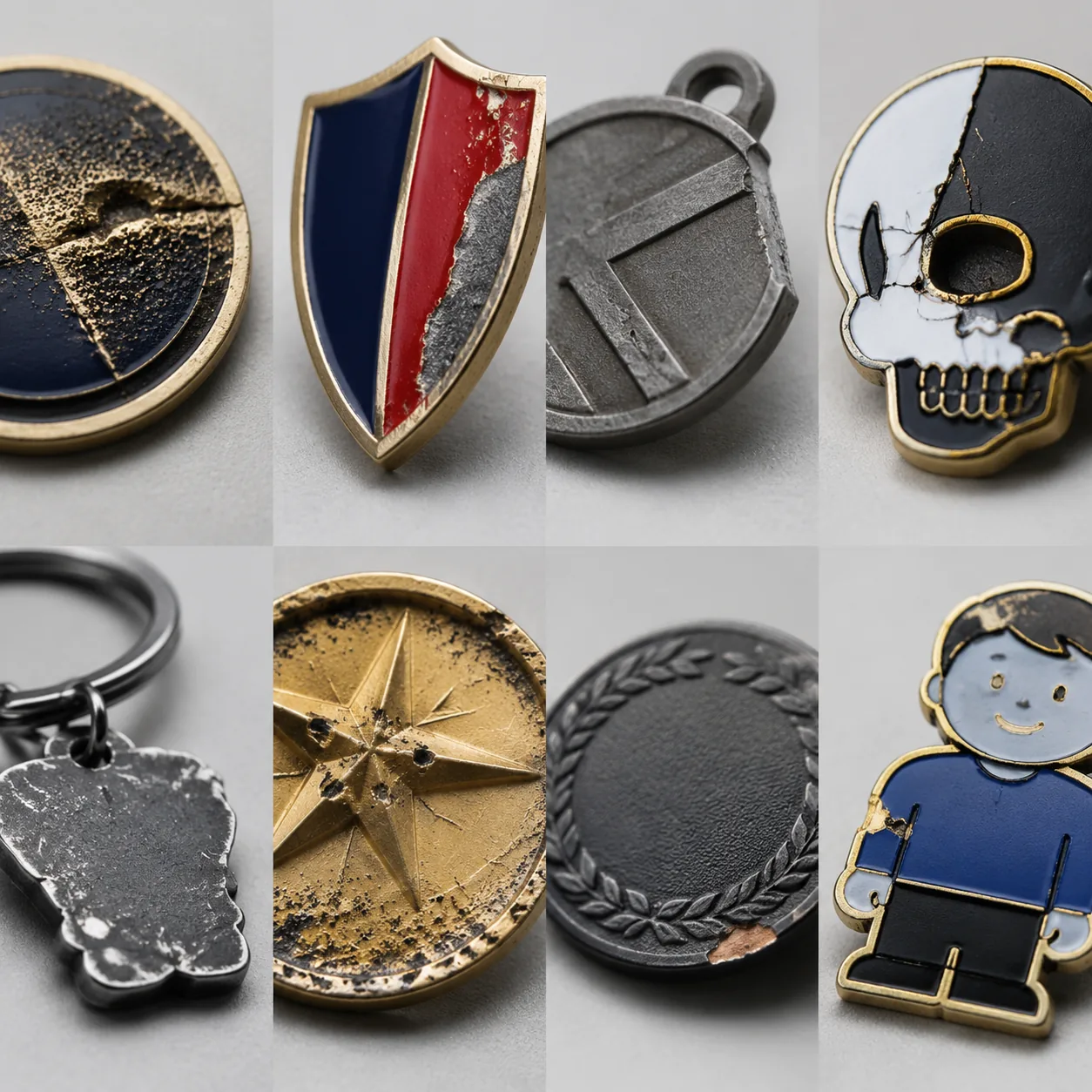
Why good-looking metal giveaway orders still fail
Custom metal giveaways usually do not fail because the artwork is unattractive. They fail because the RFQ leaves too many production variables open: minimum wall width, plating thickness, enamel fill depth, finish gloss, attachment pull strength, edge tolerance, defect class, and packing method. On a 3,000-piece order, one vague instruction can become 300 pieces with weak plating, 500 with fill defects, and a final carton mix of usable stock and scrap.
The safest way to buy enamel pins, challenge coins, badges, keychains, fridge magnets, and similar items is to specify the job by failure mode. A factory can often produce one excellent hand sample. The real test is whether it can repeat that result in bulk, within measurable limits, at the approved cost and lead time.
Typical offshore pricing is predictable if the spec is stable. Soft enamel pins under 40 mm are often USD 0.45-1.10 FOB at 1,000 pieces, rising to USD 0.70-1.60 FOB for larger or more complex shapes. Hard enamel pins commonly run USD 0.80-1.90 FOB at 1,000 pieces. Die-struck coins in the 40-50 mm range usually land at USD 1.20-3.50 FOB depending on thickness, relief, and plating. Metal keychains are often USD 0.75-2.60 FOB, with premium closures, enamel, or multi-part assembly moving toward the high end. MOQ is commonly 100-300 pieces for sampling or small runs, with pricing breaks at 300, 500, 1,000, 3,000, and 5,000 pieces. Standard lead time is 5-8 days for mold and pre-production sample, then 12-22 days for bulk production after approval; add 3-7 days for multi-plating, epoxy doming, complex assembly, or retail carding.
- Approve one golden sample and one written specification sheet before bulk production.
- Set measurable limits for line width, plating microns, enamel recess, attachment pull force, and cosmetic defects.
- Use separate AQL targets for critical, major, and minor defects.
- Freeze reorder specs after approval; do not rely on “same as last time” memory.
- Inspect packed goods, not only loose samples, because abrasion and attachment damage often appear after packing.
Failures 1-2: artwork that cannot be tooled, and geometry that deforms in finishing
Vector artwork can be printable but not manufacturable. Thin islands, hairline gaps, micro text, sharp internal corners, and unsupported spikes may look fine on screen but fail during die cutting, casting, polishing, or enamel filling. In soft enamel, raised metal partitions below 0.20 mm often plate unevenly or disappear after polishing. In hard enamel, the repeated fill, bake, sand, and polish cycle makes weak detail even less stable.
A production-ready metal giveaway spec should state minimum feature sizes before tooling starts. For visible metal lines, use 0.25 mm minimum; for brand-critical detail or light plating over dark enamel, 0.30 mm is safer. For readable text, 1.2 mm character height is the practical lower limit for simple sans-serif letters, while 1.5 mm or more is better for serif fonts, curved text, or antique finishes. Enamel cells should not narrow below 0.8 mm unless variation is acceptable. For openwork, keep bridges at 0.8 mm minimum in stamped brass and 1.0 mm minimum in zinc alloy casting; increase to 1.2 mm for long unsupported spans.
The second failure is edge and relief deformation during finishing. Buffing wheels round off delicate outlines. Deep relief traps polishing compound and creates dirty recesses. Thin tails, star points, and narrow tabs bend or feel sharp. If the product must hold a crisp silhouette, specify outline tolerance and burr limits: ±0.20 mm for small pins, ±0.30 mm for coins or keychains, burr height below 0.05 mm, and no sharp edge that snags a cotton glove during inspection.
| Feature or tolerance | Recommended production spec | Failure if omitted |
|---|---|---|
| Raised metal line | 0.25 mm minimum; 0.30 mm for brand-critical detail | Lines polish away, plate unevenly, or lose separation |
| Readable text | 1.2 mm minimum height; 1.5 mm for serif or curved text | Letters fill, merge, or become unreadable |
| Enamel cell neck | 0.8 mm minimum at narrowest point | Poor fill, bubbles, color gaps, inconsistent appearance |
| Openwork bridge | 0.8 mm brass; 1.0 mm zinc alloy; 1.2 mm for long spans | Warping, breakage, or bent outline after polishing |
| Outline tolerance | ±0.20 mm small pins; ±0.30 mm coins/keychains | Inconsistent profiles across bulk production |
| Burr limit | Below 0.05 mm; no glove snag | Sharp edges, scratched packing, user complaints |
Failure 3: plating that shines at approval but fails in handling
Plating failures are often hidden at sample approval because a thin bright deposit can look acceptable on day one. Problems appear later as dull rubbing, oxidation, dark edges, fingerprints, or finish shift after packing. For decorative metal giveaways, the plating layer should be specified in microns rather than described only as “gold,” “nickel,” or “antique brass.” A common decorative range is 0.08-0.12 microns for low-handling items. For keychains, coins, bottle openers, and wearable pieces that will be touched often, 0.12-0.20 microns gives better durability. Very low-cost flash plating below 0.08 microns can be acceptable for short-life event giveaways, but only if it is an explicit cost decision.
Thickness is only part of the stack. Zinc alloy castings need good surface preparation because pores and die-cast pits telegraph through bright nickel or gold. Brass and iron stampings need consistent pre-polish because grinder lines remain visible under mirror finishes. If the item uses black nickel, antique silver, or antique brass, define the contrast level with a signed sample because antiquing is hand-wiped and naturally variable. A vague finish name is not a control plan.
For quality control, require tape adhesion testing on representative plated surfaces, a dry rub test of 20-30 cycles with a white cotton cloth for dark transfer, and packed abrasion simulation if items are bulk bagged. For retail or long storage, ask for individual polybags or tissue separation; loose metal-on-metal packing can damage plated surfaces before the carton leaves the factory.
- Specify plating stack and target thickness, for example nickel 0.12-0.15 microns or imitation gold 0.12 microns minimum.
- State whether the finish is bright, matte, antique, brushed, or sandblasted.
- Lock base metal, because zinc alloy, brass, iron, and stainless steel do not plate identically.
- Use packed-goods inspection for abrasion, not only loose-piece inspection.
- Avoid bulk loose packing for polished gold, black nickel, mirror nickel, and painted surfaces.
Failure 4: enamel fill that sinks, bubbles, bleeds, or misses the color target
Enamel defects come from fill volume, cavity design, pigment behavior, bake control, and sanding. Soft enamel is supposed to sit below the raised metal walls; a recess of about 0.20-0.50 mm is normal. If a buyer expects a flush surface but orders soft enamel without epoxy, the dispute is built into the specification. Hard enamel should be filled, baked, overfilled, sanded, and polished nearly level with the metal, but small sink marks can still appear in deep or narrow cavities.
Define fill acceptance by process. For soft enamel, specify recess by zone, such as 0.30 mm ±0.15 mm from the top of the metal wall. For hard enamel, require levelness within 0.10-0.20 mm across one color field and no visible sanding scratches at 30 cm viewing distance. Pinholes above 0.20 mm in brand-critical color areas should be major defects; tiny bubbles below 0.15 mm outside logo areas may be minor if they are not visible at normal inspection distance.
Color must also be controlled as a material, not just a Pantone number. Opaque enamel, translucent enamel, glitter, glow pigment, and pearlescent fill behave differently. A Pantone reference helps, but the final standard should be a physical approved sample under defined light, typically D65 daylight or neutral 4000-5000K lighting. For repeat orders, keep a retained sample from the first run and allow a realistic color tolerance, such as no obvious mismatch at 30-50 cm under 4000K light, unless the brand requires tighter lab measurement.
| Enamel defect | Likely cause | Preventive specification |
|---|---|---|
| Sinking or low fill | Underfill, shrinkage, deep cavity | Soft enamel recess 0.20-0.50 mm; hard enamel levelness within 0.10-0.20 mm |
| Bubbles or pinholes | Trapped air, contamination, fast filling | No pinholes above 0.20 mm in logo areas; de-air viscous fills |
| Color bleed | Metal wall too thin or broken | Raised partition 0.25 mm minimum; 0.30 mm for adjacent dark/light colors |
| Uneven gloss | Baking or sanding variation | Signed golden sample; inspect at 30 cm under 4000-5000K light |
| Glitter/glow variation | Pigment settling or batch variation | Approve physical sample and define wider acceptance before bulk production |
Failure 5: attachments that pass photos but fail in use
Attachments create many field failures because they are approved visually instead of mechanically. A lapel pin under 20 g can often use a butterfly clutch, but the same clutch may rotate on thick fabric or loosen during repeated wear. Rubber clutches feel softer and reduce scratching, but they are not automatically more secure. Magnets avoid piercing garments, yet they are risky for heavy badges, outdoor use, children’s products, and any situation involving movement.
The attachment spec should be based on finished weight, center of gravity, and use case. For pins above 25 g or designs wider than 35-40 mm, use two posts or a brooch safety clasp to prevent rotation. For magnetic badges, define magnet grade and pull force rather than asking for a “strong magnet.” A wearable magnet set should be validated on the actual garment type, not just on paper. For keychains, specify split-ring outside diameter and wire thickness. A common promotional split ring is 25-30 mm OD with 1.8-2.2 mm wire; heavier metal charms should use thicker rings and closed jump rings where possible.
Inspection should include functional pull and torque checks. For pin posts, a practical internal requirement is no detachment under a 3-5 kgf axial pull for standard small pins, with higher requirements for heavier pieces. For glued magnets, include shear testing because magnets often slide before they pull straight off. For keychains, inspect ring closure, burrs, plating cracks at the ring, and gap opening after repeated twist cycles.
- Match the attachment to finished weight, width, and use case, not only to artwork size.
- Use two posts for wide pins or any design likely to rotate.
- Define magnet pull force and test on the intended fabric or display surface.
- Specify split-ring OD, wire diameter, and jump-ring closure method.
- Classify loose posts, weak magnets, open rings, and broken clasps as critical or major defects, not cosmetic defects.
Failure 6: color drift across reorders and mixed product sets
Color mismatch is usually a chain of small differences rather than one obvious error. The enamel batch changes, the metal substrate changes, the finish changes reflectivity, or the buyer approves a photo instead of a physical standard. A matte black nickel badge and a polished gold coin can use the same enamel Pantone reference and still look different because the surrounding metal changes perceived color. Soft enamel and hard enamel can also differ because sanding and polishing alter surface smoothness.
For brand programs, create a hierarchy of standards. The master brand reference is the starting point, but each product category needs its own approved physical sample. Do not demand identical brightness across metal, textile, PVC, and printed paper unless the budget includes controlled material matching. For metal giveaways, define the base metal, plating finish, enamel type, and inspection lighting together. A useful acceptance rule is: no obvious color difference between approved sample and production piece at 30 cm under 4000K neutral light for standard promotional grade. For premium retail-grade work, add instrumental color readings if the supplier has access to a spectrophotometer, but visual approval remains the primary standard in this category.
Mixed sets need special attention. If a campaign includes a coin, pin, bottle opener, and keychain, ask the factory to produce a pre-production set, not isolated samples on different days. Approving each item separately creates drift inside the final kit. Reorders should reference the retained golden sample and revision date, including Pantone code, enamel formula where available, plating batch, and any approved deviation.
| Material or product pair | Why color drift occurs | Best control method |
|---|---|---|
| Soft enamel vs hard enamel | Different surface level, gloss, and sanding | Approve separate standards but compare under same light |
| Polished coin vs matte badge | Reflectivity changes perceived color | Lock plating finish and use one viewing distance |
| Zinc alloy vs brass | Different base tone and polishing response | Do not switch substrate without reapproval |
| Metal item vs textile item | Pigments, dyes, and inks absorb light differently | Set category-specific tolerance, not one impossible match |
| First run vs reorder | New enamel batch, new operator, changed plating bath | Retain golden sample and issue controlled reorder spec |
Failure 7: inspection standards that reject too much or accept the wrong defects
A single instruction such as “AQL 2.5” is not enough for custom metal giveaways. It does not tell the inspector whether a tiny enamel bubble is acceptable, whether a loose pin post is critical, or whether a plating dot on the back matters. Without a defect map, factories may pass pieces the brand cannot use, or scrap acceptable goods over marks that are invisible in normal handling.
Use defect classes. Critical defects are safety or usability failures: sharp burrs, broken posts, loose magnets, missing attachments, detached rings, toxic material risk, or wrong logo. These should be controlled at AQL 0 or AQL 0.65-1.0 depending on buyer risk tolerance. Major defects affect saleability or brand presentation: obvious plating stains, wrong color, large enamel voids, bent outlines, visible scratches on the front, or incorrect packing. These are commonly inspected at AQL 1.5-2.5. Minor defects are small cosmetic marks outside the main logo area that are not visible at normal viewing distance; AQL 4.0 can be acceptable for low-cost promotional orders, while premium programs may hold minor defects to 2.5.
The inspection method should state distance, light, angle, and surface priority. A practical rule is visual inspection at 30 cm for 3-5 seconds per side under 800-1,000 lux neutral light. Front logo areas receive stricter judgment than backs, edges, or hidden clasp surfaces. For cartons, inspect assortment, labeling, barcode if used, inner bag count, rust inhibitor if required, and drop damage. Many metal giveaway disputes are packing failures disguised as product failures.
Failure 8: MOQ, lead-time, and packing assumptions that create late compromises
The final failure is commercial rather than cosmetic: the buyer approves a design that only works at sample pace, then compresses mass production, packing, inspection, and freight. Custom metal items need fixed process time. Tooling and sample production usually require 5-8 days. Standard mass production is often 12-18 days for soft enamel pins and 15-22 days for hard enamel, coins, multi-plating, epoxy, or assembled keychains. Complex orders with retail cards, sequential numbering, laser engraving, or mixed-kit packing can need 25-35 production days after sample approval.
MOQ also affects process control. At 100-300 pieces, factories may run semi-manual operations with higher unit cost but closer handling. At 1,000-3,000 pieces, production becomes more efficient and price drops, but variation control depends on jigs, batch records, and in-line QC. At 5,000 pieces and above, insist on first-article approval from the actual mass-production line, not only a hand-finished sample.
Before issuing a purchase order, convert the item into a failure checklist. Record the thinnest feature, base metal, thickness, plating microns, enamel process, fill tolerance, attachment type, pull-force requirement, color standard, AQL plan, packing method, carton drop requirement, and approved lead time. If the supplier cannot repeat these points back clearly, the order is not ready for tooling. ZheCraft uses this kind of locked specification control across pins, coins, badges, keychains, magnets, patches, and lanyards because the lowest-cost order is the one that ships once, passes inspection once, and does not require a rescue run.
Have a project? Send your artwork and target quantity and we’ll reply with a detailed quotation within 12 working hours.
Ready to get this made?
Send your sketch, target quantity and ship-date. Detailed quotation in 12 hours.



