7 Questions to Ask Before Ordering Promo Metal Goods
Q1: What job is this order supposed to do?
The most common sourcing mistake is starting with a product name instead of a use case. A 2-day trade-show giveaway, a retail item for a fan shop, and a presentation coin for executive gifting may all be “custom metal goods,” but they are not the same product from a manufacturing standpoint. Each one implies different alloy choices, plating wear expectations, edge finishing, packing, and inspection depth.
Define the job in operational terms before you ask for pricing. If the item will be pinned to clothing, mailed individually, handled daily on a keyring, displayed in a collector case, or carried by children, say so explicitly. That information determines whether the factory should recommend soft enamel, hard enamel, stamped brass, zinc alloy casting, or a simpler printed metal structure. The right build is the one that fits how the product will actually be used, not the one that looks cheapest on paper.
For 2026 procurement, it helps to separate orders into three buckets: promo giveaways, retail-grade collectibles, and presentation pieces. Promo giveaways can tolerate lighter plating and simpler packing. Retail items usually need tighter cosmetic control, stronger hardware, and more repeatable color matching. Presentation pieces often prioritize weight, polish, and perceived value, even if the decoration is minimal. If you skip this step, suppliers will quote to the drawing, not to the application.
A practical rule: the more the item will be touched, shipped, or reused, the more you should invest in plating consistency, edge finishing, and attachment strength. One-off event giveaways can often use simpler stamped or soft enamel builds. Retail or collector products should be specified more like brand assets: define the look, the wear life, and the acceptable defect level before production starts.
Q2: How do MOQ, lead time, and unit price really trade off?
MOQ is not a fixed industry number; it moves with tooling, plating line setup, part complexity, and how many SKUs are in the order. For simple soft enamel pins, common MOQ tiers are 100, 300, and 500 pcs per design, with the lowest tier usually carrying the highest unit price. Hard enamel pins, basic coins, and small metal badges are often most economical at 300 to 500 pcs. For cast zinc alloy pieces with 3D detail, 500 pcs and up is often the practical floor because mold setup, polishing, and hand finishing add labor quickly.
Lead time is usually lost in approvals, not on the press or plating line. Typical factory lead times after pre-production sample approval are 10 to 15 days for standard pins, keychains, and magnets; 15 to 25 days for coins and heavier badges; and 20 to 30 days for mixed sets or multi-part promo kits. If a supplier says “12 days,” confirm whether that starts from artwork approval, sample approval, or deposit receipt. Those are not interchangeable dates, and the real calendar can be much longer once proofing and freight booking are included.
Below is a realistic planning range buyers can use for initial RFQs. Actual pricing varies with size, finish, color count, and packaging scope, but the numbers are useful for sanity-checking early quotes.
| Order type | Typical MOQ tiers | Typical lead time after sample approval | Common FOB range (USD/pc) |
|---|---|---|---|
| Soft enamel pin | 100 / 300 / 500 pcs | 10-15 days | 0.35-1.20 |
| Hard enamel pin | 100 / 300 / 500 pcs | 12-18 days | 0.55-1.80 |
| Stamped coin | 300 / 500 / 1,000 pcs | 15-25 days | 1.20-4.50 |
| Cast zinc keychain | 200 / 500 / 1,000 pcs | 12-20 days | 0.60-3.20 |
| Fridge magnet | 300 / 500 / 1,000 pcs | 10-18 days | 0.40-2.80 |
| Metal badge | 200 / 500 / 1,000 pcs | 12-25 days | 0.70-3.50 |
Use unit price only after you verify what is included. A low quote may exclude tooling, Pantone matching, backstamp, individual polybags, backing cards, or outer carton reinforcement. For procurement, the real cost is landed cost plus defect risk. A slightly higher FOB from a factory with better sample control is often cheaper overall because it reduces rework, claims, and schedule slip.
Q3: Which build method actually fits the artwork?
The most expensive mistake is choosing a process because it sounds premium. Cast, stamped, etched, die-struck, and epoxy-coated builds all have different limits on line width, relief depth, edge sharpness, and color stability. Hard enamel delivers a polished, jewelry-like surface, but it is less forgiving when the artwork contains tiny isolated color islands. Stamped metal works well for logos and coins, but extremely fine cutouts increase burr risk if the die geometry is too aggressive.
Ask the supplier to map your artwork to a build method before final quotation. That means checking minimum line width, minimum hole size, minimum text height, and the outline tolerance the factory can realistically hold. For small promo goods, a reasonable target tolerance is +/- 0.3 mm on critical outlines. For larger coins or badges, +/- 0.5 mm is usually acceptable unless the design has tight registration or nested parts. If the design needs tighter control than that, it should be redesigned for manufacture rather than “insisted upon” at the quote stage.
For line detail, a practical floor is usually 0.25 to 0.30 mm for raised metal separation lines and about 0.4 mm for small text that must remain legible after plating. Small internal cutouts should generally stay above 0.8 mm to reduce breakage and polishing damage, especially on zinc alloy castings. If a design goes below those thresholds, the supplier should simplify the art before quoting. Otherwise the approved sample may only prove that the drawing was too detailed for the process.
If your order includes pins, coins, and badges in the same brand family, do not force the same method onto every item. It is usually better to keep the visual language consistent while adapting the build to the geometry of each product. That keeps the set coherent without paying for unnecessary complexity on the simplest SKU.
| Build method | Best for | Main limitation | When not to choose it |
|---|---|---|---|
| Soft enamel | Bold logos, vivid color, lower cost | Raised metal edges hold texture and dust | Tiny text or ultra-smooth surfaces |
| Hard enamel | Retail-style finish, polished look | Higher cost, longer polishing time | Deep relief or very small color cells |
| Stamped / die-struck | Clean metallic logos and coins | Limited color flexibility | Full-color artwork or gradients |
| Cast zinc alloy | 3D shapes, sculpted detail | Tooling cost and shrink risk | Flat graphics with many fine lines |
| Etched | Fine line art and lighter products | Shallower depth | Heavy relief or strong tactile feel |
Q4: What specs should be locked before asking for quotes?
The fastest way to compare suppliers is to make sure they are quoting the same specification. Without defined size, thickness, finish, attachment, and packing, two quotes that look far apart may actually describe different products. The minimum spec sheet should tell the factory what cannot change without approval, not just what you want in theory.
The most common rework triggers are unclear plating color, missing thickness data, vague backing type, and no tolerance for enamel fill or print registration. If a supplier is unsure whether the product is 1.2 mm or 1.5 mm thick, or whether a rubber clutch or butterfly clutch is required, you will get inconsistent samples and inconsistent production. A good RFQ reduces interpretation and makes factory responsibility measurable.
Lock the following before quotation so apples-to-apples pricing is possible. Use mm, not visual references. If possible, give the supplier a marked drawing or a dimensioned AI/PDF file with a revision number.
- State size in mm, not only in inches or reference images.
- State thickness in mm and the acceptable tolerance, such as +/- 0.2 mm.
- Specify plating finish and, if relevant, target thickness in microns.
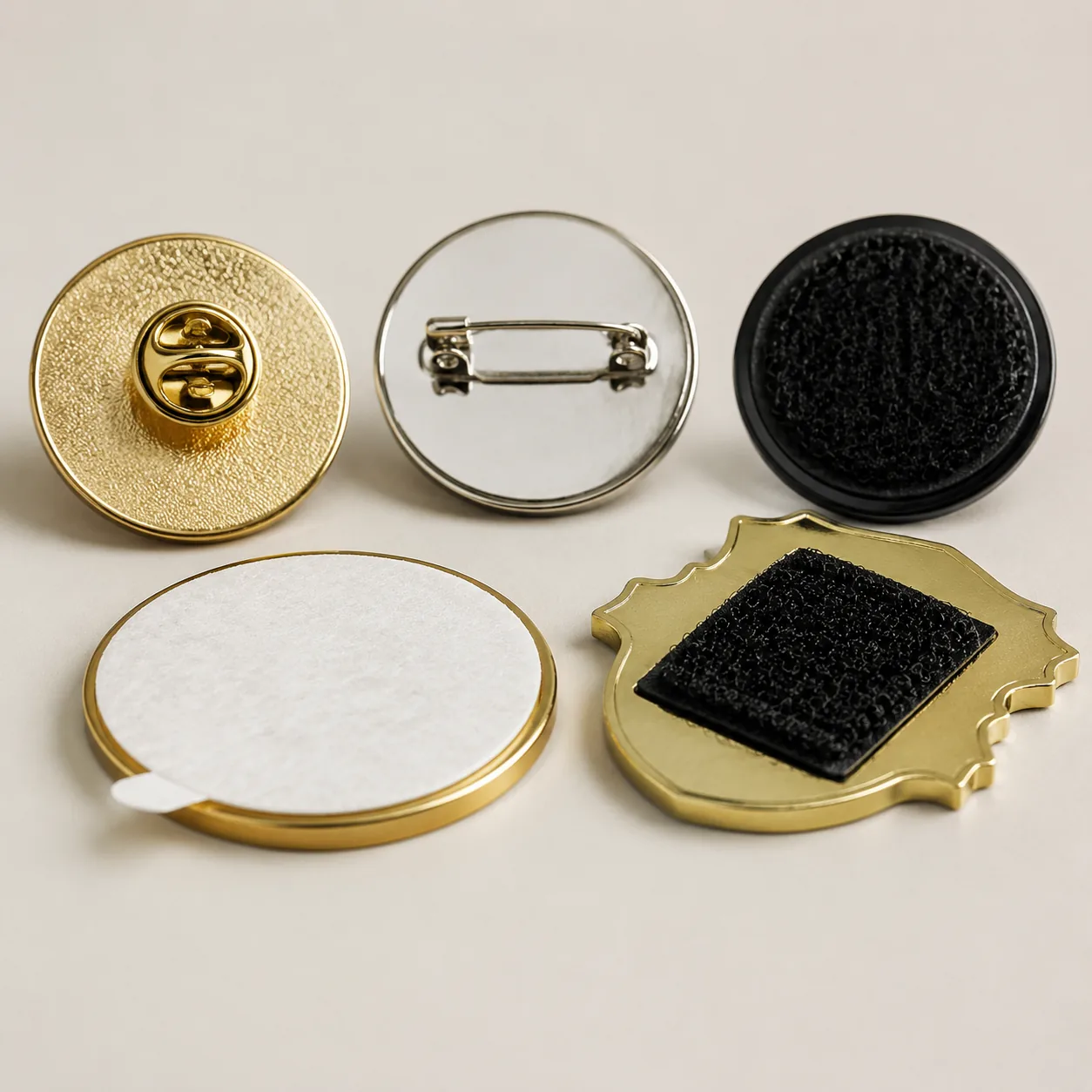
- Define attachment type: butterfly clutch, rubber clutch, magnet back, safety pin, split ring, lobster clasp, or carabiner.
- Name the color standard with Pantone code; do not rely on an image alone.
- Confirm packaging: bulk pack, polybag, backing card, velvet pouch, or gift box.
- Ask for final inspection at AQL 2.5 for major defects and AQL 4.0 for minor defects, unless the item is retail-critical.
- Require a pre-production sample signed off before mass production starts.
If the item is worn on clothing, backing specification matters as much as the front face. For lapel goods, many buyers prefer a stronger clutch for heavier metal or a magnetic back for delicate fabrics, but magnets add cost and may not suit thick outerwear. For badges and coins, backstamp placement, edge polishing, and any serial numbering should also be locked if the item will be reordered later.
For plating, ask the factory to state the finish standard in writing. Decorative nickel, black nickel, antique brass, antique silver, and gold-tone finishes are not interchangeable in appearance or cost. If the supplier can provide a micron target, ask for it. Decorative electroplating on promo goods commonly lands around 0.1 to 0.3 microns for light-duty items; better wear resistance may call for 0.5 microns or more on exposed surfaces, plus clear coating where appropriate. For low-cost giveaways, a thinner decorative layer may be acceptable if the buyer signs off on cosmetic, not wear-intensive, use.
Q5: How do you compare factory quotes without getting fooled?
Quote comparison should separate product cost, process cost, and risk cost. Product cost is the obvious FOB price. Process cost includes setup, sampling, plating changeovers, and packaging changes. Risk cost is the hidden part: rework, delay, color mismatch, weak hardware, or transit damage caused by poor packing or loose tolerance control. A quote that saves $0.08 per piece but generates a 15-day delay is not a savings if the order is tied to an event date.
In 2026, many buyers source multiple categories at once, such as pins plus keychains plus magnets. That can create a false comparison if one supplier quotes each item individually and another quotes them as a combined set. Check whether the factory is reusing one mold family, one artwork conversion, or one plating bath across the order, because those efficiencies materially change the real cost structure. If the quote does not state what is included, it is not yet a usable quote.
Ask for unit price, tooling, packing, and inspection to be broken out separately. This makes it easier to see whether a lower price is real or just a smaller scope. It also lets procurement compare supplier A’s “all-in” quote against supplier B’s low headline price without missing add-ons that appear later.
| Quote line | What it should include | Red flag |
|---|---|---|
| Tooling | Mold or die cost, ownership terms, and remake terms | No mention of who owns the tool |
| Unit price | Base item, finish, attachment, and standard packing | Price that changes after sample approval |
| Decoration | Enamel, printing, engraving, epoxy, or numbering | Color or print not specified |
| Packing | Bulk, polybag, backing card, carton spec, carton count | Packing described only as “standard” |
| Inspection | AQL level, visual criteria, sampling plan | No final inspection commitment |
When two suppliers are close in price, ask them to confirm three items in writing: measured size tolerance, plating target, and sample approval gate. If one supplier refuses to document those points, the lower quote is usually not the safer choice. The cheapest order is the one that does not come back for correction.
Q6: What quality checks prevent rework in production and receiving?
The best quality plan is simple enough to enforce and strict enough to catch common failures. For promo metal goods, that means checking metal edges, color fill, surface scratches, attachment strength, and packing damage. AQL 2.5 is a reasonable default for critical or highly visible defects, while AQL 4.0 can be acceptable for lower-risk giveaway items if the buyer has a wider tolerance.
Ask for a golden sample, not just a digital proof. The golden sample should show actual plating color, actual enamel fill, actual print density, and actual hardware attachment. If the production lot differs from the approved sample in any visible way, the supplier should treat that as a change request, not a silent substitution. For retailer orders, this sample should be retained by both sides with revision number and date.
For finish control, the receiving standard should include normal-light inspection for cloudiness, plating spotting, pinholes, and uneven tone. If the product uses soft enamel or printing, check that the color fill is level and does not sit significantly below the intended line. For retail-grade items, some buyers require surface scratch limits no worse than 0.3 mm visible at 30 cm under standard lighting. Attachment testing should include a simple pull-and-twist check on sample pieces, especially for keychains and bag charms.
- Inspect outer shape against the drawing or approved sample before full packing.
- Check plating for cloudiness, spotting, or uneven tone under normal light.
- Confirm enamel or print does not sit below the intended fill level beyond the agreed limit.
- Test attachments for rotation, pull strength, breakage, or loose rivets.
- Verify individual packing count and carton labeling.
- Ask for photo evidence of final packed cartons before shipment.
- For mixed sets, confirm all components match the same color standard and branding language.
Receiving teams should measure a few pieces on arrival. For high-volume orders, checking 3 to 5 pcs per carton is usually enough to catch systematic issues early. If the first cartons are off-spec, stop receiving quickly; do not wait until the whole shipment is unboxed. A defect discovered on day one is a quality issue. A defect discovered after distribution is a customer-service problem.
If the item will be shipped into retail, ask for carton drop-test expectations in advance. Even a well-made product can arrive damaged if the outer carton, inner tray, or polybag is too light for the route. For export shipments with mixed SKUs, carton marking should also identify each variant clearly to reduce warehouse picking errors.
Q7: What should you do next to keep the order on schedule?
Start by writing a one-page spec that answers the seven questions above: use case, quantity, target lead time, build method, locked dimensions, finish, and inspection standard. Then ask each supplier to quote the same version of that spec, not their own interpretation. If you already know your reorder risk, add tool ownership and reuse terms now so the first run does not create hidden dependence later.
If you are buying across pins, badges, coins, magnets, patches, or lanyards, standardize the language before you negotiate price. The goal is not only a clean first order; it is a spec you can reuse without revisiting the basics every season. That is what keeps procurement stable when budgets tighten and schedules get shorter.
A practical next step is to request one pre-production sample with measured specs and compare at least two quotes using the same checklist. If the supplier cannot answer the seven questions clearly, the order is not ready to release. Good sourcing is not about moving fast at any cost; it is about removing avoidable uncertainty before production starts.
Have a project? Send your artwork and target quantity and we’ll reply with a detailed quotation within 12 working hours.
Ready to get this made?
Send your sketch, target quantity and ship-date. Detailed quotation in 12 hours.



