7 Production Failures That Ruin Custom Metal Giveaways
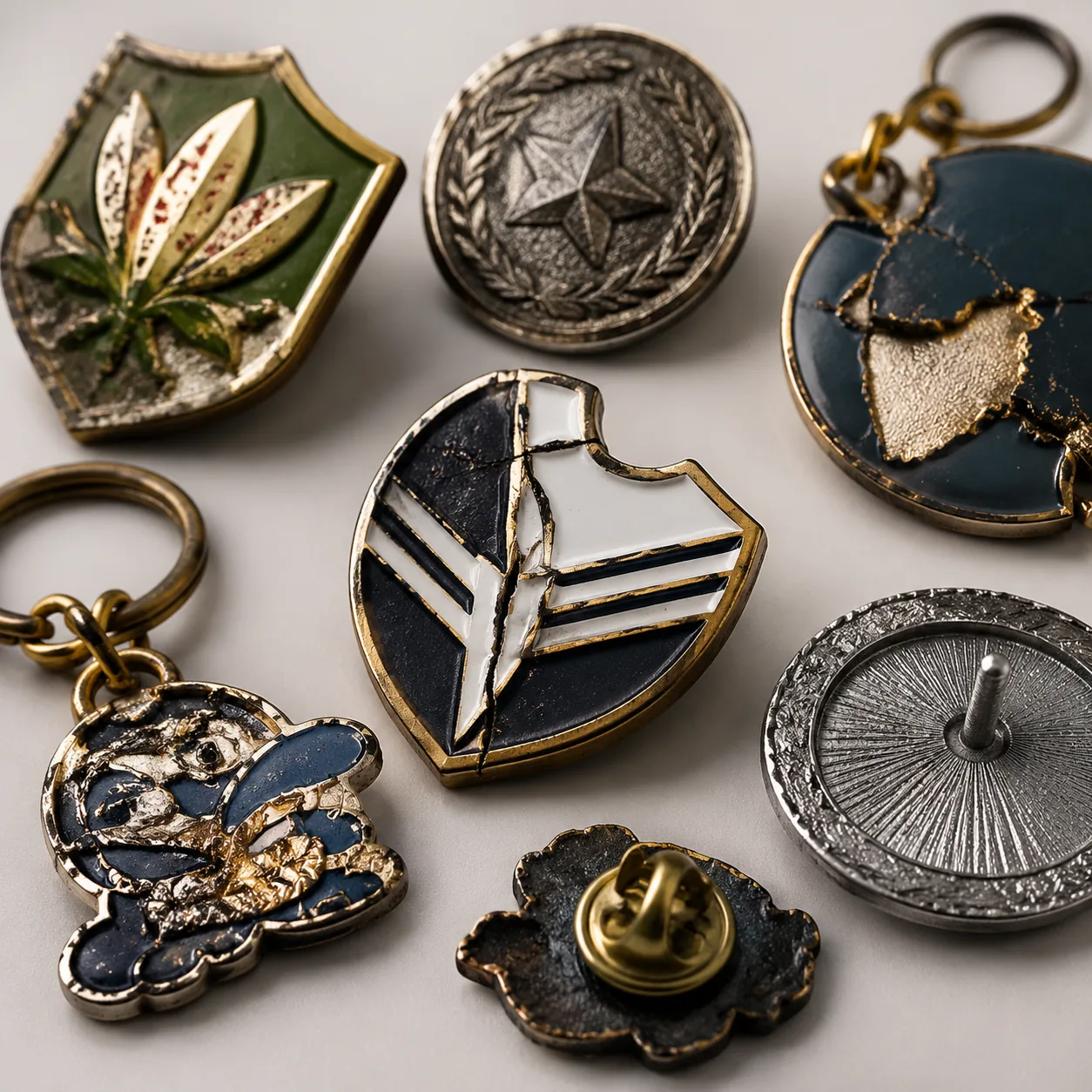
Why Good Artwork Still Produces Bad Goods
Most rework in custom pins, coins, keychains, badges, and magnets does not come from poor branding. It comes from artwork that is too loose for manufacturing: no minimum line widths, no tolerance callouts, no finish definition, and no inspection standard. A file can look perfect on screen and still fail when a factory has to convert it into zinc alloy, brass, or iron with real shrink, real plating build, and real operator judgment.
The usual failure pattern is predictable. Buyers approve a clean render, then receive parts with softened edges, uneven plating, weak hardware, color bleed, or packing damage. The fix is to spec around process limits instead of aesthetics alone. A strong RFQ should define what the part must be, what it must not exceed, and which features are critical-to-function or critical-to-appearance.
For custom metal giveaways, the most useful numbers are practical rather than theoretical. Typical starter targets are a 0.30 mm minimum line width, a 0.25 mm minimum gap, ±0.20 mm overall dimensional tolerance on small parts, and a sample approval that includes written notes, not only photos. If a supplier cannot quote against those numbers, the quote is probably too vague to control quality.
Failure 1: Artwork That Cannot Be Produced Cleanly
The first failure mode is geometry that looks sharp in vector art but collapses in metal. Very fine text, hairline borders, tiny internal cutouts, and shallow relief transitions are the first details to disappear in stamping, die casting, polishing, and enamel fill. On zinc alloy enamel products, features below 0.25 mm are high risk; below 0.20 mm they are usually only viable as a special-case exception after sampling.
A workable baseline for soft enamel pins is 0.30 mm minimum line width, 0.25 mm minimum gap, and 0.20 mm minimum raised rim height. For hard enamel, push text and line art slightly heavier because post-polish rounds edges and can reduce visual contrast. For die-struck coins and badges, use broader relief changes and avoid micro-engraving unless it is part of a separate tooling budget. If a logo must remain readable at 25 mm or 30 mm overall size, specify the smallest approved reproduction size in millimeters, not pixels.
Concrete example: a 32 mm pin with 7-point text and 0.18 mm strokes will often read clean in a mockup and fail in production. The better spec is 32 mm overall, 0.30 mm minimum stroke, 0.25 mm minimum gap, and text no smaller than 1.2 mm cap height. That gives the factory enough room to polish, plate, and fill without the type closing up.
Failure 2: Tooling Shrink and Edge Collapse
Tooling failures show up after the CAD is approved and before the part looks premium. Shrink, metal flow, venting, and polishing all alter the final outline, especially on cast zinc alloy pieces and textured surfaces. A buyer may request a 40 mm badge with a 1.0 mm border, but after process compensation the visible face can read smaller and softer than intended if the toolmaker was not instructed on the critical edges.
Lock nominal size and tolerance in the drawing, then identify the features that control fit or alignment. For small promo metal items, a practical tolerance is ±0.20 mm on overall length and width, ±0.10 mm on paired alignment features such as magnet pockets or clasp holes, and ±0.15 mm on decorative cutouts that do not affect function. If the part is heavily polished, allow the factory to measure after finishing, but require the finished part to remain within the stated window.
Repeat orders need extra discipline. Tool wear, cavity polish, and minor process changes can drift a design even when the artwork is unchanged. A golden sample should therefore include a dimension note sheet with dated approvals, not just a photo. For reorders above 1,000 units, ask for first-article confirmation on the first 10 to 20 pieces and in-process checks at least once per production shift.
Typical commercial timing for a new zinc alloy or brass tool is 7 to 12 days for sampling and 15 to 25 days for mass production, depending on plating and packing complexity. If the supplier promises a much faster schedule, confirm whether they are excluding sampling, plating queue time, or carton assembly.
Failure 3: Plating That Looks Uneven or Wears Too Fast
Plating problems usually appear as dark edges, thin coverage in recesses, dull top surfaces, or early wear after handling. Buyers often ask for “gold” or “silver” as if those were single finishes, but the result depends on base alloy, pre-polish quality, bath control, masking, and deposit thickness. Decorative plating that is only 0.03 to 0.05 microns can look acceptable at unpacking, but it is fragile on high-contact areas and prone to visible wear.
For visible promo pieces, define the finish and the build conditions together. If you want shiny gold, antique brass, nickel, black nickel, or rainbow plating, specify the base metal, the visible surfaces, and the minimum thickness target the factory can actually measure. A practical decorative target for better wear is often 0.05 to 0.10 microns on exposed areas for light-duty items; for better abrasion resistance on premium pieces, many buyers ask for 0.10 to 0.15 microns where the process and cost allow it. If the supplier cannot verify thickness, do not write a number that nobody can inspect.
Example: for a corporate lapel pin in black nickel, ask for black nickel on all exposed faces, no plating voids on raised edges greater than 0.2 mm, and no visible base-metal breakout in recesses at arm’s length under 500 lux. For antique finishes, define the darkness of recesses and whether highlight polishing is allowed on raised areas. That keeps the batch from drifting between “warm antique” and “over-buffed.”
Price is also finish-sensitive. As a rough FOB guide, small custom zinc alloy pins or keychains often land around USD 0.35 to 1.20 per piece at 500 to 1,000 units, USD 0.22 to 0.85 at 3,000 to 5,000 units, and USD 0.15 to 0.55 at 10,000 units or more, with plating complexity, enamel count, and packaging pushing the number upward. If a quote is far below that band, confirm whether plating thickness, die complexity, or individual packing has been omitted.
Failure 4: Color Fill That Sinks, Cracks, or Bubbles
Enamel and paint fill failures are common because fill material is sensitive to cavity depth, cure time, contamination, and oven control. Overfilled cells dome above the rim and chip during packing; underfilled cells sink and expose metal edges; trapped air leaves pinholes that become obvious after cure. Transparent, glitter, and fluorescent fills are even more sensitive because defects are easier to see and harder to hide.
The key controls are fill depth relative to rim height and a visual standard that the factory can repeat. For soft enamel, keep fill about 0.10 to 0.20 mm below the rim if you want the classic textured surface. For hard enamel, specify flush or near-flush after polishing and state whether the piece must be sanded smooth. If two colors meet, adjacent cells should not bleed by more than 0.15 mm, and any visible bridge between colors should be treated as a defect, not a normal variance.
A concrete RFQ example is better than a color list. Instead of asking for “red and blue enamel,” specify Pantone references, gloss level, fill depth, and cure requirement. Example: PMS 186 C red, PMS 286 C blue, gloss finish, no pinholes larger than 0.20 mm, no sink below 0.10 mm from rim on any visible cell, and no color migration across partition lines greater than 0.15 mm. That level of detail gives the supplier a measurable target.
For small compartments, ask for a pre-production sample if the narrowest cell is under 1.0 mm wide or the cavity depth is under 0.5 mm. Those dimensions are where fill often becomes unstable and where artwork may need to be widened before mass production.
Failure 5: Hardware That Fails After Use
Many product defects are really attachment defects. Pins spin because the post is off-center or the clutch is too light. Keychains break because jump rings open, split rings are undersized, or the chain wire is too soft. Badges sag because the attachment cannot carry the load. Magnets can look perfect and still fail because pull strength was never matched to the display surface.
Treat hardware as a functional subassembly, not an accessory. A butterfly clutch is inexpensive and common, but heavier pins or premium event badges often need a rubber clutch or a magnetic back. For keychains, define ring diameter, wire gauge, and closure force. For magnets, define pull force against a stated steel thickness, because “strong magnet” means nothing without a test condition. If the item is meant to be worn on clothing, say so directly so the factory does not substitute desk-only hardware.
The table below shows the most common hardware risk points and the specs that reduce surprises.
| Component | What goes wrong | What to specify |
|---|---|---|
| Pin back | Rotation, sagging, or pull-off | Post position, clutch type, item weight, and pull-off expectation |
| Keychain ring | Opening or breakage | Ring diameter, wire gauge, closure method, and load target |
| Magnet | Falls off display surface | Magnet type, pull force, and test steel thickness |
| Badge clasp | Fabric damage or slip | Attachment type, clip spacing, and load limit |
Useful hardware numbers make RFQs easier to compare. For lapel pins under 12 g, one post with a standard butterfly clutch may be fine; above that, two posts or a locking clutch reduces rotation. For keychains, split rings around 20 to 30 mm diameter are common, while heavy charms often need 24 to 30 mm rings with thicker wire. For fridge magnets, ask for a pull test on 0.8 mm to 1.0 mm steel if the product is meant for retail display, and require the sample to hold a card or paper stack for at least 24 hours without slip.
Failure 6: Surface Finish That Gets Marked in Transit
A part can leave the line perfect and still arrive scratched, scuffed, or rubbed through. This usually happens because trays, polybags, inserts, and cartons were chosen for cost rather than finish sensitivity. High-gloss plating, epoxy dome, and black nickel show handling marks faster than matte finishes, and hard edges can cut through thin protective film during vibration and stacking. The root cause is often packing friction, not plating quality.
Packing should match finish risk. If the product is polished, domed, or high gloss, use individual polybags or compartment trays rather than loose bulk packing, and specify that no metal-to-metal contact is allowed in master cartons. For plated items going long distance, ask for carton compression protection and a simple inspection gate for appearance defects. A common commercial approach is AQL 2.5 for critical appearance defects and AQL 4.0 for minor cosmetic marks, provided the supplier actually follows the sampling plan instead of using it as a vague promise.
For export orders, define the packaging spec in practical terms: individual OPP bag of at least 0.03 mm thickness, tray dividers if pieces can touch, outer carton burst strength if the route is long-haul, and humidity control if the destination has an ocean leg. A foam insert or card-mounted pack is often cheaper than reshipping damaged inventory. If the product is intended for e-commerce fulfillment, ask for a drop-safe pack that can tolerate one 60 cm carton drop without visible damage to the item surface.
Typical FOB packaging adders are modest relative to the cost of rework: an individual polybag may add only USD 0.01 to 0.03 per unit, a card-mounted blister or printed backer can add USD 0.05 to 0.20, and a custom tray or foam insert can add USD 0.08 to 0.35 depending on size. For premium finishes, that is usually cheaper than a return shipment or replacement run.
Failure 7: QC That Checks the Wrong Thing
The final failure mode is inspection focused on appearance alone. A gold pin can pass visual approval and still fail because the post is crooked, the color shifts between batches, or the magnet is off-center. Sample approval without measurable checkpoints is especially risky when the product includes mixed materials, moving parts, or multiple decorations. The buyer thinks the factory ignored the sample, but the real issue is that the sample was never translated into measurable acceptance criteria.
A serious QC plan needs visible and functional checks in the same document. Put dimensions, plating, color match, attachment position, surface defects, and packaging condition into one checklist. For repeat orders, lock the golden sample with approved photos, batch code, finish name, and dated notes, then require the factory to hold the same spec across reorder lots. If the supplier changes polish level, alloy mix, or packing method without disclosure, the product may still be saleable but it is no longer the same item.
The practical acceptance standard should match the product class. For general appearance, a common approach is AQL 2.5 for critical defects and AQL 4.0 for minor defects, with no visible plating peel, no broken attachment, and no unresolved color mismatch in the approved viewing condition. For dimensions, require 100 percent checks on truly critical features such as post position, magnet placement, or keyring hole location if those features affect use.
{ul}[ "Confirm nominal size and all critical tolerances before tooling.", "Name the finish, plating type, and any minimum thickness target.", "Define minimum line width, gap width, and fill depth.", "Specify hardware type, position, and load-bearing expectation.", "State packing method, carton protection, and AQL target.", "Approve a golden sample with photos and written notes, not memory." ]
What To Do Next
Start your next RFQ by listing the top three ways the product could fail in production, not the top three ways you want it to look. Then translate each risk into a measurable spec: dimensions, line width, plating, fill depth, hardware, and packing. If the order matters, ask for a pre-production sample that proves the risky features before mass production starts. That approach usually costs less than one correction cycle and protects the schedule too.
If you want a cleaner handoff to suppliers, build one page that combines artwork notes, functional dimensions, finish targets, inspection criteria, and approved packaging. That format works well for pins, coins, badges, magnets, keychains, patches, and lanyards when different product types need the same brand standard. For a standard reorder, a realistic schedule is often 3 to 5 days for sampling revisions, 15 to 25 days for production, and 5 to 12 days for export transit depending on destination and mode. The goal is simple: fewer assumptions, fewer surprises, and fewer rejected cartons.
Have a project? Send your artwork and target quantity and we’ll reply with a detailed quotation within 12 working hours.
Ready to get this made?
Send your sketch, target quantity and ship-date. Detailed quotation in 12 hours.



