7 Production Failures That Break Custom Promo Sets
Why promo sets fail after the sample
A sample often looks right because it hides the real production spread. One approved unit can pass while the full set still drifts in plating tone, print density, hardware fit, and packing orientation once four separate SKUs are built on different lines, by different operators, and sometimes from different material lots. A pin may read cool silver, a keychain warmer, a lanyard darker by half a shade, and a backing card 1.5 mm off center. To the end buyer, the set feels inconsistent even when every item technically passed its own check.
The root cause is usually incomplete specification rather than one bad process. When the approved sample does not lock measurable details, the factory fills the gaps with standard practice. For mixed promo sets, that creates drift in size, color, finish, and packing sequence. The fix is to treat the set as one coordinated build with item-level tolerances, not as four loose products that happen to ship together.
A usable set spec names the shared appearance target, the item-level exceptions, the acceptance tolerance, and the inspection stage where each risk is checked. That lets the factory quote realistically, plan tooling correctly, and reject incompatible substitutions before mass production starts.
Failure 1: The set looks mismatched on arrival
Visual mismatch is the first thing end customers notice. A lapel pin may use bright nickel plating while the keychain lands on a slightly warmer silver tone, or a red enamel fill may be matched to a screen file instead of a physical Pantone target. Even small differences in sheen or contrast make a set feel cheap under retail lighting, especially when the items sit side by side in one box or on one backing card.
For metal items, specify the finish family, surface target, and acceptable visual band. Bright nickel, matte nickel, antique silver, antique brass, and black nickel are not interchangeable looks. If visual coherence matters, keep the same plating family across all metal items, or explicitly design contrast into the set. For example, a pin-and-coin set can intentionally pair bright nickel on the pin with antique silver on the coin, but only if the concept calls for it.
Use measurable color control, not only artwork files. For print and enamel, call out a Pantone target and a physical reference sample. A practical internal target is ΔE 1.5 to 2.5 against the approved master; beyond that, most buyers notice the shift in a mixed set. For painted or coated parts, state whether gloss may vary by finish family or must stay within one sheen band, such as 20 to 30 GU for matte and 70+ GU for glossy surfaces.
| Mismatch source | What it looks like | What to specify |
|---|---|---|
| Plating drift | Different shine or tone between items | Same plating family, finish reference, and visual allowance |
| Color shift | Red, blue, or black looks unrelated | Pantone target, substrate note, and physical proof standard |
| Scale drift | Items feel unequal even when sizes are close | Nominal size plus/minus 0.3 mm to 0.5 mm tolerance |
| Packing drift | Set opens with items turned or offset | Insert layout, orientation photo, and pack sequence |
Failure 2: One weak spec forces the whole order to rework
In mixed sets, one unclear drawing can infect the entire order. If the keychain needs a 3.2 mm hole but the split ring planned for it needs 3.8 mm clearance, the line may stop, or worse, ship with an improvised substitution that weakens the attachment. The same thing happens when artwork line width is acceptable for a pin but too fine for a woven patch or laser engraving. Rework costs rise quickly because every SKU must be checked against the common set standard.
The prevention is a shared spec sheet with item-level exceptions. Include dimensions, thickness, attachment method, art scale, plating, and packaging for each SKU, then mark which variables must match across the set and which may differ. Separate nominal dimensions from critical dimensions. Nominal values can vary slightly; critical values affect fit, safety, or display alignment and should be held tighter. In practice, pin thickness might carry a plus/minus 0.2 mm tolerance, while a card slot or hardware hole may need plus/minus 0.1 mm to preserve assembly fit.
If one item needs 1.8 mm thickness and another needs 2.5 mm, say so up front. If the lanyard is sublimated polyester at 20 mm width and the badge reel is zinc alloy with soft enamel, define both so the factory does not try to standardize them incorrectly. Buyers who build the spec this way typically cut at least one approval loop and reduce set-level disputes after shipment.
- Lock a master color reference for the entire set.
- State which dimensions are nominal and which are critical.
- List attachment hardware by exact type and size.
- Define packaging orientation and insert placement.
- Approve one combined golden sample, not separate loose samples.
Failure 3: The artwork is right, but production tools are wrong
Many set defects begin before any metal is poured or fabric is cut. The tool may be built from an uncorrected file, a scaled-down logo, or a version optimized for one item but not the others. That creates pin edges too soft, coin relief too shallow, or lanyard text too small to read after weaving or sublimation. Tooling problems are expensive because the defect becomes structural, not cosmetic.
Specify artwork conversion rules for each process. For die-struck or stamped metal, note the minimum line width, minimum text height, and whether cutouts can bridge or must stay closed. A practical floor for small metal promo items is about 0.25 mm minimum line width and 1.2 mm minimum text height for readable raised detail; finer than that often collapses after polishing or plating. For soft enamel, keep recessed channels wide enough to retain fill without overflow, usually 0.4 to 0.6 mm minimum depending on size.
For printed or woven items, state the final production size and the exact readable area after hems, folds, or borders. A 20 mm woven label loses much more usable space than a flat art proof suggests, and a lanyard with a sewn safety break cannot use the same repeat layout as a full-length print. If a logo must appear on multiple products in the same set, ask for one shared artwork master and separate production drawings for each item so the factory does not reuse an unsuitable layout.
For photo-printed products, define the expected raster resolution at final size, not just the file resolution. A 300 dpi source image printed at half size can still show banding or soft edges if the production file is downsampled incorrectly. The safest rule is to approve a proof that shows the final trim size, final line weights, and the exact placement of every logo on every SKU.
Failure 4: The hardware works in isolation but fails in a set
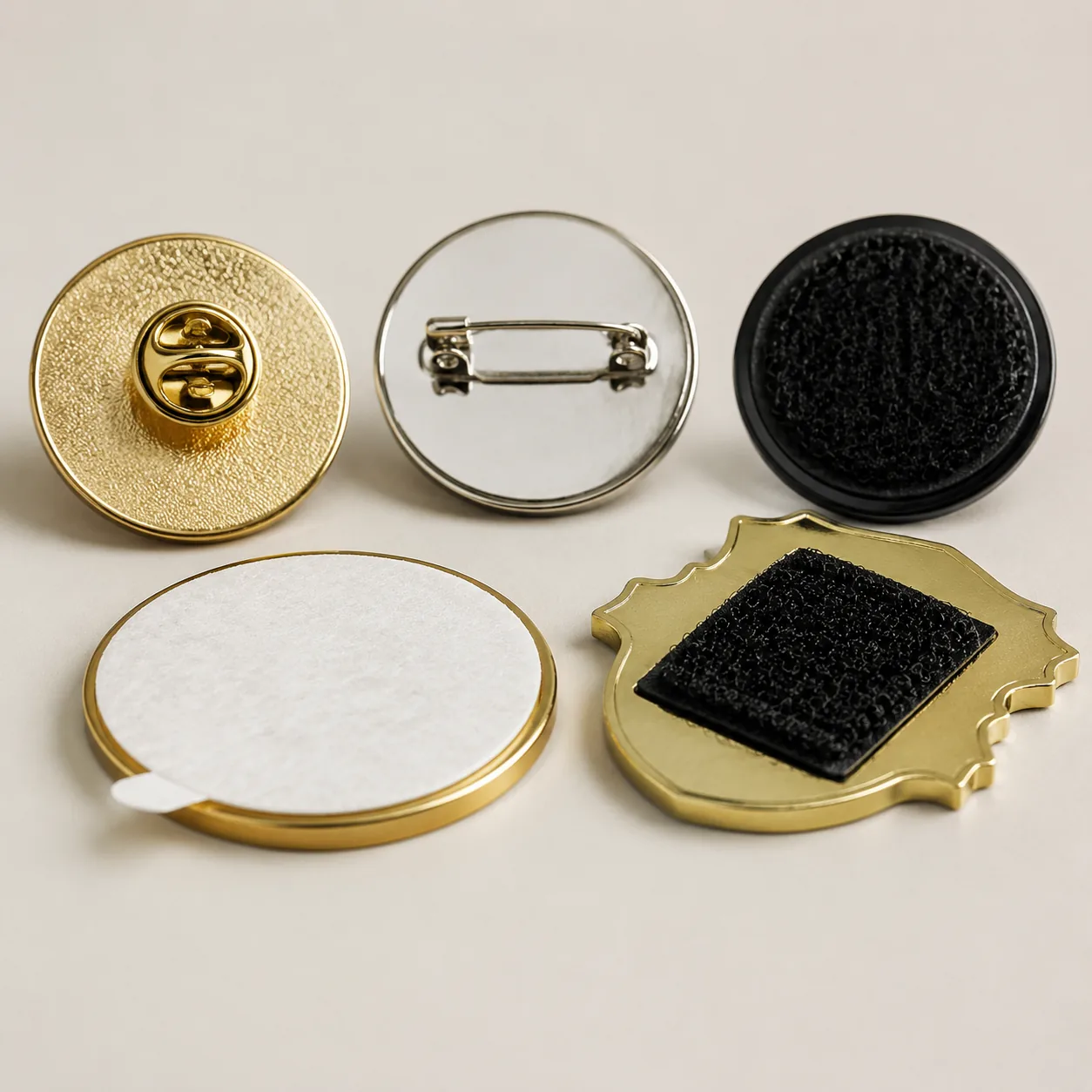
Hardware failures are common when the buyer only tests each item once. A butterfly clutch may hold on paper but sag on thick denim. A split ring may survive a pull test but still open after repeated torsion. A magnet may pass adhesion on bare steel but fail through paint, powder coating, or a thicker badge card. These are not random defects; they are mismatches between hardware spec and end use.
State the substrate and usage conditions for each item in the set. For lapel pins, define whether the target fabric is light cotton, twill, denim, felt, or a thick coat lapel. For badges and magnets, specify the backing material and ask for a pull-force target instead of a generic strong magnet claim. A small promotional magnet might need 300 to 500 g pull on bare steel to feel secure, but less if it is only for lightweight paperboard packaging. For rings, clasps, and chains, ask for wire diameter, plating, and cycle expectations if the set is meant to be reused.
The important distinction is static fit versus real-world handling. A clasp that closes once in the sample room may still fail after 50 open-close cycles or when attached to a key set with a higher torsional load. If the order is a mail-out promo, lighter hardware may be enough. If the set will be sold through retail or handled daily, ask for more conservative hardware, larger wire diameter, or a higher pull-test threshold.
| Hardware | Common failure | Buyer spec that prevents it |
|---|---|---|
| Butterfly clutch | Spin or fabric damage | Use case, pull target, and anti-rotation requirement |
| Split ring | Opens under repeated use | Wire diameter and torsion expectation |
| Magnet | Looks strong but slips | Pull-force target on stated substrate |
| Ball chain | Kinks or stains | Plating type, length, and material grade |
Failure 5: The surface finish looks good, then wears badly
A set can pass first inspection and still fail in the field if the finish is too thin, too soft, or poorly sealed. On metal items, the visible problem is often rub-off on edges, especially at raised details and cut lines where plating is thinnest. On enamel or printed items, the issue may be scuffing, dull patches, or epoxy yellowing after short use. Buyers overlook this because the defect is time-based, not immediate.
The right spec depends on exposure. If a set is for display only, a more delicate finish may be acceptable. If it will be handled in transit, packed loose, or carried daily, the finish needs better abrasion resistance. For decorative zinc alloy items, a practical plating range is often 0.08 to 0.15 micron for standard finishing, with higher-wear pieces needing a thicker build or a protective lacquer layer. If the part is expected to see frequent contact, ask the factory to confirm coverage on edges, not only flats.
Do not use epoxy as a default fix. It can reduce scuffing, but it also raises visual height, traps dust during curing, and can distort ultra-fine art on small pins. If the design includes transparent fills, glitter, glow pigment, or sandblast effects, call those out separately because they need different curing and QC controls than standard enamel. The best prevention is matching finish choice to handling conditions, not to an abstract idea of durability.
Tolerance matters here too. If the buyer expects a matte finish, the factory should not substitute a semi-gloss look to hide surface texture. For retail sets, specify whether a finish may vary by lot or must remain within the approved master sample across the full order.
Failure 6: Packaging creates the return, not the product
A well-made set can still generate complaints if the packaging moves the parts around or damages the finish. The usual failure is friction: metal-to-metal contact in a polybag, a backing card that is slightly too tight, or a lanyard folded in a way that creates a permanent crease. Retail buyers also see problems when the card design covers product details or the barcode area gets blocked by the item itself. Packaging is part of the product, not a separate afterthought.
Specify packing geometry, not just packing style. If the pin goes on a backing card, define the distance from product center to card center, the insertion direction, and whether the clutch should face up or down. If a set includes multiple pieces, state separators, cavities, or sleeves so the factory knows whether items may touch. For bulk cartons, ask for carton size, inner pack count, and stacking limits so deformation does not happen before the goods reach the distributor. A rigid backing card is often 350 to 400 gsm board with 0.2 to 0.3 mm lamination, while a 250 gsm card can curl under heat and humidity.
If the pack-out includes shrink wrap or heat sealing, confirm seal temperature and dwell time because too much heat can warp printed cards and too little can leave the set loose. For lanyards, specify fold length and crease direction so the print lands flat in the opening shot. For multi-item sets, request one packed sample before mass packing and ask for a photo of the packed unit from the same angle the customer will see in retail or unboxing.
Packaging should also protect against mixed SKU errors. If the order includes left/right variants, alternate colors, or multiple lengths, the carton label and tray map should make the differences visible at a glance. That reduces the chance of a clean product arriving in the wrong configuration.
- Use insert photos for every set configuration.
- State whether surface-to-surface contact is allowed.
- Define fold direction for lanyards and straps.
- Specify if backing cards must stay flat after sealing.
- Require one packed sample before mass packing.
Failure 7: QC checks the wrong thing at the wrong time
The biggest quality loss happens when inspection is too late or too generic. If a buyer only checks final cartons, they may miss a color shift introduced at plating, a hole misalignment created during punching, or a packaging issue caused during final assembly. AQL is useful, but only if the inspection points match the actual failure modes. Otherwise you get a clean report and unhappy customers.
For multi-item promo sets, inspection should be layered. Check raw material lot, first article, in-line process, and final packing separately. A practical final-inspection plan is AQL 2.5 for major defects and 4.0 for minor defects, with tighter internal checks for critical fit items like key rings, pin posts, and card slots. For premium launches or retail programs, many buyers also tighten the major-defect limit to 1.5 and hold critical dimensions to a 100 percent first-article check before bulk output starts.
Use the inspection stage to match the risk. First article should confirm dimensional accuracy and artwork translation. In-line checks should catch drift in plating, stitching, or print density before thousands of pieces are affected. Pre-pack checks should confirm count, orientation, and SKU segregation. Final AQL should focus on carton-level defects, missing parts, and packing mistakes rather than trying to catch every process error after the fact.
For critical dimensions, write the tolerance into the drawing and the inspection sheet together. If a badge slot must be 10.0 mm, say whether 9.9 to 10.1 mm is acceptable or whether the range is tighter. That is the only way the factory and the buyer will evaluate the same standard.
| Inspection stage | What to catch | Useful acceptance focus |
|---|---|---|
| First article | Wrong size, color, or tooling | Dimensional match to approved drawing |
| In-line | Process drift before mass output | Consistency of finish, print, and assembly |
| Pre-pack | Missing parts or mixed variants | Count, orientation, and SKU segregation |
| Final AQL | Carton-level defects | AQL 2.5 major, 4.0 minor, or tighter as needed |
What to do next
Start by building one set-level spec sheet that names every component, every shared appearance rule, and every exception. Then tie each high-risk item to a measurable control: size tolerance, plating family, pull target, print method, or packing orientation. If you are buying from China, ask the factory to confirm the sheet line by line before sampling, because that is where ambiguity is cheapest to fix. ZheCraft can usually help buyers turn one vague promo concept into item-level production specs without losing the common look across the set.
Before you place the order, request one combined golden sample, one packed sample, and a short inspection checklist covering the top three failure modes for that set. If the factory cannot explain how each item will be measured, the order is not ready. The goal is not perfection on paper; it is reducing the number of ways the set can fail after approval.
A practical buying checklist is simple: lock the master visual, define critical dimensions, verify hardware against the real substrate, and approve packing with photos. Do that before mass production, and most of the expensive rework disappears before it starts.
Have a project? Send your artwork and target quantity and we’ll reply with a detailed quotation within 12 working hours.
Ready to get this made?
Send your sketch, target quantity and ship-date. Detailed quotation in 12 hours.



