7 Production Failures That Break Custom Promo Products
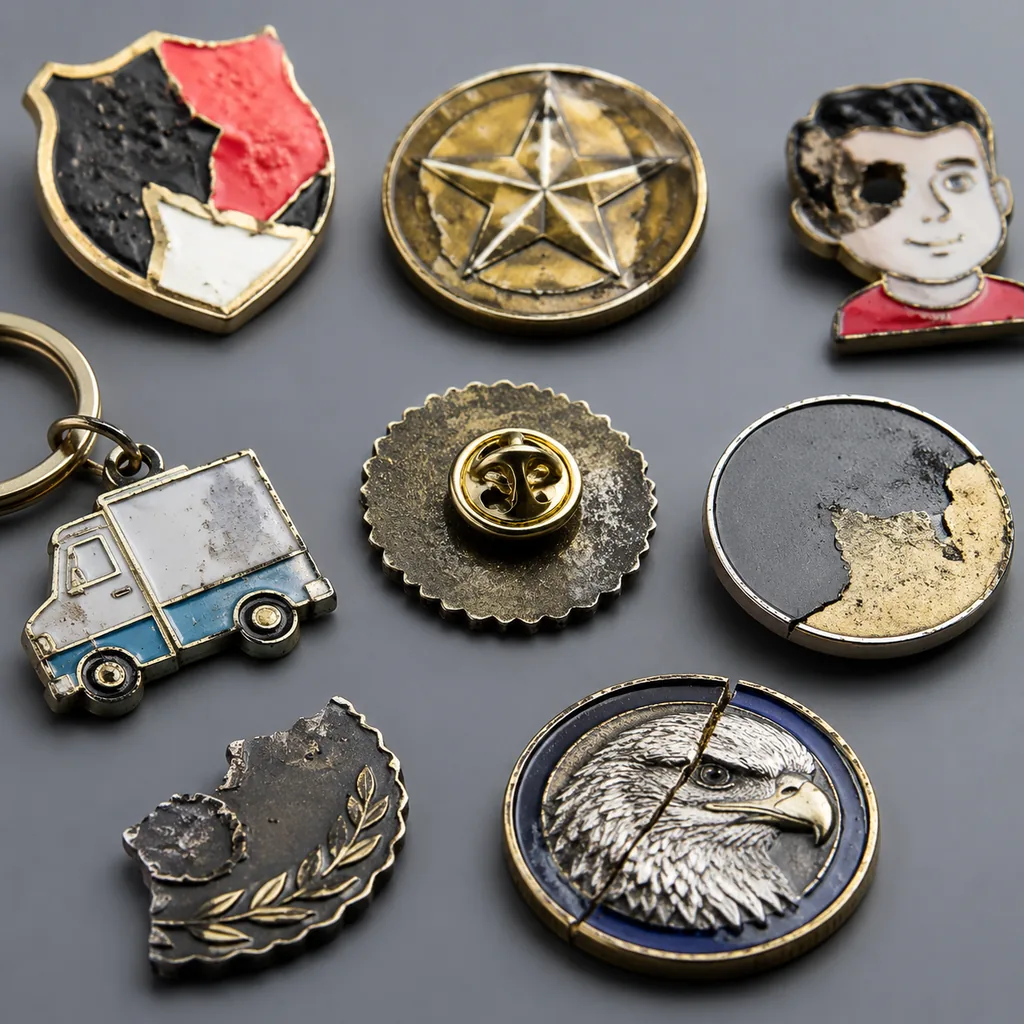
Why good samples still fail in mass production
A clean pre-production sample does not guarantee a clean shipment. In custom enamel pins, badges, coins, keychains, patches, and lanyards, the most expensive mistakes usually appear after tooling is approved: plating shifts, color mismatch, weak attachments, warped parts, and packing damage that only shows up at scale. Buyers often approve the sample because it looks right in hand, then discover that the factory never locked the same conditions for plating thickness, line width, fill depth, or attachment load.
The root problem is that many promo products are specified by appearance instead of failure mode. A supplier can match the artwork and still miss the performance requirement if the spec never states what must not happen. For factory control, the question is not only “Does it look right?” but “What breaks first, and under what tolerance?”
At ZheCraft, we usually see rework come from three places: unclear acceptance criteria, mismatched assumptions between sample and bulk, and missing QC checkpoints between cutting, plating, filling, assembly, and packing. The sections below break down those failure modes one by one so you can spec against them before production starts.
Failure mode 1: plating looks fine, then tarnishes or patches
Plating problems often start as a color complaint but are actually a process-control issue. Thin plating, poor base polishing, contamination before plating, or over-aggressive tumbling can produce patchiness, dark edges, or fast oxidation after shipment. For custom pins and coins, common decorative plating thickness is about 0.03 to 0.08 microns for flash-style finishes and 0.1 to 0.3 microns for more durable decorative layers, but the exact range depends on design and process route.
If the product will be handled often, shipped in humid regions, or stored in retail inventory, specify both finish type and minimum appearance retention. Nickel-free or environmental plating does not automatically mean corrosion-resistant. Ask for neutral-salt or accelerated humidity expectations only if your supplier can genuinely test to a defined internal method; otherwise, require a visual standard after a set packing and storage period, plus a sealed bag or anti-tarnish insert where needed.
- State the plating finish by name and target thickness, not just a color word.
- Require uniform edge coverage on raised details and recessed channels.
- Add a storage condition for sample-to-bulk matching, especially for humid routes.
- Use sealed polybags or anti-tarnish protection when the product is sold slowly.
Failure mode 2: color drifts after approval
Color drift usually comes from one of four issues: unapproved Pantone conversion, inconsistent fill viscosity, overfilled cavities, or curing conditions that vary between sample and bulk. Enamel pins and badges are especially vulnerable because a minor shade shift becomes obvious next to metal outlines. Even when the artwork uses a valid Pantone reference, the factory still needs to know whether the target is coated paper appearance, matte enamel appearance, or a specific physical swatch.
The safest spec is to name one primary color standard, one fallback sample, and the acceptable deviation window. For bulk promo orders, buyers commonly work to a visible tolerance of Delta E about 2 to 3 for close-match work, but the real control is a signed standard kept at the factory and in the buyer file. If your brand color is sensitive, avoid mixing gloss and matte surfaces in the same design unless you’ve reviewed the visual difference under the same lighting.
Do not choose a highly saturated translucent effect if the order needs tight color consistency. Transparent and glitter enamels can look premium, but they also increase the risk of batch-to-batch visual variance. For reorder programs, lock the exact formula, surface finish, and approved reference under the same item code so a later purchase does not get treated as a new color interpretation.
Failure mode 3: lines close, bridges disappear, or fill bleeds
This failure is usually not the operator’s fault; it is a spec problem. When lines are too fine, recesses too narrow, or separations too tight, enamel can bridge over detail or bleed into adjacent areas. For small custom metal products, a practical minimum line width is often around 0.25 to 0.3 mm for controlled production, while very intricate designs may need more generous spacing depending on alloy, mold depth, and finish style.
If the design includes text, borders, or nested shapes, define minimums before tooling. A pin can look sharp on-screen and still fail in metal because the die cannot hold the geometry once the edges are polished and plated. The same risk applies to cutouts and openwork: a clean vector file is not enough if the narrowest bridge cannot survive stamping or casting without distortion.
| Design feature | Safer spec range | Common failure if underspecified |
|---|---|---|
| Minimum line width | 0.25–0.3 mm or wider | Lines collapse or enamel bridges |
| Gap between colors | 0.2–0.3 mm or wider | Color bleed across borders |
| Tiny text height | 2.0 mm or larger | Legibility loss after polishing |
| Thin structural bridge | 0.6–0.8 mm or stronger | Breakage during demolding or packing |
Failure mode 4: hardware passes sample, fails on wear
Attachment failures are often invisible in a static sample and obvious only after repeated handling. A butterfly clutch may hold a light lapel pin fine, then loosen on thick fabric or during repeated removal. Magnetic backs avoid piercing garments, but weak magnets can slip on heavy textiles, while overly strong magnets can mark or pinch delicate apparel.
The buyer should specify both function and load condition. For brooch-style products, define whether the item will hang vertically, move with a jacket lapel, or be worn on thicker coats; that determines whether anti-rotation, dual-pin support, or a wider backing is necessary. For keychains, ask for the connector style, pull direction, and expected pull force; a swivel or split ring is not the same as a weak jump ring, and they should not be treated as interchangeable by the supplier.
If there is any child access, frequent handout use, or outdoor wear, avoid under-specifying hardware because the cheapest failure is the one that happens in the customer’s pocket. A better spec is slightly heavier hardware with a clearly defined attachment test, even if unit cost rises by a few cents. In most promo categories, a stable attachment is worth more than a lighter piece that returns in two weeks.
Failure mode 5: the sample fits, bulk pieces don’t
Fit problems show up when multiple dimensions stack against each other: metal thickness, backing card thickness, pin post length, clasp depth, coin ring width, or magnet housing clearance. A sample can fit because one dimension was slightly generous, then bulk production shifts by fractions of a millimeter and the assembly becomes tight, crooked, or impossible to close. This is why dimensional tolerance matters even for low-cost giveaway products.
For custom metal products, define critical dimensions and the allowable deviation separately from cosmetic dimensions. A general tolerance of plus or minus 0.1 mm may be achievable on many features, but small internal fit points and attachment channels often need tighter control or deliberate extra clearance. Do not force the factory to guess which dimension is decorative and which dimension is functional.
The same logic applies to multi-item promo sets. If a pin, backing card, and polybag all need to work together, each component must be specified as a system, not as isolated parts. One component drifting by 0.5 mm can make the whole kit look sloppy even when every piece passed its own local inspection.
Failure mode 6: packing damage creates hidden returns
Many buyers focus on the product and under-spec the journey. Sharp pin points, plated corners, detached key rings, crushed backing cards, and scuffed epoxy domes often happen because cartons were packed to survive factory handling, not export transit. If the product moves inside the bag or rubs against another metal part, the finish can degrade before it reaches the customer.
Packing should be treated as a QC stage, not just a shipping task. State whether each item must be individually bagged, carded, sleeve-protected, or nested, and whether outer cartons need inner dividers or poly-lined protection. For mixed sets, carton compression and vibration matter as much as the product itself, especially when the shipment includes both rigid metal items and flexible printed components.
A good packing spec also sets a clear acceptance level for external damage. For example, you might allow no visible scuffing on A-side faces, a limited rate of minor bag wrinkles, and zero bent posts or detached hardware. The point is to stop the factory from deciding that “mostly okay” is acceptable when your downstream customer will not agree.
What to lock before you place the order
The fastest way to reduce rework is to convert the order from a design request into a controlled manufacturing spec. That means naming the failure you want to avoid, the dimension or process that controls it, and the inspection point that proves it is under control. For recurring programs, this is more important than negotiating a slightly lower FOB price, because the cheapest quote is often the one with the loosest interpretation.
- Lock the reference sample, revision number, and exact artwork file.
- Define critical dimensions, especially lines, gaps, thickness, and fit points.
- State finish type, target plating thickness, and color standard in writing.
- Add a packaging spec that protects the product through export transit.
- Require bulk inspection at AQL 2.5 for major defects and 4.0 for minor defects, or your house standard if stricter.
If you are sourcing custom enamel pins, coins, badges, keychains, patches, or lanyards, ask the factory to quote against a failure-mode spec, not just a picture. At ZheCraft, we can map each design to the likely production risks, then align tooling, plating, assembly, and packing around the same acceptance standard. That usually costs a little more time up front, but it is far cheaper than redoing a shipment later.
What to do next: pick one product line, list the top three failures you cannot tolerate, and turn each into a written spec with a dimension, tolerance, finish, or test. If you want, use that as the basis for a factory RFQ and I can help you structure it for pins, coins, magnets, keychains, patches, or lanyards.
Have a project? Send your artwork and target quantity and we’ll reply with a detailed quotation within 12 working hours.
Ready to get this made?
Send your sketch, target quantity and ship-date. Detailed quotation in 12 hours.



