7 First-Import Failures in Custom Metal Promo Orders
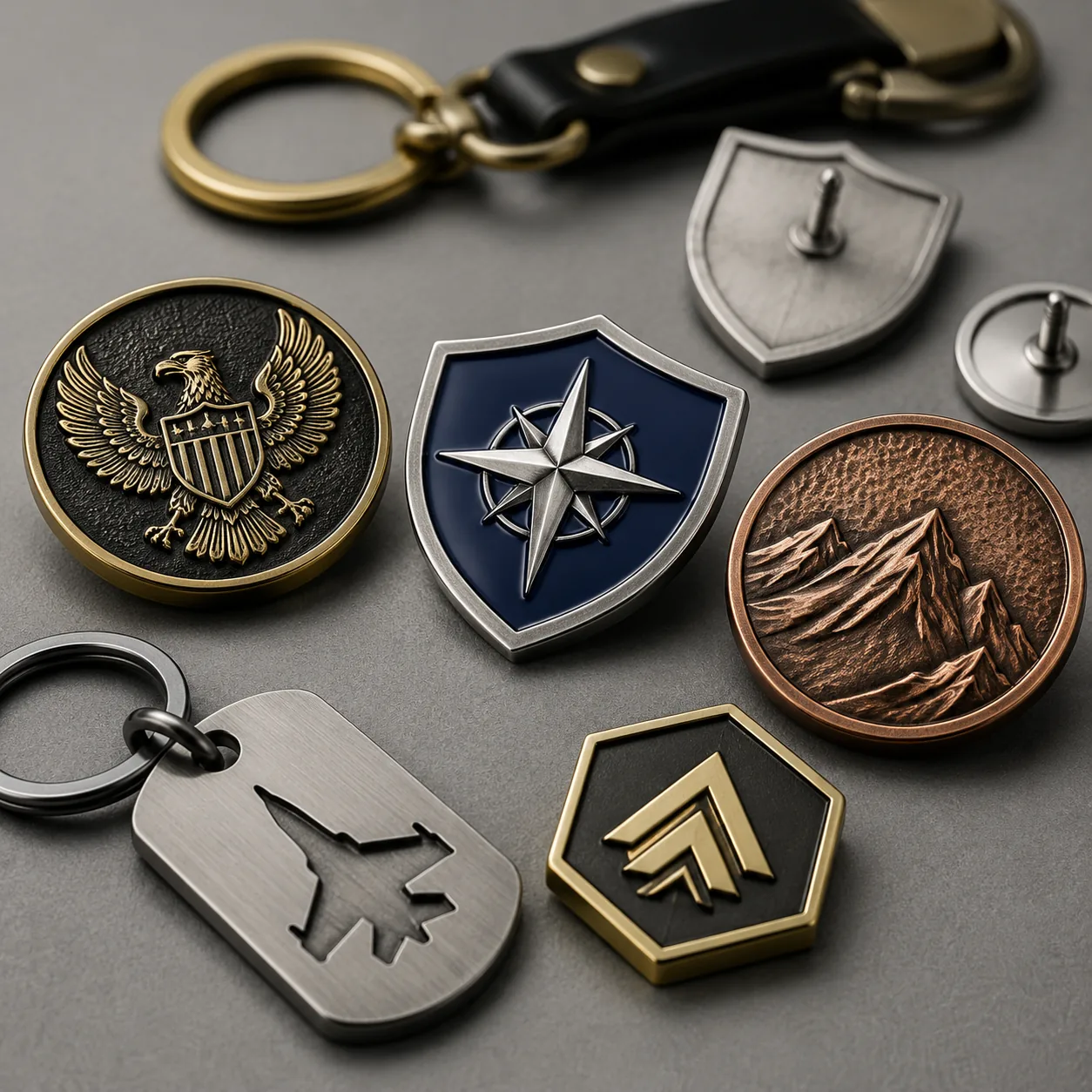
1. Lowest quote wins because the product was never fully specified
Most first-order cost overruns start at RFQ stage, not on the production floor. A brief such as "30 mm enamel pin with gold plating" still leaves the factory deciding base metal, thickness, process route, edge finish, attachment count, plating thickness, and packing. Several very different products can match the same description and produce very different landed costs, reject rates, and customer impressions.
For example, a 30 mm pin could be 1.2 mm stamped iron with soft enamel, 1.5 mm brass with imitation hard enamel and polished face, or a 2.0 mm zinc-alloy die casting with deeper relief. Those three builds can all follow the same artwork, but they differ in weight, line definition, mold cost, plating durability, and freight. On challenge coins, a change from 3.0 mm to 4.0 mm thickness typically increases piece weight by roughly 20-30 percent depending on diameter and relief, which directly affects airfreight and parcel cost.
Before asking for pricing, lock the build sheet. For economy soft enamel pins, stamped iron at 1.2-1.5 mm is common. For imitation hard enamel or polished flat-face badges, 1.5 mm brass or upgraded iron is safer because the face is ground after enamel curing. For undercuts, openwork, bottle-opener shapes, irregular outlines, or body thickness above 2.0 mm, zinc-alloy die casting is usually more realistic than stamping. On coins, 3.0 mm is entry level, 3.5 mm is a common commercial standard, and 4.0 mm reads as premium but adds cycle time in polishing and plating.
Also separate unit price from non-recurring charges. Tooling, pre-production sample, backing card, polybag, barcode label, export carton, and freight estimate should all appear as separate line items. A quote that looks USD 0.06 lower per piece can become more expensive once a USD 90 mold fee, USD 0.10 card pack, and larger carton volume are added.
| Item | Concrete first-order specification | Typical MOQ tiers | FOB China price range |
|---|---|---|---|
| Soft enamel pin | 25-35 mm, stamped iron 1.2-1.5 mm, soft enamel fill, 0.15-0.25 micron nickel/gold-tone plating, 1-2 posts, butterfly or rubber clutch | 100 / 300 / 500 / 1,000 pcs | USD 0.38-0.95/pc |
| Imitation hard enamel pin | 25-35 mm, brass or iron 1.5 mm, polished flat face, enamel filled and ground, 0.20-0.35 micron plating, individual OPP bag | 100 / 300 / 500 / 1,000 pcs | USD 0.65-1.60/pc |
| Die-cast keychain | 40-60 mm zinc alloy, 2.0-3.0 mm body, 25-30 mm split ring in 1.6-1.8 mm wire, optional enamel or epoxy | 100 / 300 / 1,000 / 3,000 pcs | USD 0.75-2.20/pc |
| Challenge coin | 40-50 mm, brass or zinc alloy, 3.0-4.0 mm thick, 2D or moderate 3D relief, antique or shiny finish | 100 / 300 / 500 / 1,000 pcs | USD 1.60-4.80/pc |
| Metal fridge magnet | 50-80 mm metal face or die-cast body, ferrite or NdFeB magnet selected by holding force, individual bag | 300 / 500 / 1,000 / 3,000 pcs | USD 0.45-1.80/pc |
For a first import, 300-1,000 pieces per design is usually the safest opening band. Below 100 pieces, setup charges dominate. Above 3,000 pieces, every unclear specification gets multiplied into a larger financial problem.
2. Artwork looks clean on screen but cannot be tooled cleanly in metal
Factories do not reproduce vector files like digital printers. Dies, cast molds, polishing wheels, etching plates, and enamel needles all have minimum workable widths. If the art ignores those limits, details fill in, small holes close, walls become too thin, and plating or polishing wipes out features the buyer thought were approved.
For soft enamel, keep raised metal lines at 0.25 mm minimum and recessed enamel channels at 0.30 mm minimum; on small logos, 0.35-0.40 mm is safer. Color islands below 0.50 mm are risky because enamel can underfill or bleed into adjacent cells. For imitation hard enamel, raised borders should usually be at least 0.30 mm because polishing removes height from the top metal. Text should generally be 1.2 mm minimum character height for simple uppercase fonts, and 1.5-1.8 mm for mixed-case or serif fonts.
Relief depth also needs realistic limits. On a 45 mm coin, practical 2D level changes are often 0.3-0.8 mm. More aggressive 3D sculpting can reach about 1.0-1.8 mm, but only if the surface area is large enough to transition cleanly. Very steep walls create polish traps, thin plating on peaks, and muddy detail in recesses. Open cutouts should be checked for bridge strength; narrow bridges below roughly 0.8-1.0 mm can bend during trimming or barrel handling.
Serial numbers, QR codes, and micro text are frequent failure points. Laser-engraved serials need a flat field, around 0.20 mm minimum stroke width, and about 1.5 mm minimum character height to remain readable after plating glare. QR codes on shiny metal are often overestimated. If the code is not tested on the final finish, under real lighting and with the intended scanner, move it to a printed card, adhesive label, or insert instead of forcing it into the metal face.
Approve the engineering proof at actual size and enlarged scale before tooling starts. Ask the factory to mark all artwork adjustments in red: widened lines, merged cavities, blocked holes, changed fonts, or shifted posts. If the problem is discovered only after mold cutting, remake cost is commonly USD 30-120 for a simple pin tool and USD 80-250 for a coin or keychain mold, with another 3-5 working days added.
3. The sample gets approved with no measurable acceptance rules
A pre-production sample is useful, but "approved as sample" is not a quality system. Video calls and phone photos can hide enamel wave, pitting, solder issues, thickness drift, or plating haze. If the PO contains no measurable standards, inspection becomes a negotiation instead of a pass-fail decision.
Set tolerances by product type. For pins and keychains under 50 mm, overall size tolerance of ±0.3 mm is practical. For coins or magnets from 50-80 mm, ±0.5 mm is more realistic. Stamped thickness tolerance of ±0.15 mm is common; die-cast zinc alloy often needs ±0.20 mm, especially on irregular outlines. Attachment placement can usually be held to ±0.5 mm unless it must align to a retail card hole or display fixture.
Control color with both Pantone references and a physical golden sample. For standard opaque enamel, Delta E around 2.0-3.0 under D65 lighting is a workable commercial target. Metallic, glitter, translucent, glow, pearl, and near-black colors should be approved from actual production samples because their appearance changes with cavity depth, base metal color, and topcoat gloss.
- Keep one signed golden sample at the factory and one sealed reference sample with the buyer or third-party inspector.
- State the cosmetic inspection condition: front face viewed at about 30 cm under 500-1,000 lux white light for 5 seconds per side.
- Define defects before production: critical, major, minor.
- A common import standard is AQL 0 for critical, AQL 2.5 for major, and AQL 4.0 for minor under ANSI/ASQ Z1.4 single normal sampling.
- Write front-face limits explicitly: no exposed base metal, no enamel void over 0.3 mm on the face, no burrs that fail a finger-swipe check, no visible plating pit at 30 cm.
- Clarify reverse-side standards. Allowing minor back-side polish marks often reduces cost by about 5-12 percent versus cosmetic-grade backs.
Define shipment blockers in advance. Wrong artwork, mixed plating colors, missing hardware, detached magnets, incorrect country-of-origin labeling, or mixed SKUs in one carton should trigger hold-and-rework, not argument at final inspection.
4. Plating looks good at final inspection, then tarnishes or spots in transit
Plating failures are deceptive because they often appear after packing. Goods can leave Guangdong clean and arrive 30 days later with black spots, haze, fingerprint marks, sulfur staining, or edge corrosion. Typical causes include weak degreasing, plating that is too thin, trapped polishing residue, insufficient rinsing, damp packing, sulfur-bearing paper, or bagging before the finish has stabilized.
Do not accept vague wording such as "gold plating" or "nickel finish." For low-cost promo items, anything below about 0.10 micron is essentially flash plating and best reserved for short-life giveaways. A safer entry spec for nickel, imitation gold, silver-tone, black nickel, or rose gold is 0.20-0.30 micron over the proper undercoat. For coins and keychains that will be handled repeatedly, 0.30-0.50 micron is more defensible. If anti-tarnish performance matters, specify a clear e-coat or anti-oxidation lacquer and approve the resulting change in gloss and tactile feel.
Finish choice matters as much as plating thickness. Mirror gold and mirror silver scratch quickly on flat fields larger than about 15 mm, especially when shipped in bulk or assembled with chains and rings. Antique brass, antique nickel, matte gold, sandblasted backgrounds, and textured recesses hide handling marks much better. Black nickel is attractive but unforgiving; it should usually be individually bagged because rub marks show fast.
For first orders, ask for basic process controls: at least 24 hours dry storage after plating before bagging, gloves for handling bright finishes, and a simple adhesion check such as a cross-hatch tape test on a flat plated area where feasible. Neutral salt spray is not standard for low-cost promo goods, but for premium retail coins or humid-market shipments, 24-48 hour NSS can be specified if cost and lead time are agreed before production.
Packaging materials around plated surfaces also matter. Low-grade acidic paper, damp cardboard, or foam with chemical residue can stain bright finishes. If pieces are individually sealed, confirm they are fully dry before bagging; trapped moisture is one of the most common causes of transit spotting.
5. The attachment is treated like decoration instead of a functional component
Many first imports pass cosmetic inspection but fail in use. Pins rotate on fabric, clutches loosen, key rings spread open, and magnets slide down coated refrigerator doors. Buyers often spend hours refining the front artwork and only seconds selecting the hardware.
Match the attachment to weight, orientation, and use case. A single butterfly clutch is acceptable for many pins up to about 25 mm and under 6 g on stable fabric. For 30-45 mm pins, long horizontal shapes, or pieces above 6-8 g, use two posts spaced at least 18 mm apart. Standard pin post diameter is about 0.9-1.0 mm with a 3.5-4.5 mm solder pad. Rubber clutches generally grip better than the cheapest butterfly clutches, while locking clutches reduce loss but add thickness and roughly USD 0.08-0.20 per unit depending on style and order size.
For brooch bodies above 45 mm or around 12 g and up, a 25-35 mm safety brooch bar is safer than pin posts. For keychains, define the ring style and wire gauge. On 40-60 mm zinc-alloy keychains, a 25 mm split ring made from 1.6-1.8 mm wire is a practical minimum; 30 mm rings are better for bottle openers, heavier medallion styles, or multi-charm assemblies. If a jump ring joins the body to the split ring, specify whether it must be welded or fully closed after forming. Open rings are cheaper but commonly spread in use.
Magnets should be specified by holding force on the target surface, not only by dimensions. A magnet that holds 80 g on a flat painted steel test plate may still slide on a curved or heavily coated refrigerator door, especially if the metal body creates leverage. If the magnet can detach from the product body, treat it as a critical defect and require a pull test or destructive bond check from each lot.
| Use case | Recommended hardware | Practical spec | Common failure if under-specified |
|---|---|---|---|
| Small wearable pin | 1 post + rubber or butterfly clutch | Up to 25 mm, under 6 g | Rotation or accidental loss |
| Medium pin / horizontal pin | 2 posts + 2 clutches | 30-45 mm or 6-8 g+ | Spinning, tilting, bent post |
| Brooch | Safety brooch bar | 25-35 mm bar for 45 mm+ body | Weak closure or fabric stress |
| Keychain | Split ring + short chain or direct ring | 25-30 mm ring, 1.6-1.8 mm wire | Ring opens, deforms, or wears fast |
| Fridge magnet | Ferrite or NdFeB matched to weight | Specify hold test on target surface | Sliding or detachment |
6. Packing protects the carton, not the product surface
A shipment can be manufactured correctly and still arrive damaged because the packing spec was too light. Bulk packing lowers the quote, but metal faces, chains, rings, and clutches rub during trucking, export handling, airfreight, ocean transit, and warehouse receiving. The risk is highest for mirror plating, black nickel, epoxy domes, transparent enamel, and large flat coins.
Choose packing to match finish and sales channel. Individual OPP bags are usually enough for soft enamel pins with antique or matte finishes and typically add USD 0.02-0.04 per piece. A printed backing card plus OPP bag often adds USD 0.06-0.18 depending on card size, 250-350 gsm board, print sides, die-cut hole, and insertion labor. PVC sleeves, velvet pouches, coin capsules, or rigid gift boxes can add roughly USD 0.15-0.90 per piece and substantially increase carton volume, so they fit premium retail coins, commemorative sets, and VIP gifting better than mass giveaway orders.
Packing should also support receiving. Request inner boxes of 50-100 pieces for most pins and keychains, and 20-50 pieces for heavy coins to reduce carton crush and counting errors. Keep export cartons under about 15 kg gross weight unless the destination warehouse accepts heavier manual handling. Use 5-ply cartons for coins and heavy keychains, include desiccant for ocean shipments or humid storage, and print outer labels with item name, PO number, SKU, quantity, net weight, gross weight, carton number, and country of origin where required.
If goods are going to Amazon, retail DCs, subscription boxes, or event kits, define barcode format, label size, label placement, polybag suffocation warning, and carton assortment before mass packing. Reworking 2,000 pieces for missing labels or wrong assortment commonly adds 2-4 days and can cost more than the labels themselves.
7. Inspection is booked too late to protect the ship date
The weakest QC plan is the one where the event date is fixed, production slips, and inspection becomes ceremonial because there is no time left for sorting or remake. Custom metal goods move through proofing, tooling, stamping or casting, trimming, polishing, plating, enamel filling, curing, assembly, packing, and final inspection. Compressing these steps increases defect risk, especially with many enamel colors, shiny plating, epoxy domes, or retail-ready packaging.
A realistic first-order schedule is usually 2-4 working days for engineering proofing, 5-8 working days for tooling plus pre-production sample, 10-18 working days for mass production after sample approval, and 2-4 working days for final inspection and packing. For larger runs of 5,000-20,000 pieces, add roughly 3-10 working days depending on cavity count, color count, plating-bath capacity, and packing complexity. Airfreight from China often runs 4-8 days door-to-door after pickup; sea freight commonly takes 25-45 days port-to-door depending on lane and customs.
Book inspection against milestones, not only against ex-factory date. For higher-value first orders, schedule one in-process check after plating or after the first packed lot while there is still time to sort or rework. Use ANSI/ASQ Z1.4 single normal sampling unless your internal standard differs. For most promotional metal items, AQL 0 critical, 2.5 major, and 4.0 minor is a workable baseline.
Critical defects usually include sharp burrs, detached magnets, broken posts, wrong customer artwork, mixed SKUs, and restricted-substance non-compliance. Major defects include wrong plating color, color outside the approved standard, missing enamel, weak attachment, wrong packing count, or unreadable carton labels. Minor defects may include slight reverse-side polish marks, small back-side fill inconsistency, or packaging wrinkles that do not affect saleability.
Before paying the deposit, convert the design into a production control sheet. At minimum include item size, thickness, base metal, process type, finish, plating micron target, enamel type, Pantone colors, relief depth, hardware, packing method, carton marks, inspection standard, latest acceptable ship date, and compliance requirements such as REACH, CPSIA, EN71, or California Proposition 65 when relevant. Then request tiered pricing at 300, 500, 1,000, and 3,000 pieces using exactly the same specification, with separate lines for tooling, sample, carding, bagging, upgraded clutch, barcode labeling, and freight estimate. That discipline does more to prevent first-import failure than any last-minute inspection ever will.
Have a project? Send your artwork and target quantity and we’ll reply with a detailed quotation within 12 working hours.
Ready to get this made?
Send your sketch, target quantity and ship-date. Detailed quotation in 12 hours.



