7 Failure Modes That Ruin Custom Promo Orders
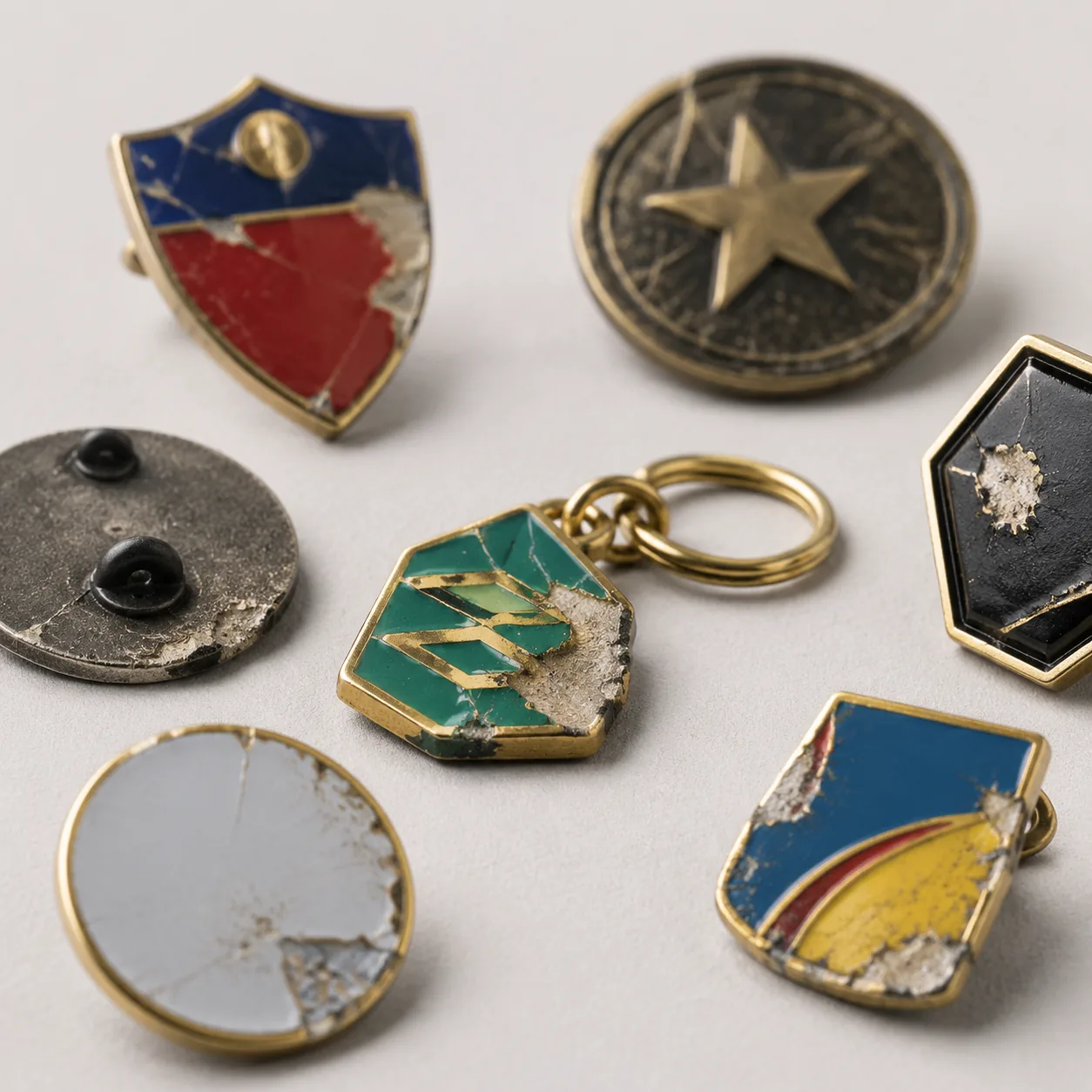
Why good designs still fail in production
Most promo products do not fail because the artwork is bad. They fail because a design that looks fine on screen has no production guardrails for thickness, plating, color fill, backing, or packing. A factory can make a visually accurate sample and still ship a batch with rotation, weak adhesion, scratch marks, or color drift if those limits were never written into the spec.
The common pattern is simple: buyers ask for the look, but not the tolerances. Once tooling is cut, the factory has to choose between speed, yield, and visual consistency, and if the spec is vague, yield usually wins. That is why the right way to buy custom metal products is not “describe the item,” but “define the failure modes you will not accept.”
This teardown focuses on pins, coins, keychains, badges, magnets, patches, and lanyards because the same production mistakes repeat across all of them. The exact risk changes by product, but the control logic stays the same: lock critical dimensions, choose the right build, and make QC inspect the real weak points instead of only checking artwork approval.
Failure mode 1: Fine details collapse after tooling
The first failure is geometric: line work that is readable in vector art becomes mushy once it is cast, stamped, or embroidered. Thin borders, tiny cutouts, and closely spaced text can close up during plating, polishing, or stitch pull, especially when the part is scaled down below comfortable manufacturing limits. In metal goods, the issue is often minimum line width and gap width; in patches, it is stitch density and thread overlap.
For custom enamel pins and badges, a practical floor is about 0.25 mm minimum line width for raised metal walls, with 0.30 mm being safer for repeatability. For open areas and internal gaps, keep at least 0.30-0.40 mm unless you are willing to accept partial bridging on the first sample. For woven patches, anything below roughly 1.0 mm can become unreadable depending on thread count and edge finishing.
The spec should state which details are functional and which are decorative. If the buyer says all details are equal, the factory will protect the biggest shapes and sacrifice the smallest ones. That is acceptable for artistic work, but not for logos, serial marks, or any feature that affects brand recognition or legal text.
Failure mode 2: Finish defects appear after polishing and plating
A lot of “plating problems” are really surface-prep problems. Scratches, pinholes, cloudy chrome, dull gold, and uneven color all start before the finish layer goes on, when the base metal is not clean enough or the polishing sequence leaves micro-scars. On high-relief items, over-polishing can also soften edges and reduce the perceived sharpness of the design.
For most plated promo items, buyers should ask for the plating type and thickness in microns, not just the color name. Decorative nickel or gold plating often sits around 0.1-0.3 microns on low-cost work, while more durable premium builds may target 0.5 microns or higher, depending on the finish system. If wear resistance matters, ask the supplier to state the plating stack and whether a clear coat, e-coat, or anti-tarnish layer is used.
Do not specify mirror polish if the design has shallow engraving or fine texture that needs contrast. A mirror surface can erase definition and make small defects easier to see. In many cases, satin or antique finishes hide handling marks better and produce more stable visual results across a run.
Failure mode 3: Color fill looks right on sample and wrong in bulk
Enamel, ink, screen print, and sublimation all have a color-control problem: the first sample is usually matched under ideal conditions, while the bulk order is made under production pressure. The result is one batch with colors that are too translucent, too dark, or too warm compared with the approved sample. This is common when the buyer approves from a monitor image instead of a physical standard.
For hard enamel and soft enamel pins, specify Pantone references for each color and state whether the factory must match to printed swatches, coated chips, or a physical golden sample. If your design uses very light colors, ask for underfill control because enamel shrinkage after baking can expose metal walls or create a low spot in the color field. A practical visual acceptance limit is flush-to-slightly-crowned fill on hard enamel and controlled recess on soft enamel.
If the product will be reordered, lock the approved standard in writing. Color drift often happens because different pigment lots, curing temperatures, or operators are used months later. Reorders should reference the exact master sample, not only the original artwork file, and the spec should say that a bulk run must stay within the same approved shade family even if the supplier changes raw materials.
Failure mode 4: Parts move, sag, or break in use
Mechanical failure is the fastest way to create returns. Pins rotate on weak backs, key rings deform, chains open, brooches sag on fabric, and magnets detach because the attachment method was chosen for cost instead of load. Buyers often overfocus on the visible face and under-spec the hidden hardware that actually carries the product.
For lapel pins and brooches, define the attachment based on garment weight and motion. A single butterfly clutch is acceptable for light pins, but larger or heavier pieces usually need two backings, a military clutch, or a locking magnetic system if fabric damage is a concern. For keychains, ask for ring wire diameter, split-ring turns, and connector strength, because those are the weak points that usually fail first.
The factory should also know the intended use case: display, gifting, daily wear, or outdoor exposure. A keychain that rides in a handbag can survive a lighter build than one that hangs from a work belt. If the product is promotional but meant for frequent handling, spec the hardware like a functional component, not a souvenir accessory.
Failure mode 5: Artwork survives, but the product is unsafe or uncomfortable
Safety and comfort issues are often invisible in the drawing. Sharp burrs, exposed needle tips, irritating edges, toxic materials, and heavy pendants can all pass a visual inspection but fail in use. This matters most for children’s products, event badges, and wearable items that contact skin or clothing for long periods.
Buyers should specify edge deburring, point protection, and nickel-free or skin-contact requirements where needed. For metal items, ask for burr limits, rounded edge treatment on high-contact zones, and whether the coating system creates a sealed surface. If the product will be worn all day, the backside finish matters almost as much as the front because rough backs scratch clothing and reduce comfort.
Failure mode 6: Packing turns acceptable goods into rejects
Many buyers discover defects only after the cartons are opened, but some of those defects were created by packing, not production. Pins rub against each other, plated surfaces scuff, magnets chip, and printed parts pick up pressure marks from loose packing or poor compartment design. If the item leaves the factory in good shape and arrives damaged, the root cause may be the carton spec rather than the product spec.
Packing control should be written down with the same discipline as the item itself. For mixed metal products, use individual polybags, trays, or partitioned cartons when plated surfaces can rub together; for flat goods like patches or lanyards, specify stacking direction and compression limits so the package does not crease the material. If the shipment is going to a distributor warehouse, add outer-carton strength, drop protection, and humidity control to avoid transit damage and corrosion.
A useful rule is to test the product in its final packing format, not only as loose samples. A beautiful pin in a velvet tray may fail once the same tray is packed five layers deep in a master carton. Packing should be treated as part of product engineering, because it changes both appearance and survivability.
Failure mode 7: QC checks the wrong things
The most expensive quality problem is not a defect; it is a defect nobody measured. If the inspection sheet only checks count and appearance, the factory can ship a run with the right artwork but wrong thickness, wrong magnet pull, wrong attachment strength, or wrong color consistency. That is how orders pass inspection and still generate complaints.
AQL should be matched to risk, not copied from a template. Many buyers use AQL 2.5 for major defects and 4.0 for minor defects on general promotional goods, but critical features like attachment strength, plating coverage, or sharp edges may need tighter internal limits even if the outer AQL stays the same. In practice, the inspection plan should separate cosmetic defects from functional defects and give the functional ones priority.
The best QC sheet names the measurable points: overall size, thickness, color zones, back attachment, edge burrs, and packaging format. It also says what sample standard is used and what happens if a borderline part appears. Without that, inspections become subjective, and subjective inspections are how factories and buyers argue after shipment.
The specs that catch problems early
The table below shows how to convert common failure modes into written requirements that a factory can actually execute. The point is not to over-spec every product; it is to put numbers on the features most likely to fail. If a feature cannot be measured, it usually cannot be controlled consistently across mass production.
| Failure mode | What to specify |
|---|---|
| Fine details closing up | Minimum line width 0.25-0.30 mm; gap width 0.30-0.40 mm; approved artwork scale |
| Finish defects | Plating type, target thickness in microns, polish level, acceptable scratch class |
| Color drift | Pantone reference, physical master sample, fill level, reorder reference |
| Weak attachments | Back type, wire diameter, pull expectations, intended use case |
| Packing damage | Individual pack format, carton partitioning, compression and drop expectations |
| QC misses | Critical dimensions, defect classes, AQL targets, sample standard |
For buyers juggling multiple item types, the best approach is to standardize the way failures are written, even when the products are different. A pin, a coin, and a lanyard do not share the same mechanical risks, but they do share the need for measurable acceptance criteria. ZheCraft often sees smoother production when the RFQ names the exact defect to prevent instead of only the design to reproduce.
What to do next
Start by reviewing your next order against the seven failure modes above and identify the two that would be most expensive for your brand. Then rewrite the RFQ so those risks are measured: dimensions, plating thickness, color references, attachment type, packing format, and inspection limits. If the item is a reorder, attach the approved physical sample number and make that the controlling standard.
If you want to reduce back-and-forth with the factory, send one page that separates cosmetic requirements from functional ones. That makes it easier for production, QC, and packing to work from the same target instead of guessing. For ZheCraft-style factory workflows, the fastest approvals usually come from buyers who specify the failure they want to avoid, not just the look they want to achieve.
Have a project? Send your artwork and target quantity and we’ll reply with a detailed quotation within 12 working hours.
Ready to get this made?
Send your sketch, target quantity and ship-date. Detailed quotation in 12 hours.



