7 Failure Modes That Break Custom Promo Product Orders
Why one approved sample is not process control
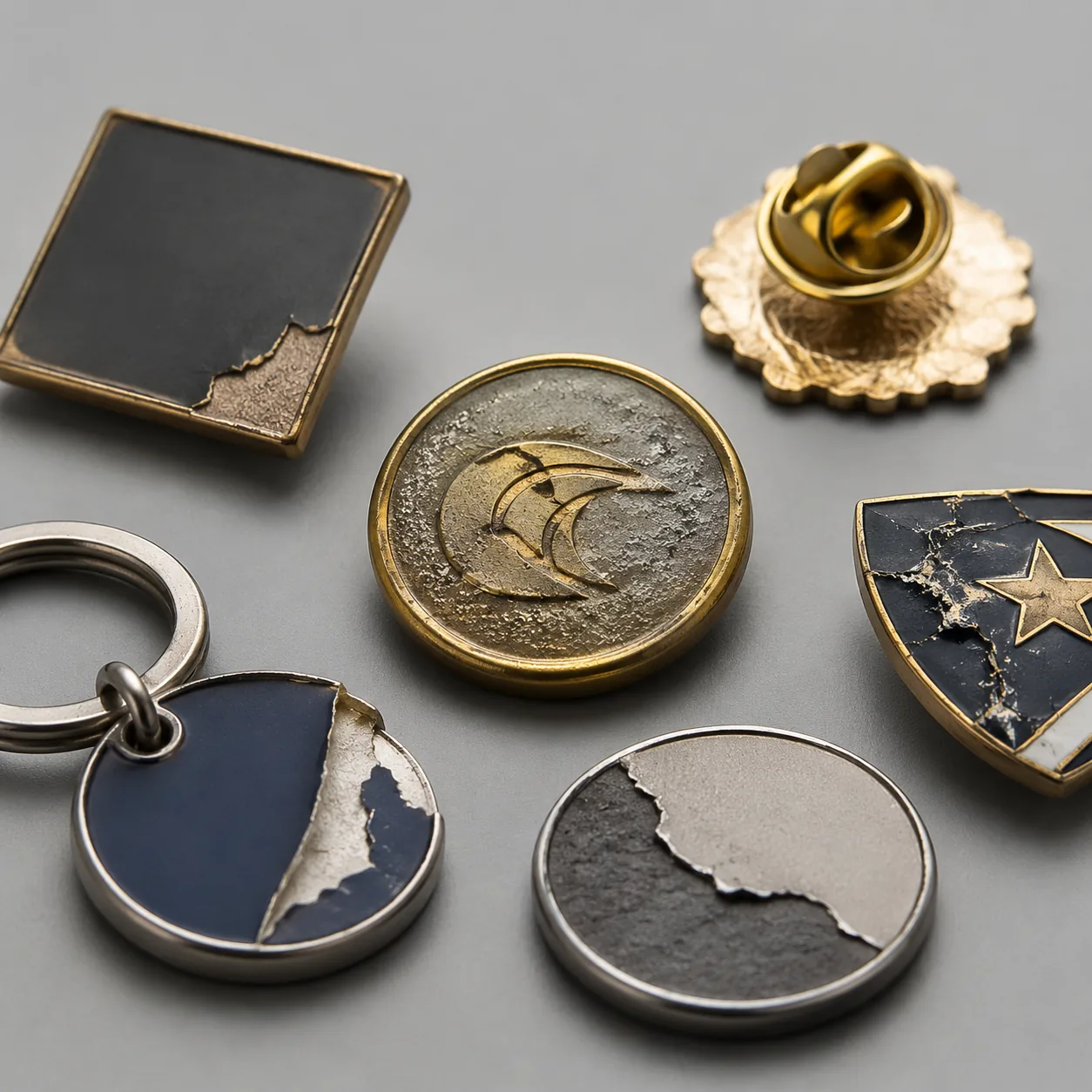
Most custom promo product failures do not start with bad artwork. They start when one attractive hand sample is treated as evidence that 5,000, 20,000, or 50,000 pieces will behave the same way. A lapel pin, challenge coin, keychain, patch, medal, lanyard, magnet, or bottle opener can pass sample approval while hiding weak plating adhesion, unstable enamel fill, loose hardware, poor deburring, or a mold tolerance that only becomes obvious after several hours of production.
The control point is the RFQ, not the complaint email. Before tooling starts, define the measurable requirements: base metal, thickness, plating stack, topcoat thickness in microns, minimum line width, color tolerance, fill depth, flatness, hardware pull force, packing method, and AQL level. The approved sample should become a golden reference plus an inspection checklist. It should not replace process specifications.
Commercial ranges are predictable enough to quote with discipline. A 25 to 35 mm stamped iron soft-enamel pin often runs about USD 0.38 to 0.95 FOB China at 1,000 pieces, with a USD 35 to 90 mold charge and 12 to 18 production days after sample approval. A zinc alloy 3D coin, bottle opener, or shaped keychain may run USD 1.10 to 3.80 FOB at 1,000 pieces, with tooling from USD 80 to 250 and 18 to 30 production days. Epoxy doming, dual plating, serial numbering, retail gift boxes, or custom inserts typically add 3 to 10 days. Quality requirements should be priced and scheduled, not left as assumptions.
1. Artwork geometry that cannot run at speed
The first failure mode is artwork that looks clean in vector form but cannot be produced cleanly at production speed. Fine islands, tiny letters, narrow enamel dams, floating elements, deep recesses, sharp internal corners, and thin cutouts increase burrs, incomplete fill, polishing loss, and tool wear. A design that works at 40 mm wide may fail at 22 mm, especially when the buyer also wants soft enamel, cut-through areas, recessed texture, or two plating colors.
A useful RFQ states minimum manufacturable geometry. For soft-enamel pins and coins, raised metal lines of 0.30 mm are safer than 0.20 mm lines for repeat production. Color separation walls should generally be at least 0.25 to 0.30 mm. Pad-printed text should usually stay above 4 pt, and screen-printed text above 5 pt, unless the factory proves smaller type on the actual surface. For die-cast zinc alloy, allow a 2 to 3 degree draft angle on deeper relief. For stamped iron or brass, keep relief moderate so polishing does not erase edge detail.
MOQ and lead time change when geometry becomes difficult. A flat stamped pin may be practical at 100 to 300 pieces, but the unit price is often 2 to 4 times the 1,000-piece price because tooling, setup, plating, and inspection are spread across fewer units. A custom zinc alloy mold with 3D relief or cutouts is usually more economical from 500 pieces upward. A stable quote should separate mold charge, sample lead time, bulk lead time, unit FOB price at 300, 500, 1,000, 5,000, and 10,000 pieces, and the cost of any special packing.
2. Plating that passes receipt but fails in use
Plating failures are often invisible on day one. The surface may look bright at incoming receipt, then show tarnish, dull patches, fingerprints, nickel exposure, edge wear, or peeling after handling. Keychains, coins, badges, medals, zipper pulls, and bottle openers are high-risk because they rub against hands, keys, cartons, fabric, and packing trays. Antique finishes and mirror finishes need different controls: antique finishes vary in darkness and rub-off; mirror finishes reveal pits, scratches, and polishing waves.
The specification should name the base metal and plating stack. For low-touch event giveaways, decorative flash plating with a top layer around 0.08 to 0.12 microns may be commercially acceptable. For handled items, target a more durable decorative layer around 0.15 to 0.25 microns over a consistent copper or nickel underplate. Premium metal gifts may need thicker underplating, better pre-polishing, electrophoretic lacquer, or anti-tarnish protection rather than simply a brighter topcoat. If nickel sensitivity matters, state nickel-free or low-nickel requirements and ask how the factory verifies them; do not assume nickel-free is included because the finish is gold, antique silver, or black nickel.
Inspection should separate normal cosmetic variation from rejectable defects. For campaign giveaways, AQL 2.5 for major appearance defects and AQL 4.0 for minor defects is common. For licensed, retail, membership, or premium goods, AQL 1.5 for major defects is safer, with zero acceptance for peeling plating, exposed sharp metal, wrong logo, missing safety marking, or unsafe hardware. If finish is critical, approve a sealed golden sample or reference panel and inspect color, gloss, pits, stains, and edge coverage under the same light source.
3. Enamel, print, and textile color drift
Color failures happen when one sample is approved under one lighting condition and production is inspected under another. Soft enamel, hard enamel, epoxy doming, UV print, screen print, sublimation, woven labels, silicone patches, and dyed lanyards all shift differently. The same Pantone value can appear darker in recessed enamel, lighter on glossy plastic, duller on woven polyester, and warmer against antique brass. Mixed promo kits magnify the problem because the brand color must travel across metal, fabric, paper, and plastic.
The color spec should define the Pantone target, material, finish, and inspection light source. D65 daylight is a practical reference for many international orders; retail programs may also need store-light comparison. For printed plastic or metal, Delta E 2.0 to 3.0 is a realistic target when substrate, ink system, and topcoat remain constant. For dyed textiles, woven lanyards, and embroidered patches, Delta E 3.0 to 4.0 is often more realistic, especially on dark, fluorescent, or neon colors. For enamel, approve cured production material, not wet fill, because cured gloss and shade can shift.
The best way to reduce drift is to simplify the palette and lock the reference chain. Two or three strong spot colors separated by 0.30 mm metal lines are more repeatable than five small shade zones. Gradients should move to UV print or be redesigned as flat separations. If a program includes pins, patches, and lanyards, request a master color board with all substrates mounted together and signed off before bulk production. For reorders, keep the physical reference sample; a screenshot, PDF proof, or phone photo is not a color standard.
4. Burrs, flash, and rough edges
A product can pass visual review and fail the moment a user touches it. Burrs on stamped edges, die-cast flash, sharp pin backs, rough cutouts, unfinished keyring holes, and abrasive medal slots create complaints that are cheap to prevent and expensive to sort after packing. These defects usually come from worn tools, rushed trimming, short tumbling time, uneven polishing, or a process that improves the front face while leaving the sidewall sharp.
The purchase spec should define edge condition in functional language. Wearable items should be smooth to touch and should not snag skin, fabric, ribbon, paper backing cards, or polybags. For decorative outer profiles on small metal parts, plus or minus 0.20 mm is a common tolerance; larger non-mating shapes may allow plus or minus 0.30 mm. Functional areas need tighter control: pin post location, magnet cups, hinge seats, clasp slots, and insert cavities often require plus or minus 0.10 to 0.20 mm.
Early production inspection should be stricter than final random sampling. On a first run, inspect the first 100 to 300 pieces for edge condition before approving full-speed output. If burrs appear, adjust trimming, tumbling media, polishing sequence, or manual deburring immediately. After the process stabilizes, move to normal sampling but keep sharp-edge defects classified as critical. One sharp edge on a wearable item is not a minor cosmetic variation; it can damage clothing or create a safety complaint.
5. Hardware that looks fine but fails in service
Many returns come from hardware rather than the decorated face. Butterfly clutches slide off posts, rubber clutches split, split rings deform, lobster clasps jam, chains open, magnets slide on coated surfaces, and adhesive backings release after humidity exposure. These failures escape visual inspection because the inspector checks the logo but does not measure pull force, wire diameter, opening cycles, weld strength, magnet grade, or adhesive bond.
Hardware should be specified by use case. A pin worn once at a trade show can use a lighter clutch than a badge worn weekly on a heavy jacket. A daily-use keychain should use a split ring with defined wire diameter, typically 1.0 to 1.5 mm depending on product weight, and a ring temper that resists permanent opening. A magnet should be tested on the agreed steel panel or target surface, including coating thickness. Adhesive patches, phone grips, and nameplates should state dwell time, peel angle, humidity exposure, and operating temperature range.
Practical minimum checks include a 2 to 3 kg pull test for standard pin posts, 5 kg or more for medals, bag tags, or heavy badges, 200 to 500 open-close cycles for reusable clasps, and a 24 to 48 hour humidity hold at 40°C and 90 percent RH for adhesive or paper-backed assemblies. These are not universal engineering limits, but they turn vague expectations into testable RFQ requirements. Children’s items, outdoor use, uniforms, and retail resale should receive a stricter hardware test plan before bulk approval.
| Failure mode | Typical symptom | Preventive spec | Production QC check |
|---|---|---|---|
| Unstable artwork geometry | Filled details, broken lines, polishing loss | Minimum 0.30 mm metal lines, 0.25 to 0.30 mm color gaps, draft angle for cast relief | Tooling review plus first-article dimensional check |
| Weak pin or clasp hardware | Pins fall off, rings open, clasps jam | Backing type, wire diameter, weld method, pull-force target | Pull test on first pieces and sampled cartons |
| Burrs and flash | Rough edges, snagging, hand discomfort | Deburring requirement and edge tolerance of +/-0.20 mm where practical | Tactile inspection plus visual audit under bright light |
| Color drift | Brand color varies across units or substrates | Pantone target, D65 light source, Delta E window, master color board | Golden sample comparison and batch shade log |
| Plating wear | Dull spots, tarnish, peeling, exposed base metal | Base metal, underplate, top layer thickness in microns, lacquer if needed | Visual audit, tape test where applicable, bath record review |
| Warp or poor fit | Parts rock, tilt, or do not sit flush | Flatness, gap, tilt, and interface tolerance | Flatness gauge, fit test, assembled-unit inspection |
| Packing damage | Scratches, crushed cards, loose hardware in cartons | Unit bag, tray, insert, carton grade, drop-test height | Carton drop check and post-pack inspection |
6. Tolerance stack-up in multi-part assemblies
Some orders fail even when every component looks acceptable by itself. The cause is tolerance stack-up. A pin post is 0.15 mm off center, the clutch hole is loose, the backplate has slight warp, and the enamel face is marginally thicker than the approved sample. Each issue is small; together they make the product tilt, rotate, wobble, or pack badly. Multi-part medals, spinning keychains, challenge coins with inserts, magnetic badges, charms, sliding bottle openers, and boxed sets are especially exposed.
The fix is to specify the functional assembly, not only the individual parts. If a badge must sit flat, define maximum edge gap and tilt angle. If a spinner coin must rotate, define clearance and acceptable rubbing. If a charm must hang straight, define hole position tolerance and chain length tolerance. Functional interfaces often need plus or minus 0.10 to 0.20 mm control, while decorative outer profiles may tolerate plus or minus 0.30 mm or more depending on item size and visual risk.
Pre-production approval should include worst-case assembly, not only the best-looking sample. Ask the factory to measure several samples and submit a short dimensional report for critical points: overall size, thickness, hole diameter, post location, magnet seat depth, clasp gap, card slot width, flatness, and finished weight. For orders above 10,000 pieces or for products shipped as sets, this small report can prevent days of sorting at final packing.
7. Packing and export handling that damage good product
A well-made item can arrive as a reject if packing is treated as an afterthought. Scratched plating, crushed backing cards, detached clutches, bent posts, moisture spotting, rubbed epoxy, and mixed SKU cartons often occur after final inspection. Plated metal parts are vulnerable because two acceptable pieces can damage each other in the same bag. Paper cards and gift boxes are vulnerable because export cartons are compressed, dropped, and rehandled several times before delivery.
The packing spec should be as explicit as the product spec. Define whether each unit is individually polybagged, mounted on a backing card, packed in a PET tray, placed in a velvet pouch, or boxed. For mirror-finish or dark-plated items, avoid metal-to-metal contact and consider tissue, trays, or separate cavities. For export cartons, use 5-layer corrugated cartons for most overseas shipments, keep gross weight generally below 18 to 20 kg where manual handling is expected, and define inner pack quantities so units cannot shift. A 50 cm carton drop check is a practical minimum for ordinary export handling; heavier retail packs may need ISTA-style testing.
Moisture control also matters. For ocean freight or humid destinations, add desiccant, moisture-resistant inner bags, anti-tarnish paper, or sealed master polybags where appropriate. For reorders, lock the backing card size, insert thickness, carton count, gross weight target, SKU label format, and carton mark placement. Otherwise, the second shipment can look cheaper or suffer more transit damage even when the product itself is unchanged.
RFQ checklist that prevents repeat failures
A strong RFQ does not need to be long, but it must be measurable. Start with the three failures that would hurt the program most: visual rejection, functional failure, late delivery, or transit damage. Convert those risks into specifications the factory can quote, sample, and inspect. Include target quantity and MOQ tiers such as 300, 500, 1,000, 5,000, and 10,000 pieces because process choice and unit price often change at each tier. Ask for FOB unit pricing, mold charge, sample cost, sample lead time, bulk lead time, packaging cost, and inspection standard as separate lines.
A realistic approval path for a custom metal promo order is artwork review in 1 to 2 days, digital proof in 1 day, physical sample in 5 to 10 days after mold start, sample correction in 3 to 7 days if needed, and bulk production in 12 to 30 days depending on process, quantity, and finish. Final inspection should occur before balance payment and before cartons leave the factory. The signed sample should be stored as a golden sample, but the inspection plan should still define AQL, critical defects, measurement points, hardware tests, and packing checks.
- Define base metal, item size, thickness, finish, plating stack, and target plating thickness before tooling.
- State minimum line width, gap width, functional tolerances, and plus or minus limits that affect fit.
- Approve Pantone or physical color references under the same light source used for final inspection.
- Classify defects by severity: critical safety or function defects, major appearance defects, and minor cosmetic variation.
- Set AQL targets by risk level, such as 0 critical defects, AQL 1.5 or 2.5 for major defects, and AQL 4.0 for minor defects.
- Specify hardware pull force, cycle tests, adhesive checks, magnet tests, or humidity holds based on real use conditions.
- Lock unit packing, inner box count, export carton strength, moisture control, labels, and carton drop expectations.
- Keep one signed master spec sheet and golden sample for reorders so the next batch matches the first.
Have a project? Send your artwork and target quantity and we’ll reply with a detailed quotation within 12 working hours.
Ready to get this made?
Send your sketch, target quantity and ship-date. Detailed quotation in 12 hours.



