6 Production Failures That Ruin Custom Metal Promo Orders
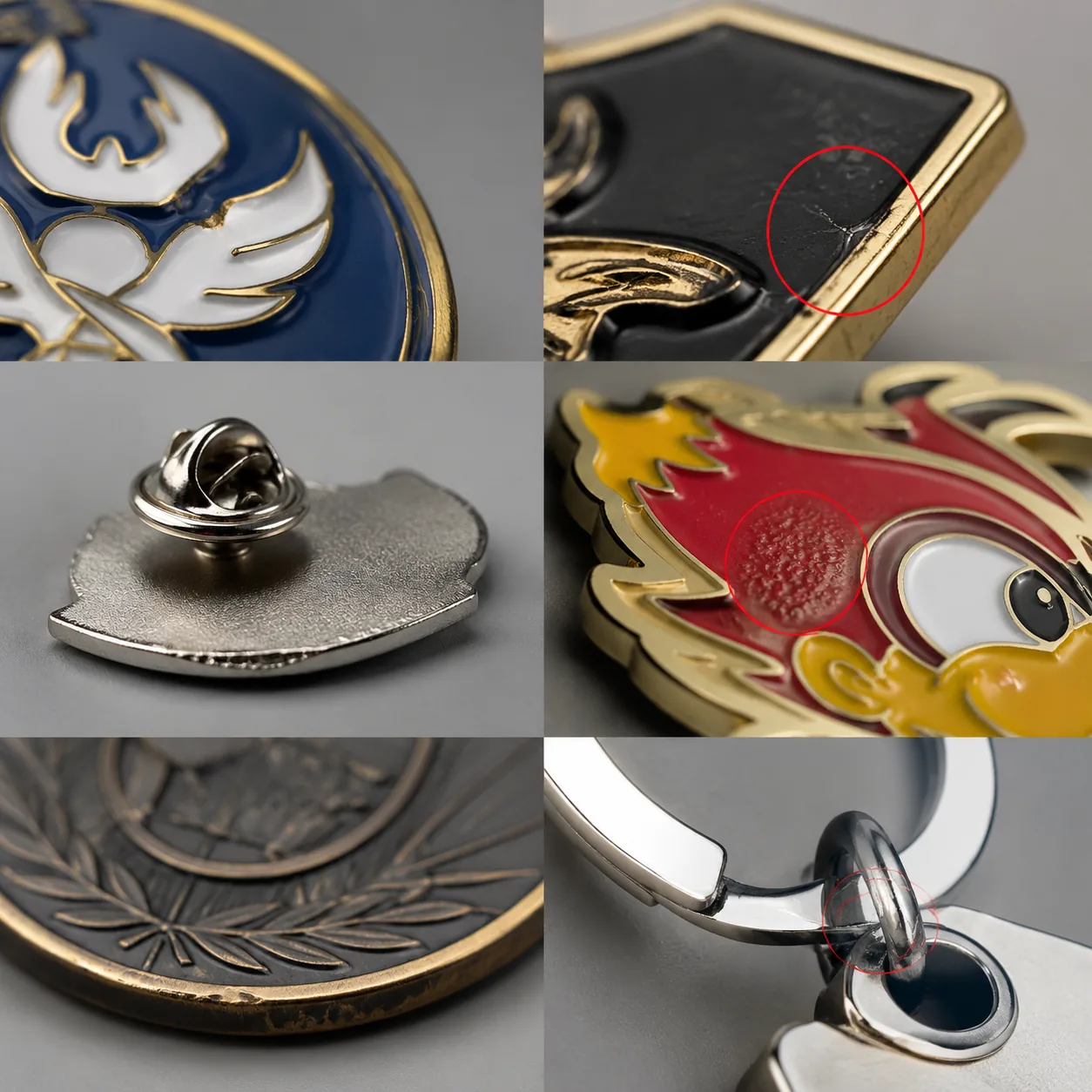
Where custom metal promo orders usually fail
Most disputes on custom pins, coins, badges, keychains, and magnets do not begin with a dramatic factory error. They begin with a spec that was too vague to verify, a sample approved too quickly, or a quote that hid a process shortcut. In metal promotion goods, the same artwork can fail in very different ways depending on base metal, relief depth, plating thickness, fill height, and attachment method. If you buy at volume from China, the safest way to control quality is to think in failure modes, not just product styles.
The recurring pattern is simple: the design looks fine in rendering, but becomes fragile when translated into tooling, plating, enamel fill, hardware assembly, and packing. ZheCraft sees the same root causes across soft enamel pins, hard enamel badges, challenge coins, fridge magnets, and keychains: distortion from stamping or die-casting, shallow color fill, thin plating, weak attachments, and shipment mismatch versus the approved sample. The question is not whether the factory can make it. The question is which exact step can go wrong, and how you will measure it before mass production starts.
- Specify measurable limits, not adjectives like nice, strong, or premium.
- Tie every approval to a physical sample, a signed spec sheet, and a reference photo set.
- Ask for the factory’s internal inspection points before mass production begins.
- Treat plating, attachment, and packing as failure risks, not afterthoughts.
1) Artwork that cannot survive tooling
The first failure happens before metal is even cut. Artwork that looks clean on screen may collapse once it is translated into die lines, raised borders, recessed fills, and small cutouts. Thin letters, tiny gaps, and hairline details often produce broken tooling, filled-in voids, or edges too weak to plate evenly. A design that works for digital print is not automatically manufacturable in stamped or cast metal.
For most enamel pins and badges, a practical minimum line width is 0.25 to 0.30 mm; 0.35 mm is safer for repeat orders and mixed-shift production. Keep small text above 1.2 to 1.5 mm high if you want it readable after plating and enamel fill. Minimum negative space should be at least 0.25 mm, and anything below 0.20 mm should be treated as high risk. If the logo depends on ultra-fine strokes, move to a larger size, simplify the art, or switch to laser engraving or soft etching instead of forcing a stamped build.
Do not approve artwork as a JPG alone. Ask for vector files in AI, EPS, or PDF with dimensions, line weights, and a clear indication of raised versus recessed areas. The factory should be able to tell you what will be lost in transfer before the die is cut. A quote that accepts impossible details without comment is not a strength; it is a warning sign.
| Risky spec | Safer spec | Typical outcome if ignored |
|---|---|---|
| Hairline outlines under 0.2 mm | Lines at 0.3 mm or wider | Broken tooling or fused detail |
| Tiny text under 1.0 mm high | Text at 1.2 to 1.5 mm high | Unreadable marks after plating |
| Openwork gaps with no tolerance | Openings with 0.25 mm minimum clearance | Blocked cutouts or weak bridges |
| Design approved only as a JPEG | AI, PDF, or vector file with dimensions | Misread proportions and tooling errors |
2) Tooling distortion and uneven metal flow
Once the die is made, the next risk is geometry distortion. If a product is too thin, too deep, or too broad for the chosen process, the edge can warp, the face can sink, or the relief can blur. This is common on large badges, heavy coins, and long lanyard slides where the design asks for crisp detail across a wide surface. The defect is not always obvious in the sample photo, but it becomes obvious when batches are stacked, measured, or compared side by side.
The main controls here are thickness, relief depth, and tolerance. For zinc alloy cast items, 1.8 to 2.5 mm thickness is common for pins and badges, while challenge coins often sit around 3.0 to 4.5 mm depending on diameter and edge treatment. Ask for dimensional tolerance of +/- 0.2 mm on small items and +/- 0.3 to +/- 0.5 mm on larger pieces, with the factory stating what is realistic by process. Relief depth is usually more stable when kept moderate; deep sculpture looks impressive in renderings, but shallow-to-medium relief often produces cleaner repeatability.
Base metal matters. Brass and iron stamp cleanly for many pin and badge applications. Zinc alloy supports more 3D relief, but can soften detail if the die quality, filling pressure, or cooling is poor. For products with large flat areas, confirm whether the factory will use stamping, die-casting, or a hybrid build. A quote that hides the process choice is a quote that hides distortion risk.
Use this as a pricing and process sanity check: stamped iron pins at 25 to 35 mm are commonly quoted around USD 0.35 to 0.95 FOB per piece at 500 to 1,000 pcs, depending on plating and backing; zinc alloy 3D badges or coins typically move to USD 1.20 to 4.50 FOB at 300 to 1,000 pcs, with larger formats or special edges higher. Lead time is usually 12 to 18 days for sample tooling approval and 18 to 30 days for mass production, assuming no artwork revisions after proof sign-off.
3) Plating that looks good at shipment but fails in use
Plating failure is expensive because it is often invisible at approval. A product can look bright, even, and premium when fresh out of polishing, then show discoloration, thin spots, or edge wear after handling, salt exposure, or carton friction. Buyers often learn about the issue only when a retailer reports returns or a marketing team opens the second carton. Thin deposit, poor under-polish, and inconsistent bath control are the usual causes.
State plating type and thickness in microns, not just the color name. For decorative promotional goods, 0.1 to 0.3 microns may be acceptable for short-term giveaways, but for handling-heavy gifts or resale items, specify a heavier finish where the factory can support it, such as 0.5 micron nickel or 0.3 to 0.8 micron gold-tone top layers on suitable substrates. Ask whether the finish is nickel, black nickel, antique brass, antique silver, matte gold, or polished gold, because wear and tone vary by chemistry and surface prep. If you need longer shelf life, ask about a clear lacquer or anti-tarnish topcoat and confirm whether it shifts the color.
For cosmetic acceptance, do not rely on “bright and even” alone. Ask for visual checks under daylight-equivalent light, edge inspection on high points, and rub testing on plated ridges. On premium orders, a practical factory AQL is often 2.5 for major defects and 4.0 for minor defects, but premium retail programs may require tighter internal controls before cartons are released. MOQ for plated promo metal goods usually starts at 300 to 500 pcs per design, with lower prices at 1,000 pcs and above.
| Use case | Plating spec | Trade-off |
|---|---|---|
| Short-term giveaway | 0.1 to 0.3 micron decorative plating | Lowest cost, fastest production |
| Retail souvenir | 0.3 to 0.5 micron with tighter visual inspection | Better tone consistency |
| High-touch gift item | 0.5 micron or more plus protective topcoat | Higher cost, longer lead time |
| Outdoor or humid use | Finish plus anti-tarnish control | Possible tone shift |
4) Enamel fill, color, and edge problems
Color problems are rarely just color problems. They usually come from fill depth, overbake, underbake, poor masking, or a border wall too thin to contain the enamel. Soft enamel, hard enamel, and epoxy dome styles fail differently. Soft enamel can sink below the metal and collect dirt at the edge. Hard enamel can flatten detail if over-polished. Epoxy can hide scratches, but it also magnifies dust and surface bubbles if the environment is not controlled.
The safest spec is to define fill level, color target, and border height together. For soft enamel, the fill is usually 0.1 to 0.3 mm below the raised metal so texture remains defined. For hard enamel, the surface should be polished flush, but you should still specify acceptable gloss variation and the maximum rounding at the edge. If you use Pantone matching, remember that pigment load, firing temperature, substrate tone, and polishing pressure all affect the final result. One approved physical sample is far more reliable than a screen render.
For enamel pins and badges, common FOB pricing ranges are roughly USD 0.25 to 0.80 for simple soft enamel at 300 to 1,000 pcs, USD 0.60 to 1.80 for hard enamel at 300 to 1,000 pcs, and USD 0.80 to 2.20 for epoxy dome or special-finish variants. Lead time is usually 15 to 22 days after sample approval for standard enamel production. If the factory quotes much faster, ask what step is being compressed.
Ask the factory to check for pinholes, dust points, and color bleed under light and magnification before packing. For general promotional goods, AQL 2.5 for major defects and AQL 4.0 for minor defects is common, but premium brands often tighten visual acceptance below factory default. The key is to define what counts as a major defect: wrong color, missing fill, exposed base metal, or obvious contamination should be rejected every time.
5) Hardware that breaks after first use
A lot of returns blamed on the metal body are really hardware failures. Butterfly clutches that loosen, magnetic backs that slide, keyring joints that open, and brooch pins that sag all create the impression of a bad product even when the face is perfect. These problems usually come from undersized hardware, weak spring tension, poor welding, or a mismatch between product weight and attachment method. If the item will be worn on thick fabric, carried daily, or attached to a bag, the hardware spec must be part of the order, not a generic accessory line.
Match the backing to the mass and use case. For small lapel pins under 10 to 12 g, butterfly or rubber clutches may be acceptable. For heavier brooches or badges, a locking pin, double post, or magnet backing may be safer depending on fabric sensitivity. For keychains, specify split ring diameter, wire gauge, chain length, and a minimum pull expectation. For mixed-use promotional items, request a simple pull test and torque check before shipment rather than discovering a weak weld in transit.
Use concrete hardware language in the RFQ. A pin with a 1.0 mm post and standard butterfly clutch is not the same as a 1.2 mm post with locking back. A keychain with a 25 mm split ring and 18 mm chain has a different fatigue profile than a 30 mm ring and welded link. If the item includes moving parts, ask for 5 to 10 sample cycles on the motion joint, plus a carton-level spot check on alignment. Hardware is often where low-cost suppliers save cents and create dollars of returns.
- State the product weight and expected wear frequency.
- Specify attachment type by use case, not by habit.
- Require pull testing on random cartons before final packing.
- Reject any sample where hardware alignment changes the product angle.
6) Packing, transit, and carton damage
The final failure mode happens after production is already complete. Surface scratches, bent posts, crushed backing cards, mixed SKUs, and transit moisture can make a perfectly good item unsellable. This is especially common when the factory packs sharp metal against loose paper, skips individual polybags, or uses carton counts that are easy to miscount under time pressure. Many buyers focus on unit price and then lose margin on damaged goods, repacking labor, and delayed launches.
Packing specs should be written as tightly as the product specs. If you want a backing card, specify card stock, print finish, slot size, and whether the pin is fixed by a seal or only inserted. For scratch-sensitive finishes, require individual polybags or small inner trays, with carton dividers if needed. For humid routes or sea freight, add moisture barrier considerations and confirm outer carton strength before the order is released. If you are combining pins, coins, and keychains in one set, each item needs its own packing logic so hard edges cannot rub against plated surfaces.
For carton control, specify piece count per inner box, master carton quantity, and label format. A common expectation is 100 to 200 pcs per inner box for small pins, but the exact count should reflect weight and crush risk rather than convenience. Ask for an outer carton test standard, such as 5-ply or 7-ply corrugated depending on route and weight, and require desiccant for humid destinations. FOB pricing for simple polybag packing may add little or nothing, while printed backing cards, trays, or insert cards can add USD 0.03 to 0.25 per unit depending on complexity.
| Packing risk | Spec to add | Why it matters |
|---|---|---|
| Scratches in transit | Individual bag or tray | Prevents metal-on-metal abrasion |
| Missing parts | Piece count per inner box | Reduces picking errors |
| Mixed SKUs | Clear carton label and barcode | Speeds receiving checks |
| Moisture marks | Barrier bag or desiccant | Protects plated finishes |
What to do next
Start with the item that costs the most to rework: tooling, plating, hardware, or packing. Write one spec sheet that names the process, tolerance, finish thickness, attachment method, packing method, and inspection standard, then attach a signed golden sample photo set. If the factory cannot answer those points in writing, you do not yet have a production-ready order. Lead times for custom metal promo goods are usually 15 to 25 days from sample approval to shipment for straightforward jobs, and 25 to 40 days for complex multicolor or 3D work; urgent orders often cost more because they compress polishing, plating, and inspection windows.
If you are preparing an RFQ, build a failure-based checklist for your product type and compare quotes only after each supplier has answered the same questions. Ask for MOQ, FOB price at 300/500/1,000 pcs, plating thickness in microns, acceptable tolerance, and AQL level in writing. That will expose who is pricing a stable process and who is pricing optimism. In custom metal promotional goods, preventing one remake is usually worth more than shaving a few cents off the unit price.
Have a project? Send your artwork and target quantity and we’ll reply with a detailed quotation within 12 working hours.
Ready to get this made?
Send your sketch, target quantity and ship-date. Detailed quotation in 12 hours.



