5 Best Custom Pin Backing Cards for 2026: Freight-Ready vs Retail-Grade
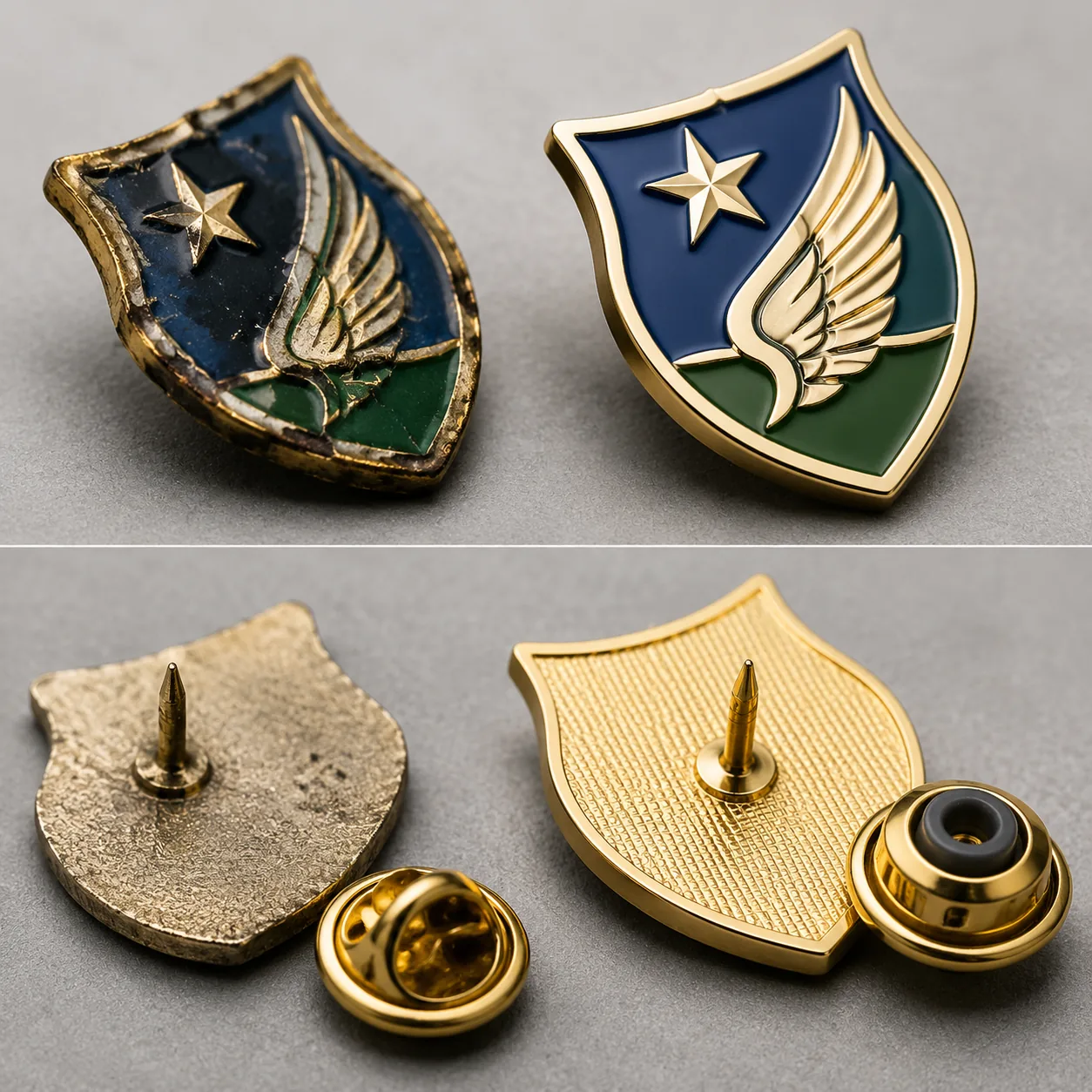
The Problem: When a Perfect Pin Arrives on a Busted Card
A US promotional distributor recently shared photos of a 2,000-unit shipment of 35 mm hard enamel pins. The pins were flawless: polished gold plating, crisp Pantone 294 blue fill. The backing cards, however, had curled in the container, butterfly clutches punched through 250 gsm cardstock, and the matte aqueous coating scuffed to a milky haze. The entire batch needed re-carding stateside at $0.18 per unit—wiping out the order's margin. This is the hidden variable in pin sourcing: the backing card is not just a display surface; it is a structural component that must survive sea freight compression, humidity swings, and the mechanical stress of a 7 g pin on a butterfly clutch for 45 days in transit.
Buyer Criteria for Ranking Backing Cards in 2026
We evaluated the five most commonly specified backing card constructions against four criteria critical for B2B buyers. First, freight survivability at 35–40°C container temperatures and 85% relative humidity, without card curling exceeding 3 mm edge lift. Second, pin retention under vibration: the card must hold a 5–12 g pin with standard butterfly or rubber clutch without the post tearing through the card face during simulated ISTA 3A transport. Third, print quality and brand perception for retail-rack or direct-mail contexts. Fourth, landed cost impact, factoring in card weight per 1,000 units, carton cube, and the difference between air and sea freight rates for a Shanghai-to-Los Angeles lane in Q1 2026. Each card type receives a rating out of 10 on these four axes, with the understanding that no single card wins everywhere.
1. 350 gsm C1S with Soft Touch Lamination — Best for Premium Retail
This is the card you specify when the pin retails above $12 and the unboxing moment matters. C1S board provides a bright white, clay-coated print surface on the front for crisp CMYK plus spot Pantone, while the uncoated back is toothy enough to hold a hot-melt adhesive dot for pin attachment. We laminate the front with a 25-micron soft-touch BOPP film, which adds $0.02–$0.03 per card at 5,000 units and delivers a suede-like tactility that resists fingerprinting. At 350 gsm, the card has enough beam strength that a 55 mm x 85 mm format will not buckle under a 10 g coin. The trade-off is weight: 1,000 cards weigh approximately 3.2 kg, versus 2.1 kg for 250 gsm. On a 500,000-unit order, that delta adds roughly $180 in sea freight and $1,200 in air freight. FOB price range: $0.08–$0.14 per card at 5,000–10,000 units, die-cut to shape, with a butterfly clutch pre-punched hole and hang tab slot. MOQ: 3,000 units; lead time: 15–20 days.
2. 300 gsm Kraft Back with Aqueous Coating — Best for Freight-Only, No Retail
If your pins go directly into a subscription box or a conference swag bag with no retail pegboard exposure, this is the pragmatic choice. Unbleached kraft board has a natural flex that absorbs vibration without tearing; we have tested 300 gsm kraft cards with a 9 g soft enamel pin through 60-minute vibration tables per ISTA 1A and observed zero clutch puncture. The aqueous coating is a thin, water-based sealant that prevents the kraft from absorbing moisture and warping in the container, at roughly half the cost of lamination. Print quality is deliberately rustic: CMYK reproduction is muted, fine serif type below 7 pt will fill in, and there is no optical brightener in the board, so whites read as cream. At $0.045–$0.07 per card FOB for 5,000 units, and a weight of 2.5 kg per 1,000 cards, this spec keeps landed cost flat. The real spec to lock is the fluting direction of the kraft fibers; we orient the grain parallel to the long edge of the card so any curl bias works with the pin's weight, not against it. MOQ: 5,000 units; lead time: 12–18 days.
3. 400 gsm Duplex Board with Spot UV — Best for Heavy Challenge Coins
Challenge coins and 3D relief badges above 15 g need a card that behaves more like a rigid substrate than a flexible carrier. Duplex board is a two-ply sheet with a grey core and a white top liner, providing 400 gsm of caliper with less cost than solid bleached sulphate (SBS) of the same thickness. We specify spot UV on the logo area only—a 100-micron cured varnish layer that creates a high-gloss, domed effect without the full-card curling risk of flood UV coating. The critical spec here is the pin attachment method. Do not rely on a simple die-cut slit for a coin this heavy; we use a 25 mm diameter self-adhesive foam pad, 1.5 mm thick, with a 3M 300LSE acrylic adhesive that bonds to both the grey board back and the coin's recessed backstamp. This adds $0.04 per card but reduces coin detachment in transit to near zero. FOB pricing runs $0.10–$0.18 per card at 3,000–5,000 units, with the spot UV plate costing a one-time $60–$90. MOQ: 2,000 units; lead time: 18–25 days.
| Card Type | GSM | Coating | Best For | Pin Retention Method | Weight/1k cards | FOB Price (5k units) | Freight Suitability |
|---|---|---|---|---|---|---|---|
| C1S + Soft Touch Lamination | 350 | 25μ BOPP matte | Premium retail, gift sets | Hot-melt dot + die-cut slit | 3.2 kg | $0.08–$0.14 | Good; protect edges from scuffing |
| Kraft + Aqueous | 300 | Water-based sealant | Bulk promo, conference swag | Die-cut slit + optional foam dot | 2.5 kg | $0.045–$0.07 | Excellent; resists humidity well |
| Duplex + Spot UV | 400 | Spot UV varnish | Challenge coins, heavy badges | 3M 300LSE foam pad | 3.8 kg | $0.10–$0.18 | Good; requires rigid carton packing |
| SBS + Gloss Lamination | 350 | 30μ BOPP gloss | Mid-tier retail, pegboard | Die-cut slit + clutch | 3.2 kg | $0.07–$0.12 | Moderate; lamination can delaminate in heat |
| Recycled Grey Board + No Coating | 250 | None | Budget, short-term use | Die-cut slit only | 2.1 kg | $0.03–$0.05 | Poor; high curl and tear risk |
4. 350 gsm SBS with Gloss Lamination — Best for Mid-Tier Pegboard Retail
Solid bleached sulphate is the workhorse of retail packaging, and for good reason: it prints a clean, bright white point, holds fine type down to 5 pt, and takes a 30-micron gloss BOPP lamination that makes colors pop under fluorescent retail lighting. This is the spec you see on the pegboard at national craft store chains. The risk with gloss lamination is heat delamination; we have measured card surface temperatures of 52°C inside containers crossing the Pacific in August, and at those temperatures a poorly cured lamination can peel at the edges. The fix is a specification line requiring a minimum 180°C curing tunnel temperature and a cross-hatch adhesion test per ASTM D3359 method B, with a 5B rating (no peel). At $0.07–$0.12 per card for 5,000 units, this is the most balanced option for brands that need retail presence but cannot justify the soft-touch premium. We recommend a 55 mm x 90 mm format with a Euro slot hang hole and a 4 mm diameter clutch hole, positioned no closer than 8 mm from any edge to prevent tear-out. MOQ: 3,000 units; lead time: 15–20 days.
5. 250 gsm Recycled Grey Board with No Coating — When It Works (and When It Doesn't)
I include this option because buyers ask for it constantly—usually with a sustainability brief that mandates 100% post-consumer recycled content and zero plastic coatings. At $0.03–$0.05 per card, it is the cheapest option by a wide margin. It can work for a specific use case: lightweight enamel pins under 4 g, shipped via air freight in a rigid carton with individual cell dividers, and intended for immediate distribution at a single event. In that narrow scenario, the card never faces sustained humidity, compressive stacking, or vibration. For sea freight, or for anything above 5 g, the failure rate becomes unacceptable. The board has short fibers that tear easily, no barrier against moisture, and a natural grey-brown color that mutes any print to a muddy tone. If sustainability is non-negotiable, I steer buyers toward the 300 gsm kraft with aqueous coating; the aqueous sealant is water-based and fully repulpable, and the kraft fiber is typically 60–80% recycled content anyway. MOQ: 10,000 units; lead time: 10–15 days.
Attachment Specs: The Real Source of Card Failure
The card material gets the attention, but the attachment method is what actually fails. A butterfly clutch pushed through a raw die-cut slit will abrade the card fibers with every vibration cycle, widening the hole until the pin drops free. We have measured hole elongation of 1.2 mm after 30 minutes of ISTA vibration on un-reinforced 300 gsm board. The solution is a two-part spec: first, a 10 mm diameter adhesive reinforcement ring (a paper donut with a pressure-sensitive adhesive) applied to the back of the card, centered on the clutch hole; second, a 6 mm diameter hot-melt glue dot placed 3 mm below the slit to anchor the pin's lower edge and prevent rotation. Together these add $0.012 per card and reduce in-transit detachment by an estimated 80% based on our in-house ISTA testing. For rubber clutch pins, we specify a tighter hole diameter tolerance: 3.8 mm ±0.2 mm, which provides enough grip on the rubber stem without requiring excessive insertion force that could crease the card during assembly.
- Specify grain direction on all card stock; it must run parallel to the card's long axis to control curl bias.
- Require a minimum 8 mm margin from any die-cut hole to the card edge to prevent tear-out under load.
- For sea freight, add a 10 mm adhesive reinforcement ring to every clutch hole as a standard line item.
- Request a pre-production card sample with the actual pin attached and run a 48-hour humidity test at 40°C/85% RH.
- Include a carton packing spec: cards must be packed flat, not on edge, in corrugated bins with a minimum B-flute wall.
Freight Economics: Why Card Weight Matters More in 2026
Shanghai-to-Los Angeles container spot rates have fluctuated between $2,800 and $5,400 per 40-foot container over the past 12 months, and most logistics analysts expect sustained pressure from Red Sea rerouting and blank sailings through mid-2026. In this environment, the weight difference between a 250 gsm card and a 400 gsm card is no longer a rounding error. For a 100,000-unit order of 55 mm x 85 mm cards, the total card weight delta is roughly 110 kg. At a blended sea freight rate of $3.50 per kg for LCL shipments, that is a $385 difference in freight cost alone. If the order must go by air—common for event-driven deadlines—the rate jumps to $6–$8 per kg, making the card weight a four-figure line item. The kraft and recycled options become disproportionately cheaper as order volumes scale, while the duplex and C1S options require a hard look at whether the retail premium justifies the freight penalty.
How to Match the Card to the Sales Channel and Lock the Spec
The right card is a function of three variables: sales channel (retail pegboard, direct mail, event handout), pin weight (under 5 g, 5–12 g, over 12 g), and freight mode (sea, air, or a combination). For retail pegboard with pins over 8 g, the 350 gsm SBS with gloss lamination and reinforcement ring is the default spec at ZheCraft. For direct-mail subscription boxes where the pin is under 6 g and the card will be handled once, the 300 gsm kraft with aqueous coating saves money without creating a quality problem. For challenge coins above 15 g destined for executive gift sets, the 400 gsm duplex with spot UV and foam pad attachment is the only spec we recommend. Write these three variables into your RFQ explicitly, and request a physical card sample with the pin attached before approving the golden sample. A card that looks perfect on a supplier's studio table can fail in a container in 72 hours; the only way to know is to test it under the conditions it will actually face.
Have a project? Send your artwork and target quantity and we’ll reply with a detailed quotation within 12 working hours.
Ready to get this made?
Send your sketch, target quantity and ship-date. Detailed quotation in 12 hours.



