300 Pins, 3 Weeks: A Small-MOQ Buyer Plan for 2026
Monday brief: 300 custom pins due in 23 calendar days
A regional distributor gets a Monday-morning request: 300 custom enamel pins for a launch event, delivered in hand within 23 calendar days. The landed budget cap is roughly USD 1.60 per piece including a printed backing card suitable for handout presentation. At 300 units, the order sits in an awkward sourcing band. It is too small to absorb repeated die revisions, premium hand-finishing, or packaging experiments, but large enough that 10 to 15 defective pieces or a two-day shipping slip can disrupt the event plan.
At this volume, the buyer’s priority stack should be schedule first, manufacturability second, and unit cost third. A 45 mm die-cast zinc alloy pin with dual posts, glitter fill, screen print, custom-cut card, polybag, and rigid gift box may look strong in a mockup, but every added process introduces queue time, extra manual handling, and more points of failure. On a three-week window, the best specification is the one that runs on a factory’s standard line with one clear proof, one die, and minimal engineering back-and-forth.
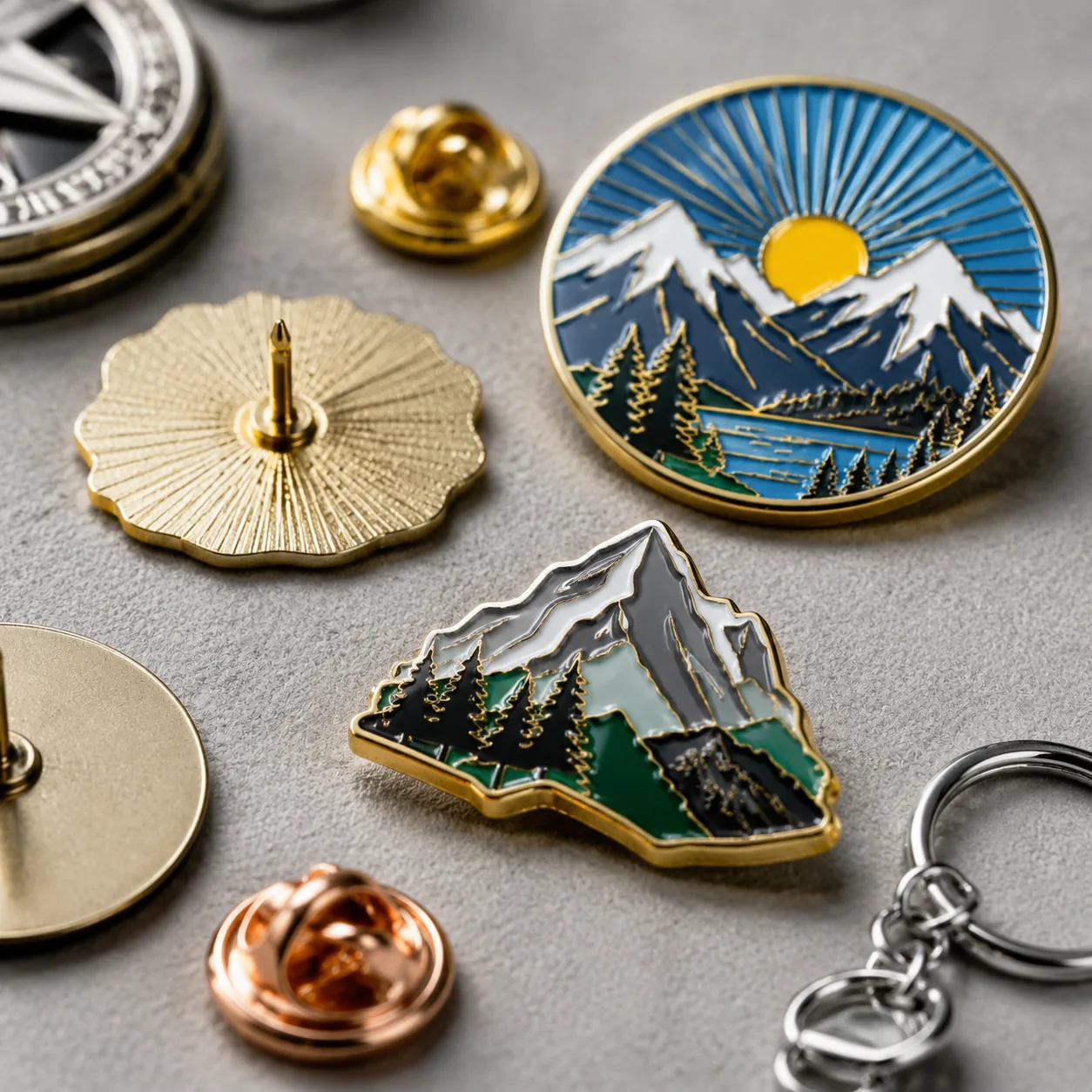
For most event programs, the safest build is a stamped soft enamel pin in iron or brass at 28 to 32 mm wide, 1.2 to 1.5 mm thick, with 4 to 6 spot colors, one standard butterfly clutch, and a 350 to 400 gsm backing card around 90 x 55 mm. That format keeps die cost manageable, plating predictable, and carding fast. It also keeps packed weight low, which matters because express courier or priority air is usually the only realistic freight mode when the client says "23 days" and means delivered, not shipped.
Pick a spec that survives a 300-piece run
The first decision is process, not style. Buyers often ask for imitation hard enamel because it reads as more premium, but it is less forgiving under schedule pressure. After color filling, the face is polished flat. That increases the risk on fine outlines, tiny reverse text, and isolated metal islands. As a working rule, text below 0.8 mm cap height, line widths below 0.25 mm, or unsupported metal details under 0.30 mm raise the chance of die edits, polishing loss, or visibly inconsistent fill.
Soft enamel is usually the safer option at this MOQ. A production-ready drawing should call for raised metal lines of at least 0.25 to 0.30 mm, recessed enamel cells no narrower than 0.35 mm, enclosed openings at least 1.2 mm, and an outer border of at least 0.8 mm on pins under 32 mm. Hold overall size tolerance to plus or minus 0.5 mm, thickness tolerance to plus or minus 0.15 mm, and post placement tolerance to plus or minus 1.0 mm. Those are realistic factory controls on a standard stamped line and tight enough to prevent rotation, weak solder joints, or a visibly off-center presentation on the card.
If the design includes dark printed micro-details, gradients, or a tiny corporate mark, a printed pin with epoxy may outperform enamel. A 0.6 to 0.8 mm clear epoxy dome typically adds 1 to 2 production days and about USD 0.04 to 0.09 per piece at 30 mm, but it protects printed detail from scuffing during bagging and transit. By contrast, glitter fill, translucent enamel, mixed plating, or dual attachments usually add cost faster than they add value on a 300-piece event run.
| Build option | Best use at 300 pcs | Typical MOQ reality | Lead time after artwork approval | Typical FOB unit price at 30 mm | Main trade-off |
|---|---|---|---|---|---|
| Stamped iron soft enamel | Fastest, lowest-risk standard event pin | Often accepted from 100-300 pcs | 10-14 days | USD 0.62-0.95 | Lowest cost, but edge finish is less refined than brass |
| Stamped brass soft enamel | Sharper edge definition and more stable plating on finer logos | Usually accepted from 200-300 pcs | 11-15 days | USD 0.82-1.18 | Higher metal cost and slightly tighter rush capacity |
| Imitation hard enamel | Premium flat surface for simple logos with limited colors | Sometimes accepted at 200-300 pcs | 13-18 days | USD 0.95-1.40 | Less forgiving if artwork needs revision or polishing affects detail |
| Die-cast zinc alloy | Needed for 3D relief, cutouts, or thickness above 2.0 mm | Often starts at 300-500 pcs | 14-19 days | USD 1.08-1.65 | Higher tooling, higher weight, and more finishing steps |
| Printed pin with epoxy | Best for gradients, photo detail, or text too fine for enamel | Usually accepted from 100-300 pcs | 8-12 days | USD 0.68-1.02 | Strong graphic fidelity, but less of a premium metal feel |
Quote review: where small-MOQ pricing gets padded
By Monday afternoon, several quotes arrive. One headline price looks low until the buyer notices separate charges for die, backing card, bagging, second clutch, export carton, and inspection. That pattern is common on low-volume orders. Factories and trading companies need to recover setup time, and some split out costs so the unit price looks more competitive than the true delivered set price. A usable comparison requires one exact build sheet and a clean split between one-time charges and repeatable per-piece cost.
For a 30 mm stamped pin, tooling on a simple outer shape is typically USD 50 to 120. Intricate outlines, inner cutouts, or asymmetrical forms can push the die charge to USD 130 to 180. A 90 x 55 mm card printed on 350 gsm coated stock usually costs USD 0.08 to 0.18 each at 300 pieces depending on one- versus two-sided print, matte versus gloss lamination, and whether a custom notch or shape cut is required. Individual polybags add roughly USD 0.01 to 0.03. A second butterfly clutch adds about USD 0.05 to 0.08, while rubber clutches, magnet backs, or locking backs are higher and often require extra assembly time.
For this scenario, the buyer should force all suppliers to quote the same FOB spec: 30 mm width, 1.2 mm thickness, stamped iron soft enamel, bright gold or black nickel plating, 4 to 6 Pantone-referenced colors, one butterfly clutch, one 90 x 55 mm card, one polybag, export carton included, and inspection to AQL 2.5 major and 4.0 minor. On that basis, a realistic 2026 FOB total at 300 pieces is usually USD 0.88 to 1.35 per completed set including card and bag, before freight and duty. If a quote comes in far below that band, the usual explanation is omitted tooling, downgraded packaging, lighter-gauge metal, or no defined inspection standard.
Artwork engineering: simplify what factories actually reject
Artwork review is where short-deadline pin orders are won or lost. Clients often send a logo with metallic gradients, outlined type, a 0.2 mm edge ring, and tiny reverse text because it looks clean on screen. In metal, that combination is fragile. On a 300-piece run, there is no room for two die revisions, a plating redo, or a repaint caused by artwork that was never engineered for production.
A practical simplification protects recognition, not every decorative effect. Gradients should usually be converted to two solid Pantone colors or moved to a printed layer under epoxy. Raised metal lines should be thickened to at least 0.25 mm, reverse text increased to a minimum 1.0 mm cap height, and narrow enclosed openings widened to at least 1.2 mm. If the client insists on a fine corporate mark or small legal text, a printed pin with epoxy is often safer than forcing detail into enamel cells too narrow to fill consistently.
Back-side geometry also matters early. On an asymmetrical 30 mm pin, a single post placed too high can cause rotation on the card or a crooked set on lightweight garments. A practical standard is one post for pins up to about 25 mm, and two posts for pins 28 mm and above or for long horizontal shapes. Post centers should typically sit at least 5 mm from the edge and be balanced around the center of gravity to reduce spin and solder stress.
- Request a manufacturing proof with exact dimensions in mm, thickness, plating, and post position
- Approve Pantone references or accept a defined nearest-match tolerance of Delta E below 3 where the factory uses powder mixing
- Reject enclosed cutouts narrower than 1.2 mm unless the supplier confirms die-cast construction
- Keep raised metal lines at 0.25-0.30 mm minimum and enamel cells at 0.35 mm minimum
- Use one plating finish only; mixed plating at 300 pcs usually adds 2-4 days and more reject risk
- Remove glitter, translucent fill, and screen print unless they are essential to the client outcome
- Confirm card stock, card size, slot or hole style, and handout format before mass production starts
The most useful supplier output here is not a glossy sales mockup. It is a manufacturing proof showing width, thickness, tolerances, Pantone callouts, plating, backing card dimensions, packing notes, and carton quantity on one page. That becomes the control document for purchasing, production, inspection, and any claim after delivery.
Production calendar: what 23 days really allows
Once artwork is approved, the schedule needs to be built in working days, not sales language. A factory promise of "7 days production" often excludes die engraving, plating queue, card printing, assembly, and final QC. For a standard 300-piece pin order, a realistic timeline is 1 day for proof revision and release, 2 to 3 days for die making and sample strike, 4 to 5 days for stamping, plating, filling, and curing, 1 to 2 days for epoxy if used, 1 day for carding and bagging, and 1 day for final inspection and carton closeout. That yields a true production range of roughly 10 to 14 working days after final artwork approval.
The pressure becomes clear when converted to dates. If the brief arrives Monday and artwork is not approved until Thursday, the factory may not complete until the middle of the second week after that. Door-to-door express from Guangdong or Zhejiang to North America or Western Europe typically takes 3 to 6 days after pickup; deferred courier or economy air can take 5 to 8 days and is more exposed to peak-season variability. In practice, a 23-calendar-day program leaves only about 14 to 16 calendar days for factory work and 4 to 6 for freight, with almost no buffer for revisions, missed pickups, or customs delay.
That is why saving USD 0.05 per piece by debating every artwork detail is usually false economy. On a 300-piece run, one lost day can cost more in freight upgrade or event risk than the total gain from aggressive price negotiation. Schedule discipline is not just an operational concern; it is a direct cost-control tool.
QC on a 300-piece order: small defects hurt faster
Small orders need tighter practical control because there is no surplus stock. On a 10,000-piece reorder, 1 percent fallout is manageable. On a 300-piece event run, 10 visibly flawed units can disrupt handout counts, VIP sets, or press distribution. Inspection criteria therefore need to be defined before production starts, not argued over after cartons are sealed.
For custom pins, the buyer should clearly separate front-face presentation from reverse-side tolerance. A workable defect standard is: no exposed base metal on the face; no plating stains visible at arm’s length under normal office lighting; no enamel overflow crossing raised metal boundaries; no underfill deeper than 0.2 mm on principal face areas; soldered post position within plus or minus 1.0 mm; card print alignment within plus or minus 2.0 mm; and count accuracy by inner bag and master carton. Minor handling marks on the back or slight edge roughness may be acceptable if the front remains commercially clean.
AQL still matters, but only when paired with a written defect list. A solid standard is AQL 0 for critical, 2.5 for major, and 4.0 for minor. Critical defects include wrong design, wrong plating, missing clutch, detached post, sharp unsafe burrs, or missing units. Major defects include obvious front scratches, severe color mismatch beyond the agreed Delta E tolerance, heavy enamel overflow, or carding errors that make the piece unsellable or unpresentable. Minor defects cover small back-side marks, slight edge imperfections, or limited color shift within the agreed band. On a 300-piece order, the single most effective checkpoint is a finished-piece photo approval before mass packing. Ask for 5 to 10 random units showing front, back, carded view, bag size, carton label, and pack count method.
Landed cost: freight and packaging can erase the margin
By the second week, production may be under control, but landed cost can still break the project. Small-MOQ buyers often focus on FOB price and overlook how strongly freight affects real unit economics. A 30 mm pin with card and polybag may weigh only 18 to 28 grams as a packed set, but courier billing is based on actual or volumetric weight, whichever is higher. Increase the card size, add rigid gift boxes, or specify thick foam inserts, and the billed weight rises even if the metal pin does not.
For 300 carded pins packed in compact export cartons, actual shipment weight is often around 6 to 10 kg. Billed weight depends on carton dimensions and courier divisor, but the difference between flat card-and-bag packing and rigid boxes is usually material. Switching to individual gift boxes can increase carton cube by 20 to 40 percent. On express air, that can add roughly USD 60 to 180 to the shipment, equal to about USD 0.20 to 0.60 per piece, without improving event performance if the pins are free handouts rather than retail merchandise.
A realistic landed-cost model for this job is straightforward: FOB set cost around USD 1.02, tooling amortized across 300 pieces at roughly USD 0.17 to 0.30 if treated as project cost, express freight allocation around USD 0.22 to 0.48 per piece depending on destination and carton size, plus duty, tax, and brokerage by market. That puts true landed cost at roughly USD 1.30 to 1.68 each. If the customer target is closer to USD 1.20 landed, the fix is usually specification control rather than supplier pressure: reduce size from 32 mm to 28 mm, keep thickness at 1.2 mm, drop epoxy, use one standard clutch, and stay with flat card-and-bag packaging.
Execution plan if the client approves today
If the client approves today, the buyer should move in a strict sequence. First, issue one purchase-order line with all critical variables locked: size, thickness, base metal, plating, Pantone colors, attachment type, card size, bagging method, carton pack, inspection level, and FOB term. Second, approve manufacturing artwork within 24 hours and confirm the required in-hand date, not just the ship date. Third, require the supplier to separate tooling, unit price, packaging add-ons, and freight basis so repeat-order economics stay visible.
Fourth, request a finished-piece photo check before full packing and keep the acceptance list commercial: front-face appearance, attachment security, card alignment, and quantity accuracy. Fifth, protect the schedule with contingency. If possible, build in 3 to 5 spare calendar days or request 2 to 3 percent overage to cover transit damage, event-day shortages, or courier exceptions. On a 300-piece order, even 6 to 9 extra pieces can solve a real distribution problem.
For a 2026 event order at 300 pieces, the winning strategy is not chasing the cheapest quote. It is choosing the process with the lowest rework risk, freezing the specification early, and removing decorative steps that do not earn their keep in time or cost. With a standard 28 to 32 mm soft enamel build, realistic tolerances, defined AQL controls, and disciplined artwork approval, a small-MOQ pin order can still arrive on time, look consistent, and protect margin instead of consuming it.
Have a project? Send your artwork and target quantity and we’ll reply with a detailed quotation within 12 working hours.
Ready to get this made?
Send your sketch, target quantity and ship-date. Detailed quotation in 12 hours.



