300-Piece Launch Order: Split SKUs Without Costly Rework
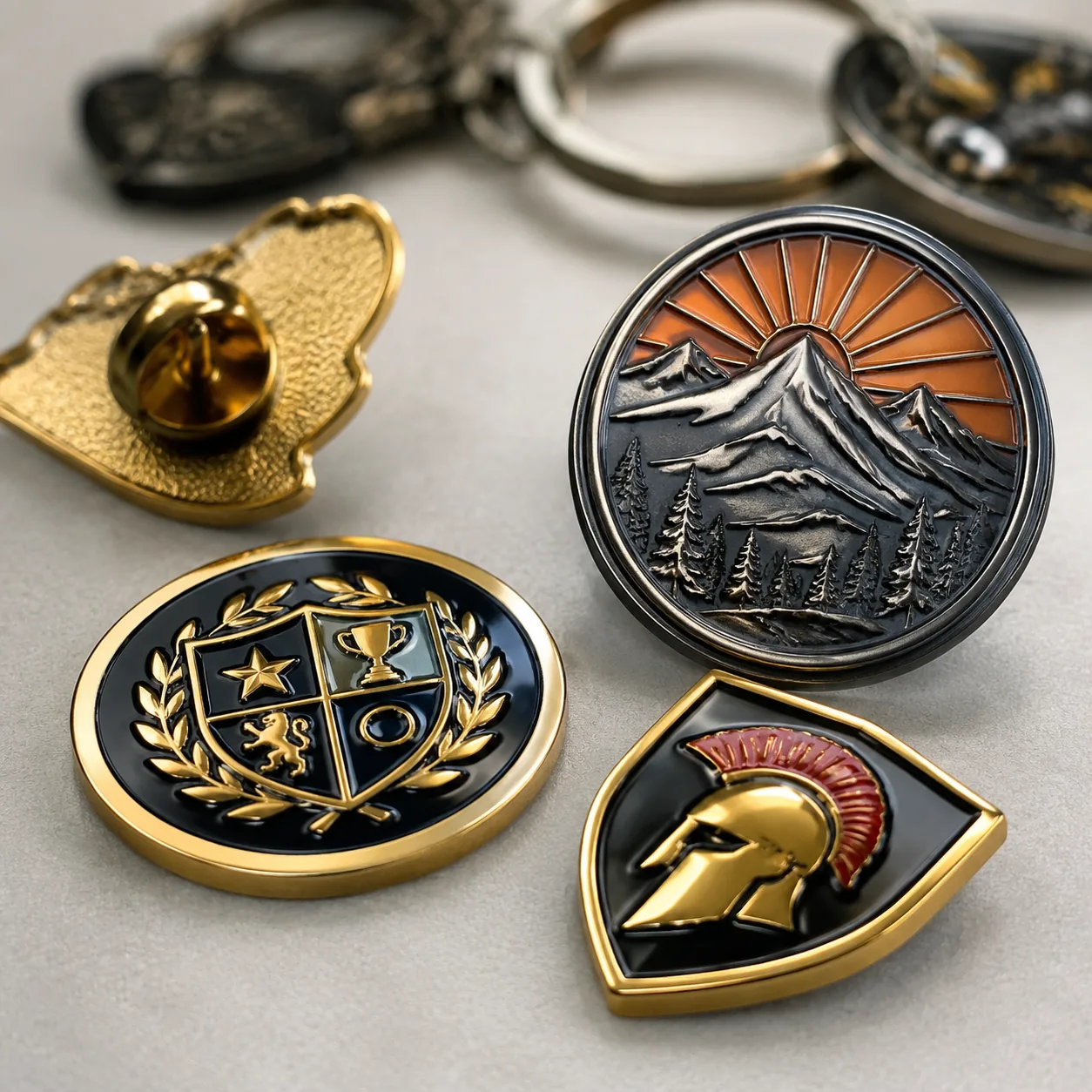
Why 300 total pieces do not buy 300-piece pricing
A common 2026 brief sounds simple: 300 custom metal pieces for one launch, split across three or four designs. Typical buyers include museums, startup brands, sports programs, event organizers, and distributors needing city-specific, sponsor-specific, or character-specific variants. The assumption is usually that 300 total pieces should price like one 300-piece SKU. In production terms, that is usually wrong.
Factories price decorated metal goods by SKU-level labor and setup, not only by total PO quantity. Every design change can trigger separate tooling, proof review, enamel batching, print setup, first-article approval, counting, labeling, and pack-out. A 300-piece order split into four designs at 75 pieces each behaves much closer to four short runs sharing some raw material than one efficient 300-piece run.
A realistic example is 300 soft enamel lapel pins at 32 mm, divided into four designs at 75 pieces each, stamped iron or cast zinc alloy base, butterfly clutch, and individual OPP bag. Even when all four SKUs belong to one campaign, each art file still creates its own manufacturing path and QC exposure. The commercial question is not whether the factory can make them. The real question is whether the split still works after mold count, MOQ rules, unit price inflation, lead-time drag, and sorting risk are priced honestly.
Where the extra cost really comes from
The first cost increase is tooling. In 2026, a 32 mm stamped iron mold for a standard 2D soft enamel pin commonly runs USD 35-60 per design for a simple round or shield shape, and USD 45-75 when the perimeter is more complex or includes inner cut detail. A cast zinc alloy mold at the same face size is more often USD 70-120 because cavity machining, draft control, gate layout, and polishing time are higher. If each design has a different silhouette, four variants usually mean four molds even on one 300-piece PO.
The second increase is unit price. A basic 32 mm soft enamel pin, one design, 300 pieces, 1.2-1.5 mm stamped iron, shiny nickel plating, butterfly clutch, and OPP bag often lands around USD 0.68-1.05 FOB. Split the same order into four designs at 75 pieces each and the unit price commonly moves to USD 0.98-1.65 FOB. The increase comes from lower batch efficiency in stamping yield, tray loading, color fill, oven cycle utilization, polishing loss, inspection time, and final SKU separation.
The third increase is operating risk. Four SKUs means four proofs, more Pantone callouts, more revision history, and more opportunities to mis-pack finished goods. On small mixed orders, a meaningful share of failures are not metal-forming defects. They are execution errors: the wrong back card, swapped polybags, one variant plated in satin nickel after another proof requested shiny black nickel, or barcode labels applied to the wrong bundle.
| Order structure | Tooling count | Typical unit FOB | Typical production lead time |
|---|---|---|---|
| 300 pcs, 1 design, 32 mm soft enamel pin | 1 mold | USD 0.68-1.05 | 10-14 days after approval |
| 300 pcs, 2 designs x 150 pcs | 2 molds | USD 0.82-1.30 | 12-16 days |
| 300 pcs, 4 designs x 75 pcs | 4 molds | USD 0.98-1.65 | 14-20 days |
| 300 pcs, shared base + 4 printed variants | 1 mold + print setup | USD 0.80-1.28 | 12-17 days |
The split strategy that usually works at 300 pieces
At this order size, the most efficient structure is usually one shared physical base with limited visual variation. Keep the outer shape, finished size, base thickness, plating, attachment type, and packaging identical across all variants. Change only the printed center, one recessed enamel field, laser-marked text, sequential numbering, or backing-card artwork. This lowers mold count, shortens approval cycles, and keeps the collection visually coherent.
A workable shared specification is a 30-35 mm stamped iron pin, 1.2-1.5 mm base thickness before plating, 1.4-1.8 mm finished total thickness depending on relief, relief depth of about 0.25-0.35 mm, polished front, sandblasted recesses where needed, shiny nickel or black nickel finish, and one butterfly clutch positioned within plus or minus 1.0 mm of the approved location. If the perimeter remains identical, one mold can often support several variants through offset print, screen print, laser marking, or a controlled enamel color swap inside a defined recess.
This approach works well for city names, event years, chapter identifiers, sponsor marks, serial numbers, or alternate character faces inside a common border. It works poorly when each SKU needs a different silhouette, large internal cutouts, different weight balance, or sculpted 3D relief. Trying to force very different art into one mold usually produces thin metal bridges, weak clutch positioning, crowded graphics, or an obviously compromised final piece.
Best build methods when each SKU is only 75 pieces
At 75 pieces per design, construction method matters more than many buyers expect. Stamped iron with soft enamel remains the default low-MOQ option when artwork has clear metal outlines, 2-6 colors, and limited fine type. It gives the best balance of mold cost, speed, and tactile definition. Practical minimums are about 0.30 mm metal line width, 0.35-0.40 mm enamel cell width, and text no smaller than roughly 5.5-6 pt equivalent at 32 mm scale if legibility is important.
Zinc alloy casting makes sense when the design needs irregular outlines, inner cutouts below about 8 mm, bridge sections that would be fragile in stamping, or a thicker 2.0-3.0 mm finished profile. But short-run economics are less forgiving. Tooling is higher, trimming and hand polishing take longer, and heavier parts slightly increase freight. At 75-piece sub-quantities, casting should be chosen for geometry, not because it sounds more premium.
Printed metal with epoxy is often the best value in this range when art accuracy matters more than raised metal segmentation. Stainless steel, brass, or aluminum with offset print and epoxy dome can hold fine lines around 0.15-0.20 mm, small text down to roughly 4.5-5 pt equivalent, and image detail such as gradients, skin tones, or facial features that soft enamel cannot reproduce cleanly. A 0.6-0.8 mm printed metal base with a clear epoxy dome is also lighter and often faster to approve because the proof is closer to the final appearance.
Hard enamel is regularly over-specified on small split runs. It can look excellent, but it adds color-fill, bake, stone, and final polish steps. Rejects such as underfill, color sink, overpolish on metal lines, or slight color mismatch become more expensive to absorb when each SKU is only 75 pieces. Unless the item is a long-life commemorative piece or higher-price retail collectible, soft enamel or printed metal usually gives better margin discipline and fewer avoidable defects.
| Build option | Best fit at 75 pcs per SKU | Useful spec range | Primary watch-out |
|---|---|---|---|
| Stamped iron soft enamel | Bold art, 2D outlines, lowest setup cost | 1.2-1.5 mm base; line width >= 0.30 mm | Tiny text and narrow enamel cells may fill poorly |
| Zinc alloy cast soft enamel | Irregular shapes, cutouts, thicker relief | 2.0-3.0 mm total thickness | Higher mold cost and heavier part |
| Printed metal with epoxy | Gradients, fine text, illustration-heavy art | 0.15-0.20 mm printable detail; 0.6-0.8 mm base | Less tactile metal definition |
| Hard enamel style | Flat polished surface, premium commemorative use | Tighter polish and color-fill control | Longer cycle time and higher reject cost |
Specs to lock before deposit
On mixed-SKU orders, the approval package matters more than the opening quote. The cleanest structure is one master control sheet for all shared specifications, plus one page per SKU showing only approved differences. That keeps the production file readable and reduces the chance that one variant quietly changes finish, clutch, or packaging during revision.
The shared page should state final size, material, base thickness, finished thickness range, plating finish, decorative plating thickness target, attachment type, attachment position, edge finish, artwork process, packaging method, shipping mark format, and inspection standard. Practical tolerances for this category are usually plus or minus 0.30 mm on finished size, plus or minus 0.15 mm on stamped base thickness, plus or minus 0.10 mm on printed registration where artwork alignment is critical, plus or minus 1.0 mm on clutch position, and plus or minus 5 percent on individual piece weight where balance matters.
Color language must be explicit. List Pantone references for each enamel area or printed field, and note whether the factory is matching to Pantone solid coated, CMYK conversion, or a supplied physical sample. Those are not equivalent standards. Plating also needs precise naming: shiny nickel, matte nickel, black nickel, imitation gold, antique brass, and imitation rose gold all produce materially different appearance. A note like silver finish is too vague for a four-SKU order.
For decorative plating thickness, promo-grade nickel-tone or gold-tone finishes commonly sit around 0.03-0.08 micron, with appearance prioritized over corrosion resistance. If the item will be worn outdoors, stored for long periods, or sold as better retail merchandise, request an anti-tarnish topcoat and define a target such as 24-48 hours neutral salt spray with no severe visible discoloration on the presentation face. That is a cost adder and needs to be quoted before approval, not discovered after the PO is placed.
- Use one master spec sheet for all shared dimensions, metal, plating, clutch, and packaging.
- Lock one plating finish across every SKU; mixed plating on a 300-piece run adds avoidable setup cost and inspection risk.
- Specify process minimums in the artwork file: about 0.30 mm metal lines for soft enamel and 0.15-0.20 mm printable detail for offset print.
- State Pantone references or approved CMYK targets for each design; do not approve by verbal color description.
- Write inspection criteria into the PO, such as AQL 2.5 major / 4.0 minor, with appearance checked at 30-50 cm under 5000-6500K neutral light.
- Approve one pack-out map showing exact SKU counts per bag, card, inner box, or kit to prevent sorting errors at final packing.
MOQ tiers and budget math before you request quotes
Budget split orders by separating fixed cost from variable cost. Fixed cost includes tooling, pre-production sample charges, backing-card setup, barcode label setup, and any custom carton marking. Variable cost includes the piece price, packaging labor, and freight. This is the only clean way to compare a three-SKU plan against a four-SKU plan instead of hiding the economics inside one blended unit number.
For a realistic 2026 model, four stamped soft enamel designs at 75 pieces each may require USD 140-240 in tooling, USD 294-495 in item cost, and USD 18-55 in packaging extras before freight. A shared-base version with one mold and four printed or laser-marked variants may cut tooling to roughly USD 40-85 and hold item cost in the USD 240-384 range. On a small launch, that difference is often large enough to determine whether the order proceeds now or is delayed to the next budget cycle.
MOQ language also needs scrutiny. Many factories advertise a 50-piece MOQ, but that usually means 50 pieces per design, not 50 pieces mixed across several art files. In practical terms, common breakpoints for stamped soft enamel are 50, 100, 300, 500, and 1000 pieces per SKU. At 75 pieces per variant, you are above minimum but still below the first efficient quantity break. Moving one design from 75 to 100 pieces can sometimes reduce its unit FOB by USD 0.08-0.15 because setup waste, inspection time, and plating overhead are spread more efficiently.
Buyers should also ask about overrun policy. On small decorated-metal orders, a 1-3 percent production overage is reasonable when goods must be pre-sorted into exact kits or retail assortments. That overage may not be free, and it does not replace normal QC, but it can prevent a costly repack if one SKU finishes two or three pieces short after final inspection.
Lead times in days, not wishful estimates
The production floor is often not the main delay. Approval cycles are. A simple one-design order may finish in 10-14 calendar days after final artwork approval. A four-SKU order more often needs 14-20 calendar days before freight because proofs, mold confirmations, color review, and pack-out instructions all multiply.
A realistic 2026 schedule for a mixed order is 2-3 working days for quotation and DFM artwork review, 2-4 working days for proof revision, 3-5 working days for tooling, and 10-15 working days for mass production after final approval. Add 3-5 working days for custom backing cards or inserts, and another 1-3 working days for barcode labels, SKU stickers, or retail bundle assembly. Air freight usually adds 3-7 days in transit depending on service level and destination; express courier can be faster but costs more per kilogram; sea freight only makes sense if the order ships inside a larger consolidation.
For a launch tied to a fixed event date, schedule backward from the required in-hand date. If goods must arrive by 15 September, subtract freight time, customs buffer, production days, pre-production sample time if needed, and proof approval time before placing the order. On a 300-piece split run, losing two days in revision often hurts more than paying an extra USD 0.10 per piece for a process that is easier to approve and manufacture.
When the low quote is actually the expensive option
Some suppliers make mixed-SKU quotes look competitive by weakening hidden specifications: thinner base metal, fewer polish passes, looser color control, lower-grade clutches, downgraded OPP bags, or an undocumented plating substitution. That may trim a few cents from the piece price, but it usually makes the finished set look inconsistent. On launch merchandise, buyers notice inconsistency faster than they notice a small invoice saving.
Treat the quote as incomplete if it does not clearly state base material, material thickness, plating finish, clutch type, packaging method, mold count, and whether artwork changes create separate setup charges. Be skeptical when a supplier claims several different silhouettes can share one mold. Unless they show exactly which geometry remains constant, one-mold language usually means the files have not been reviewed in production terms. Different silhouettes almost always require different tooling.
A workable decision rule is simple. If every SKU must be physically different, reduce the number of SKUs or increase quantity per SKU to at least 100-150 pieces. If the collection needs variety at only 300 total units, standardize the physical build and vary only graphics, text, or cards. The cheapest path at this volume is rarely four true micro-runs. It is one disciplined platform with controlled variation, locked specs, and a pack-out plan detailed enough that the factory cannot improvise.
Have a project? Send your artwork and target quantity and we’ll reply with a detailed quotation within 12 working hours.
Ready to get this made?
Send your sketch, target quantity and ship-date. Detailed quotation in 12 hours.



