30-Day Trade Show Pin Orders: RFQ-to-Delivery Plan
Day 0: lock a rush-safe pin specification before requesting quotes
A 30-day custom pin order only works when the specification fits a factory’s fastest repeatable process. The common failure pattern is to start with a premium concept—small details, hard-enamel look, custom cards, multiple SKUs, or gift packaging—then try to win back time by pushing the supplier. That rarely works. For most China-based badge and pin factories, 30 calendar days from RFQ to delivered goods is realistic only for a simplified design, standard attachment, standard plating, and express courier or priority air. Sea freight is not compatible with this timeline except for domestic handoff to a forwarder after the event window is no longer critical.
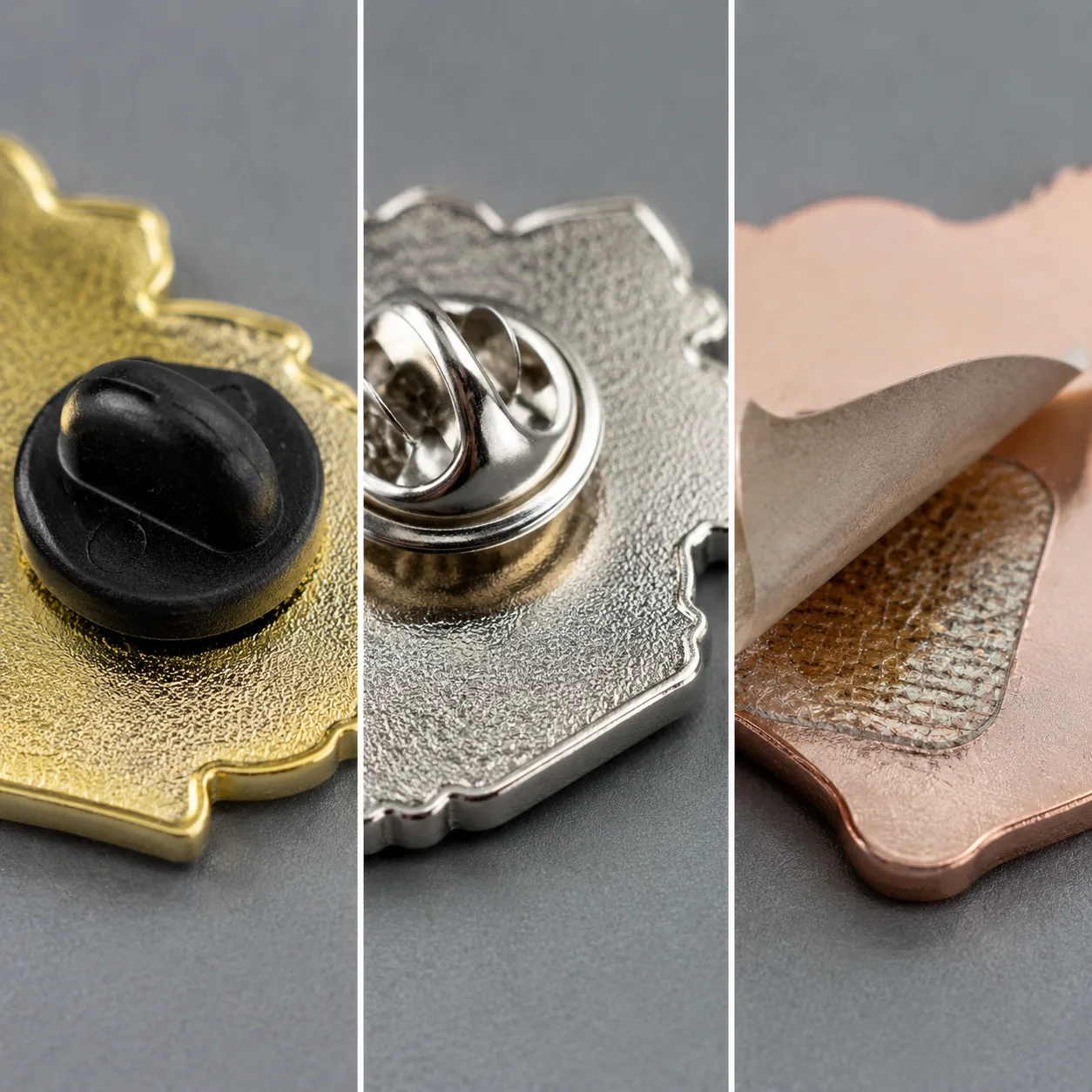
For the highest probability of on-time delivery, specify a flat 2D soft enamel pin in stamped iron, 25 to 40 mm on the longest side, with body thickness of 1.2 mm for economy or 1.5 mm for a heavier feel. Use bright nickel, bright gold, or black nickel plating because these finishes are widely available and usually run on standard production queues. Keep enamel colors to 2 to 6 Pantone references. Use one butterfly clutch on pins below 30 mm, and two posts on most pins from 30 to 45 mm to reduce rotation during wear. Standard individual polybags or bulk pack are materially faster than custom backing cards, velvet boxes, or mixed event kits.
Rush MOQs can be as low as 100 pieces, but the meaningful price tiers are usually 100, 300, 500, and 1000 pieces. For a 30 mm stamped-iron soft enamel pin, 1.2 mm thick, one post, four colors, standard plating, indicative FOB China pricing is often USD 0.68 to 1.10 at 100 pieces, USD 0.50 to 0.84 at 300 pieces, USD 0.40 to 0.70 at 500 pieces, and USD 0.29 to 0.55 at 1000 pieces. A second post typically adds USD 0.03 to 0.06 per piece. A rubber clutch instead of a butterfly clutch often adds USD 0.02 to 0.04. Simple stamped tooling is commonly USD 50 to 120, while zinc-alloy die-cast tooling is more often USD 90 to 180. Some suppliers waive tooling at 1000 pieces, but buyers should confirm whether the tool remains factory-owned and reusable for repeat orders.
Treat the following as schedule-risk features, not default options: imitation hard enamel, epoxy doming, glitter fill, glow pigment, moving parts, danglers, cut-to-shape cards, multiple artwork versions, sequential numbering, velvet boxes, lines below 0.25 mm, open cells below 0.40 mm, and more than 8 fill colors. None is impossible, but each adds process steps, cure time, manual handling, or another approval gate. On a fixed trade-show date, removing one risky feature usually protects more schedule than negotiating a few cents of unit cost.
Day 1-2: issue an RFQ that can move directly into tooling and booking
Rush orders often lose their first 48 hours because the RFQ is only good enough for a rough quote, not for tooling release, proofing, and freight planning. A usable RFQ lets the supplier answer three practical questions immediately: can the design be manufactured as drawn, what build method is fastest and safest, and what are the lead times and FOB prices at each quantity tier.
State finished size in millimeters, body thickness, base metal, plating finish, Pantone references, attachment type, backstamp requirement, packing method, target quantity, ship-to country, postcode, and latest acceptable delivery date. Separate the event opening date from the last usable receipt date. If the show opens on Monday, the real deadline may be the prior Thursday or Friday once venue receiving windows, drayage handling, internal QA, and booth setup are included. On compressed timelines, this distinction can decide whether courier is still viable or whether the job needs split shipments.
- Artwork file: AI, EPS, or vector PDF with all fonts outlined
- Finished size: for example 32.0 x 28.0 mm with tolerance of ±0.30 mm
- Body thickness: 1.2 mm standard, 1.5 mm premium feel, ±0.10 to ±0.15 mm tolerance
- Raised metal lines: keep at or above 0.30 mm; 0.35 mm is safer on dark plating
- Enamel cells: keep open areas at or above 0.40 mm; 0.50 mm is safer for consistent fill
- Front text: avoid character height below 0.60 mm; back text is safer at 0.80 to 1.00 mm
- Plating stack: ask supplier to state decorative finish plus copper or nickel underlayers
- Decorative plating thickness: typically about 0.03 to 0.10 micron over underplating; cosmetic, not corrosion-grade
- Attachment: butterfly clutch, rubber clutch, deluxe clutch, safety pin, or magnet, with one-post or two-post layout shown
- Inspection plan: define AQL 2.5 major and 4.0 minor unless brand requirements are tighter
- Packing: bulk, individual polybag, carded, or boxed; each added manual step can add 1 to 3 production days
- Approval rule: digital proof only, first-article photos with dimensions, or physical pre-production sample
If the pins will be stored for several months, used outdoors, or distributed as a premium brand item, ask for the supplier’s normal plating stack and expected shelf-life behavior. Decorative pin plating is primarily cosmetic. It should not be assumed to meet salt-spray or high-corrosion requirements unless that performance is written into the RFQ and priced accordingly. For most trade-show giveaways, the real priority is cosmetic consistency at normal viewing distance, not engineered corrosion resistance.
Day 2-4: choose the build method that removes days instead of adding them
Manufacturing method is an operations decision first and a branding decision second. For most event deadlines, soft enamel is the safest choice because the recessed color fields tolerate normal process variation and do not require the extra polishing cycle used for imitation hard enamel. Soft enamel also makes first-article approval faster because a slight surface texture is acceptable as long as the metal lines are clean, the plating tone is correct, and the enamel fill is within agreed limits.
Stamped iron is usually the lowest-cost and fastest option for flat 2D pins in the 20 to 45 mm range. Brass can stamp cleanly and hold fine detail, but it usually costs more and offers little commercial advantage for event giveaways. Zinc-alloy die casting is the better option when the design needs irregular outlines, interior cutouts, bridges, or a thicker profile of roughly 2.0 to 3.0 mm. If the artwork includes narrow bridges, floating islands, or deep cutouts, request a manufacturability markup before tooling approval. Tool revision after die cutting or mold machining commonly costs 1 to 3 calendar days on a rush order, which is a meaningful share of a 30-day window.
| Build option | Best use in a 30-day project | Typical MOQ | Sample time | Bulk time | Indicative FOB price at 500 pcs |
|---|---|---|---|---|---|
| Soft enamel, stamped iron, 30 mm, 1.2 mm | Fastest, lowest-risk option for flat 2D event pins | 100 | 3-5 days | 8-12 days | USD 0.40-0.70 |
| Soft enamel, zinc alloy cast, 35 mm, 2.0 mm | Irregular outline, cutouts, thicker profile | 100 | 4-6 days | 10-14 days | USD 0.58-1.00 |
| Imitation hard enamel, 30 mm, 1.2-1.5 mm | Premium smooth face only if schedule has buffer | 100 | 5-7 days | 12-18 days | USD 0.70-1.25 |
| Die-struck no color, 35 mm, 1.5 mm | Metallic look with fewer fill steps | 100 | 4-6 days | 9-13 days | USD 0.46-0.88 |
| Challenge coin, 45 mm, 3.0 mm | VIP item possible, but less forgiving on timeline | 100 | 5-7 days | 12-18 days | USD 1.45-3.10 |
Avoid epoxy unless it solves a specific problem, such as protecting a printed insert or smoothing a screen-printed surface. On enamel pins, epoxy adds a coating operation and cure time, and it introduces new defect modes including bubbles, dust inclusions, edge overflow, fisheyes, and gloss inconsistency. On a 30-day plan, that extra process usually adds more schedule risk than user value.
Day 4-7: approve artwork against measurable tolerances, not visual preference
The proof stage should freeze the product as a manufacturing document, not as a design concept. Approve the front design, backstamp, exact finished size, thickness, post location, clutch type, plating finish, and packing method at the same time. If any of those items remain open, the factory can still produce the wrong item even when the logo itself looks correct.
Rush-safe technical limits for small metal pins are straightforward. Keep raised lines at 0.30 mm or wider, enamel cells at 0.40 mm or larger, and avoid front-facing micro text below 0.60 mm character height unless the font is simple and bold. Typical finished-size tolerance is ±0.30 mm on standard shapes. Thickness tolerance is commonly ±0.10 to ±0.15 mm. Post-position tolerance is usually about ±0.20 mm. On two-post pins, specify center-to-center spacing in millimeters so QC measures one fixed dimension rather than judging position visually.
Approve Pantone numbers, not color names such as red, navy, or metallic gold. If brand color matters, ask for first-article photos under two lighting conditions: daylight-balanced lighting around 5000 to 6500 K and warm indoor lighting around 3000 K. This is not laboratory color control, but it is enough to expose major mismatch before the full run is finished. Also confirm whether dark finishes such as black nickel reduce apparent contrast around thin outlines, because a proof that looks sharp on-screen can look visually heavier after plating.
If the logo contains thin outlines, ask the supplier to widen them before tooling where needed. A change from 0.22 mm to 0.30 mm is often invisible in normal artwork review but materially improves die life, plating separation, enamel fill stability, and reject rate. On a compressed schedule, this kind of pre-tooling adjustment is one of the cheapest ways to prevent rework.
Day 7-12: control first articles without wasting the schedule on sample transit
For a standard 2D soft enamel pin, a physical pre-production sample is not always the best control method. International courier transit typically consumes 3 to 5 days each way, and customs delay can add another 1 to 2 days. That can burn 20 to 30 percent of the total timeline before bulk production even starts. For standard pins under 40 mm with no unusual packaging, digital proof approval plus first-article photos and dimensional confirmation is often the better trade-off.
A practical checkpoint is 5 to 20 first-article pieces reviewed by photo and measurement. Request front, back, side-profile, and attachment images, plus a short dimension sheet showing overall width and height, body thickness, post spacing, and pack-out method. This catches the defects that matter most on rush orders: wrong plating tone, weak detail, incorrect attachment count, poor enamel fill, off-center backstamp, wrong card orientation, and missing protective bagging.
If a physical sample is required, define the decision rule before tooling starts. Either the sample is for reference only and bulk may proceed after digital proof approval, or the sample is a hard gate and mass production must wait for your written release. Ambiguity here is expensive because sourcing, sales, and marketing teams often assume different approval thresholds, while the supplier usually defaults to the most conservative interpretation to avoid claim risk.
Day 12-22: run bulk production with two checkpoints and a defined AQL
A rushed order does not benefit from more approvals; it benefits from the right approvals at the right stages. Two checkpoints are usually enough: one in-process review during plating, color fill, or attachment assembly, and one final pre-shipment inspection after packing. Additional sign-off layers often add delay without improving output quality.
At the in-process stage, verify plating tone, enamel fill level, edge finishing, post solder or cast integrity, clutch type, and card orientation if carding is used. Common rush defects include underfilled enamel, enamel overflow onto metal lines, burrs on the perimeter, plating shade drift between lots, missing or loose clutches, shallow backstamp detail, and mixed finishes in the same batch. If epoxy is used, inspect specifically for bubbles, trapped dust, edge thinning, and incomplete perimeter coverage.
Attachment integrity deserves a simple mechanical check. For soldered posts, sample pieces should show no visible wobble, no cold-solder appearance, and no exposed brass or steel at the joint. For cast posts, confirm that the base is fully formed without short-shot edges or cracking around the root. For magnets, verify adhesive bond strength after 24-hour cure and confirm matched polarity if two-part magnet sets are supplied. Magnets can also trigger courier restrictions or add chargeable weight, so they are not a neutral substitute for standard clutches on a rush shipment.
AQL 2.5 major and 4.0 minor is a practical default for promotional pins. Define major defects as wrong artwork, wrong finish, missing attachment, detached post, sharp burrs that can cut skin, severe enamel voids, plating peel, wrong quantity packed, or mixed SKU in the wrong carton. Define minor defects as slight enamel waviness within agreed limits, small surface specks, or moderate plating tone variation not obvious at a normal viewing distance of about 300 to 500 mm. If the item is for premium customer gifting rather than booth giveaway use, tighten only the features that affect perceived quality. Trying to hold every cosmetic point to gift-grade standards on a 30-day schedule can increase rejection and remake risk without improving event ROI.
Day 22-27: close pack-out, shipping documents, and freight booking before calling it done
Production complete is not shipment ready. The order is only complete when the units are counted, packed, carton-marked, documented, and booked for export. Packaging choice affects both labor time and freight cost. Bulk pack and individual polybags are the fastest options. Custom backing cards add print lead time, hand insertion, and orientation errors. Gift boxes sharply increase carton cube and often push airfreight into a higher chargeable-weight bracket.
For trade-show deployment, pack for use at the booth rather than for warehouse density alone. If staff need fast distribution, inner bags or inner boxes of 50 or 100 pieces are usually more usable than one master carton with 500 loose pieces. Request carton dimensions, net weight, and gross weight before dispatch so the freight quote can be checked against actual cube. As a rough guide, 500 pieces of 30 mm soft enamel pins may weigh only 12 to 18 kg gross in simple pack-out, but magnet sets, thick carding, or gift boxes can push both weight and volume materially higher.
Express courier is often 3 to 7 days door-to-door for many destinations, while priority air plus local handoff is often 5 to 10 days and becomes more economical once the shipment exceeds a few cartons. Build customs clearance into the timeline, especially if the consignee needs a tax ID, broker contact, receiving appointment, or venue paperwork. Many rush orders are manufactured on time but still miss the event because consignee details or import documents were incomplete.
Before dispatch, confirm the commercial invoice description, declared value, carton count, consignee contact details, and intended HS code with the supplier or forwarder. Generic descriptions such as gift, badge accessory, or metal craft are more likely to trigger customs questions than a specific description such as custom metal lapel pins with butterfly clutch. For repeatable import handling, buyers should also ask whether country-of-origin marking is required on the carton, inner pack, or product.
Day 27-30: pre-approve fallback actions before the schedule starts to slip
The cost of missing the show usually exceeds the cost of the pins, so contingency decisions should be made before production pressure builds. Good rush management means that on day 0 you already know which features can be downgraded, split, or removed without another internal approval loop. That is often the difference between a usable event delivery and a technically perfect order that arrives too late.
Useful fallback actions include splitting the shipment so 30 to 50 percent moves by express courier and the balance by lower-cost air, changing from custom backing cards to polybags, switching from a delayed premium finish to bright nickel or black nickel, reducing separately packed SKUs, or removing epoxy. If the original concept is too complex, a common recovery strategy is to retain a premium version for VIP distribution and substitute a simpler high-volume soft enamel pin for general booth traffic. That preserves the event objective even if the original design proves too slow to execute in full.
- Lock latest acceptable ship date and latest acceptable delivery date as separate milestones
- Approve one fallback plating finish and one fallback packing method before tooling release
- Request daily progress updates after tooling release and again after bulk production starts
- Reserve budget for a partial express shipment if the first planned departure is missed
- Confirm consignee phone, tax ID, broker details, and venue or warehouse receiving window before dispatch
- Prepare local receiving support so cartons are not refused, delayed, or left unclaimed
- If shipment is split, state carton priority by SKU, event day, booth use, or attendee tier
For projects inside 45 days, a simple traffic-light screen is useful. Green: standard 2D soft enamel, standard plating, one artwork, simple polybag packing, no magnets, and no cards. Yellow: more than 6 colors, magnets, custom cards, multiple versions, zinc alloy with cutouts, or specialty clutches. Red: moving parts, imitation hard enamel, gift boxes, mixed assortments, sequential numbering, or openwork below standard line limits. Yellow and red projects need manufacturability review before price approval. The right supplier response is not only a unit price. It is a revised rush-safe specification, calendar-day lead time by stage, pricing at 100, 300, 500, and 1000 pieces, and a freight recommendation matched to the true event receipt deadline.
Have a project? Send your artwork and target quantity and we’ll reply with a detailed quotation within 12 working hours.
Ready to get this made?
Send your sketch, target quantity and ship-date. Detailed quotation in 12 hours.



