2D vs 3D Relief for Custom Coins and Badges
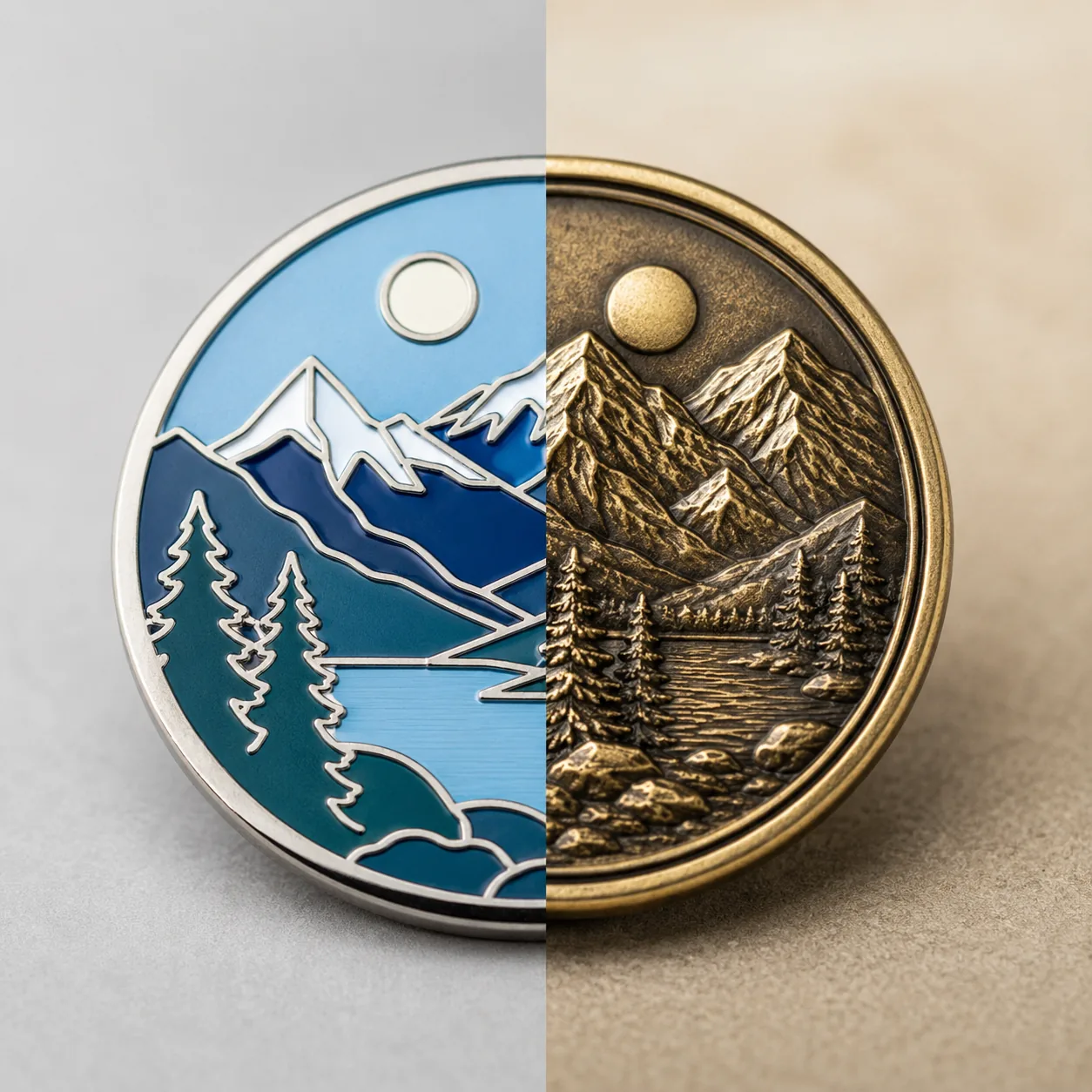
Why Good Artwork Fails in Metal
Most relief problems start before tooling. A buyer approves a flat PDF, but the RFQ does not define which areas are raised, recessed, enamel-filled, printed or sculpted. The factory then chooses the lowest-risk interpretation, often a simple 2D die. The result may be technically acceptable but visually weak: soft facial features, unreadable rim text, shallow logos or enamel cells that crowd the metal lines.
For a 40 to 50 mm coin, badge or emblem, relief has limited room to work. A mascot face that looks sharp at 100 mm on screen may collapse at production size if the eye grooves are 0.20 mm wide, the nose bridge has no height separation, or the hair detail competes with enamel walls. The same issue appears on building facades, vehicle badges, sports crests and commemorative seals.
The practical decision is not whether 3D is always better. It is whether the artwork, size, material, finish, order quantity and budget support sculpted depth. ZheCraft normally separates every design into three production zones before quoting: flat print or enamel color, stepped 2D metal levels, and sculpted 3D metal. That one step prevents the common mismatch where the buyer expects medal-like depth but the supplier priced a flat challenge coin.
2D Relief: Flat Levels, Crisp Edges
A 2D coin or badge is built from flat raised and recessed planes. The edge between levels creates the definition. Most enamel pins, police-style badges, logo coins and promotional emblems use two to four levels: raised border, recessed enamel field, raised lettering and sometimes a recessed sandblast or antique texture.
For die-struck brass, iron or copper alloy, the usual height difference between raised and recessed metal is 0.25 to 0.60 mm. Enamel cells are commonly recessed 0.20 to 0.35 mm below the raised metal rim before filling. A non-enamel antique background is often 0.30 to 0.50 mm below the polished raised face. Normal production tolerance for clean 2D metal lines is about ±0.10 mm when the artwork is not overloaded.
2D relief is the right choice when the design relies on logos, geometric icons, flags, product outlines, short text, Pantone enamel or sharp brand marks. It is also safer for badges below 30 mm, where sculpted 3D has too little diameter to show meaningful contour. For uppercase sans-serif lettering, 1.2 mm height is a practical minimum; rim text on 40 to 50 mm coins is safer at 1.8 to 2.5 mm. Raised metal strokes should be at least 0.25 mm, with 0.35 mm preferred for repeat production.
Do not force 2D relief onto realistic portraits, animal bodies, mountain ranges or architectural scenes if shadows and depth are part of the design value. Those subjects usually need 3D or a hybrid layout, such as a 3D central mascot with 2D rim text and a recessed textured background.
3D Relief: Sculpted Depth and Tooling Risk
A 3D relief design uses curved surfaces rather than only flat steps. The die or mold is digitally sculpted so cheeks, fabric folds, feathers, vehicles, mountains or mascots rise and fall continuously. This produces richer highlights and hand feel, but it also increases tooling cost, sample review time and the chance of soft detail if the relief map is not clear.
On a 3.0 mm thick die-struck brass coin, practical 3D relief is usually 0.60 to 1.50 mm above the background. A 60 to 80 mm medal can carry 1.5 to 2.5 mm relief, but it may need 3.5 to 5.0 mm base thickness, slower striking and tighter polishing control. Zinc alloy casting can form bulky 3D shapes, cutouts and thick keychains more easily than striking, but fine logo edges and small text are softer. A realistic tolerance for cast zinc alloy dimensions is ±0.20 to ±0.30 mm.
Finish selection matters more on 3D than on 2D. Antique nickel, antique brass, antique copper and antique silver make the relief easier to read because dark wash remains in low areas while high points polish brighter. Shiny gold over a sculpted face can look premium, but it shows polishing variation and handling wear more quickly than an antique finish. For high-touch collector coins, buyers should approve a physical finish sample instead of relying on screen color.
| Spec item | 2D relief typical range | 3D relief typical range | Buyer note |
|---|---|---|---|
| Best finished size | 20 to 60 mm | 40 to 90 mm | 3D needs diameter to show contour and shadow |
| Relief height difference | 0.25 to 0.60 mm | 0.60 to 2.50 mm | High relief may require thicker base metal |
| Minimum raised line | 0.25 to 0.35 mm | 0.35 to 0.50 mm | 3D ridges round off if too narrow |
| Minimum recessed gap | 0.25 to 0.35 mm | 0.40 to 0.60 mm | Deep valleys close up during plating or polishing |
| Text height | 1.2 to 2.5 mm | 1.5 to 3.0 mm | Curved surfaces need larger letters |
| Tooling lead time | 3 to 5 days | 5 to 9 days | 3D includes digital sculpt review |
| Sample lead time after tooling | 5 to 8 days | 7 to 12 days | Antique 3D samples need side-light checks |
| Typical tooling cost | USD 45 to 120 | USD 90 to 260 | Varies by diameter, side count and detail |
| FOB unit price at 500 pcs | USD 0.75 to 2.80 | USD 1.35 to 5.20 | Based on 40 to 60 mm items, excluding premium boxes |
Artwork Rules That Prevent Weak Relief
The factory cannot reproduce detail that is smaller than the process allows. For 2D die-struck metal, keep simple raised lines at 0.25 mm minimum and use 0.35 mm where the line separates enamel colors. For 3D details such as eyelids, lips, claws, fur grooves or hair, avoid features below 0.40 mm unless the item is large and antique-finished. For cutout shapes, avoid fragile points under 1.0 mm wide.
Text should be engineered, not scaled blindly from a logo file. Raised or recessed uppercase sans-serif text can work at 1.2 mm on flat 2D areas, but 1.5 mm is a safer production minimum. On curved 3D surfaces, use 1.5 to 2.0 mm minimum because the baseline distorts. Rim text on a 45 mm coin should normally be 1.8 to 2.5 mm, with at least 0.25 mm spacing between letters after conversion to outlines.
For 3D art, do not ask the supplier to infer depth from shadows in a JPG. Provide a simple relief map: high areas, mid areas, low areas, flat raised metal, recessed texture and enamel or print zones. If the design includes a portrait, mascot or landmark, include one clean vector file plus a reference image marked with arrows. This is faster and more accurate than the instruction “make it 3D.”
- Provide vector artwork in AI, EPS, PDF or SVG, plus a 300 dpi PNG preview for visual reference.
- Mark each 2D area as raised metal, recessed enamel, recessed texture, printed color or flat background.
- For 3D areas, label high, mid and low zones instead of relying on gradients or screen shadows.
- Specify diameter, thickness and side count; common coin thicknesses are 2.5, 3.0, 3.5 and 4.0 mm.
- Keep normal outer shape tolerance at ±0.20 mm for die-struck coins and badges.
- Confirm whether the back is blank, laser engraved, 2D stamped, printed or double-sided 3D before tooling.
- Define attachment and edge details, such as butterfly clutch, magnet, split ring, reeded edge or diamond-cut edge.
Material, Process and Finish Selection
Die-struck brass is the preferred material for crisp 2D relief and premium 3D challenge coins when the budget allows. It strikes cleanly, plates well and gives better edge definition than zinc alloy. For 45 to 50 mm brass coins, common thickness is 3.0 to 3.5 mm, and a realistic FOB range at 500 pieces is USD 1.80 to 4.80 depending on plating, enamel, edge style and whether one or both sides are detailed.
Iron is economical for flat 2D pins and small badges, especially below 35 mm. It is not ideal for deep 3D relief because it is harder to strike cleanly at high depth and needs reliable anti-rust plating. Zinc alloy casting is useful for thick 3D keychains, magnets, bottle openers and irregular silhouettes. It handles volume well, but very fine borders, micro text and razor-sharp logos are less crisp than die-struck brass.
Enamel and 3D relief must be planned together. Enamel needs recessed cells with raised metal walls, while 3D sculpting needs flowing surfaces. Too many tiny enamel fills can break the sculpt and weaken both effects. A dependable hybrid is a 2D enamel logo in the center with 3D antique border elements, or a 3D mascot with limited printed color accents instead of many small enamel pools.
| Material/process | Best use | Avoid when | Typical MOQ | Production lead time after sample approval |
|---|---|---|---|---|
| Die-struck brass | Crisp 2D coins, premium 3D relief, antique finishes | Lowest-cost giveaway is the only goal | 100 pcs | 12 to 18 days |
| Die-struck iron | Budget 2D pins and badges under 35 mm | Deep 3D relief or high anti-rust demand | 100 to 300 pcs | 10 to 16 days |
| Zinc alloy casting | Thick 3D keychains, magnets, cutouts and bulky shapes | Very fine text or sharp brand marks are critical | 300 pcs | 14 to 22 days |
| Photo etched brass | Thin badges with fine recessed line detail | Heavy coin feel or deep relief is required | 300 pcs | 12 to 18 days |
| Printed metal with epoxy | Photographs, gradients and fast full-color promo badges | Buyer wants real raised metal relief | 100 pcs | 8 to 14 days |
Cost, MOQ and Lead-Time Planning
A 2D design is usually cheaper because the die is simpler, the proof is easier to approve and polishing is more predictable. For a 40 mm 2D coin with one-side soft enamel, standard plating and individual poly bag, a realistic FOB range at 500 pieces is USD 1.20 to 2.80. At 1,000 pieces, the same specification may fall to USD 0.95 to 2.20 because tooling and setup are spread across more units.
A 3D design adds cost in three places: digital sculpting, deeper tooling and slower finishing. For a 50 mm antique brass or antique nickel 3D coin, 500-piece FOB pricing commonly runs USD 2.40 to 5.20, with tooling at USD 120 to 260. Double-sided 3D can add another USD 80 to 220 in tooling and should be sampled physically because both sides must balance depth, weight and polishing.
MOQ depends on process more than relief alone. Many die-struck brass or iron projects can start at 100 pieces, but zinc alloy casting often becomes economical at 300 pieces because mold and casting setup are heavier. For distributor quoting, useful tiers are 100, 300, 500, 1,000 and 3,000 pieces. A 3,000-piece 2D coin may be 25 to 45 percent cheaper per unit than a 300-piece run, while a complex 3D item still carries higher labor cost even at volume.
Lead time should be written in calendar days, not vague “fast production” language. A straightforward 2D coin or badge typically needs 8 to 13 days from approved artwork to pre-production sample, then 10 to 18 days for mass production after sample approval. A 3D coin normally needs 12 to 21 days for sculpting, tooling and sample, then 14 to 24 days for mass production. Add transit time separately: express air freight is often 3 to 7 days, while sea freight can exceed 25 to 40 days depending on destination.
QC Specs Buyers Should Put in the PO
Relief quality is difficult to judge from one glossy front photo. Require straight-on photos, angled photos and a short side-light video before approving mass production. Side lighting reveals whether the sculpt has readable depth, whether polishing has flattened high areas, and whether antique wash is trapped evenly in low zones.
Inspection criteria should combine visual and dimensional checks. Common settings for promotional metal products are AQL 2.5 for major defects and AQL 4.0 for minor defects. Critical defects should be zero tolerance: sharp unsafe burrs, broken attachments, exposed rust, wrong logo, severe plating peel or missing enamel. For relief height, use ±0.10 mm on key die-struck raised levels and ±0.20 mm on cast zinc alloy where the process is less precise.
Plating should also be quantified where possible. Decorative flash gold color is often around 0.03 to 0.08 microns, suitable for appearance but not heavy wear. Nickel-family plating is commonly 3 to 8 microns depending on finish and buyer requirement. If the coin will be handled daily, discuss thicker plating, antique finish or clear lacquer before sampling. Mirror gold on high 3D points can wear visibly faster than antique nickel or antique brass.
- Approve a physical sample for every new 3D relief tool before mass production.
- Check that faces, text and logos remain readable at arm’s length, not only in macro photos.
- Reject sharp burrs over 0.10 mm on edges, cutouts, pins, key rings or attachment points.
- Confirm plating color against a physical sample, approved finish board or retained golden sample.
- For enamel hybrids, check fill level against raised metal; ±0.10 mm is a practical acceptance range.
- Keep one signed or photographed golden sample for reorders, claims and incoming inspection.
- State AQL 2.5 major, AQL 4.0 minor, and zero tolerance for rust, broken plating and unsafe burrs.
Better RFQ Wording Before Tooling
A weak RFQ such as “50 mm 3D coin, gold, logo both sides” leaves the supplier guessing the material, thickness, relief height, background texture, edge style, plating system, back-side process and packaging. Those decisions then surface during sampling, when changes cost days and may require a second tool.
A useful specification names the process, size, material, finish and relief structure. Example: “50 mm diameter, 3.5 mm thick brass challenge coin, antique nickel, front side 3D sculpted mascot with 1.2 mm maximum relief, recessed sandblast background, back side 2D raised logo with 2.0 mm rim text, no enamel, oblique reeded edge, individual PVC pouch, AQL 2.5/4.0 inspection.” That tells engineering how to build the die and tells QC what to measure.
If price is sensitive, request alternatives instead of asking suppliers to guess. Ask for Option A as 2D brass, Option B as 3D zinc alloy and Option C as 3D brass with antique finish. Include quote tiers at 100, 300, 500, 1,000 and 3,000 pieces, plus the in-hand date and destination country. ZheCraft often quotes this way for distributors because it makes the trade-off between crisp branding, sculpted depth, MOQ and delivery risk visible before artwork engineering starts.
| Weak wording | Better wording |
|---|---|
| Make the logo 3D | Center mascot 3D sculpted; text and outer logo remain flat 2D raised metal |
| Premium thick coin | 50 mm diameter, 3.5 mm thick brass, target weight 38 to 45 g |
| Gold finish | Shiny gold color plating, no antique wash, clear lacquer optional, physical plating sample required |
| Detailed edge | Oblique reeded edge, 1.0 to 1.2 mm pitch, no sharp burrs over 0.10 mm |
| Same as artwork | Follow vector logo shape; factory creates 3D sculpt from approved high, mid and low relief map |
| Good quality | AQL 2.5 major, AQL 4.0 minor, zero tolerance for rust, plating peel, loose attachments and unsafe burrs |
Have a project? Send your artwork and target quantity and we’ll reply with a detailed quotation within 12 working hours.
Ready to get this made?
Send your sketch, target quantity and ship-date. Detailed quotation in 12 hours.



