2026 Tariff-Era Pin Sourcing: Cost and Lead-Time Benchmarks
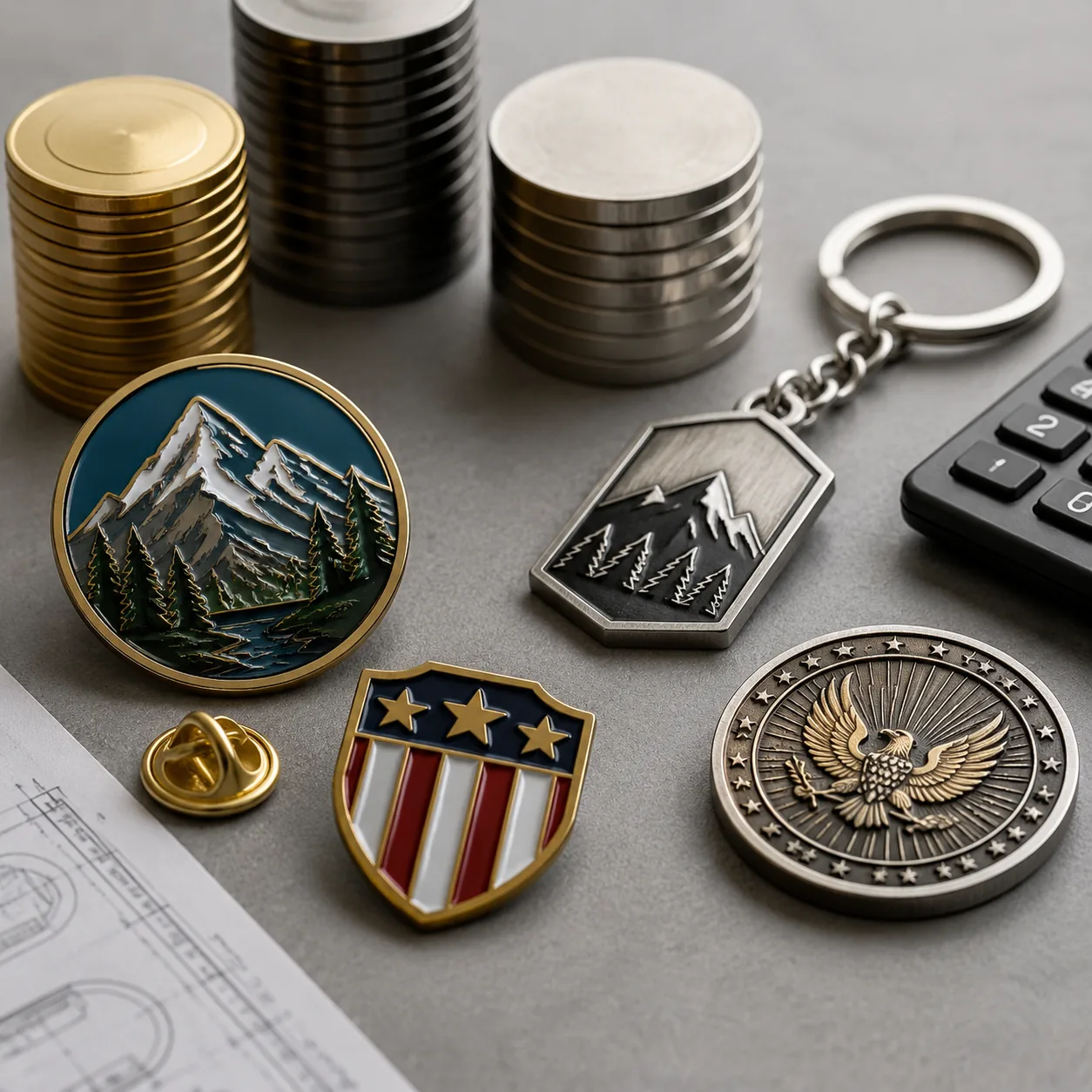
Choose the construction first, because process selection drives most cost variance
In 2026, the central sourcing decision is not whether custom enamel pins can still be made competitively in China; it is whether the selected process matches the artwork, use case, and packaging plan without creating avoidable labor, tooling, or quality cost. Most overruns start when the build changes after quote approval: switching a 32 mm stamped iron design to zinc alloy without needing extra depth, adding two-post placement for a lightweight shape, or introducing custom backing cards and barcode sorting on a 300-piece run.
That happens because pin economics are dominated by setup and handling as much as by metal content. On runs below about 1,000 pieces, die preparation, stamping or casting setup, enamel fill, baking, polishing, plating, inspection, and packing labor usually outweigh the raw-material delta between iron, brass, and zinc alloy. A buyer may negotiate USD 0.05 off unit price, then lose the saving by adding a second clutch, individual carding, polybag plus sleeve packing, split carton marks, and hand sorting by SKU after sample approval.
For most event, membership, nonprofit, school, and promotional programs, the best baseline remains a stamped iron soft enamel pin: 25 to 32 mm finished size, 1.2 to 1.5 mm thickness, 4 to 6 Pantone colors, bright nickel or black nickel plating, and one butterfly clutch. That construction gives the strongest cost-to-appearance ratio because tooling is straightforward, stamping speed is high, and reject risk is lower than on more complex jewelry-style builds. For simple 2D art, it is usually the lowest-risk commercial choice from both price and throughput standpoints.
Alternative processes make sense only when the design requires them. Imitation hard enamel is better for executive sets, resale pins, and collector programs because the color fields are polished flush and feel smoother in hand. Zinc alloy die-casting is justified when the artwork needs 2.0 to 3.0 mm body thickness, deep relief, irregular contour depth, cut-through windows, or 3D sculpting that stamping cannot reproduce cleanly. Printed epoxy is often the right answer for gradients, halftones, QR elements, and text with strokes below roughly 0.25 mm, but it looks flatter and scuffs faster unless each unit is individually protected.
2026 FOB benchmarks by process, size, and quantity
For a standard 32 mm stamped iron soft enamel pin at 1.2 mm thickness with 4 to 6 colors, one butterfly clutch, and standard polybag export packing, realistic FOB China pricing in 2026 is typically USD 0.60 to 0.95 at 300 pieces, USD 0.46 to 0.76 at 500 pieces, and USD 0.36 to 0.59 at 1,000 pieces. Tooling for a new die usually runs USD 70 to 140. Very narrow shapes, interior cutouts, or multiple open areas tend to push tooling to the high end because they slow die making and reduce stamping stability.
Imitation hard enamel generally adds USD 0.16 to 0.32 per piece over comparable soft enamel at 500 pieces, plus 2 to 4 working days. The added cost comes from extra fill control, curing, and polishing to achieve a flatter surface. If brass is specified to improve edge sharpness or detail retention, add another USD 0.06 to 0.14 per piece on many 32 mm builds.
Zinc alloy die-cast pins usually price USD 0.14 to 0.30 above stamped iron at 500 pieces, with many factories preferring a 200 to 500 piece MOQ to absorb mold and finishing setup. For flat 2D art under 32 mm, zinc often adds cost without adding function. It earns the premium when the pin needs heavier mass, relief above about 0.6 mm, open windows, or body thickness beyond the practical stamped range.
Printed epoxy on steel or aluminum base is often the cheapest path for graphic-heavy designs. A 32 mm printed epoxy pin commonly lands around USD 0.48 to 0.80 at 300 pieces and USD 0.30 to 0.52 at 1,000 pieces, with 10 to 16 working days normal production. It can save 10 to 20 percent versus filled enamel when the artwork would otherwise require many small color cells and labor-intensive fill work.
Plating is another lever that buyers routinely underestimate. Promotional pin plating is decorative, not heavy jewelry plating. A visible finish thickness of roughly 0.03 to 0.08 micron over nickel or copper underlayer is common for bright nickel, black nickel, gold-tone, antique brass, and antique copper. Dual plating, selective masking, glitter enamel, glow fill, or translucent colors over textured metal usually add 8 to 20 percent because they slow line speed and increase rework exposure.
| Build spec | Typical MOQ | FOB at 300 pcs | FOB at 1,000 pcs | Normal lead time |
|---|---|---|---|---|
| Stamped iron soft enamel, 32 mm, 1.2 mm, 5 colors, 1 butterfly clutch | 100 to 300 pcs | USD 0.60 to 0.95 | USD 0.36 to 0.59 | 12 to 18 working days |
| Stamped brass soft enamel, 32 mm, 1.2 mm, 5 colors, 1 butterfly clutch | 100 to 300 pcs | USD 0.74 to 1.10 | USD 0.48 to 0.72 | 14 to 20 working days |
| Imitation hard enamel, polished flush, 32 mm, 1.5 mm | 200 to 300 pcs | USD 0.88 to 1.28 | USD 0.56 to 0.84 | 16 to 22 working days |
| Zinc alloy die-cast with soft enamel, 32 mm, 2.0 mm | 200 to 500 pcs | USD 0.96 to 1.38 | USD 0.62 to 0.92 | 16 to 24 working days |
| Printed epoxy pin on steel base, 32 mm | 200 to 500 pcs | USD 0.48 to 0.80 | USD 0.30 to 0.52 | 10 to 16 working days |
MOQ tiers: where the real price breaks occur
MOQ is not just a factory minimum; it is the point where setup cost starts to dilute. Factories can often make 100 custom pins, but that tier is usually poor value unless the order is a proof-of-market batch, a board-approval sample lot, or a limited-edition release with intentionally high unit value. At 100 pieces, tooling may account for 20 to 45 percent of FOB and packaging labor can become disproportionately expensive.
The first commercially efficient tier is usually 300 pieces. That is where die cost amortization improves, plating lots run more cleanly, and QC labor per piece drops. Moving a standard 32 mm iron soft enamel build from 100 to 300 pieces often lowers unit FOB by 18 to 30 percent. The next useful break is 500 pieces, which commonly reduces another 8 to 15 percent while staying manageable for inventory.
At 1,000 pieces, savings continue but flatten. On many standard builds, moving from 500 to 1,000 pieces cuts only about USD 0.06 to 0.12 per piece. That is meaningful for large event distribution, but far less meaningful if branding, dates, or campaign art may still change. Excess pins have almost no recovery value once the message becomes obsolete.
The strongest buying habit is to request side-by-side pricing at 300, 500, and 1,000 pieces on the same specification sheet. That makes the cost curve visible before anyone debates plating upgrades or packaging extras. It also exposes when a supplier is using a low headline price at one tier to hide unusually high setup or tooling charges elsewhere.
- Use 100 to 200 pcs for pilot launches, executive gifts, board approvals, or preorder validation.
- Use 300 to 500 pcs for most first production runs with one SKU, one clutch type, and standard polybag packing.
- Use 1,000 pcs and above only when artwork, packaging, and demand forecast are already stable.
- Avoid mixing backing cards, barcode labels, or attachment types into low-volume runs; hand sorting can erase volume savings.
- Request quotes at 300, 500, and 1,000 pcs on the same RFQ so the marginal savings are visible before approval.
Lead-time math: schedule each production stage in days
A quote showing 15 to 20 days production is only a placeholder unless it is broken into stages. Buyers control schedule risk better when they separate artwork proofing, die or mold preparation, pre-production sample, mass production, final inspection, and export handoff. For a new custom pin order, artwork proofing is usually 1 to 2 working days, tooling 2 to 4 days, pre-production sample 3 to 5 days, mass production 7 to 12 days, final inspection 1 day, and packing plus export handoff 1 to 3 days. That yields a realistic factory timeline of 15 to 23 working days after artwork approval and deposit receipt.
Repeat orders can move faster if the die remains serviceable and no routing detail changes. A genuine repeat order often ships in 10 to 16 working days. But many buyers underestimate what counts as a spec change. Changing from one post to two, switching bright nickel to antique brass, revising card dimensions, or adding barcode labels all alter finishing, handling, or inspection checkpoints and can add 2 to 5 working days even when the artwork itself does not change.
Rush production can recover time, but usually by compressing the stages where defects are most likely to be caught. Skipping a physical pre-production sample, approving color and plating only from mobile photos, or authorizing overtime finishing may save 3 to 7 working days. The tradeoff is greater risk of color drift, underfilled enamel, plating specks, or pack-out errors. If the order depends on close Pantone matching, polished flush surfaces, or retailer-specific packing, rushing often costs more in rework and concessions than it saves in schedule.
| Stage | New order range | Repeat order range | Common delay trigger |
|---|---|---|---|
| Artwork proof | 1 to 2 days | 1 day | Missing Pantone references, unclear dimensions, or incomplete attachment notes |
| Tooling or mold prep | 2 to 4 days | 0 to 1 day | Outline changes after proof approval |
| Pre-production sample | 3 to 5 days | 2 to 4 days | Slow internal sign-off or couriered sample review |
| Mass production | 7 to 12 days | 6 to 10 days | Complex plating, multiple posts, or mixed SKU handling |
| Packing and export handoff | 1 to 3 days | 1 to 2 days | Custom carding, barcode sorting, or carton mark revisions |
Write measurable quality specs: tolerance, plating, color, and AQL
Many sourcing disputes are not caused by factory failure; they come from vague specifications. The RFQ, approved proof, purchase order, and inspection standard should all describe the same measurable targets. For most custom pins, a practical dimensional tolerance is plus or minus 0.2 mm on finished outline, plus or minus 0.10 to 0.15 mm on stamped thickness, and plus or minus 0.25 mm on thicker die-cast bodies. Post placement is commonly held within plus or minus 0.5 mm so presentation cards, boxes, and clutches fit consistently.
Surface expectations also need numbers. On soft enamel, the fill should sit below the raised metal line, typically by about 0.08 to 0.20 mm depending on line width and fill area. On imitation hard enamel, the surface should polish flat with no obvious low spots, sink marks, or edge collapse at a normal inspection distance of 30 to 50 cm under standard indoor lighting of roughly 500 to 1,000 lux. Decorative plating at 0.03 to 0.08 micron should be treated as appearance-grade, not abrasion-proof or jewelry wear-grade, unless a heavier specification is quoted and tested separately.
Color should be tied to Pantone references on the approved art proof. Enamel matching in this category is commercial-grade, so small lot-to-lot variation is normal, especially on red, orange, purple, and dark navy families. If one or two brand colors are critical, identify them as key approval points before sampling. For printed epoxy, specify whether fine text, QR readability, or gradient smoothness is more important, because resolution can be excellent while scratch resistance remains lower than on filled metal.
Inspection language should be named directly. A common standard for promotional metal accessories is AQL 2.5 for major defects and AQL 4.0 for minor defects, with zero tolerance for critical defects. Major defects typically include wrong artwork, wrong plating, missing clutch, sharp burrs, severe plating voids, pin posts detached from solder, or packaging errors that make product unsellable. Minor defects may include small enamel pits outside the main viewing field, tiny specks, or slight card misalignment. If attachment function matters, specify clutch retention force, anti-rotation requirement, and solder joint integrity before sampling rather than arguing over defects after the goods are packed.
Reduce landed cost under tariffs by simplifying labor first
When tariffs or duty exposure raise landed cost, the first response should usually be labor simplification, not an automatic supplier change. Tariffs do not eliminate the cost of custom carding, mixed pack counts, split labels, individual sleeves, or multiple attachment assemblies. Consolidating three backing card versions into one, removing individual barcode stickers from a giveaway order, or standardizing all units to one clutch type often saves more reliably than moving the work to a new factory with unknown process control.
The second lever is process simplification. For most promotional applications, stamped iron soft enamel still provides the strongest price-to-appearance ratio. If the art includes gradients, small type, or photo-style graphics, printed epoxy can reduce unit cost by roughly 10 to 20 percent and shorten production by 2 to 5 working days compared with filled enamel. The tradeoff is lower perceived value at close inspection and lower scratch resistance, which makes it a better fit for mass giveaways than for premium gifting or collector resale.
The third lever is shipment strategy. Splitting a 1,000-piece order into two exports may look safer, but it often duplicates documentation, export handling, receiving labor, and inspection cost. Unless the pins must meet separate event dates, a single consolidated lot is usually cheaper and easier to control. It also reduces visible lot-to-lot variation in plating tone, polish level, or color shade when pins are distributed side by side.
A practical example: a 500-piece, 32 mm soft enamel pin quoted at USD 0.64 FOB can move to an effective USD 0.80 to 0.84 once a second post, custom backing card, OPP sleeve, barcode label, and mixed inner-pack counts are added. In that scenario, removing the card-and-label assembly often saves more than changing the entire metal process.
Issue comparable RFQs and budget landed cost, not just FOB
A low FOB price only matters if the quoted specification is truly comparable. Every RFQ should normalize the key variables: size in millimeters, thickness, base metal, process, color count, plating finish, attachment count, packaging method, tooling charge, sample requirement, AQL standard, and lead time in working days. Without that discipline, one supplier may appear cheaper simply because it assumed 1.0 mm thickness instead of 1.5 mm, omitted the backing card, or excluded a pre-production sample.
A practical 2026 budgeting model has three layers. First, calculate FOB or ex-works against a locked specification. Second, add freight, duty, brokerage, and tariff assumptions based on the shipping route and importer-of-record structure. Third, reserve a contingency of 3 to 8 percent for late-stage changes such as proof edits, carding revisions, carton-mark corrections, or schedule compression. That reserve is more realistic than assuming a new SKU will move from art approval to vessel handoff with zero rework.
The most useful RFQ format is option-based comparison. Ask for Option A: stamped iron soft enamel, one butterfly clutch, individual polybag. Ask for Option B: imitation hard enamel, backing card, OPP sleeve. Ask for Option C: printed epoxy as the cost-down version. On a 500-piece order, the spread between those options usually reveals more than broad negotiation because it shows the exact premium attached to each design and packing choice.
For most buyers who need a dependable 2026 starting point, the safest benchmark remains a 300 to 500 piece stamped iron soft enamel pin, 25 to 32 mm size, 1.2 to 1.5 mm thickness, 4 to 6 colors, bright nickel or black nickel plating, one butterfly clutch, AQL 2.5/4.0 inspection, and simple polybag export packing. Upgrade only the features that materially improve the end use, not the features that merely look better on a concept sheet.
Have a project? Send your artwork and target quantity and we’ll reply with a detailed quotation within 12 working hours.
Ready to get this made?
Send your sketch, target quantity and ship-date. Detailed quotation in 12 hours.



