2026 Sustainable Material Swaps: QC Failures Buyers Miss
Treat any “eco material” change as an engineering change, not a colorway update
Most buyers do not get into trouble for requesting recycled zinc alloy, recycled acrylic, RPET webbing, FSC-certified card, or lower-plastic packing. The trouble starts when the PO says only: “same as approved sample, but eco material.” That assumes the sustainable version is a like-for-like substitution. In production, it rarely is.
A material swap changes process behavior: melt flow, stamping response, porosity, polishing time, plating adhesion, print anchorage, odor, sheet clarity, seam stability, coefficient of friction in packing, and transit scuff resistance. If QC still compares bulk goods to a virgin-material golden sample, the factory and buyer end up arguing after production instead of aligning before it.
The fix is to issue a controlled engineering change order and rebuild the approval pack. Update the drawing, material note, finish stack, inspection criteria, and packaging specification. Approve a new golden sample made in final material, final finish, and final pack-out—not a hand-retouched prototype or an unpacked desk sample. For 2026 programs, that discipline matters more than the sustainability claim itself, because most failures are not about recycled content in theory; they come from approving one process and mass-producing another.
1) Recycled metal: fine geometry, porosity and plating are the first points of failure
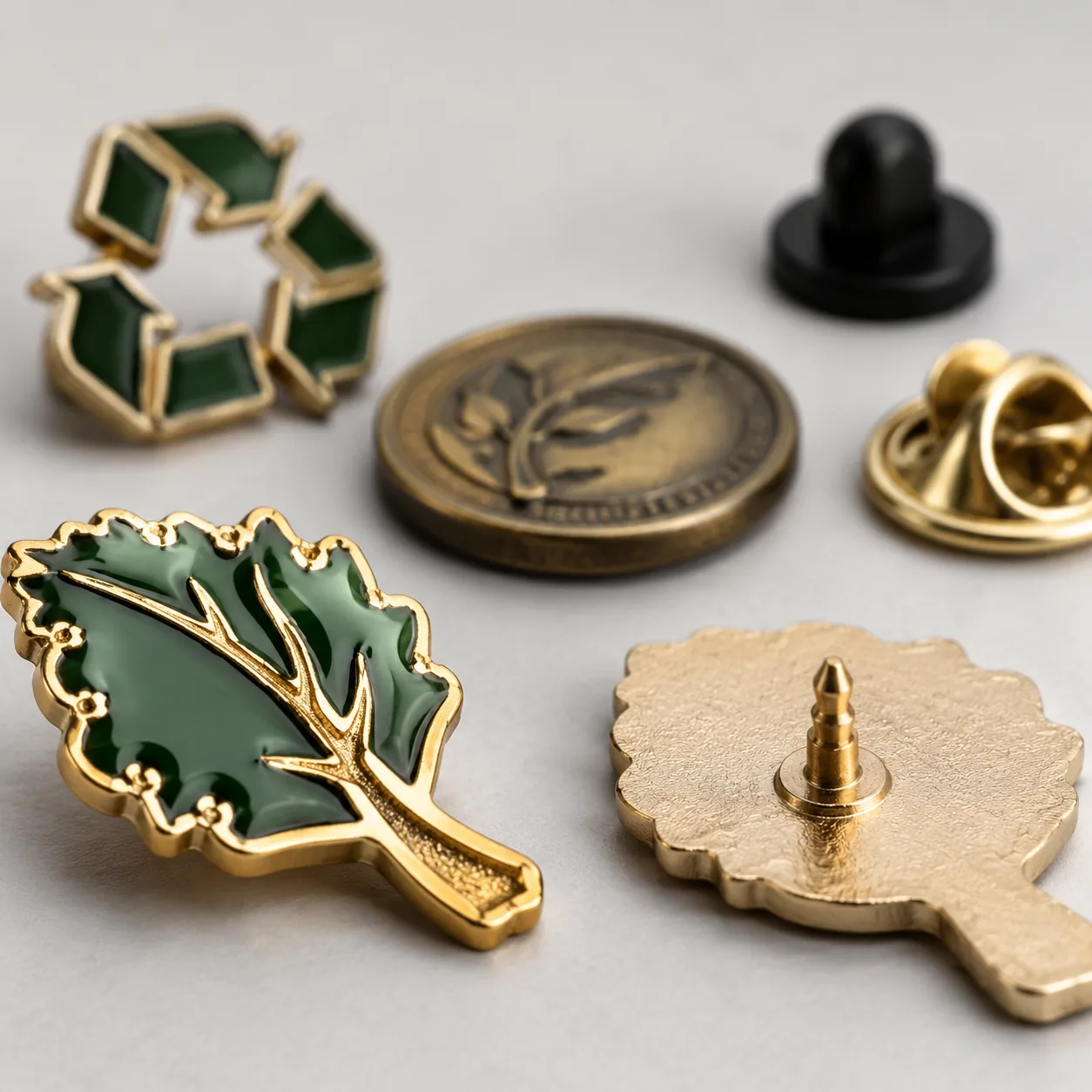
Stamped pins, badges, coins, and die-cast keychains can be made successfully with recycled-content brass, iron, or zinc. The risk is that narrower process windows punish weak artwork. Variation in alloy chemistry, oxide content, and gas porosity tends to show up first in die lines, openwork, polishing yield, and electroplating appearance.
On stamped brass or iron soft-enamel items, do not reuse pre-swap geometry blindly. A safer commercial baseline is: minimum raised metal line width 0.25 mm, minimum recessed enamel opening 0.35 mm, minimum unsupported bridge 0.50 mm, and internal corner radius 0.30 mm minimum where appearance matters. For small text on a 30 mm pin, recessed strokes should stay above 0.20 mm, which typically means about 5 pt equivalent minimum after plating and fill.
For die-cast zinc keychains or 3D ornaments, recycled-content lots are less forgiving on knife edges and deep undercuts. Keep cosmetic borders at 0.40 mm minimum, unsupported projections at 0.80 mm minimum, and redesign undercuts that force heavy hand grinding. On mirror-plated faces, write measurable cosmetic and shape criteria: maximum bow 0.50 mm over 50 mm length; no front-face pit over 0.15 mm in the primary display zone; no more than 2 pits from 0.10-0.15 mm in secondary zones.
Thickness is often the cheapest correction. A 1.2 mm stamped pin that ran in standard brass may distort during polishing or enamel bake when a recycled-content batch runs softer. For 25-35 mm pins, 1.5 mm thickness is the safer default. For 45-60 mm badges or ornaments, 1.8-2.0 mm reduces warp, edge roll, and post-straightening labor. On small runs of 100-300 pcs, the added metal cost is usually lower than sorting or remaking premium-cosmetic parts.
| Material swap | Typical failure | Safer spec revision | Typical MOQ | Lead-time impact | Typical FOB delta |
|---|---|---|---|---|---|
| Standard zinc alloy to recycled-content zinc alloy | Micro-pits after polishing/plating; softened micro-detail | Min raised border 0.40 mm; unsupported projection 0.80 mm; front-face pits >0.15 mm not allowed | 100 pcs | +2 to 4 days | +$0.03 to $0.12/pc |
| Standard brass to recycled-content brass | Reduced edge sharpness on fine die lines; higher warp risk | Min line 0.25 mm; min bridge 0.50 mm; 1.5 mm thickness for 25-35 mm pins | 100 pcs | +1 to 3 days | +$0.02 to $0.08/pc |
| Virgin clear acrylic to recycled acrylic | Specks, edge haze, slight gray/green cast | Define speck limits under D65; specify edge finish; avoid large unprinted windows | 100 pcs | +2 to 5 days | +$0.01 to $0.15/pc |
| Polyester lanyard to RPET | Color flattening, width drift, seam distortion | Width tolerance ±0.5 mm at 15-20 mm; print repeat ±1.5 mm; seam pull-test required | 500 pcs | +1 to 2 days | Neutral to +$0.03/pc at 1,000 pcs |
| Virgin OPP bag to recycled/compostable bag | Higher friction, haze, scuff transfer | Add glassine/tissue barrier; run packed drop test with final bag | 1,000 pcs | +1 to 3 days | +$0.01 to $0.04/pc |
2) Plating specs fail when buyers keep decorative notes vague
A material swap is where vague plating language becomes expensive. “Nickel + gold plating” is not a usable QC standard, especially when the base metal has changed. On recycled-content zinc in particular, parts can pass visual review and still develop edge discoloration, blistering at loops, or plating peel around split-ring holes after handling.
Write plating as a measurable stack. For decorative pins and keychains, a workable commercial spec is nickel undercoat 3-5 microns with a decorative top finish of 0.03-0.10 microns depending on finish type. Bright nickel, shiny imitation gold, and silver-tone finishes are usually more reorder-stable than matte black nickel, antique copper, or antique brass on mixed-content substrates. If the look allows it, a satin or brushed effect often hides micro-porosity better than mirror polish.
Then define the test method. For frequently handled items such as keychains, zipper pulls, and bottle openers, require a cross-hatch plus tape adhesion test on approved pre-production samples after full cure and final polishing. A common internal standard is ISO-style cross-hatch on a non-logo area followed by 3M 600 or equivalent tape: no peel, blister, or base-metal exposure allowed. If wear matters, add a dry rub test, for example 50 cycles with no obvious top-finish loss in the display zone.
Do not overspecify the wrong corrosion target. Decorative promo plating is not hardware-grade corrosion protection. For bright decorative finishes, 24 hours neutral salt spray is a reasonable screening check; 48 hours may be achievable on some nickel/chrome-like systems if substrate quality and polishing are controlled. Antique finishes should be judged first on appearance consistency, adhesion, and rub-off resistance, because aggressive NSS targets often reject finishes that were never designed for that use.
Separate cosmetic and non-cosmetic zones so inspection stays objective. Example: no blister, peel, bare metal exposure, or pits over 0.15 mm on the front display face at 30 cm viewing distance under D65 light; backside micro-pits under 0.20 mm may be accepted only if shown on the approved limit sample. That wording prevents the supplier from hiding visible front-face defects behind the generic claim that “electroplating variation is normal.”
3) Recycled acrylic and bio-based plastics: clarity, specks and print adhesion matter more than dimensions
Recycled acrylic keychains, tags, magnets, and desk signs are attractive because MOQ can stay low and the sustainability story is easy to explain. The QC issue is usually not size. It is appearance. Clear recycled sheet often carries more visual noise than premium virgin cast acrylic: faint inclusions, black specks, slight gray or green cast, and edge haze after laser cutting.
If the design includes large transparent windows, skin tones, or heavy black graphics, these defects become highly visible. Write a substrate-specific cosmetic standard. For a 50 x 50 mm clear keychain viewed at 30 cm under D65 light, for example: no black speck larger than 0.30 mm on the front face and no more than 3 specks from 0.10-0.30 mm total; no scratch over 3.0 mm length or 0.05 mm width in the viewing area; backside minor specks allowed only if fully covered by print.
Edge finish must be called out explicitly. Standard laser-cut edge, laser-polished edge, and flame-polished edge are not interchangeable in cost, clarity, or yield. On recycled sheet, demanding flame-polished optics on a low-cost order often creates sorting loss that wipes out any material saving. If the build is opaque or back-printed, accept a standard laser edge where possible and put the budget into print quality instead.
Print adhesion is another common miss. UV print that holds on virgin sheet may chip on a lower-energy recycled surface if primer, corona treatment, or cure settings are unchanged. Require cross-hatch or tape adhesion testing after 24 hours cure, with no flaking outside the cut grid. If white backing is used, state opacity too: for example, white underprint coverage to achieve less than 15% show-through over black text. On double-layer printed acrylic, registration tolerance of ±0.20 mm is practical for small icons and ±0.30 mm for larger filled graphics.
If optical clarity is truly the selling point, recycled clear acrylic may simply be the wrong swap. In many cases, reducing thickness from 4.0 mm to 3.0 mm, removing the individual polybag, or shifting to FSC card packaging delivers a cleaner sustainability gain with less QC risk and no need for extreme visual sorting.
4) RPET lanyards: the claim passes, but color, width and seams miss spec
RPET lanyards are now standard for events, schools, NGOs, and corporate programs, but they do not print exactly like conventional polyester. The yarn can take sublimation differently, so navy, red, and fluorescent-adjacent colors often look flatter or less saturated. Heat setting can also shift finished width, which matters if logos must align at the buckle, breakaway, or trigger-clip fold.
Use textile tolerances that match the product. Finished width tolerance should be ±0.5 mm for 15 mm and 20 mm lanyards, and ±0.7 mm for 25 mm width. Finished lay-flat length tolerance can be ±10 mm on a 900 mm lanyard. For double-sided print, set repeat registration at ±1.5 mm and state clearly whether mismatch at the fold line is acceptable. If Pantone matching is critical, approve a physical strike-off, not a digital proof, and expect a wider tolerance than on smooth virgin polyester—typically within one visual shade step rather than an exact coated-book match.
Do not stop at print approval. Recycled webbing can behave differently under stitch tension, so seam construction needs its own requirement. For standard event lanyards carrying only a PVC or paper badge holder, a workable standard is no seam opening, no stitch break, and no hardware detachment after a 7 kg static pull held for 10 seconds. For badge reels, metal accessories, or bundled attachments, 10 kg is safer. If a breakaway buckle is used, specify whether the pull test applies to the stitched joint only, the buckle closed assembly, or both.
Pricing should also be set realistically. A 20 mm x 900 mm RPET sublimation lanyard typically runs USD 0.45-0.90 FOB at 1,000 pcs depending on hardware, print sides, and unit packing. MOQ is usually 500 pcs per design on stock white sublimation webbing, with lead time around 10-15 days after sample approval. If the buyer wants custom-dyed RPET webbing rather than printed stock white, MOQ often rises to 1,000-3,000 pcs and lead time typically adds 5-10 days.
5) Sustainable packaging often causes the damage buyers blame on production
Material-swap programs often focus on the product and ignore the package. That is a mistake. Uncoated recycled backing cards can shed fibers onto polished metal. Compostable or recycled-film bags can have higher friction and more haze than OPP, making mirror plating look dull before the customer opens the pack. Lower-burst mailers and thin cartons can deform acrylic, PVC, or soft-packed paper sets in transit.
Package the item as a system. If using recycled paper backing cards, specify 350-400 gsm board, moisture target if relevant, grain direction if curl has been a problem, and whether front-side anti-scuff aqueous coating is required. For polished or plated metal, require a low-abrasion barrier such as 17-22 gsm tissue, glassine, or a soft pouch before the outer sleeve or bag. For hanging cards, set hole location tolerance at ±1.0 mm so the item hangs straight and does not torque the pin post or keychain loop.
Transit specs should remain numeric. A common export standard for small promo goods is 5-ply corrugate outer cartons, burst strength suitable for the route, gross weight under 15 kg, and no free movement inside the shipper. For sea freight, run a pack trial using at least 20 fully packed units with final card, final bag, and final carton. A basic sequence of corner/edge/face drops from 76 cm for small cartons, plus short vibration simulation, often catches corner rub, chain dents, card bending, and haze transfer before 5,000 units are already on the water.
For cards and sleeves, flatness should also be measurable. A practical criterion is no visible curl greater than 5 mm lift at any corner after 24 hours in packed condition at normal room humidity. That is far more actionable than a note saying only “card should be flat.”
6) Keep AQL, but rewrite defect definitions for the new material
AQL alone does not protect a sustainable conversion. Buyers often keep the same AQL numbers but forget to rewrite what counts as a defect. Inspectors cannot fairly apply a virgin-material cosmetic standard to a recycled substrate if slight fiber visibility, tonal variation, or tiny backside flecking is inherent to the approved build. At the same time, the factory cannot use “eco material” to excuse burrs, unreadable print, loose hardware, or poor assembly.
For most custom promo products, AQL 2.5 for major defects and 4.0 for minor defects remains commercially workable. What changes is the defect list. Major defects should still include wrong size beyond tolerance, unsafe sharp edges, wrong branding, detached hardware, plating peel, print chipping, incorrect color family, offensive odor beyond approved retain sample, magnet failure, or visible front-face staining. Minor defects may include limited recycled-fiber visibility on a backing card, slight edge haze on acrylic within approved limits, or backside micro-pits on die-cast zinc not visible in normal use.
- Revise the drawing whenever material, hardware, plating, print method, or package changes from the previous order.
- Set dimensional tolerance on metal parts at ±0.15 mm for features under 20 mm and ±0.20 mm above 20 mm unless geometry is irregular.
- Define cosmetic inspection conditions: 30 cm viewing distance, D65 or neutral 5000-6500K light, front face first, 3-5 seconds per side.
- Write plating adhesion and print adhesion as pass/fail by test method, not vague wording like “good quality.”
- Approve a physical strike-off, seam sample, and hardware sample for RPET lanyards before bulk cutting or sewing.
- Specify paper card gsm, coating, hole tolerance, and acceptable flatness after packing.
- Use a defect photo sheet and limit sample so inspectors are judging approved variation, not memory.
A robust approval pack should include the revised artwork, dimensioned drawing, material note, finish stack, packaging spec, test method list, approved pre-production sample, and a one-page defect photo sheet. That is what allows QC to release or reject goods objectively instead of debating whether the new sustainable version is merely “close enough.”
7) Price, lead time and the pre-PO brief that prevents expensive surprises
Lower-impact materials are not automatically cheaper and not automatically more expensive. The cost shift usually comes from yield loss, cosmetic sorting, extra process control, and slower packing rather than from the recycled content itself. Recycled zinc may add almost nothing on a simple cast shape but raise scrap sharply on a dense 3D keychain with mirror plating. RPET lanyards are often near price parity with standard polyester at 1,000 pcs, but custom-dyed recycled webbing at low MOQ typically costs more than stock white sublimation base. Recycled acrylic can be cost-neutral on opaque builds, then become more expensive if the buyer also demands premium optical clarity and 100% visual sorting.
Ask suppliers to break quotes into three lines: material premium, process premium, and yield-risk premium. That format shows whether cost sits in alloy or resin content, in extra polishing or sorting, or simply in the supplier carrying more scrap risk. On many 100-500 piece metal orders, the dominant driver is still handwork, not the recycled material itself.
As a reference point, a 30 mm stamped soft-enamel pin in a standard finish may run about USD 0.55-1.10 FOB at 500 pcs, with 12-18 days production after sample approval. A recycled-content version may add only USD 0.03-0.10 if the design is simple and line widths are healthy. If the artwork has fragile openwork, mirror plating, or tight front-face cosmetic limits, the effective increase can be much higher because of lower yield and heavier sorting. A 50 mm recycled acrylic keychain may land around USD 0.35-0.85 FOB at 300 pcs depending on print sides and edge finish. The best savings usually come from simplifying the specification: thicker lines, fewer cutouts, matte instead of mirror finish, opaque instead of clear acrylic, one standard hook across multiple SKUs, or fewer individual bags.
Before the next PO, issue a material-swap brief with the RFQ. List the current construction, proposed substitution, non-negotiable brand features, acceptable visual changes, dimensional tolerances, test methods, packaging changes, and the revised defect list. For a first run, keep the pilot large enough to expose variation but small enough to learn cheaply: 100-300 pcs for metal items and 500 pcs for lanyards is usually sufficient. Request one pre-production sample, one packed transit sample, and one retain sample stored as the new golden standard. The buyers who succeed with sustainable conversions are usually not the ones asking for the most claims; they are the ones writing the clearest specs before bulk starts.
Have a project? Send your artwork and target quantity and we’ll reply with a detailed quotation within 12 working hours.
Ready to get this made?
Send your sketch, target quantity and ship-date. Detailed quotation in 12 hours.



