2026 Supplier Handover Plan for Custom Metal Promo Orders
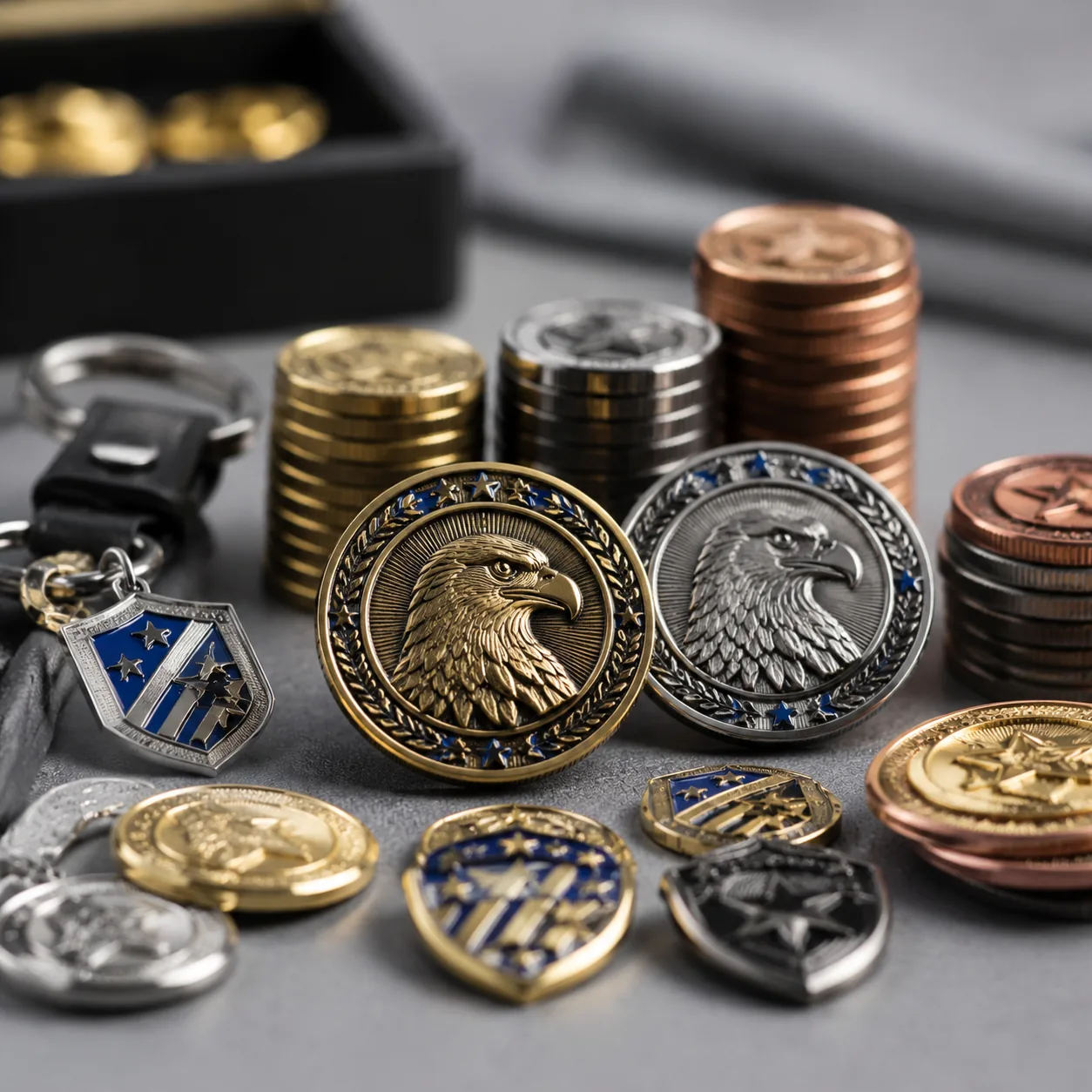
When reorders fail because the factory held the real specification
Most failed supplier transfers in custom metal are not sourcing failures. They are specification failures. A buyer can usually find another factory that makes lapel pins, challenge coins, badges, magnets or zinc alloy keychains. The difficulty is getting the new source to reproduce the approved item closely enough that old and new stock can ship under the same SKU without a visible mismatch in size, relief height, plating tone, attachment position, retail pack-out or unit weight.
The risk is highest when the inherited file set is thin: one JPG proof, one invoice, one production sample and no controlled drawing. A visual mockup does not define recessed depth, sidewall angle, polish grade, butterfly clutch position, jump-ring wire diameter, magnet grade, card orientation or carton pack count. When those details are left to factory interpretation, the supplier may deliver a product that looks acceptable on its own but fails in side-by-side comparison, on a retail peg, or in final assembly.
Treat the next PO as a handover project, not a routine reorder. The objective is to rebuild the technical file from the finished item, lock measurable requirements before quotation, and make the new supplier prove equivalence through samples and a pilot run. On products with antique plating, spinner parts, epoxy domes, offset posts, fine text, retail carding or mixed assemblies, that discipline is what prevents a 5,000-piece reorder from becoming two visibly different products under one program.
1. Rebuild a measurable spec pack before you request quotes
Start from finished goods, not from artwork alone. Measure at least 3 approved retained pieces with digital calipers readable to 0.01 mm, and record nominal values plus tolerances. For a standard pin or badge, capture overall length and width in mm, metal thickness, recessed depth, sidewall width, attachment count and coordinates, backside logo orientation, unit weight in grams, plating appearance, enamel type, and packaging configuration. For stamped items, commercial tolerance targets are commonly plus or minus 0.15 mm on overall size, plus or minus 0.10 mm on thickness, and plus or minus 0.30 to 0.50 mm on post position. For die-cast zinc alloy keychains and thicker coins, plus or minus 0.20 to 0.30 mm on size and plus or minus 0.15 mm on thickness is more realistic because of shrinkage, polishing loss and heavier edge finishing.
Process details need to be explicit because they drive both cost and visual match. Stamped iron or brass usually holds finer outlines and cleaner small text than die-cast zinc alloy. Zinc alloy handles thicker sections, deep relief, open cutouts and complex silhouettes better. As working ranges, soft enamel stamped pins are typically 1.2 to 1.5 mm thick, imitation hard enamel pins 1.5 to 2.0 mm after final polish, die-cast zinc alloy keychains 2.0 to 4.0 mm, and challenge coins 2.0 to 3.5 mm depending on relief depth and edge treatment. Text below 0.20 mm line width, recessed channels below 0.25 mm, or unsupported bridges narrower than about 0.80 mm often degrade if the process route changes without redesign.
Plating should be specified as a stack and an appearance target, not only by finish name. Decorative gold-tone topcoats on promo metal goods are often around 0.03 to 0.08 microns over a nickel undercoat of roughly 0.5 to 1.0 microns. Bright nickel, black nickel, matte gold, antique copper and dyed black do not wear the same way. If the current item shows finger-marking, tarnish, cold-tone black nickel, or uneven antique pooling, write that into the handover sheet. Where durability matters, specify a neutral salt spray expectation such as 24 hours minimum for standard promo use or 48 hours with a clear lacquer for better corrosion resistance, with the caveat that antique and dyed finishes usually need topcoat protection to perform consistently.
Packaging belongs in the same spec pack because it changes labor content, defect rates and carton density. Record backing card size, board weight, finish, hang-hole style, barcode location, OPP bag thickness, insert orientation, inner-pack quantity and maximum master-carton weight. A 30 mm pin bulk packed 100 pieces per polybag is a very different job from the same pin mounted on a 90 x 55 mm, 350 gsm C1S card, inserted upright, individually bagged in a 40 to 50 micron OPP sleeve and packed to a 10 kg gross carton limit.
- Measure finished goods, not just art: overall size, thickness, recessed depth, sidewall width, post spacing, chain length, ring wire diameter, magnet size and net weight.
- Photograph front, back and side profile under neutral light, including any defects on old stock such as plating discoloration, overfill, burrs or card misalignment.
- List every hardware component and material: butterfly clutch, rubber clutch, split ring, jump ring, chain, swivel, magnet type, adhesive pad and backing card.
- State the inspection baseline in the RFQ, such as AQL 2.5 major / 4.0 minor, so all suppliers quote on the same quality basis.
2. Normalize RFQs so price gaps reflect real differences
Large quote gaps in custom metal sourcing usually come from mismatched assumptions. One supplier prices a 1.2 mm stamped iron soft enamel pin, another prices a 1.8 mm brass imitation hard enamel pin, and a third excludes carding, individual bagging or color sorting. The cheapest quote often represents a different product, not a more efficient factory.
Use one RFQ matrix and require every supplier to fill the same fields: process, base material, nominal thickness, plating type, enamel type, hardware specification, packaging basis, inspection standard, MOQ, tooling charge, sample cost, sample lead time, bulk lead time and FOB price by quantity tier. For most promotional metal products, AQL 2.5 for major defects and 4.0 for minor defects is a practical commercial baseline. For retail, collector or tightly matched launch items, AQL 1.5 major and 2.5 minor is more appropriate, but buyers should expect more sorting cost, longer inspection time and lower usable yield.
| Spec Point | Typical Option A | Typical Option B | Buyer Impact |
|---|---|---|---|
| Base process | Stamped iron or brass, 1.2-2.0 mm | Die-cast zinc alloy, 2.0-4.0 mm | Stamped parts hold finer lines and crisper edges; die-cast supports thicker relief, more complex outlines and larger cutouts. |
| Color finish | Soft enamel | Imitation hard enamel | Soft enamel is lower cost and shows metal lines clearly; imitation hard enamel gives a flatter polished face with better abrasion resistance. |
| Plating stack | Nickel undercoat plus bright or matte topcoat | Antique or dyed finish with clear lacquer | Finish choice changes wear, tarnish risk, antique pooling, sidewall appearance and sample-to-sample consistency. |
| Packaging basis | Bulk pack 50 or 100 pcs per bag | Carded and individually bagged | Pack-out can add roughly USD 0.08-0.35 per unit depending on board grade, labels, insertion labor and barcode handling. |
| Inspection level | AQL 2.5 / 4.0 | AQL 1.5 / 2.5 | Tighter AQL reduces field defects but adds inspection time, more sorting and higher rejection risk at sample stage. |
As a 2026 China FOB reasonableness check, a 30 mm stamped soft enamel pin with one post and butterfly clutch typically lands around USD 0.55 to 1.00 each at 100 pieces, USD 0.32 to 0.62 at 500 pieces, and USD 0.24 to 0.45 at 1,000 pieces, excluding tooling. A 45 mm challenge coin at 300 pieces commonly runs USD 1.30 to 2.60, falling to about USD 0.95 to 1.75 at 1,000 pieces depending on relief, edge treatment and packaging. A 50 mm zinc alloy keychain with chain and split ring at 300 pieces often falls between USD 0.95 and 1.80 FOB, and around USD 0.72 to 1.35 at 1,000 pieces. Quotes materially below these ranges often omit packaging, assume lighter thickness, lower plating quality, or switch to a cheaper process route.
Check MOQ by process as well as by price. Simple stamped pins may start at 50 to 100 pieces. Challenge coins are commonly 100 to 300 pieces. Die-cast keychains, spinner assemblies, epoxy domes, retail window boxes and mixed finish assemblies usually make economic sense at 200 to 300 pieces minimum because setup, polishing, assembly and packing labor dominate at low volumes.
3. Verify that the supplier can engineer the item, not just redraw it
A capable handover supplier asks technical questions before releasing artwork. They should want to confirm Pantone references, minimum line width, recessed depth, relief levels, post offsets, backside texture, plating target, edge finish, assembly method and package orientation. If a supplier asks almost nothing and sends back only a polished render, they are usually reproducing the visual, not the manufacturing intent.
Request a manufacturing proof rather than a sales mockup. The proof should show overall dimensions, nominal thickness, attachment coordinates from datum points, material callouts, plating and color notes, open-area dimensions, packaging details and warnings about thin bridges, deep recesses, narrow text or moving joints. For example, a competent supplier should flag text below 0.20 to 0.25 mm line width on zinc alloy, bridges narrower than about 0.80 mm around cutouts, or offset posts that may twist during soldering.
Assume new tooling is required unless the original die can be physically transferred. Typical tooling charges remain modest relative to bulk risk: about USD 40 to 120 for simple pins and badges, USD 80 to 180 for keychains, and USD 120 to 250 or more for larger coins, spinners or multi-part assemblies. The larger cost is not the die charge itself. The larger cost is cutting new tooling from incomplete information and then discovering after sample approval that the relief is shallower, the edge radius is softer, or the backing-card holes no longer match the post spacing.
Before sampling, ask the supplier to list likely mismatch points against the control sample. Common ones include antique finish reading too dark, black nickel looking colder than prior stock, imitation hard enamel building a heavier edge after polish, or keychain lettering losing sharpness after aggressive barrel polishing. A supplier that can name these risks usually understands transfer failure modes.
4. Sample for equivalence with pass-fail limits
Sample approval in a supplier handover should answer one question: is the new source equivalent enough to approved stock for repeat production? Visual approval alone is too loose. Compare new samples side by side with the best retained control sample and record actual values.
Check dimensions, thickness, weight, plating tone, enamel fill level, polish quality, burrs, backside marks, hardware location and package assembly. For pins and badges, post positions usually need to stay within plus or minus 0.50 mm to avoid tilt on garments or on retail cards. For challenge coins, verify diameter, thickness, relief depth, edge continuity and evenness of antique settling in recessed areas. For keychains, inspect jump-ring closure, split-ring temper, chain-link gauge and swivel rotation if fitted. If the part includes an epoxy dome, confirm dome coverage, edge meniscus, cure clarity and bubble count, because yellowing, fisheyes and uneven flow are common handover problems.
Do not approve from one piece on higher-risk items. Request 3 to 5 pre-production samples from the same build lot so you can see normal variation in plating tone, enamel fill, polish level and pack-out. Ask the supplier to include a sample report listing measured dimensions, weight and any deviations from target. That report then becomes the control reference for bulk production and for any future second-source qualification.
- Approve against a physical control sample whenever possible, not only a photo or PDF proof.
- Use measured limits such as 30.00 plus or minus 0.15 mm overall size, 1.50 plus or minus 0.10 mm thickness and post offset within 0.50 mm.
- For magnets, specify magnet type and use-case performance, for example ferrite or N35 neodymium, holding two A4 sheets on a powder-coated steel cabinet.
- For keychains, hand-pull ring and chain joints and confirm jump-ring gaps are fully closed after plating and assembly.
- For carded items, verify insertion direction, barcode position, hang-hole alignment and final bag orientation before authorizing bulk packing.
5. Control production at process checkpoints, not only at final inspection
Final random inspection is necessary, but on a handover order it is too late to be the first meaningful control point. Build checkpoints into the production plan and require dated confirmation after tooling completion, first struck or cast parts, first polished parts, first plated parts, first color-filled parts and first packing setup. That is when drift can still be corrected without scrapping finished stock.
Typical 2026 lead times remain fairly stable for standard work. Artwork cleanup and engineering proof usually take 1 to 3 calendar days. Pre-production samples are commonly 5 to 7 days for standard stamped pins, 7 to 10 days for coins and die-cast zinc alloy keychains, and 8 to 12 days for items with custom cards, boxes or epoxy domes. After approval, bulk production is often 7 to 12 days for straightforward stamped pins and badges, 10 to 18 days for coins or multi-process keychains, and 12 to 20 days for mixed sets with retail packaging. Add 2 to 5 days for special plating, laser numbering, third-party inspection scheduling, carton relabeling or export document corrections.
Ask the factory what it inspects in-house and when. A credible supplier should describe checks for die accuracy, polishing completeness, plating appearance, enamel contamination, solder strength, hardware assembly, count accuracy and shipping marks. For handover orders above about 3,000 pieces, or above roughly USD 5,000 FOB, a pre-shipment inspection by your own team or a third party is usually justified even when the factory has internal QC. Use the approved control sample at both production and packing stations; verbal memory drifts quickly between shifts, especially on antique finishes and mixed hardware.
6. Qualify packaging and carton controls as part of the transfer
Packaging is often where a technically acceptable metal part still fails the handover. A pin that matches the prior production may still arrive with a lighter card stock, a rotated barcode, a different hang-hole location, a looser OPP bag or an overpacked master carton. Those changes affect retail presentation, scan reliability, transit damage and warehouse handling.
For carded products, specify card dimensions, board grade, lamination or varnish, print side, barcode size and exact position, insertion orientation, bag thickness and any label requirements. For example, a retail pin program may require a 90 x 55 mm, 350 gsm coated card, Euro slot centered within plus or minus 1.0 mm, EAN barcode 80% magnification placed 8 mm from the bottom edge, and a 45 micron self-seal OPP bag with the flap on the rear. If the item is packed in a gift box, specify EVA or sponge insert density, logo print method, box board thickness and acceptable corner crush limit.
Carton controls also need to be fixed early. State unit count per inner, inners per master, carton dimensions, gross weight limit and shipping marks. In practice, many buyers cap master cartons at 8 to 10 kg gross for small metal promo items to reduce split cartons and crushed retail cards. If assortments or color mixes are involved, define the exact pack ratio and whether overage is allowed per colorway. These are small details until a warehouse receives 20 cartons packed to a ratio that cannot be allocated cleanly.
7. Decide after first bulk whether to dual-source or consolidate
After the first successful transfer shipment, many buyers consolidate immediately. That reduces administration, but it is not always the best sourcing decision. If the item is seasonal, tied to event deadlines, sold across multiple regions, or exposed to plating-capacity constraints, a validated backup source may be worth keeping active.
Dual-sourcing works only if the technical package is tight enough to make stock interchangeable. That means the same process route, nominal dimensions, plating target, hardware specification, packaging construction, carton marks and inspection language. Without that discipline, dual-sourcing simply creates two similar items that cannot be mixed under one SKU without complaints from retail teams, distributors or end customers.
A practical model is one primary supplier for bulk and one backup validated through samples or a 100 to 300 piece pilot run. Compare total landed cost, not only FOB price. A supplier that is USD 0.05 to 0.08 cheaper per piece but causes one event delay, one repack job or one customer complaint is not the lower-cost source in procurement terms.
What to do on the next transfer order
Before negotiating final price on the next pin, coin, keychain, magnet or badge handover, do three things in order: build a one-page measurable spec sheet from the current item, issue an RFQ matrix that forces like-for-like quotes, and require a side-by-side sample report with actual dimensions, weights and packaging checks before bulk approval. Those three steps remove most of the ambiguity that causes transfer failures.
If the program covers multiple SKUs, transfer the highest-risk item first. In practice, that is usually the piece with the finest text, the tightest color match, the most complex hardware, or the strictest retail packaging. Once that SKU is controlled, the same inspection language, plating expectations and pack-out logic can usually be applied across the rest of the range. Where documentation is weak, send the physical control sample early and ask the supplier to convert it into a manufacturing spec pack before final quotation. That small upfront effort is far cheaper than discovering after 5,000 units are plated and packed that the new source matched the picture but not the product.
Have a project? Send your artwork and target quantity and we’ll reply with a detailed quotation within 12 working hours.
Ready to get this made?
Send your sketch, target quantity and ship-date. Detailed quotation in 12 hours.



