2026 Spec Sheet for Tariff-Resilient Custom Pin Orders
1. Build the RFQ around landed cost, not the lowest FOB line
Most pin overruns are created at quote stage, not during production. A supplier that is USD 0.05 cheaper on the FOB unit price can become the highest-cost option after duty, brokerage, carton inefficiency, relabeling, and expedited freight are added. For 2026 buying, every RFQ should force suppliers to quote the same commercial inputs on the same MOQ ladder: FOB unit price, tooling, packaging adders, master-carton dimensions, gross weight, net weight, units per carton, and total CBM by order tier. If carton data is missing, landed-cost modeling is too loose to compare suppliers with confidence.
For a standard 30 mm die-struck soft enamel pin with 4 spot colors, 1 post, butterfly clutch, and individual OPP bag, realistic 2026 FOB ranges are typically USD 0.60-0.95 at 300 pcs, USD 0.46-0.78 at 500 pcs, USD 0.33-0.56 at 1,000 pcs, and USD 0.24-0.42 at 3,000 pcs, excluding tooling. Stamped-iron die charges usually land at USD 60-110. Zinc-alloy die-cast tooling is more often USD 95-180, and can reach USD 220+ when the design includes interior cutouts, stepped relief, or complex silhouettes that require more polishing and mold work.
Ask suppliers to quote the same art at 25 mm, 28 mm, and 30 mm. A 2-5 mm reduction often saves more than another negotiation round because it cuts metal usage, plating area, weight, and freight simultaneously. On many 500-piece programs, dropping from 30 mm to 28 mm trims FOB by roughly USD 0.03-0.08 per unit and can improve carton density by 8-15%, which matters when duty and freight are applied on top of product value.
- Require `FOB`, optional `DDP`, tooling, packaging cost, carton size, gross weight, net weight, units per carton, and CBM on every quote.
- Price the same build at `300`, `500`, `1,000`, and `3,000` pieces to expose the real cost curve.
- Separate tooling, pin cost, and packaging cost so later changes do not hide margin creep.
- Request one preferred build and one approved cost-down build using identical core artwork.
2. Lock the physical build before debating finish
The largest cost drivers are physical, not cosmetic. Finished size, thickness, base metal, and post configuration determine material consumption, die wear, unit weight, packing density, and reject risk. For mainstream promotional programs, the most efficient range is usually 22-32 mm. Retail, collector, or museum-store pins often move into the 32-40 mm band, where extra thickness and dual posts become structurally useful rather than just premium-looking.
Process choice should be explicit. Stamped iron is usually the lowest-cost route for flat or moderately contoured faces with clean outer perimeters. Zinc alloy die casting is a safer choice for interior cutouts, irregular outlines, deeper recessed cells, or multi-level relief because the process holds those shapes with less distortion and less post-forming labor. A practical 2026 spec range is 1.2-1.5 mm thickness for stamped iron and 1.5-2.0 mm for zinc alloy. Above 35 mm width, or above roughly 12 g unit weight, move to 2 posts unless the pin is decorative only and not intended for wear.
Tolerance language should be written into the PO, not discussed after inspection. Commercially realistic tolerances are overall size ±0.20 mm for pins under 40 mm, ±0.30 mm for 40 mm and above, thickness ±0.15 mm, and unit-weight variance within ±8%. Those limits are tight enough to prevent quality drift but realistic enough for mass production across common custom-pin factories.
| Spec item | Cost-sensitive default | Upgrade trigger | Typical 2026 FOB effect |
|---|---|---|---|
| Size | 25-28 mm | Increase to 30-35 mm only when logo legibility or shelf impact requires it | Adds about USD 0.03-0.10 per piece |
| Thickness | 1.2-1.5 mm | Use 1.8-2.0 mm for premium feel, wider formats, or heavier zinc builds | Adds about USD 0.02-0.07 per piece |
| Base metal | Stamped iron | Switch to zinc alloy for cutouts, complex silhouettes, or stepped relief | Adds about USD 0.05-0.14 per piece |
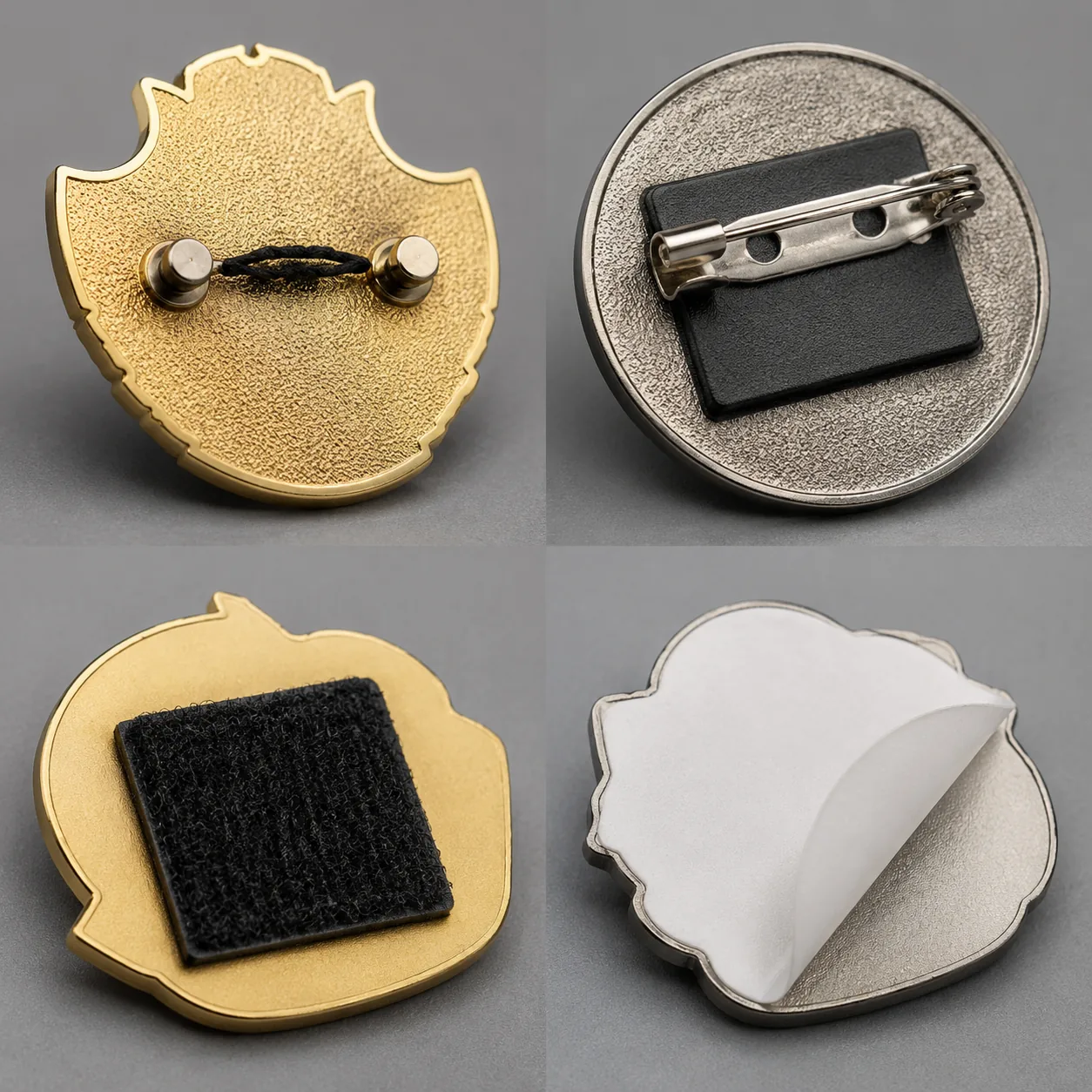
| Attachment | 1 post + butterfly clutch | Use 2 posts or deluxe clutch for widths above 28-30 mm or weights above 12 g | Adds about USD 0.02-0.09 per piece |
3. Write plating as a measurable appearance requirement
Plating is often specified too loosely. Terms like shiny gold, matte nickel, or black nickel describe color family, but not acceptable hue drift, anti-tarnish treatment, edge exposure, or approval method. A useful spec line includes finish type, approved master sample, anti-tarnish requirement, and the degree of exposed base metal allowed on high points or sharp corners. Without that language, two suppliers can quote the same finish name and ship noticeably different results.
For decorative pins, commercial plating thickness is commonly about 0.03-0.08 microns depending on substrate and finish. That is normal for gift, event, and indoor retail use, but it is not functional hardware plating. If inventory may sit for 6-12 months, or ship through humid climates, require an anti-tarnish topcoat and define a decorative corrosion expectation such as 24-48 hours neutral salt spray with no severe discoloration on the front face. Shiny nickel is usually the most stable high-volume option because lot-to-lot hue variation is lower than imitation gold. Black nickel can look more premium, but it shows polishing lines, edge wear, and scratch marks faster during repacking or retail handling.
Appearance approval should always reference a sealed physical sample viewed under neutral indoor lighting at roughly 5000-6500 K. Digital proofs are acceptable for layout, spelling, and general color intent, but not for plating tone or surface texture. That one control removes a common source of shipment claims.
4. Keep enamel geometry inside repeatable production limits
When budgets tighten, teams often preserve visual complexity by shrinking details into smaller color cells. That is usually where yield drops first. On soft enamel pins, very narrow metal lines and tiny recessed areas increase underfill, color bleed, edge contamination, and polishing inconsistency. A better 2026 spec defines manufacturable geometry numerically instead of relying only on a vector file and Pantone callouts.
A practical baseline is minimum metal line width of 0.30 mm, with 0.35-0.40 mm preferred for stable yield. Minimum enamel recess width should be 0.40 mm, and enclosed pockets below that size should be simplified, merged, or converted to print. If the design uses offset relief, leave enough wall thickness between levels to avoid weak edges after polishing. Text smaller than about 5 pt equivalent at finished scale usually reads poorly on economy builds; move dates, SKU numbers, or legal copy to the backstamp, backing card, or retail insert instead.
Color control should also be selective. Require Pantone Solid Coated references only for brand-critical visible colors. Over-specifying every small tone slows sampling without improving the final pin. For soft enamel, a practical visual standard is color match to the approved sample at normal viewing distance, with no obvious mismatch at arm's length. If exact photo-detail or fine gradients matter, printed epoxy or hard enamel may be a better process, but both usually change lead time, unit cost, and edge appearance.
- Set minimum metal line width at `0.35 mm` when repeatability matters more than ultra-fine detail.
- Keep minimum enamel recess width at `0.40 mm` or larger.
- Move dates, compliance text, SKU codes, and tiny legal copy to the backstamp or card.
- Review designs above `6 colors` for one-color reduction opportunities that improve yield and shorten sampling.
5. Treat attachment and packaging as loss-prevention controls
A meaningful share of pin claims comes from hardware failure, abrasion, or packing inconsistency rather than front-face art defects. A 30-32 mm pin with 1 post tends to rotate on fabric. A 14 g zinc-alloy pin paired with a light butterfly clutch can loosen in use. A bright-plated pin bulk-packed without separation can arrive with visible rub marks. These are not cosmetic side issues; they directly affect returns, relabeling labor, and resale value.
As a working rule, quote 2 posts for pins wider than 28-30 mm, and review clutch strength for builds above 12-15 g. Butterfly clutches remain the lowest-cost default, but they are not ideal for heavier premium pins or retail channels with higher return sensitivity. Individual OPP bagging usually adds about USD 0.01-0.03 per unit. A custom 300-350 gsm backing card plus OPP bag commonly adds USD 0.06-0.16 per set depending on card size, print coverage, barcode labeling, and hand-assembly labor. If the card is die-cut, foil-stamped, or includes multiple labels, the add-on can move above USD 0.18 at 300-piece volume.
Carton controls should sit on the same spec sheet as artwork and plating. Specify inner-pack quantity, export-carton burst strength, outer-label format, and a gross-weight cap of 12-15 kg per master carton for easier warehouse handling. Standard inner counts such as 50 or 100 units per bag usually reduce receiving and recount labor enough to justify the discipline at origin. If the order will feed Amazon FBA, retail DCs, or a 3PL, include barcode placement, carton markings, and label format in the RFQ rather than after production.
| Packaging option | Typical add-on FOB | Best use case | Main risk if omitted |
|---|---|---|---|
| Bulk polybag per 50-100 pcs | USD 0.00-0.01 each | Distributor fill, event giveaway, internal use | Loose count errors and more surface contact |
| Individual OPP bag | USD 0.01-0.03 each | Basic retail protection or cleaner piece count | Minor scuffing if no card separates pieces |
| Backing card plus OPP bag | USD 0.06-0.16 each | Retail-ready presentation and barcode control | Higher pack-out cost and longer assembly lead time |
| Barcode label application | USD 0.01-0.04 each | Marketplace, retail, or 3PL receiving | Manual relabeling and receiving delays at destination |
6. Use AQL, sample hierarchy, and day-count lead times to prevent disputes
Vague quality language is expensive. The spec should define defect classes, inspection method, sample authority, and acceptance levels before the PO is issued. For most promotional and retail custom-pin orders, AQL 2.5 for major defects and 4.0 for minor defects is a workable commercial baseline, with critical defects at zero tolerance. Critical defects include unsafe burrs, detached posts, missing clutches, wrong artwork, or any condition that makes the item unfit for sale or use. Major defects usually include size out of tolerance, wrong plating, wrong attachment, severe enamel underfill, bent posts, or incorrect packaging. Minor defects cover slight cosmetic variation that remains within the approved sample standard.
The approval chain matters as much as the AQL number. A digital proof is only for layout, spelling, dimensions, and general color intent. It should not be the sole authority for plating tone, enamel surface quality, or finish texture. A reliable schedule is digital art proof in 1-3 working days, pre-production physical sample in 7-10 calendar days after artwork approval, and mass production in 12-18 calendar days after sample signoff. For many factories, export packing adds 1-2 days after production. Rush orders can compress the timeline, but each artwork revision cycle usually adds 3-5 days and raises the risk of approval mistakes.
Inspection should occur against a sealed golden sample retained by both buyer and factory. If using third-party inspection, define the lot size, sampling level, defect photos required in the report, and whether carton drop checks or count verification are included. That prevents the common dispute where the factory assumes cosmetic-only inspection while the buyer expected packaging and count verification as well.
| Control point | Recommended 2026 spec | Why it matters |
|---|---|---|
| Golden sample | 1 sealed physical sample retained by buyer and factory | Reduces finish and color disputes during final inspection |
| Inspection standard | AQL 2.5 major / 4.0 minor / 0 critical | Creates consistent shipment-release decisions |
| Dimensional tolerance | ±0.20 mm under 40 mm; thickness ±0.15 mm | Prevents subjective size rejection after production |
| Plating approval | Match sealed sample under neutral light | Avoids screen-to-metal interpretation gaps |
| Typical lead time | 1-3 days proof, 7-10 days sample, 12-18 days production | Supports realistic launch planning and freight booking |
7. Pre-approve a cost-down version before the first PO
A tariff-resilient pin spec should define not only the preferred build, but also a fallback build that can be reordered without restarting approvals. The usual downgrade sequence is to simplify packaging first, then reduce size by 2-3 mm, then move to a more stable plating such as shiny nickel, then reduce thickness within acceptable feel, and only after that consider changing base metal or attachment. That order protects visible brand value while still delivering meaningful savings.
For example, a premium retail version might be a 30 mm zinc-alloy soft enamel pin, 1.8 mm thick, black nickel plating, 2 posts, deluxe clutch, backing card, and OPP bag at roughly USD 0.64-0.86 FOB in 500-piece volume, excluding tooling. The fallback version could be a 28 mm stamped-iron soft enamel pin, 1.4 mm thick, shiny nickel plating, 1 post with butterfly clutch, and individual bag only at roughly USD 0.39-0.58 FOB using the same core artwork. That delta is often enough to offset a duty increase, a weaker reorder volume, or a freight-rate spike without reopening the design.
The best suppliers can quote both versions in one RFQ and point out exactly where the art creates yield risk, such as sub-0.30 mm lines, deep enclosed recesses, or overly small text. That feedback is especially valuable for distributors, seasonal launches, museum shops, and pilot retail programs where opening orders may be 300-500 pcs but reorders can jump to 3,000 pcs with little warning.
8. Issue a two-version spec sheet and compare suppliers on risk-adjusted total cost
For the next custom-pin RFQ, place Version A and Version B on one sheet and lock the fields that create the most scope drift: finished size, thickness, base metal, plating finish, number of posts, clutch type, packaging method, carton weight cap, tolerance, AQL, tooling, sample rule, and lead time in days. Request pricing at 300, 500, 1,000, and 3,000 pieces, with tooling separated from unit price and packaging separated from product cost. Then compare suppliers on landed-cost stability, manufacturability feedback, and approval discipline rather than the lowest headline FOB number.
The strongest quote is usually not the fastest or cheapest. It is the one that flags unstable geometry, confirms MOQ and lead time clearly, states carton assumptions, offers alternate cost-down paths, and explains where the artwork may create enamel, plating, or attachment risk. That level of technical feedback is often a better predictor of smooth reorders than a small ex-factory price advantage.
- Prepare `Version A` and `Version B` before sending artwork so all suppliers quote the same decision set.
- Request separate lines for tooling, unit price, packaging, carton data, and any freight assumptions.
- Approve one sealed physical sample as the shipment reference standard.
- Use identical tolerance and AQL language across all suppliers to keep comparisons valid.
- Award on risk-adjusted landed cost, not the lowest ex-factory price alone.
Have a project? Send your artwork and target quantity and we’ll reply with a detailed quotation within 12 working hours.
Ready to get this made?
Send your sketch, target quantity and ship-date. Detailed quotation in 12 hours.



