2026 Small-MOQ Spec Sheet for Custom Enamel Pin Orders
Why small-MOQ pin orders fail on specs, not on price
On a 50 to 300 piece custom enamel pin order, the main cost risk is usually not the quoted FOB unit price. It is spec drift. If process, base metal, thickness, plating, attachment, packaging, or inspection standard are left open, each factory fills the gaps with different defaults. That is how buyers compare a 1.2 mm iron soft enamel pin with one butterfly clutch against a 1.5 mm brass imitation hard enamel pin with dual posts and a retail card, then assume both quotes cover the same product. They do not.
Small-MOQ production behaves differently from a 1,000-piece reorder. Tooling is spread over fewer units, setup time is a larger share of cost, and factories are less willing to absorb repeated artwork edits, custom card revisions, or reworked post placement. On a 100-piece order, one extra sample loop can add 7 to 10 calendar days and wipe out the savings from negotiating USD 0.05 to 0.10 per piece off the factory price.
The fix is not a longer creative brief. It is a short manufacturing spec that locks the variables most likely to change: process, size, nominal thickness, thickness tolerance, plating finish, enamel method, hardware, packaging, QC standard, tooling policy, and latest ship date. A one-page spec written in production language produces tighter quote spreads and fewer disputes after deposit.
Start with the process: ‘enamel pin’ is not a usable purchasing term
The first line should name the build method. For small custom pin orders, the practical choices are stamped soft enamel, imitation hard enamel, die-struck without color, and zinc alloy die cast. If that line is vague, one supplier may quote iron soft enamel and another may quote cast zinc alloy with polished color fill. Both may call the item an enamel pin, but the process, tooling, finish, and cost structure are different.
For most 20 to 35 mm lapel pins at 100 to 500 pieces, stamped soft enamel remains the lowest-cost option. Typical body thickness is 1.2 to 1.5 mm. Raised metal lines should generally be at least 0.25 mm wide, with 0.30 mm safer for repeatable filling. Recessed color cells should ideally be 0.35 mm or wider; below 0.30 mm, fill consistency and line separation become less stable. A realistic 2026 FOB range at 100 pieces is about USD 0.55 to 1.20 for iron or brass soft enamel, depending on size, color count, plating, and hardware.
Imitation hard enamel suits retail, museum-store, and collector programs because the filled areas are baked and polished flush to the metal. The surface feels flatter and usually resists scuffing better than standard soft enamel. At 100 pieces, expect roughly USD 0.10 to 0.35 more per piece than soft enamel, with production lead time commonly 12 to 18 days after art approval versus 10 to 15 days for soft enamel.
Die-struck no-color pins are a fit for service awards, formal insignia, and low-contrast corporate branding. Zinc alloy die casting is the better choice for deep 3D relief, open cutouts, irregular outlines, or shapes that are difficult to stamp cleanly. Cast pins usually start around 2.0 mm thick, use higher tooling, and should be specified explicitly rather than left to the factory’s discretion.
| Process line | Typical MOQ | Nominal thickness | Lead time after approval | FOB price at 100 pcs | Best use |
|---|---|---|---|---|---|
| Stamped soft enamel | 50-100 pcs | 1.2-1.5 mm | 10-15 days | USD 0.55-1.20 | Events, promotions, staff badges |
| Imitation hard enamel | 100 pcs | 1.2-1.5 mm | 12-18 days | USD 0.65-1.55 | Retail, collector drops, museum stores |
| Die-struck no color | 50-100 pcs | 1.2-1.5 mm | 10-14 days | USD 0.50-1.10 | Awards, insignia, understated branding |
| Zinc alloy die cast | 100 pcs | 2.0-2.5 mm | 12-18 days | USD 0.75-1.80 | Cutouts, 3D relief, irregular shapes |
Control geometry in millimeters, with tolerances the factory can actually hold
Many low-volume quote gaps come from hidden geometry changes rather than better efficiency. Write the product as a dimensional line item: 30 mm at widest point x proportional height, finished thickness 1.5 mm ±0.15 mm, overall size tolerance ±0.10 mm. If thickness is missing, one supplier may quote 1.2 mm and another 1.8 mm. The cheaper quote is often simply quoting less metal, less polishing, and lighter plating area.
For stamped pins under 32 mm, 1.2 to 1.5 mm is the efficient range. Below 1.0 mm, edges feel light and narrow forms become easier to bend. Above 1.8 mm, the product feels heavier, but polishing time, plating consumption, and freight weight all rise. For cast zinc alloy, 2.0 to 2.5 mm is standard on sculpted pieces; 3.0 mm is possible for a medallion look but must be written into the RFQ because it changes tool depth and unit cost.
Design-for-manufacture rules also matter more at low MOQ because there may be no formal engineering call. Unsupported metal bridges below about 1.0 mm wide are bend-risk features, especially on stamped iron. Sharp outer points can deform in polishing. Interior cutouts narrower than about 0.8 to 1.0 mm may require casting rather than stamping, depending on shape and die life. If the artwork includes open areas, specify the minimum bridge width and ask the factory to confirm whether the design will be stamped, saw-cut, or cast.
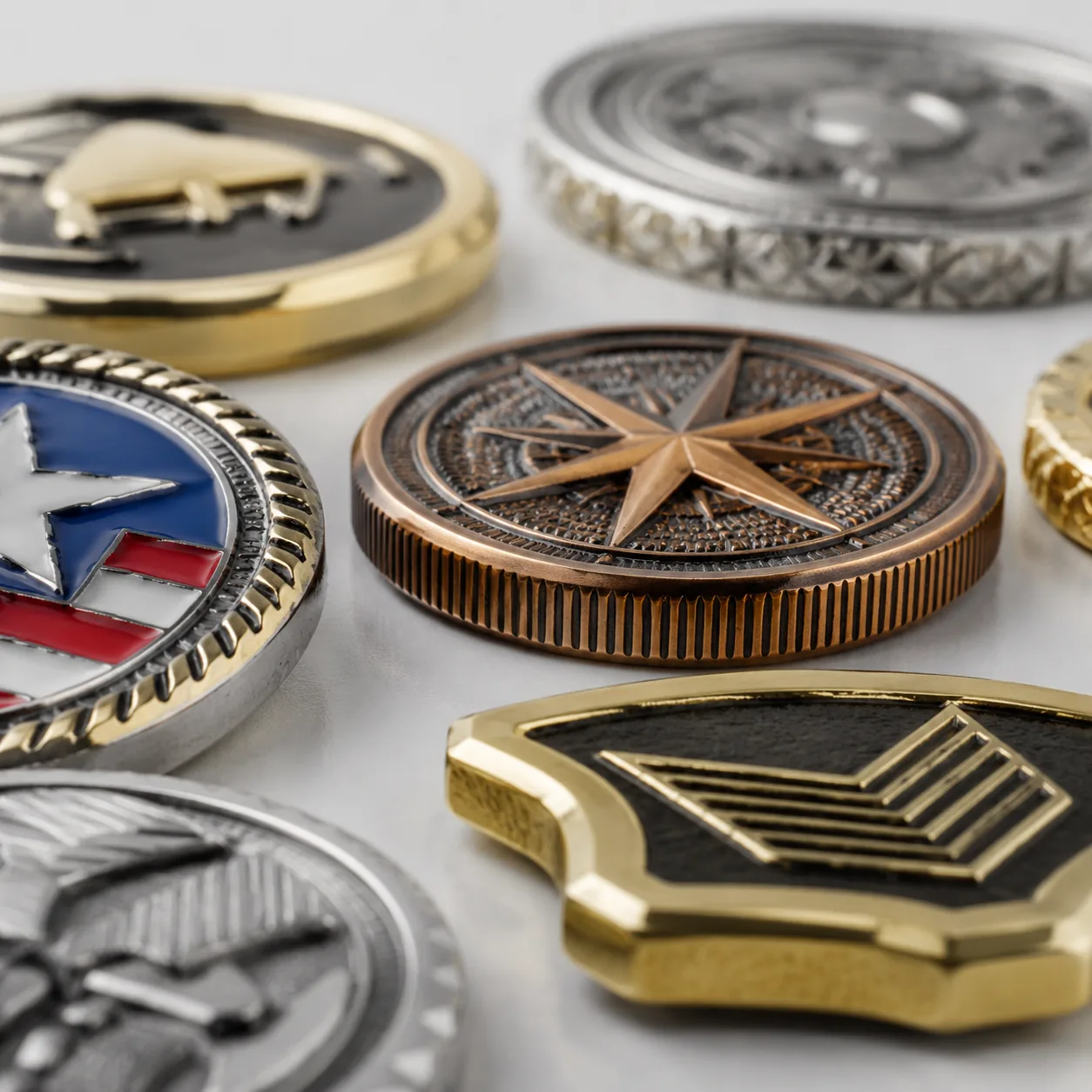
Edge style should also be written: smooth edge, rope edge, spur edge, or antique-textured border. That affects polishing steps and the visual grade. A concrete spec is more quoteable than ‘premium finish.’ Example: 28 mm width, 1.5 mm body, smooth edge, one interior cutout, minimum bridge width 1.2 mm, no burrs on perimeter after plating.
Treat color and plating as a controlled finish system
The color line should state three things: number of fills, which colors are critical, and the matching basis. Example: four soft enamel fills; match Pantone 186 C and Pantone 295 C to normal visual production tolerance; remaining fills per approved artwork. That is better than listing every color as equally critical on a 100-piece run, which usually creates argument without improving output.
On most small-MOQ pin orders, color is controlled visually rather than instrumentally. Buyers should expect minor lot-to-lot variation, especially in reds, creams, and dark blues. Plating therefore becomes part of color control. Bright nickel tends to keep whites, blues, and grays cleaner; bright gold-tone warms adjacent colors; black nickel increases contrast but can make dark fills look denser. Color and plating should be approved together, not as separate choices.
The finish line should identify both plating family and appearance: bright gold-tone, bright nickel, black nickel, dyed black, antique bronze, antique copper, matte gold-tone, plus whether borders are polished, matte, or sandblasted. Decorative plating on promotional pins commonly runs around 0.03 to 0.08 microns. That is an appearance coating, not a heavy corrosion-protection system. For black nickel, dyed black, or antique finishes, ask whether a clear topcoat is included, because dark surfaces show rub marks and humidity staining faster in storage.
Special effects should always be broken out as separate charge lines because they affect yield and lead time. Common additions include glitter, glow pigment, pearl enamel, translucent fills over texture, epoxy dome, and screen print for micro text or serials. On a 30 mm soft enamel pin, one screen-printed detail area can add roughly USD 0.05 to 0.15 per piece and 2 to 4 production days. Epoxy domes usually add about USD 0.06 to 0.18 per piece and slightly change perceived color because of the lens effect.
- List Pantone references only for brand-critical or retail-critical colors.
- Specify plating and border appearance on the same line.
- Call out glitter, glow, pearl, translucent, epoxy, or screen print as separate process charges.
- Request approval photos under neutral 5000K to 6500K lighting for plating-sensitive items.
- Avoid zero-variance color language on 50 to 100 piece rush orders unless the item is resale-critical.
Back hardware and post placement determine how the pin performs in use
Most post-delivery complaints on small pin orders are not about front-side cosmetics. They are about pin rotation, weak clutches, scratched garments, or posts placed badly on asymmetrical shapes. A standard butterfly clutch on a 0.8 to 1.0 mm post is usually acceptable for pins up to about 25 mm. Once the pin reaches 28 to 45 mm, or the width-to-height ratio exceeds roughly 1.5:1, a second post should be treated as standard rather than optional.
Dual posts reduce rotation on jackets, bags, and lanyards and typically add about USD 0.04 to 0.10 per piece on low-volume runs. For resale or uniforms, deluxe locking clutches are often justified; they usually add USD 0.08 to 0.18 per piece but materially reduce accidental loss. Rubber clutches are useful when the user removes the pin frequently or when packed sets need less scratching risk in transit.
Hardware should match the use case. Butterfly clutches are lowest cost and suitable for event giveaways. Rubber clutches are convenient for repeated on-off use. Deluxe locking clutches fit ecommerce, uniforms, and backpacks where loss rate matters more than minimum cost. If magnets are requested instead of posts, specify magnet size and pull expectation, and note that magnetic backs are not suitable for all garments or for wearers with certain medical devices.
Post placement must be written, not implied. Example: dual posts, centered on vertical axis, 14 mm apart, symmetrical to back profile, posts clear of cutout area. On long, tall, or asymmetrical shapes, request a back-view approval image before mass production. That one step catches most preventable anti-rotation and alignment errors before 100 pieces are assembled incorrectly.
Packaging often moves landed cost more than the enamel upgrade
On a 100-piece order, packaging can create a larger total-cost swing than upgrading from soft enamel to imitation hard enamel. An individual OPP bag usually adds only USD 0.01 to 0.03 per piece. A printed backing card plus polybag often adds USD 0.08 to 0.25 per set at 100 pieces, depending on card size, paper weight, print coverage, coating, and manual assembly. A rigid presentation box can easily cost more than the pin itself.
Separate protection requirements from presentation requirements. For internal awards or event handouts, bag-only packing is often enough. For ecommerce, retail, or museum-store supply, the packaging line should specify card dimensions, board weight, coating, hanging hole, barcode or SKU label, and how the pin is mounted. Without those details, one factory may quote a 250 gsm uncoated card while another quotes a 350 gsm matte-laminated card with assembly labor included.
A useful packaging line is: one pin mounted on 90 x 55 mm 350 gsm matte-laminated CMYK backing card, centered 18 mm from top edge, inserted in self-seal OPP bag, barcode label on back lower-right corner. If multiple SKUs are involved, state whether one common card is used across all variants or whether each design needs its own print run. At small MOQ, separate cards can materially increase print waste and setup cost.
Outer packing still matters on small shipments, especially if pins ship with patches, keychains, or lanyards. A practical line is: 25 sets per inner bag, export carton gross weight under 15 kg, desiccant and moisture liner if humid storage or sea transit is expected. Those details reduce plating rub, bent cards, and recount errors at the forwarder.
| Packaging spec | Typical add cost at small MOQ | Typical lead time impact | Best use case | Main trade-off |
|---|---|---|---|---|
| OPP bag only | USD 0.01-0.03 per pc | 0-1 day | Internal events, simple giveaways | Minimal presentation |
| Backing card + OPP | USD 0.08-0.25 per set | 1-3 days | Retail-ready, branded handouts | Higher assembly cost |
| Velvet pouch | USD 0.35-0.80 per pc | 1-2 days | Awards, VIP gifting | Bulkier, higher freight |
| Paper box with insert | USD 0.45-1.20 per set | 2-5 days | Commemorative or premium sale item | Packaging may exceed pin cost |
Define QC with AQL, measurable tolerances, and photo evidence
A request for ‘perfect quality’ is not an inspection standard. A workable clause for enamel pins is AQL 2.5 major and 4.0 minor on finished packed goods, with critical defects at zero acceptance. Critical defects usually include wrong process, wrong plating family, wrong attachment, missing or broken post, exposed sharp burr, missing enamel fill, incorrect SKU assortment, and wrong packaging format. Put those points in writing before deposit is paid.
Then define what normal variation is acceptable. On soft enamel, slight sink in larger fill areas is normal. Minor polish marks visible only at close range, small variation in antique wash, and slight shift on non-critical colors are usually acceptable on promotional-grade orders. For a first retail launch, those limits can be tightened, but buyers should expect either a longer sorting cycle, a higher reject rate, or a higher unit cost to cover screening.
Dimensional limits should be measurable: thickness 1.5 mm ±0.15 mm, overall width ±0.10 mm, no perimeter burrs that fail a finger-swipe safety check, posts securely soldered or cast in place, and clutch fit sufficient that the clutch does not free-drop under normal manual handling. If an epoxy dome is specified, state whether minor edge flow is acceptable and whether bubbles visible at 30 cm are rejectable.
For orders of 300 pieces or less, a full third-party inspection is often not cost-effective. A better control is documented factory final inspection with quantity count, random sample photos, and packaging verification. Request front, back, side profile, post count, clutch type, packaged set, master carton markings, and one group image under neutral light. That evidence package is inexpensive and catches most preventable shipment errors before dispatch.
Lock commercial terms: MOQ tiers, tooling, sample policy, and ship-date discipline
The commercial section should lock the exact quantity tier because small-order pricing moves sharply by break. Common quote tiers are 50, 100, 300, 500, and 1,000 pieces. On a standard 28 to 35 mm pin, new tooling usually runs about USD 50 to 120 for stamped construction and USD 80 to 150 for zinc alloy casting, depending on size, cutouts, and relief complexity. Confirm whether tooling is one-time, whether it is reusable for exact reorders, and how long the supplier retains it, such as 12 or 24 months.
Sample policy should be realistic. For a straightforward 100-piece order, a digital proof showing dimensions, plating, post placement, and packaging note is often enough. A physical pre-production sample is more useful for first-time retail launches, unusual outlines, multi-layer builds, or added effects such as glitter, pearl, glow, epoxy, or screen print. If a physical sample is required, state whether the sample fee is credited to the bulk order and how many days it adds; 7 to 10 calendar days is common.
Shipping terms should include method, invoice basis, and latest ship date, not just requested arrival. For 100 to 300 pieces, express courier is usually simplest, but premium packaging can increase volumetric weight enough that freight exceeds goods value. If the order supports an event or launch date, write the latest ship date into the PO. That gives the supplier a measurable schedule target and reduces disputes about transit delay after handoff to courier.
A compact RFQ checklist keeps every quote comparable.
- Name the process explicitly: stamped soft enamel, imitation hard enamel, die-struck, or zinc alloy cast.
- State size in mm and thickness tolerance, for example 30 mm x proportional height, 1.5 mm ±0.15 mm.
- Identify critical Pantone colors and plating finish on the same line.
- Specify post count, post spacing, and clutch type.
- Define packaging by dimensions, material, print finish, and assembly method.
- Set QC basis: AQL 2.5 major, 4.0 minor, critical defects zero acceptance.
- Confirm tooling charge, sample requirement, production lead time, and latest ship date in writing.
Use a one-page spec sheet to force like-for-like quotes
For a small custom enamel pin order in 2026, the best buying tool is a one-page production spec that forces every supplier to quote the same construction. The order matters: process first, then geometry, then color and plating, then hardware, packaging, QC, and commercial terms. Once those lines are fixed, quote differences usually reflect real manufacturing cost rather than hidden substitutions.
A strong mini-spec can be short: stamped soft enamel pin, 30 mm wide x proportional height, 1.5 mm thickness ±0.15 mm, bright nickel plating, four fills with Pantone 186 C and 295 C critical, dual posts 14 mm apart with black rubber clutches, one pin on 90 x 55 mm 350 gsm matte-laminated card in OPP bag, AQL 2.5/4.0, quantity 100 pcs, latest ship date 15 May 2026. That single paragraph eliminates most of the ambiguity that causes remake requests.
If returned quotes vary widely, check the construction lines before negotiating price. On small MOQs, big quote gaps usually come from thinner bodies, fewer posts, lower packaging spec, omitted assembly labor, or a process shift from imitation hard enamel to soft enamel. Clean specifications shorten approvals, reduce rework, and make it far more likely that the delivered pin matches the artwork, budget, and deadline.
Have a project? Send your artwork and target quantity and we’ll reply with a detailed quotation within 12 working hours.
Ready to get this made?
Send your sketch, target quantity and ship-date. Detailed quotation in 12 hours.



