2026 Landed-Cost Spec Sheet for Custom Enamel Pin Orders
FOB unit price is only one line in the cost model
Too many enamel pin RFQs still compare only the FOB piece price, then absorb a 20% to 45% landed-cost swing after freight mode, duty, brokerage, packaging cube, QC sorting, testing, and remake exposure are added. In 2026, that shortcut is more dangerous because metal cost is rarely the main source of variance. Bigger leakage usually comes from specification lines that change yield, carton density, inspection fallout, and how many units arrive saleable on first pass.
The more useful metric is cost per approved unit delivered to destination. That means each quote sheet should combine build specs and commercial assumptions in one place: process, base metal, thickness, plating, attachment hardware, pack-out, carton count, AQL, remedy terms, Incoterm, and transit mode. In the 300 to 10,000 piece range, a nominal USD 0.04 factory saving disappears quickly if the lower quote raises fallout by 3%, requires a second post after sampling, or forces air freight to recover schedule.
Example: a 1,000-piece order quoted at USD 0.66 FOB can end up more expensive than a USD 0.79 FOB offer if the cheaper build excludes backing cards, uses 1.0 mm iron on a 38 mm shape that bends during polishing, and packs in low-density gift boxes. If 4% of units fail incoming inspection, 2% need hand sorting, and replacement stock must move by express in 5 to 7 days, the effective delivered cost can exceed the higher FOB quote by USD 0.12 to USD 0.19 per approved unit. The practical fix is to issue the RFQ as a landed-cost spec sheet and require all suppliers to quote the same build, packing basis, and QC standard.
1) Freeze process, base metal, and thickness before comparing quotes
The first control point is to lock process, substrate, and thickness together. For most custom pins, the core options are stamped iron, stamped brass, and die-cast zinc alloy. Stamped iron is usually the lowest FOB route for flat 2D soft-enamel designs. Stamped brass costs more, but it holds sharper die lines, cleaner polished edges, and better dimensional stability on fine copy. Die-cast zinc alloy is usually the better choice for irregular outlines, open cutouts, thick profiles, curved surfaces, and 3D relief where stamped bridges would become fragile or distort.
Typical production specs are narrower than many RFQs imply. Stamped iron or brass pins are commonly 1.0 mm, 1.2 mm, or 1.5 mm thick before plating. Zinc-alloy cast pins are usually 2.0 mm to 2.5 mm before plating, and 3D cast pieces can go thicker. For 25 to 35 mm pins, moving from 1.2 mm iron to 1.5 mm brass often adds USD 0.08 to USD 0.22 per piece at 1,000 units FOB, depending on color count, polish standard, and pack-out. That premium is usually justified when artwork includes bridges below 0.8 mm, recessed copy under 0.30 mm line width, or raised-metal areas that need cleaner polish with fewer edge waves.
Thickness directly affects reject rate. A thin stamped part may quote well, then deform during polishing, plating, post soldering, or carding. For decorative pins, a workable starting tolerance is plus or minus 0.10 mm on stamped thickness, plus or minus 0.20 mm on overall size for pieces under 40 mm, and a minimum raised-metal line width of 0.25 to 0.30 mm for repeatable die performance. For cast zinc, buyers should also define acceptable parting-line cleanup and edge radius, because cast pieces can look softer if the factory is holding cost by reducing finishing time.
| Spec line | Economy choice | Higher-stability choice | Typical 2026 FOB impact at 1,000 pcs |
|---|---|---|---|
| Base metal | Stamped iron 1.2 mm | Stamped brass 1.5 mm | +USD 0.08 to +USD 0.22 each |
| Process | Stamped 2D soft enamel | Die-cast zinc alloy 2.0-2.5 mm | +USD 0.12 to +USD 0.38 each |
| Outline detail | Simple perimeter | Cutouts, thin bridges, stepped relief | +USD 0.05 to +USD 0.18 each |
| Finish prep | Standard polish | Fine polish on raised metal | +USD 0.02 to +USD 0.06 each |
| Artwork tolerance | Lines above 0.35 mm | Micro-copy near 0.20-0.30 mm | +USD 0.03 to +USD 0.10 each depending on yield |
2) Size bands, MOQ tiers, and tooling amortization set the real unit cost
Pin size is not a cosmetic footnote. A move from 25 mm to 32 mm increases metal area, enamel fill, plating surface, backing card size, and export cube. Many factories still quote by size bands such as under 25 mm, 25 to 32 mm, 32 to 40 mm, and over 40 mm. If two suppliers price different size assumptions, the quotes are not comparable even when the same artwork file is attached.
Advertised MOQs of 100 pieces per design are common, but the meaningful commercial breaks are usually 300, 500, 1,000, 2,500, and 5,000 pieces. Below 300 pieces, the buyer pays heavily for setup, tooling, color matching, sampling, and handling. In 2026, tooling for a simple stamped pin typically runs USD 50 to USD 120. Multi-level stamp tools or cast molds usually land around USD 120 to USD 280, and irregular 3D cast molds can exceed USD 300 to USD 450. Spread across 300 units, that adds about USD 0.17 to USD 1.50 per piece; at 3,000 units, it drops to roughly USD 0.02 to USD 0.15.
As a planning baseline, a standard 30 mm stamped iron soft-enamel pin with one post and butterfly clutch typically lands around USD 0.48 to USD 0.82 FOB at 1,000 pieces, assuming standard plating and bulk or simple OPP bag packing. The same visual design in 1.5 mm brass with finer polish and card packing often lands around USD 0.72 to USD 1.18 FOB. At 5,000 pieces, the same builds may decline by roughly 12% to 22% depending on color count, labor content, and packaging. Quotes materially below those ranges often omit tooling, backing cards, realistic scrap allowance, or workable QC yield.
Annual volume matters more than single-order volume. One 3,000-piece run is often cheaper than three 1,000-piece runs because it reduces repeated setup, repeated inspection fees, repeated customs entries, and small-lot freight inefficiency. The exception is when licensing uncertainty, event timing, or design risk makes inventory exposure more expensive than a higher unit cost. In that case, a buyer may knowingly accept a 10% to 18% higher FOB to limit obsolete stock.
3) Plating, enamel, and special effects should justify their cost
Plating affects appearance, but also defect sensitivity and handling. Common finishes include bright gold, bright nickel, black nickel, antique brass, antique copper, antique nickel, and dyed black. Decorative gold-tone plating on pins is usually thin, commonly around 0.03 to 0.05 microns over the required base layers rather than a heavy functional gold deposit. That is normal for promotional metal goods. Buyers should therefore specify appearance standards, color tone, and visible-surface criteria rather than assume premium wear performance from the word gold alone.
Color count matters less than many buyers expect until the design becomes crowded. Adding one more standard soft-enamel color may increase FOB by only USD 0.01 to USD 0.03 per unit at 1,000 pieces. The bigger cost comes from effects that add handling steps or yield risk: glitter enamel, glow pigment, transparent enamel over texture, pearl fill, epoxy dome, or screen print over enamel. Dual plating typically adds USD 0.08 to USD 0.20 each because of masking and process control. Epoxy domes commonly add USD 0.05 to USD 0.12 each, while screen printing can add USD 0.04 to USD 0.10 depending on coverage, pass count, and registration tolerance.
Fine printed detail needs realistic limits. Screen-printed microtext below about 0.20 mm line width is risky on small pins; for repeatable output, many factories prefer 0.25 mm or above with registration tolerance around plus or minus 0.15 mm. Soft-enamel color wells narrower than about 0.35 mm can also become inconsistent after fill and polish. If the design relies on transparent enamel over polished texture, ask for a pre-production sample photo under direct light and an angled-light photo, because tiny plating scratches or fill variation become much more visible through clear color.
Use premium effects only when they improve sell-through or perceived value enough to offset cost. A staff-recognition pin shipped in bulk rarely justifies glitter, transparent enamel, and epoxy in one build. A retail pin expected to sell at USD 12 to USD 18 may justify one or two premium effects if they improve shelf presentation without collapsing carton density or yield. If the market requires restricted chemistry, specify nickel-free finish, lead limits, REACH, or CPSIA-related declarations at quote stage because those requirements can change the plating route, testing scope, and documentation cost.
4) Hardware and packaging create the largest hidden landed-cost swings
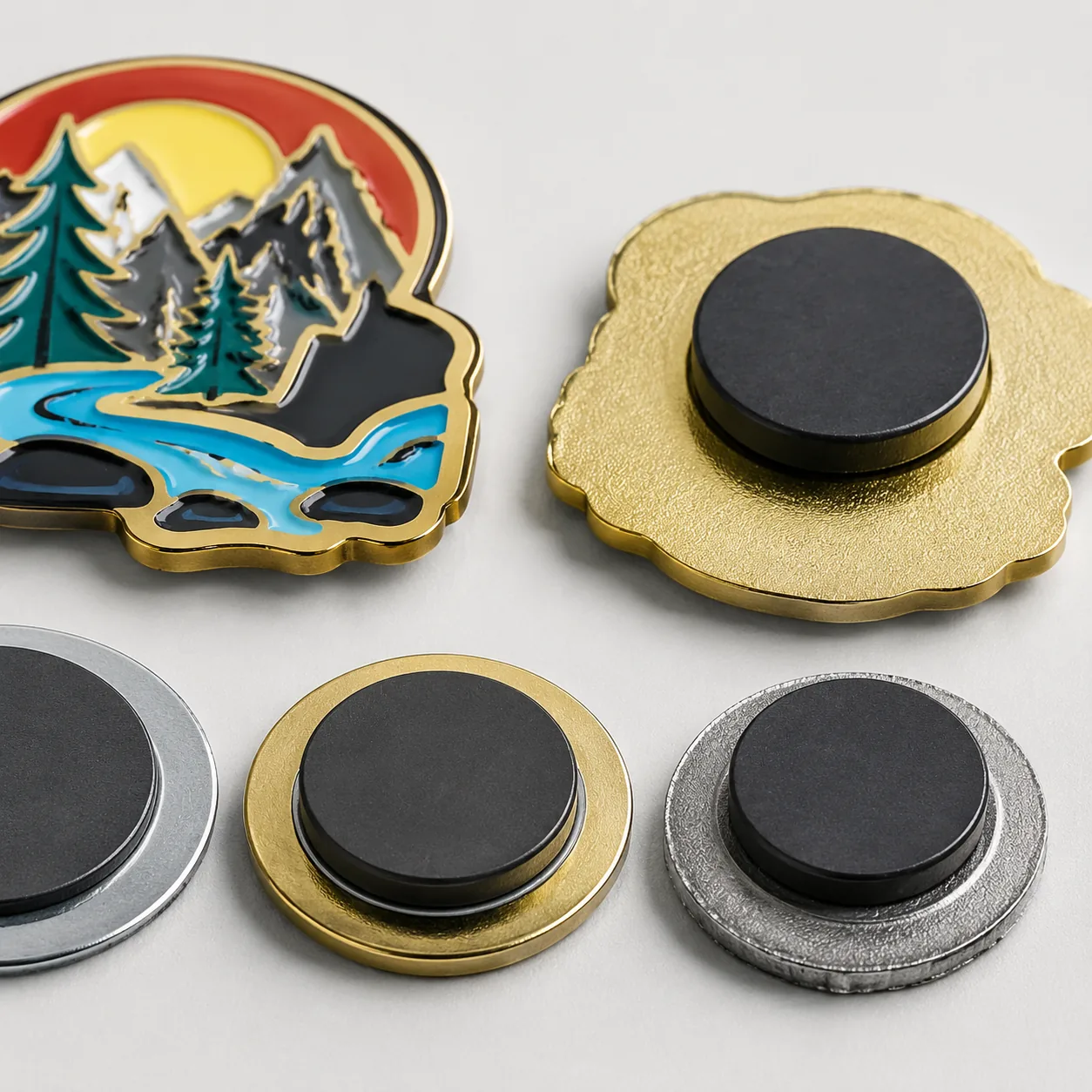
Attachment hardware is one of the easiest lines to under-specify. The baseline build is one standard post with one butterfly clutch. Adding a second post commonly adds USD 0.03 to USD 0.08 per unit and a small amount of assembly time, but it is often the right choice for pins wider than 30 mm, tall vertical shapes, or asymmetrical pieces that would otherwise rotate. Rubber clutches may add around USD 0.01 to USD 0.03 versus basic butterflies, while locking backs can add USD 0.12 to USD 0.35 and magnetic backs even more, with additional safety review in some markets.
Packaging can move landed cost more than decoration. Bulk-packed pins in master polybags are the lowest-cost route and usually give the best carton efficiency. Individual OPP bags remain relatively efficient. A custom printed backing card plus self-seal bag adds print cost, manual carding labor, and more carton volume. A rigid gift box or foam insert box can add roughly USD 0.35 to USD 1.20 per unit and may reduce units per export carton enough to make air freight uneconomic on a mid-size order.
For standard carded presentation, a practical backing card spec is 300 to 350 gsm coated paper at about 55 x 85 mm or 70 x 90 mm. Post-hole alignment should be held within plus or minus 0.5 mm so the pin seats correctly without bowing the card. If retail sale requires EAN or UPC barcodes, warning text, lot coding, suffocation warnings, country-of-origin text, or multilingual legal copy, those items belong in the first RFQ. Late packaging edits usually cost more in repacking, reprinting, and delayed shipment than in pure material.
- Use one post for small symmetric pins under about 30 mm unless rotation is a known issue
- Use two posts for wide, tall, or irregular shapes to reduce twisting and return risk
- Specify card gsm, card size, bag size, barcode, warning copy, and carton pack count in the first RFQ
- Price packaging by added cube and labor, not by unit material cost alone
- Request packed-carton dimensions, gross weight, and units per carton before PO release
5) Freight, duty assumptions, and customs data must sit on the quote sheet
A quote that ends at FOB Shanghai or FOB Ningbo is not wrong, but it is incomplete for purchasing decisions. Buyers should request estimated carton count, carton dimensions, gross and net weight, units per carton, and a packing mockup before PO release. That data allows a realistic freight comparison across express, air, and sea, and it also improves receiving and warehouse planning at destination.
For small orders below roughly 100 to 150 kg gross, express or air can still be the least expensive total option if a missed launch would trigger markdowns, event penalties, or split-shipment costs. For larger runs, sea freight usually wins on unit economics, but only if the production schedule protects the sailing window. A 7-day production slip can erase the value of a cheap FOB quote if the buyer must upgrade to air or misses a retail reset date. On many pin programs, changing from sea to air adds more landed cost than moving from iron to brass.
Carton density is the overlooked lever. A 1,000-piece order packed bulk may fit in one or two compact cartons, while the same order in gift boxes may consume two to four times the volume. Freight is charged by actual weight or dimensional weight depending on mode, so a USD 0.10 packaging upgrade can trigger a second cost increase in transport, customs handling, and storage. Buyers should also keep invoice description, material declaration, broker HS guidance, packing list, and country-of-origin marking aligned before shipment to avoid customs holds and post-entry corrections.
Duty treatment varies by importing country, product classification, and trade policy, so buyers should not hard-code a single tariff assumption into every RFQ. The safer practice is to ask finance or the broker for the current duty basis, then model at least two scenarios: standard entry and accelerated replacement shipment. A remake shipped by courier often carries not just higher freight, but also a second brokerage fee and additional admin time.
6) QC, AQL, and remedy terms determine cost per approved unit
The cheapest quote is often the quote with the weakest quality language. A usable pin specification should define visible-surface standards, enamel acceptance, plating defects, attachment strength, and inspection method. Without that, every dispute becomes subjective after production, when freight and duty may already be sunk.
For many B2B promotional orders, ANSI/ASQ Z1.4 single-sampling inspection with AQL 2.5 for major defects and 4.0 for minor defects remains a practical baseline. For retail-grade polished metal or licensed merchandise, many buyers tighten to AQL 1.0 major and 2.5 minor. Major defects usually include wrong plating, wrong color family versus approved Pantone, missing attachment, sharp burrs, detached hardware, severe enamel voids, obvious scratches on the cosmetic face, and size deviation beyond tolerance. Minor defects usually include small backside marks, light specks, tiny side scratches, or slight color variation within the approved tolerance.
Useful measurable controls include plus or minus 0.10 mm thickness tolerance on stamped parts, plus or minus 0.20 mm finished size tolerance for common pin sizes, plus or minus 0.5 mm backing-card die-cut tolerance, and print registration within about plus or minus 0.15 mm when screen print is used. If the build includes epoxy, define whether edge pooling, slight orange peel, minor surface waviness, or pinhead bubbles are acceptable. For color, approve either Pantone references or a sealed sample and define which side of the pin is the cosmetic face for inspection.
Attachment security also needs a stated expectation. Decorative pins do not follow one universal force standard, but the PO should still require secure soldering or equivalent attachment that withstands ordinary manual use and repeated opening and closing. Many buyers ask the factory to perform an internal pull, twist, or bend verification by lot and retain records. A practical internal benchmark for a standard soldered post is often a pull resistance in the low double-digit newton range, but the key issue is not the exact number alone. It is whether the supplier documents lot testing and ties failures to containment and remake rules.
The commercial remedy matters as much as the build spec. State the pre-shipment inspection right, claim window after receipt, evidence required, and whether the remedy is remake, replacement, credit, or refund. Once nonconforming goods move internationally, recovery of ex-factory price alone rarely covers the buyer's true loss in freight, duty, handling, and missed sales.
7) Standardize every reorder on one landed-cost template
When two quotes are close, the better decision usually comes from normalizing the inputs rather than negotiating another cent. A reusable template forces each supplier to quote the same build and gives sourcing, finance, and marketing one document to approve. It also prevents spec drift on reorders, where a supplier may quietly substitute hardware, plating route, card stock, or packing density to protect a nominal unit price.
- Product: process, base metal, thickness in mm, finished size in mm, and outline complexity
- Decoration: soft enamel or imitation hard enamel, Pantone references, color count, print layers, and any glitter or glow effect
- Finish: bright or antique plating, nickel-free requirement, cosmetic standard, and whether epoxy is required
- Hardware: post count, clutch type, post location, anti-rotation requirement, and attachment verification method
- Packaging: bulk, OPP bag, card gsm and size, barcode, warning text, gift box, and units per export carton
- Commercials: MOQ tier, tooling charge, sample charge, FOB unit price, payment term, and production lead time in days
- Logistics: carton dimensions, gross weight, Incoterm, freight assumption, requested ship date, and destination deadline
- Quality: AQL plan, tolerances, golden sample approval, pre-shipment inspection right, and remake or credit policy
Lead times should be written as hard numbers. A realistic schedule for standard stamped pins is often 2 to 4 days for digital proofing, 5 to 7 days for a pre-production sample or sample-photo approval if required, and 10 to 18 days for mass production after final approval. Complex die-cast pins with dual plating, screen print, epoxy, or retail carding often require 18 to 25 production days, and lab testing can add another 5 to 10 days if documents are not pre-arranged. Rush builds are possible, but buyers should expect expedite surcharges, tighter booking risk, and a higher cosmetic fallout probability.
The most reliable suppliers are not always the ones with the lowest opening FOB. They are the ones that can quote complete carton data, realistic lead times, process-specific tolerances, and a clear remedy policy without repeated prompting. In 2026, that transparency is usually what protects margin after the goods leave the factory.
Have a project? Send your artwork and target quantity and we’ll reply with a detailed quotation within 12 working hours.
Ready to get this made?
Send your sketch, target quantity and ship-date. Detailed quotation in 12 hours.



