2026 Import Cost Spec Sheet for Custom Metal Promo Orders
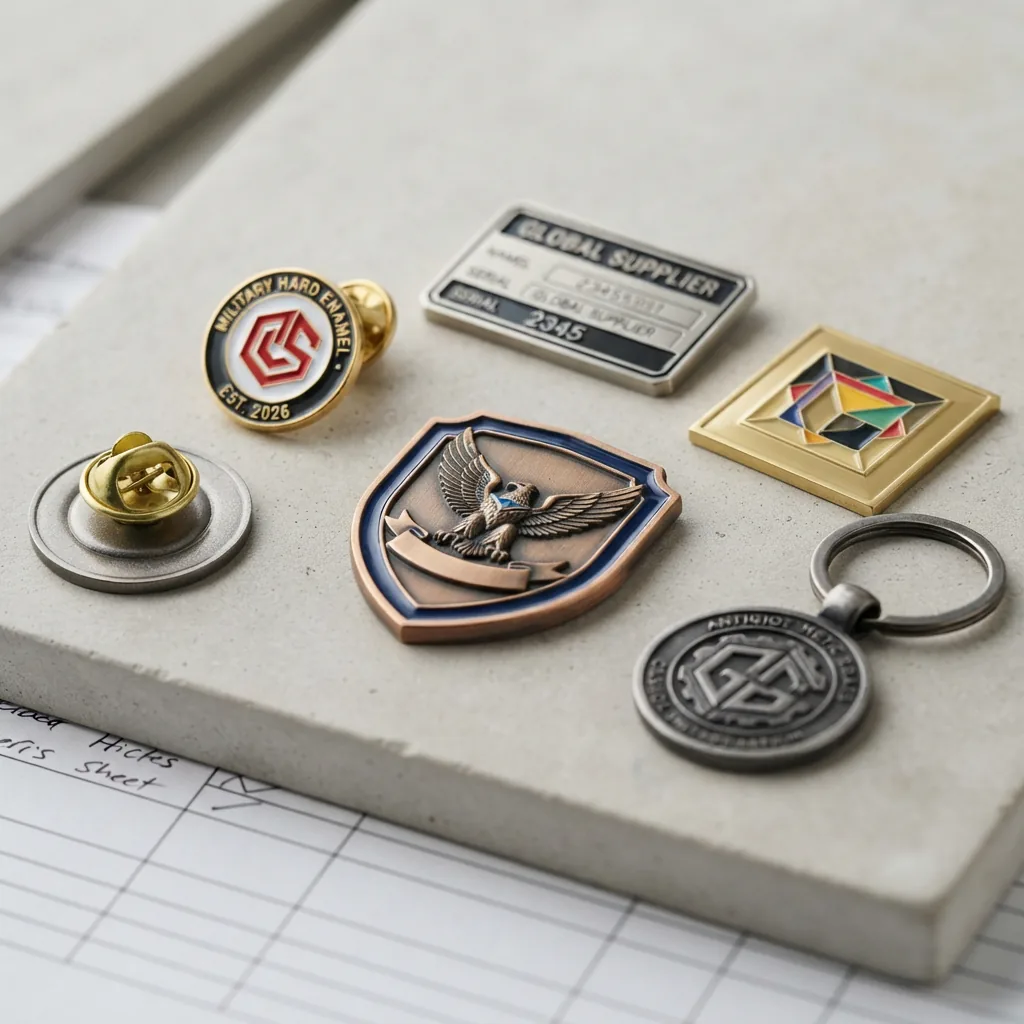
Why approved FOB quotes still miss the real import number
A buyer approves a FOB quote for 5,000 custom pins at 0.62 USD each, then finance lands the order at 0.96 to 1.12 USD per unit after duty, freight, packaging, third-party inspection, customs entry, domestic drayage, and receiving. That gap is rarely one large mistake. It usually comes from six to ten unresolved specifications in the RFQ that were left for the factory, forwarder, or packaging team to decide later.
That problem is sharper in 2026 because destination charges, LCL minimums, brokerage, and tariff-sensitive classifications can move faster than the factory unit price. For enamel pins, keychains, challenge coins, medals, and magnets, the useful comparison is not the lowest quoted FOB. It is the fully controlled build sheet that fixes process route, dimensions, finish, attachments, pack-out, QC level, and freight basis before artwork approval.
A workable quote package should separate tooling, unit FOB by MOQ tier, finish adders, hardware adders, packaging cost, units per carton, carton dimensions, gross and volumetric weight, inspection scope, and quoted lead time by stage. Once those lines are visible, supplier comparisons become defensible and cost creep is easier to stop.
1. Lock the manufacturing route before you negotiate
Process choice drives most of the cost structure. A 35 mm stamped iron soft enamel pin at 1.2 mm thickness with two butterfly clutches uses a different tooling, polishing, plating, and assembly route than a 50 mm zinc alloy die-cast keychain at 3.0 mm thickness with epoxy and a swivel clasp. If the process route is still open, every later cost assumption is unstable.
For flat pins, badges, and medals in the 20 to 50 mm range, stamped iron is usually the lowest-cost route. Brass costs more, but it holds finer die-struck detail, cleaner cut lines, and is often preferred for imitation hard enamel or premium die-struck looks. Zinc alloy die casting is the practical option when the design needs deep 3D relief, irregular outlines, cutouts, recessed back details, or web widths below about 1.5 to 2.0 mm. Photo etching works for thin, detail-heavy pieces around 0.6 to 0.8 mm, but it does not substitute well when the buyer wants edge depth, mass, or coin-style heft.
Typical 2026 China FOB ranges at 5,000 pieces are as follows: a 30 to 35 mm stamped soft enamel pin, 0.46 to 0.74 USD; a 50 mm zinc alloy keychain with standard chain and split ring, 1.02 to 1.78 USD; a 45 mm two-sided challenge coin, 1.65 to 3.35 USD; and a 60 mm steel-face magnet with ferrite or rubber backing, 0.58 to 1.12 USD. Tooling is usually separate: 80 to 180 USD for simple stamped dies, 140 to 350 USD for cast molds, 100 to 260 USD for standard coin dies, and higher for multi-part, spinner, or dual-mold assemblies.
Advertised MOQs of 100 to 300 pieces are common, but meaningful price breaks usually start at 500, 1,000, 3,000, and 5,000 pieces. Those tiers matter because tooling amortization, plating-bath loading, setup scrap, and packing labor normalize there. A proper RFQ should name the build directly: base metal, process, size, thickness, color count, finish, attachment, and unit pack. Without that level of detail, the low quote often assumes a thinner part, lighter hardware, or simpler finish than the buyer intended.
2. Fix geometry, thickness, and weight bands
Diameter alone is not enough. Thickness affects raw metal consumption, die wear, fill quality, polish time, plating area, and freight weight. Weight then affects carton count, parcel breaks, and volumetric efficiency, especially for carded units, boxed sets, or kitted programs.
A stamped 35 mm iron pin moving from 1.2 mm to 1.5 mm thickness typically adds 0.04 to 0.08 USD per piece at 5,000 units, roughly 8 to 14 percent depending on finish and attachment count. A 45 mm challenge coin moving from 3.0 mm to 3.5 mm often adds 2.5 to 4.0 g per piece. At 3,000 pieces, that is 7.5 to 12.0 kg before packaging. On zinc alloy keychains, the freight effect is often larger than the metal adder because the item is already heavy relative to invoice value.
Specifications should therefore state nominal dimensions and tolerance, not just art size. Practical factory tolerances are usually plus or minus 0.10 mm on stamped thickness, plus or minus 0.15 mm on die-cast thickness, plus or minus 0.20 mm on overall length or diameter, plus or minus 0.30 mm on irregular outer profile, and plus or minus 5 percent on unit weight unless tighter control is quoted. For enamel-filled areas, color recess depth variation of plus or minus 0.05 to 0.08 mm is typical on commercial runs. If the product must fit a blister, foam insert, or mailer, confirm actual sample weight and final packed dimensions before production. A 3 to 5 g drift can change carton counts and carrier rate breaks.
| Product type | Typical production spec | MOQ / price break pattern | Approx FOB at 5,000 pcs | Typical unit weight | Main cost risk if underspecified |
|---|---|---|---|---|---|
| Stamped soft enamel pin | 35 mm, iron, 1.2 mm, 4 colors, 2 butterfly clutches | 100 / 500 / 1,000 / 3,000 / 5,000 | 0.46 to 0.74 USD | 8 to 12 g | Thickness, clutch type, and plating quality reduced to hold target price |
| Die-cast keychain | 50 mm, zinc alloy, 3.0 mm, 1-side relief, chain + split ring | 100 / 500 / 1,000 / 3,000 / 5,000 | 1.02 to 1.78 USD | 24 to 38 g | Openwork complexity, hardware gauge, and actual weight drive both FOB and freight |
| Challenge coin | 45 mm, brass or zinc alloy, 3.0 mm, 2-sided relief, standard edge | 100 / 300 / 500 / 1,000 / 3,000 | 1.65 to 3.35 USD | 28 to 42 g | Relief depth, edge style, and plating finish added after quote |
| Fridge magnet | 60 mm, steel face with ferrite or rubber magnet backing | 300 / 500 / 1,000 / 3,000 / 5,000 | 0.58 to 1.12 USD | 18 to 30 g | Magnet grade, adhesive system, and backing size quietly downgraded |
3. Define plating and appearance in measurable terms
A quote that says shiny gold or black nickel is incomplete. Decorative finishing should specify finish family, target appearance, and, where relevant, plating thickness or protective coating. These are low-micron decorative systems, so a small reduction can lower direct cost while increasing tarnish risk, rub-off, or lot-to-lot shade variation.
For standard commercial programs, decorative nickel, imitation gold, black nickel, and antique finishes often run about 0.03 to 0.08 microns. Better cosmetic-stability programs often target 0.08 to 0.15 microns, usually with a clear lacquer or e-coat topcoat. That topcoat commonly adds 0.01 to 0.04 USD per unit at 5,000 pieces, but it is usually cheaper than replacing oxidized stock after six to twelve months in humid storage or uncontrolled field distribution.
Appearance standards should match the finish. Mirror-bright plating shows pits, buffing waves, and flow marks more readily than antique nickel or matte black. A usable specification is: front face viewed at 30 to 50 cm under 800 to 1,000 lux indoor lighting, free from exposed base metal, plating peel, obvious pits, enamel overflow, and color contamination. For soft enamel, color boundaries should remain within the metal line without visible flooding across adjacent cells at normal viewing distance.
Inspection criteria should be tied to that appearance standard. AQL 0 critical, 2.5 major, and 4.0 minor is a practical baseline for most B2B promo programs. Premium retail or licensed goods often tighten front-face cosmetics to AQL 1.5 major and 2.5 minor while allowing normal commercial finish on the back. If adhesion or corrosion performance matters, name the checks in the PO: cross-hatch or tape adhesion after cure, 24- to 48-hour neutral salt-spray screening for coated finishes, and color comparison against a signed plated reference. Most factories can run these checks, but only if they are quoted into the build.
4. Price hardware and decorative extras as line items
Epoxy domes, screen print, transparent enamel, glitter fill, glow pigment, laser engraving, cutouts, spinners, danglers, and sequential numbering are not minor embellishments. Each adds setup, handling, cure time, inspection, or assembly labor. If they are buried in one blended unit price, the buyer loses the ability to trade cost against function later.
Typical 2026 adders at 5,000 pieces are: epoxy on a small pin, 0.04 to 0.10 USD; one-color backside screen print, 0.03 to 0.07 USD; laser numbering, 0.04 to 0.10 USD; simple spinner or dangler assembly, 0.08 to 0.22 USD; and glitter or transparent fill, 0.02 to 0.06 USD depending on cavity count. Butterfly clutches are normally the base pin attachment. Rubber clutches add about 0.01 to 0.03 USD each, while deluxe locking clutches add 0.03 to 0.06 USD each. On keychains, a standard split ring with short chain is often included; a swivel clasp, lobster clasp, or heavier jump ring usually adds 0.05 to 0.16 USD per unit.
Attachment performance should be specified the same way price is specified. For pins, clutch posts should be straight, securely soldered, and located to prevent rotation; a practical pull test is no post detachment under 3 to 5 kgf for standard badges, with higher requirements quoted for larger medals. For magnets, specify backing size and adhesive system, such as EVA foam adhesive or liquid glue, because undersized backing or weak adhesive causes field failures that are cheap in production and expensive after delivery. For moving parts, define allowable free-play and rotation function before mass production because spinner and hinged assemblies are common sources of rework.
The quoting method that holds up best is simple: cost a stripped base version first, then add every functional or decorative extra as a separate line. That exposes the real premium for aesthetics and prevents the factory from hiding savings by thinning the base part.
5. Packaging changes landed cost faster than most buyers expect
Unit packaging looks cheap in the factory quote and expensive in logistics. A clear polybag may add 0.01 to 0.02 USD; a printed backing card 0.03 to 0.08 USD; a velvet pouch 0.18 to 0.40 USD; and a rigid presentation box 0.55 to 1.25 USD depending on size, board grade, insert type, and print finish. Those are only direct pack costs. Packaging also changes labor time, carton cube, pallet density, and chargeable weight.
For example, 5,000 loose-packed 35 mm pins may ship in export cartons totaling roughly 75 to 90 kg gross with efficient cube. Put the same pins into rigid gift boxes and carton volume can rise by about 1.8x to 2.5x. Air shipments are especially sensitive because carriers charge by actual or volumetric weight, commonly using 6,000 cm3 per kg. A 10 carton shipment measuring 52 x 32 x 28 cm per carton yields about 77.6 kg volumetric weight even if actual weight is lower. On LCL, the same cube increase raises minimum-charge exposure and destination handling.
Packaging specifications should therefore include operating detail: units per bag or card, units per inner, units per master, carton dimensions, acceptable carton-size tolerance of about plus or minus 2 cm, and maximum carton gross weight. Many importers cap master cartons at 12 to 15 kg to reduce handling injuries and carton failure. If goods go to a retailer or 3PL, barcode placement, carton marks, suffocation warnings, and country-of-origin labeling should be frozen before production. Repacking after import usually costs more than the original packaging adder.
On cost-sensitive programs, the better savings usually come from simplifying presentation packaging first while protecting the budget for plating consistency, attachment strength, and count accuracy. Premium boxes are visible, but they do not recover value if the core product arrives scratched, tarnished, or mispacked.
6. Put QC scope, AQL, and defect definitions into the PO
Two suppliers can quote the same FOB price and still produce very different total program cost. The difference is often QC scope. A PO that says inspect before shipment does not define what is critical, what sample size applies, which surface carries the cosmetic standard, or who absorbs the cost of rework and delay.
For mainstream metal promo goods, a practical baseline is ANSI/ASQ Z1.4 or equivalent single sampling at AQL 0 critical, 2.5 major, and 4.0 minor. Critical defects usually include sharp unsafe points, wrong artwork, wrong plating family, missing attachment, mixed SKUs, failed magnet adhesion, missing legal marking, or any accessible burr likely to cut the user. Major defects often include obvious front-face scratches at normal viewing distance, missing enamel, color outside approved tolerance, plating peel, wrong hardware, weak solder joints, or incorrect count per retail pack. Minor defects may include light backside blemishes, slight antique shade variation within approval range, or small burrs outside touch areas.
Tighter inspection costs both time and money. Extra sorting, rework, or 100 percent visual screening can add 2 to 8 calendar days and about 0.02 to 0.10 USD per unit depending on part complexity and defect mode. That spend is justified for licensed merchandise, sequentially numbered sets, premium boxed awards, or kitted orders where one bad component stops fulfillment. For event giveaways, a sealed golden sample plus sensible AQL is usually more economical than an ultra-tight cosmetic requirement that raises scrap without adding user value.
- Attach approved artwork, Pantone references, plated finish references, and defect photos to the production file before mass production.
- State the inspection standard, AQL level, and critical-major-minor defect definitions in the PO, not only in email.
- Separate front-display cosmetic requirements from backside acceptable marks and hidden assembly areas.
- Define count tolerance for bulk packs, carded goods, and mixed-SKU inners; many buyers use zero shortage and overpack only by prior approval.
- Require final carton count verification, packed-weight confirmation, and pull-test, drop-test, or adhesion results where hardware strength matters.
7. Model landed cost as freight and tariff scenarios
Landed-cost planning works best when buyers compare scenarios early. Every quote should show EXW or FOB basis, tooling charge, carton count, estimated gross weight, estimated cube, and a product description detailed enough for customs-broker review. The supplier should not be treated as the final authority on HS classification, but it should provide the metal type, process, dimensions, and principal use clearly enough for accurate classification and tariff review.
Lead time should be broken into stages, not one blended promise. A realistic schedule for standard runs is 3 to 5 days for artwork proofing, 5 to 7 days for pre-production sample approval, 12 to 18 days for simple pins, 18 to 25 days for more complex coins and keychains, and 2 to 5 days for final packing and booking. Special packaging, mixed assortments, 100 percent screening, or presentation boxes usually add another 3 to 7 days. When only one total lead-time number is quoted, schedule risk is hidden.
For budget review, run at least three landed cases: ocean LCL, air freight, and delayed consolidated reorder. On urgent orders below roughly 300 to 500 kg, freight, brokerage, and destination fees can exceed product value on low-cost pins. On heavy products such as challenge coins or cast keychains, the FOB still matters, but airfreight volatility can erase the savings from choosing a supplier that is only 0.05 USD cheaper. As a working rule, do not compare suppliers on FOB delta alone unless the gap is at least 8 to 10 percent and the assumptions on packaging, inspection, tooling, and hardware are genuinely matched.
The most useful control is a pre-approval cost sheet with these lines completed: process route, base metal, size, thickness, estimated unit weight, finish, decoration adders, hardware, unit pack, carton spec, inspection level, freight term, and quoted production days. Then request two quote versions from each supplier: a target-cost build and a risk-controlled build. That side-by-side comparison usually saves more money than pressing one incomplete quote for a lower nominal FOB.
Have a project? Send your artwork and target quantity and we’ll reply with a detailed quotation within 12 working hours.
Ready to get this made?
Send your sketch, target quantity and ship-date. Detailed quotation in 12 hours.



