Lapel Pin Wholesale Supplier Product Development Capability for Europe
Vincent Xi, Editorial Author — author profile
European B2B procurement should not award a lapel pin wholesale programme on catalogue renders. Award only after product development capability is evidenced as four gated workstreams that a named plant can repeat for a named destination in Europe — specifically in the EU, the EEA, or the UK.
The live buying decision is binary until documents exist: either the supplier can convert artwork into a metal-process drawing, cut or engrave tooling, issue a production-intent first article, lock the specification, and then repeat that specification at bulk quantity — or the programme is not ready for a tooling-balance payment or a mass-production PO.
Pass / hold / reject before commercial charm
- Pass when the first article is from the intended metal process and alloy, mold ownership and cavity ID are written, and chemical evidence is destination-specific (EU Member State, EEA country, Great Britain, and Northern Ireland listed separately where any volume will enter).
- Hold when the sample is decorative only, when a digital-mold clock is quoted without a start event, when bulk would use a different tool than the sample, or when EU and Great Britain files are treated as interchangeable.
- Reject when the factory of record is unnamed, when artwork is not converted into a millimetre production drawing, when change control is unsigned, or when REACH, UK REACH, or EU General Product Safety file duties are left as to-be-advised.
This briefing is an editorial specification aid published under the byline of Vincent Xi, Editorial Author. The named author’s published role is Editorial Author only. This page does not report factory visits, laboratory tests, customer programmes, or first-person production experience, and it does not certify any plant.
What product development capability covers on a wholesale lapel pin RFQ
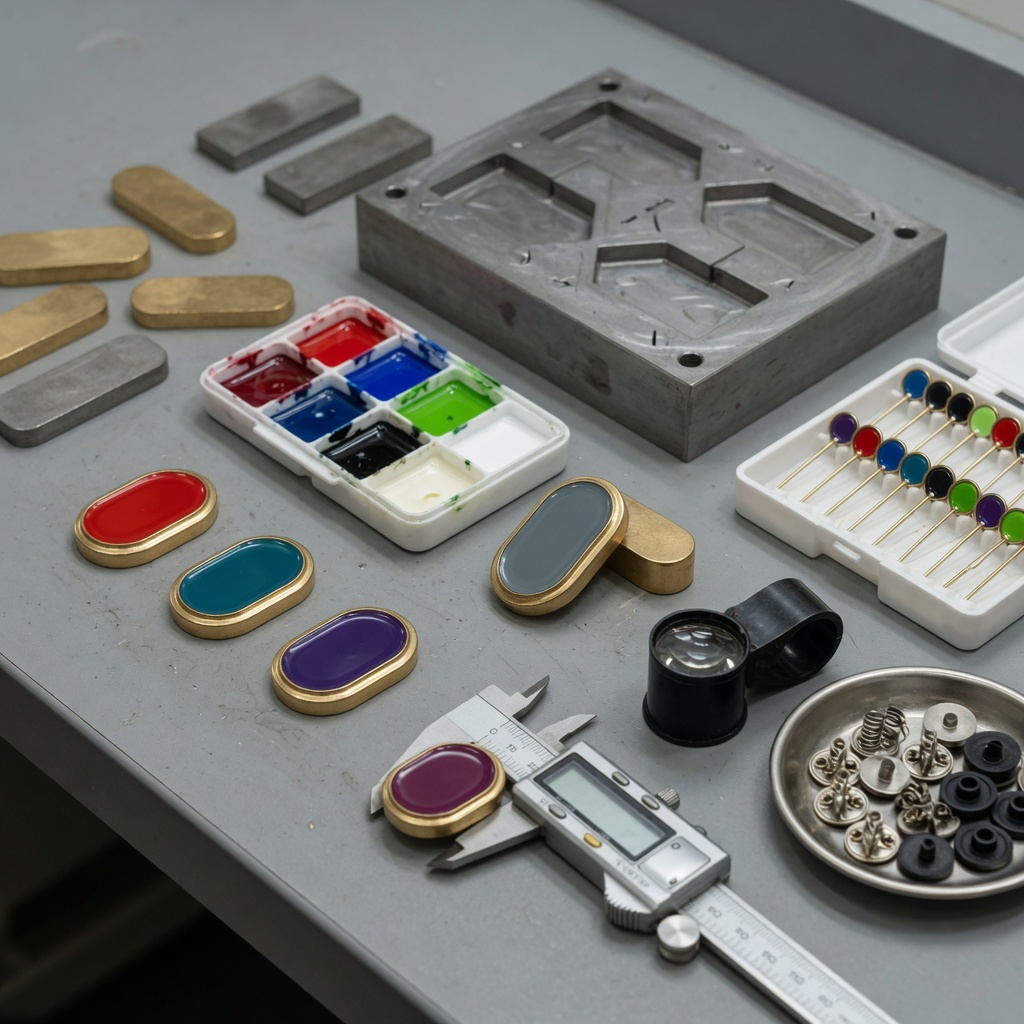
For custom lapel pins, product development is the chain that turns a logo into a repeatable stamped, cast, filled, or printed metal badge. A desk that only forwards files is not the same as a plant that can change enamel-cell walls, draft angles, plating stack-ups, and clutch hardware because a first article failed a fit, colour, or thickness check.
Capability that European procurement can actually test includes:
- Vector artwork redrawn for metal, with millimetre sizes, metal-reveal lines, colour callouts, and attachment type.
- Tooling method and location: steel die, zinc-alloy mold, print plate or screen, epoxy-dome tooling.
- Named construction: die-struck, die-cast, soft enamel, hard enamel, offset print, screen print, or a documented hybrid.
- Clock starts for digital molds and for physical first articles.
- Proof that the plant that makes the tool also plates, fills, and packs, or a named subcontract map if it does not.
Public manufacturer pages show how those gates are described commercially. Treat them as claim examples. Reconfirm every hour, piece quantity, and certificate in a design-specific, dated quote.
Jin Sheu’s custom lapel pin manufacturer page states that it delivers complete OEM and ODM solutions with support for custom artwork, prototyping, and mass production from concept to completion, and that its MOQ starts from 100 pcs per design (Jin Sheu custom lapel pin manufacturer). Star Lapel Pin’s factory page states that dedicated R&D engineers work in molding, stamping or casting, that an in-house designer will create artwork from a customer design, and that CNC 3D mold engraving is used to make the outline shape of metal molds (Star Lapel Pin factory). Accio’s customized lapel pin wholesaler briefing advises buyers to prioritise manufacturers over trading companies and to evaluate ISO 9001 or ISO 14001 documentation, enamel range, digital mold creation turnaround (ideally ≤72 hours), and in-house tooling for die-struck or printed designs; it also notes that Zhejiang and Jiangsu are associated with rapid prototyping and mid-volume orders (Accio customized lapel pin wholesaler briefing).
Those pages are examples of how factories claim development range. They are not dated audits, not destination-market certificates, and not ZheCraft measurements.
Quote-check numbers (reconfirm in the supplier quote; not plant tests):
- 100 pcs per design — unit: pieces per design; scope: Jin Sheu published starting MOQ for custom lapel pins; as-of: undated public claim on the cited manufacturer page; source: Jin Sheu. Confirm whether the floor applies to the named alloy, plating, and European destination.
- ≤72 hours — unit: hours; scope: digital mold creation turnaround as an evaluation ideal; as-of: Accio briefing target, not a dated factory SLA and not a hardened production-die promise; source: Accio. Write the clock-start event into the RFQ.
- 0.5 μg/cm²/week — unit: micrograms per square centimetre per week; scope: nickel release for articles intended to come into direct and prolonged contact with the skin under EU REACH Annex XVII (commonly cited as Entry 27; confirm the in-force entry text); as-of: confirm on EUR-Lex on the RFQ date; source: EU legal text to attach, not a laboratory result from the cited factories. This value is not a UK REACH result and is not an EEA result until the named country is checked.
- 13 December 2024 — unit: calendar date; scope: application date of Regulation (EU) 2023/988 (GPSR) to many consumer products placed on the EU market; as-of: that application date onward for EU placement; source: the regulation. GPSR is not UK law by copy-paste, and EEA application must be confirmed for the named EEA country.
- Example calculations to verify in the quote, not market prices: a common corporate badge longest dimension of 25 mm (confirm against brand guidelines); if mold NRE is a lump sum M and the first PO is 500 pcs, mold burden is M ÷ 500 per piece.
Artwork, mold-making, and first-article gates
Specify these engineering deliverables on the RFQ. Programmes stall when line weights cannot be struck or filled, enamel cells are too narrow, 3D relief will not hold in the chosen alloy, or a clutch does not match the garment standard used by a European uniform or association buyer.
- A production drawing, not only a marketing mock-up. Include longest dimension and thickness in millimetres, plating, colour references, dimensional tolerance, and attachment (butterfly, rubber clutch, magnet, or safety pin). Treat 25 mm longest dimension as an example to confirm against brand guidelines, not as a factory default.
- A process recommendation with reasons. Soft enamel, hard enamel, die-struck metal, or print should be chosen against line density and expected wear.
- Mold method, site, and ownership. CNC 3D engraving of outline molds is one documented factory technique on a cited plant page. Ask who pays for steel, who stores the tool, who may destroy it, and whether bulk will use the same cavity as the first article.
- Digital proof cycle. State file formats (AI, PDF, SVG), included revision count, revision-log owner, and whether a 3D render is dimensional or decorative only. If a bid repeats the ≤72-hour digital-mold evaluation ideal, require the clock-start event and whether weekends count.
- Physical sample policy. State quantity, whether the sample is from production tooling, whether metal and plating match the bulk stack-up, golden-sample retention, freight payer, and who pays if the order is cancelled after steel is cut.
Name the alloy on the RFQ (brass, iron, or zinc alloy) and require the first article in that alloy. Ask for mold cost as a separate line, mold life in press cycles, reorder MOQ after the tool exists, and whether sample pieces count toward MOQ. Confirm any published 100 pcs per design floor against the named construction before treating it as the first-order minimum.
Enamel routes and measurable development trade-offs
Product development capability only protects a European wholesale order if the sample predicts the bulk lot. Force a written link between sample method and production method.
Soft enamel leaves colour below the metal lines and is usually faster to fill. Hard enamel is filled then ground and polished flush; it adds finishing time and can read sharper at close range, but it is not automatically the correct route for dense wordmarks. Die-struck pins depend on die quality and plating contrast. Offset or screen print handles gradients that enamel cells cannot, provided the wear coating is specified.
Trade-offs to decide on paper:
- MOQ versus mold amortisation. Confirm any starting MOQ for the named construction. Example calculation to verify in the supplier quote, not a market price: if a mold is a lump sum of M and the first PO is 500 pcs, mold burden is M ÷ 500 per piece.
- Speed versus production-intent tooling. A digital mold in ≤72 hours may be a CAD/CNC step, not a hardened production die. If the first article is from a prototype tool, state in writing whether bulk will use the same tool.
- Manufacturer versus trader. Prefer a named manufacturer when European technical staff need a same-shift answer on wall thickness or plating. A trader can still be acceptable if the factory of record, audit rights, and sample origin are named in the contract.
- Finish versus abrasion. Epoxy domes hide fill height but change gloss and thickness. If a uniform pin must sit flat under a lapel, specify maximum finished thickness in millimetres on the first-article report.
None of the cited pages publish a plant-wide monthly capacity in pieces or a standard bulk lead time in days. Put both in the RFQ as supplier-stated values as of the quote date, with current committed load.
European chemical, safety, and file checks during product development
Do not treat Europe as one conformity box. Samples and bulk lots for the EU, the EEA, and the UK need destination-specific evidence. An EU Member State nickel result is not automatically valid for Great Britain under UK REACH. Confirm EEA chemical application for the named country. France or Germany pack rules are not a pan-European stamp on the metal.
Build the evidence pack during development, not after cartons are packed:
- REACH (EU) and UK REACH separately. For skin-contact articles, verify the in-force REACH Annex XVII nickel restriction on EUR-Lex for EU placement. The prolonged-contact value commonly cited in that legal text is 0.5 μg/cm²/week; confirm the in-force text on the RFQ date. It is not a factory lab result. Commission EN 1811 on the actual plating stack. EN 1811 is a test method, not a plant certification. A materials declaration is not a test report. Ask for a UK REACH statement on the same construction for Great Britain. List Northern Ireland separately if any volume will enter, and state which rule-set applies.
- Other restricted substances. Request a materials declaration covering base metal, plating, fill, dome, and attachment. Do not mark corporate lapel pins as toys without a legal assessment.
- General Product Safety in the EU. Regulation (EU) 2023/988 (GPSR) has applied since 13 December 2024 to many consumer products placed on the EU market. That date is an EU-placement date, not proof of application in an EEA country or in the UK. For EU placement, identify the responsible economic operator and list technical-file contents. GPSR is a role and file duty, not a reason to add CE marking unless a specific EU directive applies. Do not copy an EU GPSR file as GB evidence. For EEA destinations, name the country and confirm the in-force product-safety rule on the RFQ date.
- EEA and Great Britain. Norway, Iceland, and Liechtenstein apply many EU product rules via the EEA Agreement, but incorporation dates can differ. Name the EEA country and confirm chemical annexes and the product-safety file. For Great Britain, require a GB-market product-safety and UK REACH pack on the RFQ date. Do not relabel EU REACH or EU GPSR documents as GB evidence.
- Packaging and language. Triman-type or AGEC-related packaging information in France, LUCID packaging registration in Germany, and leaflet language rules are country-specific pack tasks. Put them on the packaging development list, not on the metal drawing.
When a European vendor policy requires ISO 9001 or ISO 14001, collect a current certificate PDF with scope, site address, and expiry date. A website badge is not a current document.
OEM versus ODM development models for wholesale programmes
OEM in this category usually means the buyer supplies controlled brand artwork and receives a pin built to that artwork. ODM means the supplier proposes construction, sizes, or hardware from proven tools, then applies the mark.
OEM needs heavier artwork engineering, new molds, and a stricter first-article loop. It is the usual path when a European brand mark cannot be approximated. ODM can be faster when an existing mold family fits, but only if exclusivity, storage, and destruction of tools are contracted when the pin is a uniform or membership emblem.
The cited manufacturer pages describe complete OEM/ODM paths and R&D routes through molding, stamping, or casting. Contract the steel, the cavity ID, and change control so the approved sample cannot be silently re-cut. Accio’s note that Zhejiang and Jiangsu specialise in rapid prototyping and mid-volume orders is a manufacturing-origin hint for due-diligence files, not a sales-market target and not a quality ranking.
Buyer decision table: score the RFQ before award
Score only against documents returned for the live RFQ. Every row is a specify, compare, verify, approve, or order action.
| Decision factor | Specify on the RFQ | Compare across bids | Verify before tooling PO | Approve before mass production |
|---|---|---|---|---|
| Development ownership | OEM, ODM, or mixed; who redraws vectors | In-house designer versus outsourced studio | Named design lead and site | Signed artwork revision log |
| Mold making | CNC 3D, conventional die, or outsourced tool | Hours for digital mold versus days for production die | Photo of tool with buyer code; ownership clause | Tooling completion report and cavity ID |
| First article | Production-intent metal, plating, and attachment | Prototype tool versus production tool | Dimensional report in mm and colour standard | Signed first-article report |
| Enamel or print route | Soft, hard, die-struck, offset, or screen | Cell-width limits and colour count | Macro photo of fill or print edge | Bulk lot against locked sample |
| Quantity gates | First PO qty, call-off, reorder MOQ | Published 100 pcs/design versus this construction | Mold life in cycles and spare-cavity plan | Packed qty versus PO |
| Speed | Digital mold hours; sample days; bulk days | ≤72-hour digital-mold target versus quoted clock | Calendar used (working days, holidays) | On-time first article; written delay control |
| Quality system | ISO 9001 or 14001 if vendor policy requires | Certificate scope includes this process and site | Current PDF, not a website badge | Incoming checks match declared scope |
| EU / EEA / UK evidence | Named destination country or countries | Nickel/EN 1811 plan; GPSR operator for EU placement | Lab name, method, plating-coupon lot | CoC and test report tied to the bulk lot |
| Traceability | Batch, mold ID, plating date format | Paper versus system records | Mock trace of one sample pin | Carton marks match the batch file |
| Commercial | Mold NRE, sample fees, revision fees | What is inside the unit price | Payment stage at each development gate | No silent process-change clause |
Hold or reject immediately if the factory of record is missing, the first article is not from the intended alloy and plating stack, bulk tooling differs from the sample without a signed change, or one chemical file is offered for EU, EEA, GB, and NI without a destination split.
RFQ checklist for European lapel pin wholesale programmes
Use this list to specify, compare, verify, approve, or order. Delete any line that does not apply; do not leave a development-critical item as TBD.
- Destination market(s): list EU Member State(s), EEA country, GB, and/or NI separately, with a separate evidence pack for each.
- Article: lapel pin; longest dimension and thickness in millimetres with tolerances; 2D or 3D; attachment type.
- Brand legal name, vector artwork, mark-ownership statement, and a ban on catalogue use without written permission.
- Process request: supplier-recommended route plus a one-paragraph engineering reason; epoxy dome yes/no.
- Colour standard: Pantone coated codes or chips; approval lighting; revision count; file formats (AI, PDF, SVG).
- Plating: metal type and micrometre thickness range if specified; otherwise lock the factory proposal on the sample report.
- Development clock: digital-mold hours from complete file; first-article days; days to first wholesale shipment; clock-start event; weekends yes/no.
- Sample terms: piece count; production-tooling yes/no; match to bulk stack-up; freight payer; golden-sample retention with cavity ID.
- MOQ for this design in pieces; whether the published 100 pcs per design floor applies; whether sample pieces count toward MOQ.
- Tooling: cost, material, cavity count, life in cycles, storage site, buyer ownership, destruction on request, cancellation if steel is cut.
- Capacity: monthly pieces for this process and committed load as of the quote date.
- Quality: inspection plan (name ISO 2859-1 level if used); visual standard photos; plating-thickness measurement yes/no.
- Restricted substances: REACH (EU) and/or UK REACH materials declaration; EN 1811 nickel plan with laboratory name and method.
- GPSR file for EU consumer placement since 13 December 2024: economic operator and technical-file list; not a GB substitute; confirm EEA country rule.
- Packaging development: bag or box, header card, inner-carton quantity, CoC language, and FR/DE or other named-destination pack marks.
- Certificates: current ISO 9001 or ISO 14001 PDF only if policy requires them, with site scope and expiry date.
- Factory of record: legal name, address, trader yes/no, audit-right clause, named subcontractors for tooling, plating, fill, or pack.
- Change control: no process, subcontractor, alloy, or plating-bath change after first-article approval without written buyer consent.
- Traceability: mold ID and batch code format on cartons; mock trace of one first-article pin.
- Commercial: currency, Incoterms® with named place, sample versus bulk invoices, payment stage at each development gate, quote validity date.
Evidence method and verification limits
Source context 1. Jin Sheu’s English-language custom lapel pin manufacturer page states complete OEM/ODM from artwork and prototyping through mass production, and an MOQ starting from 100 pcs per design (Jin Sheu custom lapel pin manufacturer).
Source context 2. Accio’s customized lapel pin wholesaler briefing sets evaluation criteria: manufacturer preference, ISO 9001 or ISO 14001, hard versus soft enamel, digital mold creation ideally ≤72 hours, in-house tooling for die-struck or printed constructions, and a regional note on Zhejiang and Jiangsu prototyping and mid-volume work (Accio customized lapel pin wholesaler briefing).
Source context 3. Star Lapel Pin’s factory page describes R&D engineers for molding, stamping or casting, in-house artwork from a customer design, and CNC 3D mold engraving for metal mold outlines (Star Lapel Pin factory).
How the data were derived. Editorial comparison of those three public capability pages against a European wholesale buying task: specify development gates, compare bids, verify documents, approve samples, and order bulk. Regulatory items are named so buyers can attach the correct official text and laboratory method. They are not copied as certificates from the three pages. The 25 mm size example and the mold-amortisation arithmetic are labelled assumptions to verify in the supplier quote.
Limitations / what to verify. Website capability copy is not a dated audit. The 100 pcs MOQ and ≤72-hour digital-mold ideal may change or may not apply to a given alloy, plating, or import country. ISO mentions on a third-party briefing are not proof of a live certificate. Nickel release values and GPSR duties must be checked against in-force official text for the named destination and against a test report on the actual production plating. EEA and NI destinations need a named-country check. Great Britain needs UK REACH and GB product-safety evidence, not relabelled EU files. This article does not estimate search demand, prices, plant capacity, or rankings. It does not claim that ZheCraft operated the cited factories or performed laboratory tests. Vincent Xi is the named Editorial Author (author profile); no first-person factory visit or trial-wear claim is made.
Send the RFQ checklist, require production-intent samples, and withhold tooling balance payment until the first-article report, materials declaration, and destination-market chemical evidence are complete.
Discuss Your Requirements
Review our manufacturing capabilities, then share your specifications for a supplier-fit review.