Keychain Wholesale Supplier Product Development Capability for United States Buyers
Byline: Vincent Xi, Editorial Author, ZheCraft. Profile: https://www.zhecraft.com/authors/vincent-xi/
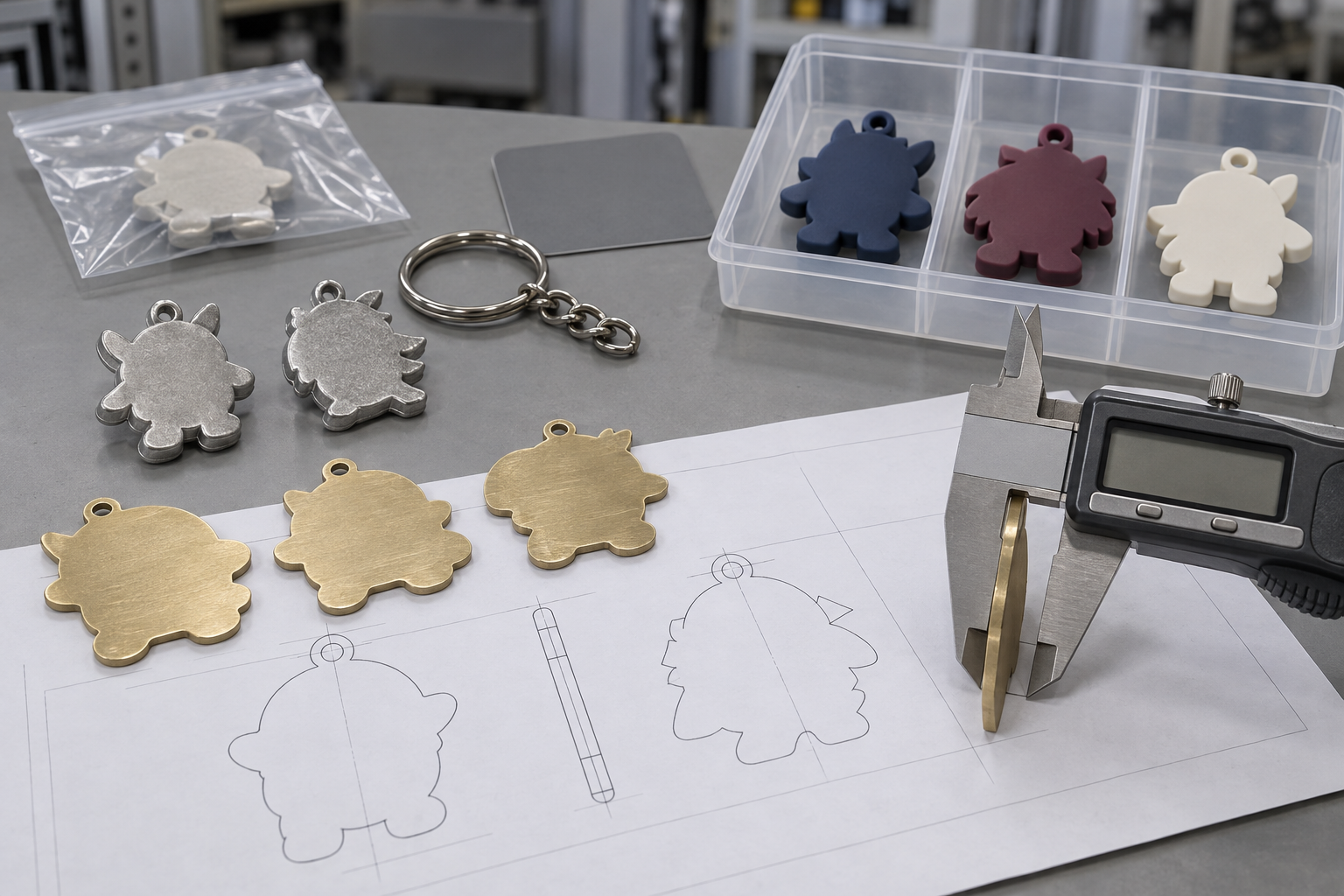
For United States procurement teams, keychain wholesale supplier product development capability is not an abstract credential—it is a controlled technical path from design files to an approved physical sample and a repeatable bulk manufacturing run. In wholesale supply contracts, that capability must specify the forming method, core alloys or polymers, surface plating or coloring, tooling ownership, revision thresholds, minimum order quantities (MOQs), inspection criteria, and mandatory customs documentation before goods ship to an American port or distribution center.
Public sourcing portals and factory websites present sharply contrasting figures for keychain manufacturing. One published sourcing overview cites metal stamping, die-casting, and PVC injection molding with a claimed monthly capacity of 500,000 pieces and MOQs starting at 500 pieces. Conversely, a jewelry manufacturer website advertises MOQs as low as 5 pieces and an aggregate monthly capacity exceeding 10,000 pieces across 15 production lines. A third wholesale guide lists entry-level bulk MOQs from 100 pieces, digital proof generation within 24 hours, and standard mass production runs of 7 to 15 days. These figures represent the published claims of their respective publishers rather than audited industry-wide metrics or ZheCraft operational data. Buyers must treat them as reference ranges requiring formal quotation verification.
This analysis evaluates product development capability specifically for United States B2B buyers seeking structured supply agreements. It does not provide consumer buying advice, rank commercial vendors, or replace engineering drawings, accredited lab testing, or formal customs filings.
Evaluating Product Development Capability for the United States Market
In practical procurement, product development capability measures whether a factory can translate technical requirements into physically stable samples and deliver production lots that match those samples without dimensional drift or aesthetic degradation. A rigorous evaluation examines six technical baseline requirements:
- Design Input Intake: Factory compatibility with vector artwork (AI/EPS), technical 2D PDFs with tolerance callouts, or 3D CAD files (STEP/IGES), alongside standardized color specifications (Pantone Matching System).
- Tooling and Process Selection: Engineering allocation across metal stamping, zinc-alloy die-casting, PVC injection molding, acrylic laser routing, or leather cutting, including assembly methods for jump rings and split rings.
- Tooling Custody and Revision Rights: Contractual clarity defining mold ownership, storage conditions between replenishment orders, and liability for die modifications resulting from buyer-requested revisions.
- Sample Approval Gates: Defect criteria and sign-off protocols separating preliminary visual proofs from first-article physical samples and sealed pre-production "golden samples."
- Import and Compliance Labeling: Factory readiness to apply permanent country-of-origin marks, master-carton shipping marks, and regulatory warning labels required under United States law.
- Commercial Milestones: Firm documentation of tooling surcharges, sample lead times, production cycle windows, and standard Incoterms.
Marketing pages advertising generic "OEM/ODM capability" rarely satisfy these operational criteria. For example, the Joacii Jewelry manufacturer page states that custom development projects can originate from CAD models or sketch files, supported by an in-house R&D staff, 15 production lines, and continuous keychain manufacturing operations dating back to 1998 (Joacii Jewelry). While this self-description illustrates established workshop operations, a United States buyer still requires an explicit engineering review, drawing control numbers, and a signed sample approval agreement before issuing a commercial purchase order.
Furthermore, catalog offerings must not be confused with bespoke development. The same Joacii webpage notes access to over 10,000 stock molds. Selecting an existing open mold can dramatically compress sample development timelines when a generic shape suffices. However, open molds do not demonstrate a factory's ability to hold tight dimensional tolerances on custom bas-relief silhouettes, licensed marks, or specialized dual-tone electroplating. The formal purchase agreement should record the designated mold serial number and specify whether tooling is proprietary or shared.
Published Process Routes and Tooling Trade-offs
The Top Jewelry sourcing guide identifies the primary forming routes for custom keychains as metal stamping, metal die-casting, PVC injection molding, and die-cutting, with specialized surface operations such as color-accurate soft and hard enamel infill (Top Jewelry). A separate bulk-order guide from Custom Keychains Wholesale outlines seven sequential milestones: requirement scoping, substrate selection, artwork submission, 24-hour digital proof generation, optional physical sampling, mass production with quality control, and final packaging (Custom Keychains Wholesale).
These production routes involve distinct tooling and quality management realities:
- Stamped Metal: Stamping dies excel at flat, high-definition geometric profiles, coins, and recessed enamel cavities using iron, brass, or copper. Modifying an exterior silhouette after die completion typically requires cutting a completely new trimming die.
- Die-Cast Zinc Alloy: Die-casting accommodates complex three-dimensional contours, curved surfaces, and integrated hardware holes. Tooling involves multi-cavity steel molds where runner placement, draft angles, surface porosity, and gate trimming are critical inspection points prior to electroplating.
- Injection-Molded PVC: Soft micro-injected PVC creates tactile, multi-layered color designs. The Top Jewelry guide specifically highlights PVC injection lines. Chemical plasticizer compliance, cure temperatures, and clean color separation between adjacent layers demand closer verification than basic hardware stamping.
- Acrylic and Leather: Acrylic parts require laser cutting or CNC routing with polished edges to prevent micro-fractures, while leather involves precision cutting dies and edge-sealing treatments that behave differently from cast hardware under abrasive wear.
Claimed minimum order quantities directly reflect these underlying processes. Joacii cites an entry MOQ of 5 pieces; Custom Keychains Wholesale outlines wholesale baseline quantities from 100 pieces; and the Top Jewelry technical guide cites baseline process thresholds starting at 500 pieces. An ultra-low MOQ of 5 to 50 pieces generally relies on stock blanks receiving digital flatbed UV printing or fiber laser engraving. Conversely, bespoke cast metal or micro-injected PVC requires dedicated tool setup, runner purges, and plating bath balancing that make run sizes below 500 pieces economically inefficient. Procurement teams must bind the supplier's MOQ directly to the quoted tooling method.
Similarly, published production capacity claims must be viewed within their stated scope. Top Jewelry reports a capacity of 500,000 pieces per month specifically for PVC injection lines. Joacii reports total output exceeding 10,000 pieces per month across 15 general jewelry and hardware lines. Neither figure represents reserved machine capacity for a prospective United States buyer. When planning recurring shipments—such as 25,000 units quarterly—the buyer must request confirmed machine reservation schedules rather than dividing a promotional capacity figure across calendar quarters.
Artwork Gates, Sampling Cycles, and Revision Controls
Custom Keychains Wholesale advertises 24-hour turnaround for digital proofs and characterizes physical sampling as an optional preliminary step before mass production. For United States corporate merchandising, brand-protection programs, and retail distribution, omitting a physical prototype introduces unacceptable commercial risk. A 2D digital rendering confirms vector layout and general text positioning; it cannot verify charm thickness, center-of-gravity balance when hanging, enamel fill consistency, plating hardness, or jump-ring weld integrity under tensile stress.
Procurement contracts should enforce three non-negotiable approval checkpoints:
- Artwork and Engineering Freeze: Written sign-off on 1:1 scale dielines, cross-sectional thickness dimensions, attachment placement, and PMS spot-color codes.
- First-Article Prototype Approval: Physical evaluation of cast or stamped prototypes for dimensional accuracy, deburring quality, plating brightness, and color infill under calibrated D65 retail lighting. Because published guides omit standardized sampling cycle durations, the supplier must formally quote prototype production and air-courier transit days.
- Golden Sample Archiving: Retaining two identical, sealed production-standard samples—one at the manufacturing facility as the assembly baseline and one at the buyer's inspection office to govern incoming lot acceptance.
Top Jewelry's sourcing narrative emphasizes a factory policy of 100% internal piece-by-piece inspection. Visual sorting can capture obvious surface scratches or missing enamel fills, but it does not evaluate functional mechanical performance or metallurgical stability. United States purchase agreements should explicitly identify the test type (such as tensile pull tests on chain attachments or cross-hatch plating adhesion tests), define sampling lot sizes (such as ANSI/ASQ Z1.4 sampling tables), and articulate non-conformance thresholds.
Illustrative Production Timeline Model (Planning assumption to verify in formal supplier quote, not an observed ZheCraft manufacturing lead time): Assume vector dieline revisions and digital proof sign-off require 2 business days. The supplier quotes physical mold preparation and prototype delivery at 12 calendar days. Upon written golden sample acceptance, factory production requires 10 calendar days for stamping, electroplating, assembly, and internal packaging. Total ex-factory readiness requires 24 days. Subsequent ocean freight (20–35 days) or air freight (4–7 days) to a United States consignee operates on a separate logistics clock. Buyers must replace every modeled duration with contractually bound milestone dates.
Quality Standards, Laboratory Testing, and Regulatory Realities
Industry sourcing pages frequently highlight formal audit certifications. Top Jewelry references supply-chain frameworks such as Sedex and licensor audit mechanisms like Disney FAMA. The Joacii web material references "ISO/SGS certification." These external mentions are specific to the publishing entities and do not certify third-party manufacturers, nor do unverified website mentions confirm that a vendor maintains active credentials.
Procurement officers must distinguish three separate compliance tiers:
- Management System Standards vs. Product Conformity: ISO 9001 certifies organizational quality management systems; it does not dictate keychain tensile strength, plating chemistry, or dimensional tolerances. Sedex SMETA evaluates ethical labor practices and workplace safety, not product durability. Disney Facility and Merchandise Authorization (FAMA) confirms that a specific manufacturing facility has satisfied proprietary brand-audit standards for licensed production runs; it does not confer blanket authorization for unrelated client trademarks. SGS is an independent testing and verification agency; citing "SGS certification" without an accredited laboratory test report number, testing standard, and publication date provides no technical assurance.
- Internal Quality Control (IQC/IPQC/FQC): A vendor's internal standard operating procedure—such as manual defect sorting or salt-spray chamber testing—governs daily operations. These internal procedures do not supersede statutory safety requirements in the destination market.
- United States Import and Product Safety Regulations: All commercial shipments entering the United States must comply with U.S. Customs and Border Protection (CBP) country-of-origin marking rules (19 U.S.C. § 1304), requiring permanent, conspicuous, and legible origin marking (e.g., "Made in China"). If a keychain is marketed to or intended for children aged 12 and under, mandatory Consumer Product Safety Improvement Act (CPSIA) rules apply, including total lead content limits (100 ppm for accessible substrates, 90 ppm for surface coatings), phthalate restrictions, mandatory third-party testing at a CPSC-accepted laboratory, permanent tracking labels, and a Children's Product Certificate (CPC). For distribution in California, Safe Drinking Water and Toxic Enforcement Act (Proposition 65) settlement limits for lead, cadmium, and phthalates must be evaluated to determine whether chemical warnings are legally mandated. Importers must commission accredited laboratory testing on production-grade materials rather than relying on promotional marketing statements.
Commercial Terms and Landed Cost Planning for United States Orders
Cross-border wholesale transactions encounter friction more often through commercial misunderstandings than physical casting flaws. Every development document, approved drawing revision, and commercial invoice must align under a single SKU identifier and agreed Incoterms (typically FOB origin port, CIF destination port, or DDP buyer facility).
To construct an accurate landed cost model, United States buyers should separate fixed development expenses from variable manufacturing and logistics costs:
- Dedicated die or mold manufacturing fees (including re-tooling allowances).
- Prototype production costs and international express courier transit to the United States.
- Tiered per-unit manufacturing costs based on volume breaks and surface treatments.
- Custom packaging, individual barcoding, master-carton burst strength ratings, and palletization.
- Regulatory warning labels, country-of-origin stamping, and compliance testing documentation.
- Ocean or air freight charges, merchandise processing fees (MPF), harbor maintenance fees (HMF), customs broker entry costs, and applicable Harmonized Tariff Schedule (HTS) customs duties.
Illustrative Landed Cost Calculation (Planning model based on explicit assumptions; verify with formal supplier quote and freight forwarder invoice): Assume an initial procurement run of 5,000 custom die-cast zinc-alloy keychains with soft enamel fill at a quoted price of USD 0.80 EXW per piece (USD 4,000 subtotal). One-time steel mold tooling is invoiced at USD 600. Air courier prototype delivery is billed at USD 150. Origin inland logistics, international air cargo, and U.S. customs entry processing are estimated at USD 900 by the logistics provider. The initial baseline landed expenditure totals USD 5,650 prior to applicable HTS duties, resulting in an effective fully loaded first-run cost of USD 1.13 per piece. A subsequent re-order of 5,000 units using the existing mold without sample fees amortizes logistics across the run, dropping the loaded baseline to USD 0.98 per piece before duties. Buyers must discard these baseline model figures once formal vendor quotations are secured.
Logistics planning must also establish clear ownership of delivery schedules. While Custom Keychains Wholesale cites a mass manufacturing window of 7 to 15 days, that duration covers workshop processing exclusively. Port drayage, customs clearance, and United States inland carrier transit must be scheduled independently.
Buyer Evaluation Matrix
This matrix synthesizes technical development checkpoints against published industry ranges. The reference data reflects claims made on the cited public websites and does not represent ZheCraft empirical test data.
| Technical Checkpoint | Specification Requirement | Published Source Reference (External Claims) | Buyer Action Prior to Contract Award |
|---|---|---|---|
| Design Ingestion | File formats (AI, CAD, PDF), 1:1 scale, PMS callouts | Joacii Jewelry states intake support for CAD models and custom design files | Require written confirmation of supported CAD formats and formal drawing control numbers |
| Process Selection | Metal stamping, die-casting, PVC injection, or cutting | Top Jewelry details stamping, casting, PVC, and enamel; Custom Keychains Wholesale notes PVC, acrylic, leather, and metal | Mandate a specific production route per SKU and prohibit unapproved workshop substitutions |
| Minimum Order Volume | Pieces per design, finish, and packaging variant | Joacii publishes MOQs from 5 pieces; Custom Keychains Wholesale cites 100 pieces; Top Jewelry cites 500+ pieces | Demand process-specific MOQ tiers tied directly to dedicated tooling requirements |
| Capacity Validation | Dedicated output within target delivery window | Top Jewelry claims 500,000 PVC pieces monthly; Joacii claims over 10,000 pieces monthly across 15 lines | Require committed weekly production scheduling rather than relying on published aggregate factory capacity |
| Sampling Protocol | Physical prototype iteration versus digital proofing | Custom Keychains Wholesale describes 24-hour digital proofs with optional sampling | Mandate physical golden sample sign-off for all new tooling; define revision cost allowances |
| Quality Verification | Visual inspection, mechanical testing, defect thresholds | Top Jewelry emphasizes a 100% internal piece-by-piece inspection process | Define written acceptance quality limits (e.g., AQL 1.5/4.0) and mandatory tensile pull-test parameters |
| Compliance Credentials | Auditing framework, report identifiers, validity dates | Sedex and Disney FAMA cited by Top Jewelry; "ISO/SGS" referenced by Joacii | Require valid, unexpired third-party certificates and accredited laboratory test numbers matching the vendor |
| United States Ingress | Country of origin, tracking labels, customs documents | Regulatory requirements not quantified in source marketing materials | Mandate compliant origin markings, applicable CPSIA/Prop 65 documentation, and defined Incoterms |
Evidence Basis, Methodology, and Verification Limits
Methodology: The comparative operational figures, manufacturing categories, and turnaround windows cited in this report originate exclusively from three publicly accessible vendor resources: the Top Jewelry keychain sourcing guide, the Joacii Jewelry manufacturing overview, and the Custom Keychains Wholesale bulk procurement guide. Stated figures reflect the self-reported marketing and operational claims of those specific commercial entities. They do not constitute an empirical survey of global manufacturing, nor do they represent ZheCraft operational testing or historical production logs. The timeline projections and unit-cost calculations presented are labeled structural examples intended to structure buyer financial analysis. This article contains no provider-derived keyword search volumes, cost-per-click values, difficulty ratings, or search engine ranking projections.
Verification Limitations: None of the underlying source materials contain formal publication or revision timestamps; reported production capacities, baseline MOQs, and lead times remain subject to unannounced factory modification and must be validated through formal quotation. An aggregate monthly capacity statement may denote historic peak production or non-keychain manufacturing lines. Historical operational claims (e.g., Joacii's founding in 1998) characterize a single supplier and cannot be extrapolated across other manufacturers. Certification references in the source texts omit specific registry numbers, test standards, and expiration dates. ZheCraft does not claim affiliation with or certification under ISO, Sedex, Disney FAMA, or SGS programs. This guide does not provide formal legal analysis regarding CBP classification, CPSIA testing, or California Proposition 65 compliance. Procurement teams must verify all physical, chemical, and shipping criteria against their finalized production drawings and independent laboratory reports.
Author Note: Vincent Xi, Editorial Author at ZheCraft (https://www.zhecraft.com/authors/vincent-xi/), prepared this editorial procurement guide through systematic desk analysis of the cited public manufacturing documentation. This report reflects rigorous editorial review of available industry data; no first-person factory audits, proprietary laboratory tests, or commercial project outcomes are claimed by the author.
```json { "@context": "https://schema.org", "@type": "Article", "headline": "Keychain Wholesale Supplier Product Development Capability for United States Buyers", "author": { "@type": "Person", "name": "Vincent Xi", "jobTitle": "Editorial Author", "url": "https://www.zhecraft.com/authors/vincent-xi/" } } ```
RFQ Checklist
- Ask the supplier to identify the exact forming method, base alloy or polymer grade, surface plating or coloring technique, and split-ring wire gauge for each keychain SKU, confirming that bulk lots will use the identical production process.
- Require the manufacturer to provide a milestone schedule separating digital dieline proofs, physical tooling, prototype delivery, and mass production, explicitly identifying the triggering event that starts the production clock.
- Specify the exact MOQ, tooling ownership terms, mold maintenance warranties, and per-unit volume price breaks on the quotation, rejecting generalized factory-wide minimums that lack process-specific binding.
- Ask the supplier for current third-party audit reports or accredited laboratory certificates supporting all marketing claims, including standard designations, issuing bodies, test report identifiers, and expiration dates.
- Require the factory to state all pre-shipment inspection parameters in writing, specifying whether internal screening is visual only and documenting which dimensional, cross-hatch adhesion, or tensile pull tests govern batch acceptance.
- Specify country-of-origin marking formats, master-carton labeling dimensions, and any mandatory children's-product tracking labels or California Proposition 65 warnings required for United States customs entry and retail distribution.
- Verify that the purchase order, approved golden sample serial number, drawing revision code, and commercial invoice align under a single SKU before releasing production deposits.
- Approve landed-cost budgets only after replacing all modeled tooling, prototype freight, customs duty, and inland drayage estimates with binding vendor quotations and forwarder rate sheets.
Discuss Your Requirements
Review our manufacturing capabilities, then share your specifications for a supplier-fit review.