Keychain Sourcing Production Scalability Planning for United States Buyers
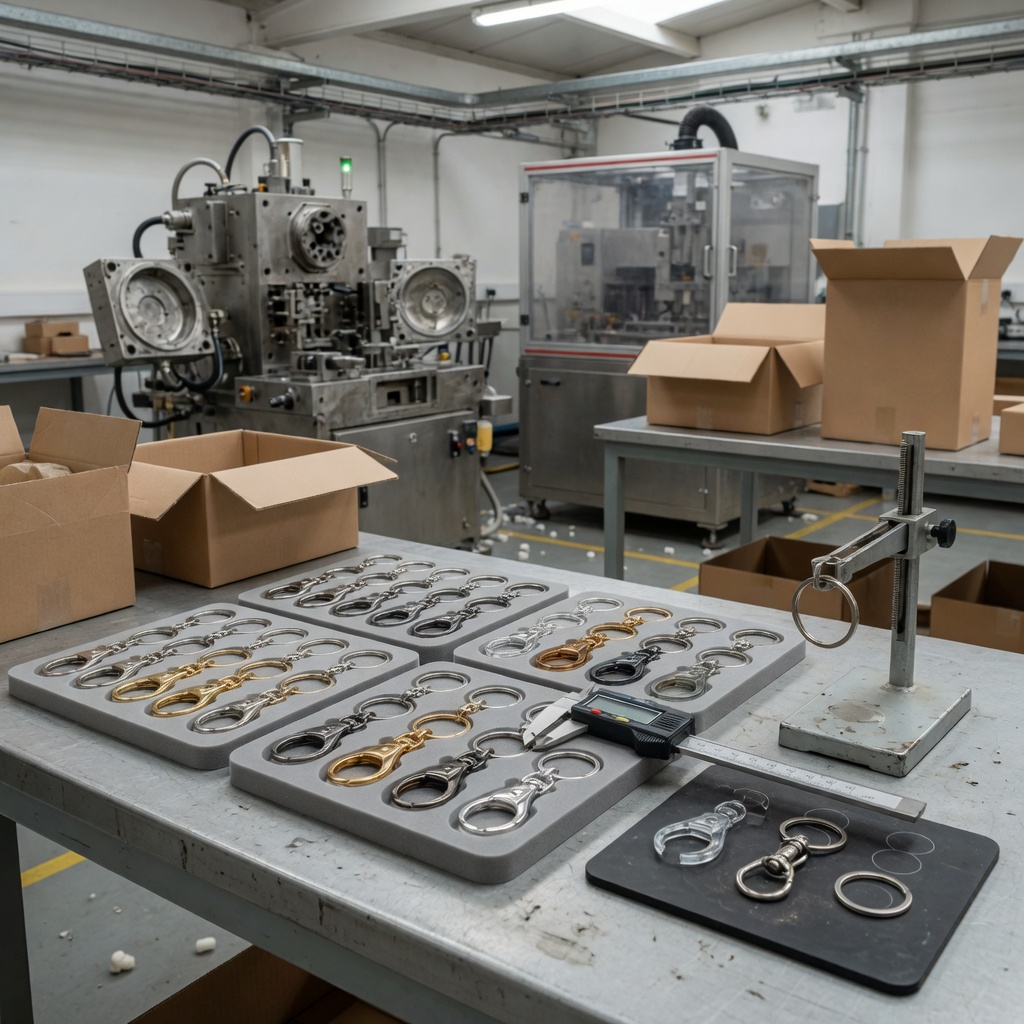
Editorial by Vincent Xi, Editorial Author, ZheCraft. Author profile: https://www.zhecraft.com/authors/vincent-xi/. This brief compiles cited public process and cluster guidance for procurement comparison. It does not claim factory visits, client results, certifications held by ZheCraft, or first-person production experience.
United States B2B buyers should treat keychain sourcing production scalability planning as a gated procurement decision, not a unit-price contest. Freeze the specification and durability protocol; audit demonstrated capacity and booked utilization; reserve machine-weeks, with a dual-cluster backup if one site cannot hold the ship window; then release volume only against RFQ numbers for QC, packing, origin marking, and landed cost.
As published on a keychain manufacturing process page (unit: calendar days; scope: sampling versus production as stated on that page; as-of: the cited page’s published planning ranges, not a live factory slot), treat 15–25 days for sampling and 30–45 days for production as envelopes to verify on the quote, not as guaranteed calendars (How to Manufacture Keychains). An acrylic-focused 2026 sourcing page (unit: percent of described acrylic keychain capacity and percent of 2026 capacity booking as stated there; scope: that page’s acrylic cluster description, not all metal keychain plants; as-of: the page’s 2026 framing) also states Guangdong versus Zhejiang cluster shares and a high booking-rate warning. Use those figures as calendar-lock signals, then reconfirm against the factory’s current book (Sourcing Acrylic Keychain Manufacturer from China: The Ultimate Guide 2026). This page stays on production scalability planning for custom keychain procurement: what to specify, how to compare capacity, and which RFQ controls United States teams should require before a scale order.
Award rule (use before the PO): If any item is missing, do not treat the quote as scalable. Request a revised RFQ or run a paid pilot: (1) written process, hardware, and pass/fail tests; (2) last-90-day demonstrated output plus next 8–16 week booking (buyer-specified windows); (3) a capacity-reservation clause; (4) United States packing, country-of-origin marking, and a landed-cost worksheet the importer’s broker can complete.
What United States procurement teams should lock before volume keychain orders
Lock a specification pack and a durability protocol before comparing piece price. A keychain is low unit cost and high failure cost once a finish, ring, print, or plating defect repeats after a large shipment.
Freeze before quoting:
- Material and process route (zinc-alloy die-cast, stamped metal, acrylic laser/CNC, PVC/soft enamel only if that route is in scope).
- Hardware SKU (split ring, lobster clasp, chain length, wire diameter in mm, opening force in N, finish).
- Plating or print stack and color standard.
- Dimensional tolerances and cosmetic AQL by defect class.
- Pass/fail durability tests with method, not an unnamed factory default.
A manufacturing overview of these routes emphasizes locking pull-strength, drop, and related QC gates before scale because rework and air freight erase the unit-cost advantage (How to Manufacture Keychains).
For United States programs, add origin marking, carton labeling, packing density for ocean freight, and a landed-cost model (EXW or FOB plus freight, insurance, duties, broker, and inland). Do not treat published cluster lead-time or MOQ ranges as PO terms. Use them as a starting envelope, then require current open slots, tool ownership, and a reservation clause tied to a deposit and a freeze date.
A low-MOQ workshop can turn a pilot quickly (for example, a 500-piece trial inside the published 500–3,000 unit MOQ envelope cited below; verify on the quote) but may not hold plating, die-cast, or laser cells at a larger repeat lot (for example, 20,000–100,000 pieces as a buyer-assumed scale step, not a published factory limit). Dual-tooling across two clusters costs more in steel and first-article time; it buys a second queue when one site hits a plating or labor constraint.
Pilot kill criteria (trial PO gates, not third-party statistics): stop mass release if first-article dimensions, color, or hardware fail; if pull or drop tests fail on retain samples; if packing or country-of-origin marks fail a United States inbound checklist; if open machine-weeks cannot cover the DC need-by date after ocean transit and a rework buffer; or if both clusters share the same plating shop or ring mill.
How to evaluate current capacity, utilization, and expansion for scale
Buy demonstrated output and open machine-weeks. Reject slogan capacity.
A supplier-selection guide used as a public screen list, not as certified plant performance, asks buyers to request and date-check these filters: factory floor area over 1,000 m² as a size screen (unit: square meters; scope: factory-size screen on that page; as-of: as published on the cited page); documented staff and equipment lists; ISO 9001 or BSCI documents to request and date-check (not an assumption that a factory holds a current certificate); on-time delivery cited above 98% as a reported threshold to verify with shipment history (unit: percent on-time as defined by that page; scope: selection threshold, not a named plant’s OTIF; as-of: as published on the cited page); physical samples; and reorder rates exceeding 20% as one signal that other buyers returned for bulk rather than only samples (unit: percent reorder as stated there; scope: selection signal on that page; as-of: as published on the cited page) (How to Find a Keychain Manufacturer: Top Suppliers & Sourcing Guide). Those figures are selection criteria from that guide, not certified performance of any specific plant.
Request in writing:
- Monthly nameplate and demonstrated output by process (die-cast shots, stamp strokes, laser hours, packing lines) for the last 90 days (buyer-specified lookback).
- Utilization percentage and the share already booked for the next 8–16 weeks (buyer-specified horizon).
- Bottleneck machine (plating line, epoxy dome, laser, or assembly) and backup plan.
- Any expansion (added presses, second plating shift, new laser) dated against equipment purchase orders or photos of installed machines, not a brochure claim.
High utilization leaves little surge room for a United States retail drop. Low utilization can embed idle cost in piece price. An expansion claim is useful only if the equipment is ordered and the quality system for the new cell is already defined.
Dual-sourcing Guangdong precision and Zhejiang high-volume clusters
Dual-source only after two first-article reports pass the same golden sample and the same pull/drop protocol. Paper dual-source (two logos, one qualified cell) is not a scale plan.
For acrylic and mixed custom keychains, one 2026-oriented cluster guide attributes about 55% of described acrylic keychain capacity to Guangdong (positioned on that page for higher-precision work), about 35% to Zhejiang (positioned there for high-volume standard items), and about 10% to Fujian (positioned there as lower-cost). Unit: percent share as described by that guide. Scope: acrylic keychain capacity as that page describes it, not a census of all zinc-alloy or stamped keychain plants. As-of: 2026 framing on that page. It recommends dual-sourcing Guangdong and Zhejiang to cut single-site risk and states a claim that 90% of 2026 capacity was already booked (unit: percent of 2026 capacity booking as that page defines it; scope: the page’s 2026 capacity claim; as-of: 2026-oriented language on that page). United States buyers should treat that language as a published warning to lock calendars, then reconfirm against the factory’s live schedule (Sourcing Acrylic Keychain Manufacturer from China: The Ultimate Guide 2026). Guangdong/Jiangsu-style integrated clusters are also described elsewhere as supporting high-volume output and prototyping, with a stated 30–50% shorter lead-time effect versus less integrated sources (unit: percent lead-time reduction claimed by that guide; scope: cluster-style comparison on that page, excluding United States inland transit and customs holds; as-of: as published on the cited page). That is a guide claim to test with a real Gantt, not a contract term (How to Find a Keychain Manufacturer: Top Suppliers & Sourcing Guide). Manufacturing origin in these clusters is a supply-base fact, not a sales-market target.
Practical dual-source model for United States procurement:
- Tool the hero SKU in one precision cell and a visual-match or overflow SKU in a high-volume cell.
- Keep one approved plating/print stack and one hardware SKU (same ring wire diameter in mm and opening force in N).
- Split the first scale PO only after both sites pass the same tests (for example, a 70/30 quantity split as a buyer assumption to verify in the quote).
- Require two first-article reports and two packing specs that still scan the same UPC/inner for one United States SKU.
- Map sub-tier plating and ring supply so both plants do not share the same bath or mill.
Extra tooling and two FAIs add weeks and cost. Dual source without independent hardware and finishing is a single point of failure with two logos.
MOQs, lead times, automation, and capacity locking
Separate sample, pilot, and mass calendars. A sample MOQ that cannot repeat at program volume is not scalable. Reserve machine-weeks, not only a ship week.
Published planning envelopes include MOQs of 500–3,000 units (unit: pieces per order as stated on that page; scope: acrylic-focused envelope on that 2026-oriented guide; as-of: 2026 framing on that page) and lead times in the 12–25 day band on the same page (unit: calendar days; scope: lead-time band as published there; as-of: 2026 framing, not a dated factory slot), versus the 15–25 day sampling and 30–45 day production envelopes on the general manufacturing overview already cited (unit: calendar days; scope: sampling versus production as stated on that process page; as-of: as published on the cited page) (Sourcing Acrylic Keychain Manufacturer from China: The Ultimate Guide 2026; How to Manufacture Keychains). Treat those ranges as envelopes to verify on the live quote. The same acrylic guide cites a requirement-style claim of CNC/laser automation over 70% associated with 99.2% accuracy (unit: percent of CNC/laser process steps and percent accuracy as stated there; scope: claim on that 2026-oriented page, not a named SKU’s CPK; as-of: 2026 framing on that page). Treat that as a specification to request (share of CNC/laser process steps, CPK or first-pass yield on a named SKU), not as a certified result for an unnamed factory.
Capacity locking for United States programs:
- Freeze art and Pantone/plating standards before the production clock starts.
- Reserve machine-weeks with a written release date and a cancel/postpone fee.
- Separate sample, pilot (often a few hundred to a few thousand pieces as a buyer-planned trial inside the published 500–3,000 unit envelope; confirm on the quote), and mass.
- Ask for volume breaks that match die-cast shot life, plating rack density, and carton optimization.
- For seasonal United States retail, back-plan from the DC need-by date: ocean transit, customs, and a buffer for a second lot if the first fails AQL.
Quotes in the 12–25 day band usually assume approved files, available metal/acrylic, and open plating slots. Custom zinc die-cast plus multi-color enamel plus unique hardware often lands closer to the 30–45 day production band once tool tweaks are included.
Materials, processes, and QC gates that decide whether scale holds
Put test methods in the RFQ. An unnamed factory default is not a scalable QC gate.
Process routes that matter for scalability:
- Zinc-alloy die-cast: 3D logos and weight; tool cost and shot life dominate. Dimensional drift and porosity often show only after volume.
- Stamping: faster for flat metal; burrs and plating hang-points become the volume defect.
- Acrylic laser/CNC: art changes are cheaper than steel tools; edge quality, print adhesion, and warpage become the volume defect.
- Hardware: split-ring wire diameter (mm), opening force (N), and finish must be specified; mixed rings are a common field failure.
QC that should be in the RFQ: pull test on the ring/joint (state force in N and hold time in seconds), drop test (height, cycles, floor type), plating thickness in µm or salt-spray hours if corrosion is in scope, print/adhesion, color delta, and AQL by defect class. The process guide flags pull-strength and drop tests among the checks to lock before scaling (How to Manufacture Keychains).
For United States delivery, specify carton burst/ECT, inner count that matches store or DC handling, polybag or paper wrap rules, and country-of-origin marking on the product or hangtag as required for the SKU. If the keychain is marketed for children, classify CPSC/CPSIA obligations separately with counsel and a lab scope. Prop 65 and other state rules are chemistry-specific; require a materials declaration and test plan. Naming those regimes is not a claim that any factory, SKU, or ZheCraft program is certified.
United States landed cost, labeling, and delivery controls
Keep the keychain RFQ primary. Treat labeling, HTS, Incoterm, and DC routing as scale controls, not as a generic country guide.
United States-specific controls that belong in production scalability planning:
- HTS classification by material (metal versus plastic/acrylic) from the importer’s broker. Duty is not a factory quote line unless you buy DDP and the seller is contractually on the hook.
- Incoterm (FOB named port versus EXW) and which party books the vessel during peak space.
- Origin marking, English labeling, and any retailer routing guide (ASN, pallet, UCC).
- First scale-up mixed mode: air a gold-sample and a small sell-in lot; ocean the balance only after AQL pass.
- Inventory policy: if booked share is already near the acrylic guide’s published 2026 capacity-booking warning, United States DC safety stock is part of the scale plan. Reconfirm that third-party 2026-oriented claim; it is not a ZheCraft statistic (Sourcing Acrylic Keychain Manufacturer from China: The Ultimate Guide 2026).
Do not copy duty percentages from old blogs. Re-run landed cost on actual net weight (kg), carton cube, and current freight. Cluster lead-time claims do not include United States inland transit or a hold caused by mis-classified product or incomplete marking (How to Find a Keychain Manufacturer: Top Suppliers & Sourcing Guide).
Buyer decision table: scalability indicators for keychain suppliers
Fill every row with a number, document, or fail before awarding volume.
| Decision item | RFQ specify / verify | Scalability implication | Public-guide range (verify on quote) |
|---|---|---|---|
| Process route | Die-cast, stamp, acrylic, hardware; traveler + FAI | Wrong route cannot scale without new tools | Process menu (source) |
| Floor / cell size | Dedicated cell vs shared; video audit, m² | Shared cell loses slots at peak | >1,000 m² size screen (source) |
| Utilization and booking | Last-90-day %; open weeks; booking calendar | High booking = lock or dual source | 90% 2026 booking claim—reconfirm (source) |
| Cluster dual-source | Two FAIs, two pack specs, mapped sub-tiers | Works only if finishing is independent | ~55% GD / ~35% ZJ described acrylic share (source) |
| Lead time | Sample vs mass; Gantt; clock = files + deposit | Sample speed is not mass speed | 15–25 sample / 30–45 production days (source); 12–25 day band (source) |
| MOQ and breaks | MOQ by process/color; repeat MOQ; amortization | Pilot MOQ that cannot repeat is not scalable | 500–3,000 unit envelope (source) |
| Automation | % CNC/laser or SPC on hero SKU; last-lot yield | Repeatability vs flexibility | >70% CNC/laser and 99.2% accuracy claim to test (source) |
| Delivery reliability | On-time definition; last 12 dates vs promise | Reorder only if OTIF holds at volume | >98% on-time check threshold (source) |
| Repeat business | Repeat keychain SKU share; redacted POs | Bulk capability vs sample mill | >20% reorder check threshold (source) |
| QC protocol | Pull N/hold s; drop; plating/print; AQL; retains | Cheap QC fails after the ocean leg | Pull and drop tests before scale (source) |
| United States packing | COO, carton marks, routing; pack photo | Failed mark delays United States entry or DC | Buyer-specified; not a factory default |
| Capacity lock | Reserved machine-weeks, deposit, cancel fee | Without a lock, the Gantt is a wish | Buyer-specified |
Production scalability planning RFQ checklist for United States keychain orders
Attach this list to the RFQ. Every item should produce a number, document, or pass/fail.
- Named processes and monthly demonstrated output (units or machine-hours) for the last 90 days, by die-cast / stamp / acrylic / assembly.
- Utilization % and already-booked share for the next 8 and 16 weeks; open slot dates if files are approved by a stated freeze date.
- Equipment list for the cell (presses, lasers, plating, printers) and the bottleneck with a backup plan.
- Share of CNC/laser or other automated steps on this SKU family, plus first-pass yield or defect ppm on a comparable recent lot (buyer to verify).
- Dual-cluster option: second plant, second tool plan, incremental tool cost, second FAI date, and whether plating/rings are independent sub-tiers.
- Sample lead time and mass lead time with the clock definition (deposit + approved art + hardware in house).
- MOQ by SKU, by color, and for repeat orders; volume breaks tied to racks/shots, not only price.
- Tool ownership, cavity life, and who pays for a second tool if the first cannot meet the United States ship window.
- Hardware spec: ring wire diameter (mm), opening force (N), finish, and approved vendor; no mixing lots.
- Durability protocol: pull force (N) and hold time (seconds); drop height and cycles; plating thickness (µm) or salt spray if in scope; print adhesion; color delta; AQL.
- Golden sample, pre-production sample, and mass retain policy; photo and dimensional report with each lot.
- Packing: inner count, carton size/weight, edge-crush or burst, polybag rules, pallet pattern for a United States DC.
- Marking: country of origin, any English care/warning the buyer’s counsel requires, UPC/GTIN placement.
- Incoterm, port, and whether the factory will reserve space; air-versus-ocean split for first scale lot.
- Documents: material declaration, plating chemistry, dated test reports, and any ISO 9001 or social-audit certificates with expiry if offered. Review dates; a named standard is a document request, not a claim that ZheCraft or a named plant is certified.
- Capacity-reservation clause: weeks reserved, deposit, postponement fee, and what happens if utilization is already above a stated %.
- On-time definition and the last 12 actual ex-factory dates versus promise (redacted is acceptable).
- Reorder evidence: share of keychain output that is repeat programs, as a figure to validate, not a slogan.
- United States landed-cost worksheet fields: net kg, cube, carton count, and HTS confirmed by the importer’s broker.
- Trial-run quantity and kill criteria before the mass PO is released.
How the data in this article was derived
Source context 1: a keychain manufacturing process page covering material routes, methods (die-casting, stamping, laser cutting), hardware, plating, pull-strength and drop tests, and published sampling and production day ranges (How to Manufacture Keychains). Source context 2: a manufacturer-finding guide that lists cluster characteristics and supplier screens (floor area, equipment, documents such as ISO 9001 or BSCI to request, on-time and reorder thresholds, samples) (How to Find a Keychain Manufacturer: Top Suppliers & Sourcing Guide). Source context 3: an acrylic-focused 2026 sourcing page that states cluster-share percentages, a high 2026 booking claim, automation/accuracy figures, MOQ/lead-time envelopes, and dual-sourcing of Guangdong and Zhejiang (Sourcing Acrylic Keychain Manufacturer from China: The Ultimate Guide 2026).
Methodology: numbers above are restated with their published unit and scope (days, m², percent of described acrylic capacity, percent booking, percent automation, percent on-time, percent reorder, unit MOQ). Buyer-specified RFQ windows (for example last 90 days, next 8–16 weeks, last 12 shipments) and example quantities (pilot, 70/30 split, repeat-lot steps) are audit-design choices or assumptions to verify in the supplier quote, not factory statistics. These figures are planning envelopes for RFQ comparison. They are not ZheCraft factory statistics, not a forecast of keyword demand, and not a certification of any plant.
Limitations and what to verify on the live quote
Cluster shares, 90% 2026 booking language, 99.2% accuracy, 98% on-time, and 20% reorder figures come from third-party guides; audit dates are not fully specified on those pages except the 2026 framing of one source. Reconfirm every figure against a current capacity calendar, equipment list, shipment log, and dated certificates. Lead-time bands omit United States ocean transit, customs, and retailer routing. Duty and product-safety classification are importer obligations and depend on material, intended user, and claims. Dual-sourcing only works if hardware, color, packing, and sub-tier finishing stay matched. Do not treat a sample MOQ of 500–3,000 units as proof the same cell can hold a national United States program. Run a paid pilot, freeze the spec, then lock machine-weeks.
Production scalability planning for United States keychain procurement succeeds when the RFQ forces numbers (capacity, utilization, test forces, carton cube) and when the PO pays for a reservation and a second qualified route. Price without those controls is not a scale plan.
Discuss Your Requirements
Review our manufacturing capabilities, then share your specifications for a supplier-fit review.