Keychain Sourcing Product Development Capability for European Procurement
By Vincent Xi, Editorial Author ZheCraft · Author profile
European B2B buyers should award a custom keychain program only when product development capability is written as a contractable sequence of files, tools, and signed samples—not as a catalog promise. Freeze geometry, materials, color, print, plating or coating, and attachment hardware against a retained golden sample, then release bulk. If the RFQ still scores a digital mockup, a stock shape, or an unverified customization claim, hold the award: those paths miss launch dates, fail incoming inspection, or ship a SKU the importer of record cannot place on the intended EU member state, EEA, or UK market.
Map every quote to one development path, one sample ladder, written mold ownership, and a document plan named to a destination—not to “Europe” as a single regime. Hold the purchase order when the supplier offers mockup-only approval for plated metal, PVC color, or fine print; cannot name cavity count and steel ownership; or substitutes plant-wide monthly output for a SKU-level calendar to a named European approver.
This article is for European procurement of custom keychains. It shows how to specify and compare product development capability so RFQs can be scored side by side. It does not attribute factory visits, tests, certifications, or customer outcomes to the author or to ZheCraft.
Keychain sourcing product development capability: RFQ artifacts European buyers should demand
On a keychain RFQ, product development capability is the supplier’s ability to convert a brand brief into a repeatable production process. Score that ability as four artifacts the buyer can file:
- Design translation. Logo art, size, shape, and colors become dimensioned drawings or 3D files, then digital mockups for a first visual check. A manufacturing guide on custom keychain flow places this concept-to-mockup step before any physical part exists (The Guide To Custom Keychain Manufacturing: From Prototyping To Mass Production).
- DFM and process choice. Zinc alloy die-cast, iron stamp, PVC/soft PVC, silicone, acrylic, wood, leather, or mixed assemblies each change draft angles, wall thickness, insert hardware, and print method. Factory-selection guidance on OEM/ODM customization typically includes shape and size in 2D or 3D, Pantone matching, and material options (What Should You Look for in a Reliable Custom Keychain Factory?).
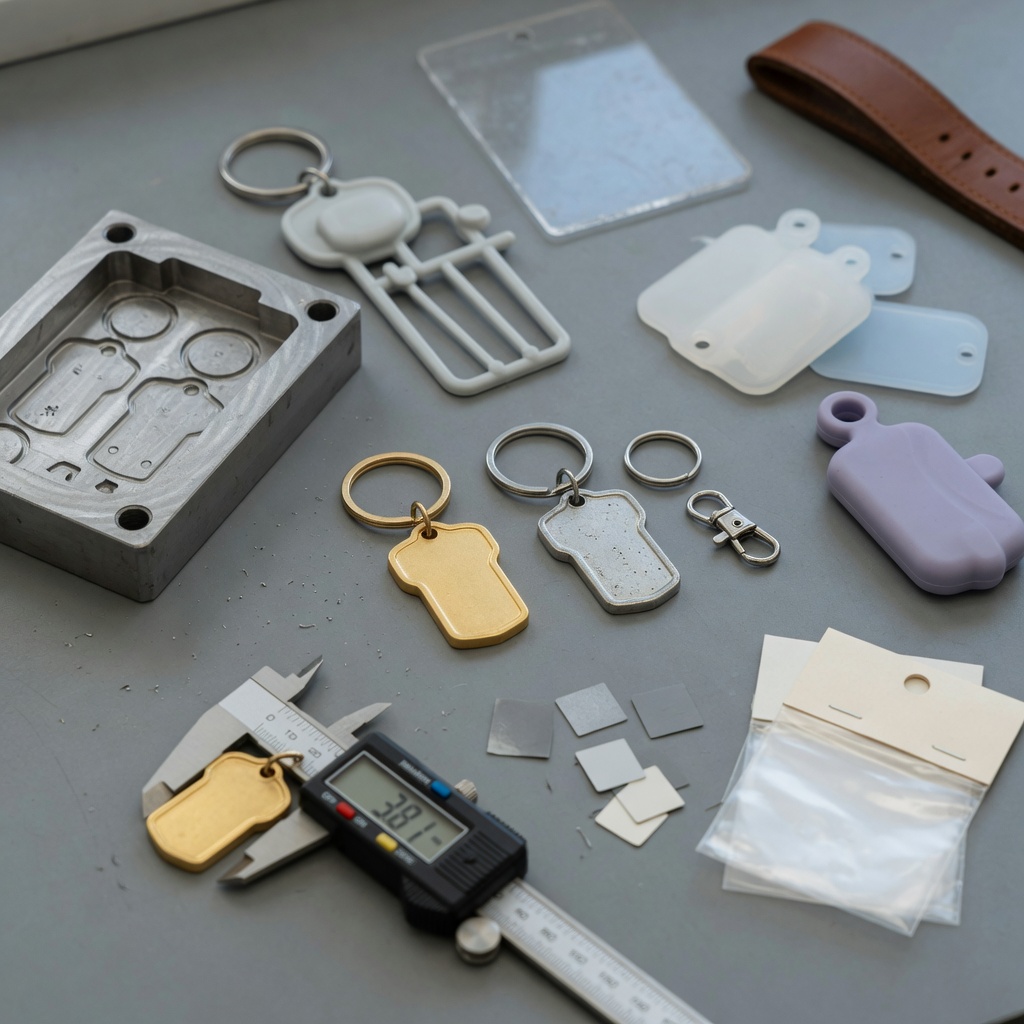
- Tooling. Existing-mold libraries speed look-alike parts. New geometry usually needs CNC-cut custom molds. A public overview of China-based keychain and keyring factories states that custom molds using CAD files and CNC typically take two to four weeks (unit: calendar weeks; scope: custom keychain molds in that vertically integrated factory description; as-of: undated public page, not a timed study) and that many plants keep libraries of thousands of existing keychain molds (unit: mold-count band; same page scope; as-of: undated excerpt) (Keychain & Keyring China factory and Manufacturers). Those figures are typical-range statements on that page; they are not measurements of ZheCraft operations and must be re-quoted against your drawing, cavity count, and finish.
- Physical proof. Before bulk, a prototype or T-sample is used to assess size, material quality, color consistency, and print clarity—the checkpoint named in the prototyping-to-mass guide above.
Buy those artifacts, not adjectives. “In-house R&D” without named file formats, sample stages, and mold ownership is not a capability you can audit. If two suppliers cannot return the same four artifacts, their prices are not comparable.
The same factory-overview page also describes vertical integration of injection molding, metal stamping, and assembly under one roof. Treat that as process-layout language from an undated public page, not as a substitute for SKU-level sample discipline.
Europe destination files versus factory process claims
Process capability and market-access evidence are different purchase items. A supplier can CNC a mold and still leave the European importer of record without a usable technical file for the destination country.
Treat EU member states, the EEA, and the UK as separate destination regimes in the RFQ. Do not assume that one marking statement, one chemical screen, or one labeling layout covers “Europe.” Enforcement, on-pack language, and the legal person who places the product on the market differ. If the keychain is sold as a toy, a giveaway with a children’s motif, or jewellery-like prolonged skin contact, the evidence pack the importer must hold changes again. This article is not legal advice, does not name a certificate, and does not apply a single chemical or marking rule to every European country. The cited factory-education pages do not document member-state enforcement; therefore this page does not invent country-by-country legal tables.
What procurement can still demand during development, as RFQ fields rather than brochure language:
- Material declaration for every component (body, plating, paint/ink, epoxy, PVC/silicone, split ring, chain, lobster clasp, paper card, polybag).
- A written test plan scoped to the destination (named EU member state vs EEA vs UK), not to “export.”
- Retention of the golden sample and a change-control clause: no steel, pigment, or print-process change after approval without a new sample loop.
- Pack-out that matches the importer’s on-pack language and batch/lot coding needs.
- A hold on leftover trial shots so T0/T1 parts cannot mix into the production lot bound for the named European destination.
Factory pages that stress vertical integration and monthly scale do not replace that destination file. Scale after freeze is useful; it is not a substitute for sample control.
CAD, mold libraries, CNC tooling, and sample-loop trade-offs
The measurable trade-offs sit in the tooling path, not in press-count marketing. Choose one path in the RFQ before asking for a unit price.
Existing-mold library versus new CNC tool. A library described as thousands of existing keychain molds (mold-count band; vertically integrated factory-overview page cited above; undated excerpt; not a ZheCraft count) can compress development when the buyer can accept catalog geometry with logo or color changes. The trade-off is weaker exclusivity, possible shared cavities, possible use of the same parent tool by other brands, and limited control of wall thickness or attachment position. A new CNC custom mold supports unique 2D/3D shape at the cost of the two-to-four-week typical band for CAD-and-CNC custom molds on that same page (unit: calendar weeks; scope: custom keychain molds in that factory description; as-of: undated public page)—plus however many approval loops your organization adds. Re-quote the band in calendar weeks against your undercuts, cavity count, and finish; do not treat the public range as a contractual lead time.
Digital mockup versus physical prototype. Mockups are cheap for layout and logo placement. They do not prove shrink, flash, plating color, PVC Shore hardness, epoxy bubble rate, or print edge definition. Keep the prototyping guide’s sequence in the contract: mockup, then a physical prototype scored for size, material quality, color consistency, and print clarity (The Guide To Custom Keychain Manufacturing: From Prototyping To Mass Production).
Development bottleneck versus bulk capacity. The factory-overview page describes production of millions of units per month (unit: units per month; scope: plant-wide output in that undated factory description, not SKU available-to-promise; as-of: undated excerpt) (Keychain & Keyring China factory and Manufacturers). After golden-sample freeze, capacity may be high. Before freeze, the critical path is CAD, steel, T0/T1 shots, and courier time to a named European city. Buying plant-wide monthly output without a sample calendar mis-specifies the job.
Speed versus revision rights. Compressing the public two-to-four-week mold window (calendar weeks; same CAD-and-CNC custom-mold scope and undated page as above) by skipping DFM or combining T0 and bulk is how undercuts, weak split-ring bosses, and off-Pantone plating show up in the first container. Each extra sample round adds calendar time and freight; each skipped round adds scrap and relaunch cost. Quote both tool lead time and the number of included sample iterations. Extra-round NRE is an example line the buyer must verify in the supplier quote (unit: currency per CAD round and per physical sample round; scope: this SKU; as-of: quote date).
Ownership. Specify who owns the 3D, the electrode/CAM files, and the physical mold; where the steel is stored; and whether the buyer can move the tool. Library molds are often not movable or exclusive. Custom CNC molds should be, in writing.
Buyer decision table for keychain development paths
Use this table in scoring, not as a price list. Typical time bands are public-page ranges to verify in the supplier quote (unit: calendar weeks; scope: custom CAD-to-CNC mold as described for a vertically integrated keychain factory; as-of: undated public page, not a timed study; source: factory-overview page in Evidence). Each row must change an NRE line, a sample quantity, and an ownership clause. If a supplier cannot map itself to a row, product development capability is not specified.
| Development path | What the buyer is really buying | Typical tooling/sample implication (public typical range to re-quote) | Must-have inputs from the buyer | Verify before PO | Main trade-off |
|---|---|---|---|---|---|
| Logo-on-library mold | Shared or catalog cavity plus print/color | Often faster than new steel; library size described as thousands of existing molds (mold-count band; same undated factory-overview page) | Vector logo, Pantone, attachment type | Exclusivity, cavity wear photos, whether steel can be reserved | Speed vs unique geometry and IP |
| Soft 2D/3D tweak on existing tool | Partial DFM, insert or print-area change | Shorter than full CNC if undercuts do not change | Marked-up drawing with mm tolerances | Whether a new electrode is actually cut | Lower cost vs leftover draft from the parent tool |
| New CNC custom mold | Exclusive cavity from CAD | Custom molds using CAD and CNC typically two to four weeks before counting buyer approval loops (calendar weeks; same undated factory-overview scope) | STEP/IGES or production 2D, material, finish, function | Steel grade, cavities, mold ownership, T0 vs T1 definition | Unique part vs calendar and tool amortization |
| Mockup-only then bulk | Visual PDF/JPG approval | No physical proof of shrink, plating, or print | Brand colors only | Refuse this path for metal plating, PVC color, or fine text | Lowest development cost vs highest incoming-fail risk |
| Physical prototype then hard tool | Process proof before steel freeze | Extra sample loop; prototype assessed for size, material, color, print clarity | Prototype qty, measurement method, accept/reject form | Whether prototype process matches mass process (e.g. 3D print ≠ die-cast) | Better risk control vs added weeks |
| Dual-path (library backup + custom tool) | Launch buffer | Two sample streams | Which SKU is hero vs backup | Separate item codes and BOM lock | Higher NRE vs launch insurance |
Verifying OEM/ODM support, QC, and communication without unverifiable claims
A factory-selection page recommends looking for 5+ years of production experience and a supplier that understands OEM/ODM product development, custom material sourcing, and bulk handling (unit: years of claimed production experience; scope: that page’s buying advice; as-of: undated excerpt) (What Should You Look for in a Reliable Custom Keychain Factory?). Treat “5+ years” as a screen, not a certificate. Years do not prove your Pantone, your nickel-sensitive metal, or your UK versus EU pack copy.
Verification that does map to keychain development:
- File literacy. Ask for a redline on your drawing (mm, radii, split-ring hole, logo depth). CAD/CAM talk without a marked PDF is theatre.
- Sample scoring sheet. Size (mm), weight (g), coating thickness if plated, color vs named Pantone under a stated light, print registration (mm), function (open/close clasp, bottle-opener edge if claimed). The prototyping guide’s four checks—size, material quality, color consistency, print clarity—are the minimum columns (The Guide To Custom Keychain Manufacturing: From Prototyping To Mass Production).
- Process match. A CNC mould is the mass-production path named on that guide; a 3D-printed souvenir is not evidence of die-cast flash control.
- Communication artifacts. Named sample IDs, a photo set from the same angle each round, and a single change log. Europe-bound programs need courier tracking and a defined approver in the buying company, not a chat screenshot.
- QC during development, not only at bulk. Incoming material check for the trial shot, first-article against the drawing, and a hold on leftover trial parts so they cannot mix into the production lot.
Do not accept a certification name as a substitute for a current document scoped to the SKU and the named destination. If no current document is on file, write “to be provided against destination X” rather than implying the factory is certified. ZheCraft is not claiming those certificates in this article.
RFQ checklist for keychain product development capability
Each item is something a European buyer can specify, compare, verify, approve, or order. Ask every bidder to answer in the same field order. If an item is unanswered, the RFQ is not yet comparable and the award should wait.
- Destination of first shipment — Name the country and whether legal placement is an EU member state, the EEA, or the UK; do not write “Europe” as a single customs and labeling regime.
- SKU function and user — Identifier only, bottle opener, trolley token, leather strap, LED, or children’s motif; this changes the evidence pack the importer must hold.
- Geometry package — Vector logo, mm drawing, 3D (STEP/IGES) if the shape is non-flat; state which file is master.
- Tolerances — Critical dimensions in mm (outline, hole for split ring, logo depth); state measurement method (caliper, pin gauge).
- Material per component — Body, plating/coating, fill, epoxy, PVC/silicone grade, hardware; ban “as sample” without a named material.
- Color standard — Pantone or equivalent, surface (polished, antique, epoxy dome), and whether color is plating, paint, or molded-in.
- Print/decoration method — Silk screen, offset, laser, enamel, UV; maximum text size the buyer will still approve.
- Attachment hardware — Split ring diameter, chain length, clasp type; finish match to body; hardware as separate BOM lines.
- Tooling path — Library mold ID or new CNC custom mold; cavity count; steel grade; steel ownership and storage location; whether the buyer may move the tool.
- Sample ladder — Digital mockup, prototype or T0, T1, golden sample; written definition of each stage; quantity of each to ship to the named European approver.
- Sample accept/reject form — Size, material, color, print clarity, function; photo standard (same angle each round); who signs and in how many working days (buyer-specified SLA, not a catalog default).
- Included revision rounds — Number of CAD and sample iterations in the NRE; unit price of extra rounds; what “one round” includes.
- Lead-time clock — Calendar start (PO + complete files vs PO only); tool time versus sample freight to the named European city; clock stops while buyer comments are open.
- Change control — No pigment, steel, or process change after golden sample without written re-approval and a new retained master.
- Retention — Golden sample pair (buyer + supplier) and how long trial shots are held so they cannot enter bulk cartons.
- Packaging development — Header card size, polybag, barcode, language of on-pack text for the named destination; sample of pack with the part.
- Documentation pack — Component BOM, material declarations, and test plan scoped to the named destination; current documents only, no implied certificates.
- Bulk release rule — Mass production may start only after written golden-sample approval; state the PO clause and the person who may release.
- Capacity after freeze — Monthly capability for this SKU after approval (do not paste a plant-wide “millions of units per month” figure without SKU mapping).
- Payment milestones tied to artifacts — Deposit against DFM pack, tool milestone against mold photos, sample milestone against signed form, bulk against approved golden sample.
Evidence basis, method, and limitations
Author note. Attribution is limited to Vincent Xi’s published role as Editorial Author on ZheCraft (author profile). That published editorial role is the only experience basis used here. This article does not add factory-floor observation, laboratory tests, or first-person production claims.
Source contexts used. (1) A public overview of typical keychain and keyring factory integration, mold libraries, CAD/CNC mold timing, and plant-scale output (Keychain & Keyring China factory and Manufacturers). (2) Buyer-facing selection guidance on OEM/ODM customization, 2D/3D shape, Pantone matching, materials, and a 5+ years experience screen (What Should You Look for in a Reliable Custom Keychain Factory?). (3) A process guide from concept and digital mockups through prototype checks and CNC custom moulds (The Guide To Custom Keychain Manufacturing: From Prototyping To Mass Production).
Method. Process steps and figures were taken from those pages’ typical-range statements as provided for this editorial. Exact numbers used as data points are: custom CAD-and-CNC molds typically two to four weeks (duration in calendar weeks; scope: custom keychain molds in a vertically integrated factory description; as-of: undated excerpt; source: factory-overview page above); output described as millions of units per month (capacity in units per month; same factory-description scope, plant-wide not SKU-level; as-of: undated excerpt; source: same overview page); recommended 5+ years of production experience (screen in years of claimed production experience; scope: that page’s factory-selection advice; as-of: undated excerpt; source: factory-selection page above). A fourth qualitative figure is thousands of existing keychain molds in a library (count band; same factory-description scope; as-of: undated excerpt; source: factory-overview page). None of these are ZheCraft lab results, timed jobs, or contractual lead times. Extra-round NRE prices, steel grade, cavity count, and courier days to a named European city are example calculation fields to verify in the supplier quote.
Limitations / what to verify. Excerpts did not include publication dates or audited time-and-motion studies. Actual mold weeks move with undercuts, multi-cavity steel, insert tools, surface finish, and how fast the European buyer returns comments. Plant-wide monthly capacity is not SKU capacity. The 5+ years screen does not prove chemical or labeling fitness. EU, EEA, and UK rules are not interchangeable; a named EU member state is not a proxy for the EEA or the UK. This page does not certify products, does not name a factory’s current certificates, and does not apply one marking or chemical rule across all of Europe. Confirm every number, steel grade, sample definition, and destination document in the supplier quote and in the purchase contract before ordering.
Discuss Your Requirements
Review our manufacturing capabilities, then share your specifications for a supplier-fit review.