Keychain Sourcing Material Options for European Procurement
By Vincent Xi, Editorial Author
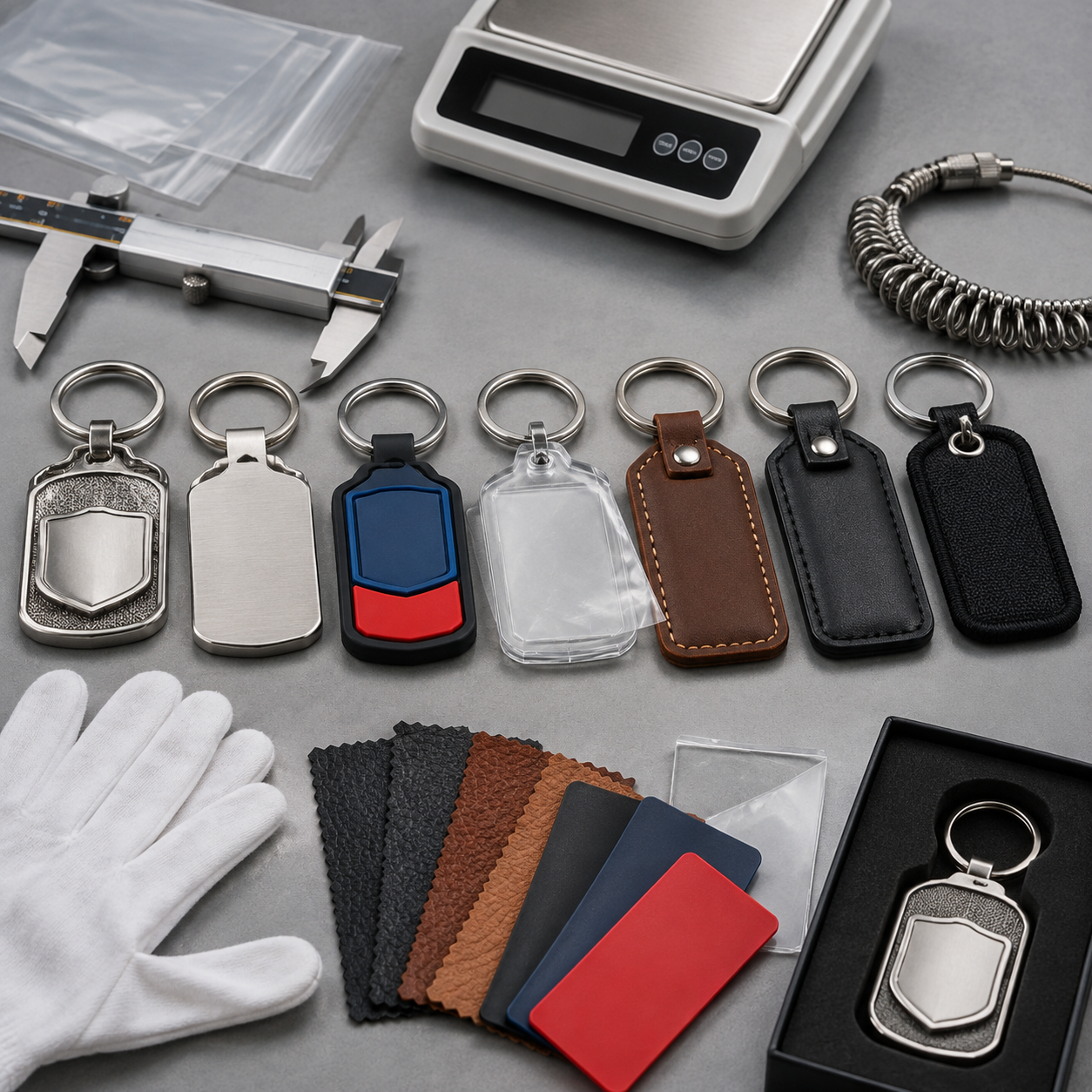
For European B2B procurement, keychain material options include metal, soft PVC, acrylic, leather-based construction, and embroidered textile. These are distinct construction families, not interchangeable performance grades, compliance conclusions, or supplier rankings. The quoting supplier should identify the exact body material, component materials, manufacturing process, finish, hardware, dimensions, tolerances, packaging contact materials, and production configuration before its offer is compared with another route.
The cited Ruixing supplier guide presents metal, soft PVC, acrylic, leather, and embroidery as separate keychain sourcing families (Ruixing Gifts material guide). That classification can organize a shortlist. It does not establish a performance ranking, a suitable grade or formulation, destination compliance, or approval of a particular supplier.
Procurement decision: choose the material route that can be fully defined against the intended construction, then release production only after the evidence, physical sample, destination review, and change controls apply to that exact configuration.
Keychain Material Options for Europe
| Required construction | Material option to quote | Fields that must be declared | Hold the quote when |
|---|---|---|---|
| Rigid body with a flat face, relief, or formed profile | Metal | Grade or alloy; forming process; finished dimensions and tolerances; mass; edge condition; finish layers; decoration; connector and split-ring materials | The base material, process, finish stack, or hardware material is unidentified |
| Flexible moulded body with defined colour areas or relief | Soft PVC | Polymer identity or controlled formulation reference; hardness method and scale; pigment or colour reference; body and relief dimensions; attachment insert; connector and ring materials | The offer uses a generic term such as rubber or leaves the attachment construction open |
| Flat sheet body with printed, transparent, opaque, or backed construction | Acrylic | Polymer identity; sheet thickness and tolerance; print and viewing sides; backing layers; cut method; edge condition; hole geometry; protective film; connector and ring materials | The offer says only plastic or omits the print layers, backing, edge, or hole construction |
| Stitched, folded, wrapped, or laminated body | Leather-based construction | Exact identity of natural leather, PU-coated substrate, or another declared construction; total thickness; surface and substrate; thread; adhesive; edge treatment; connector and ring materials | Natural leather and PU are treated as interchangeable or the complete layer construction is not disclosed |
| Textile tag with stitched artwork | Embroidered textile | Fibre content; base fabric or webbing; thread; backing; edge construction; stitch reference; attachment reinforcement; connector and ring materials | Fibre, backing, edge construction, or reinforcement can change without approval |
These are quote-definition controls. The Ruixing source supports the family-level shortlist and general construction context, but it does not verify a supplier's grade, formulation, tolerance, finish, hardware, testing, production site, or legal conclusion.
Source-Traced Planning Data
The cited vendor table associates die casting and stamping with metal, injection moulding with PVC or ABS, and die cutting with leather or other sheet materials. These are vendor-displayed process associations, not universal process-selection rules (Top Jewelry vendor guide).
| Process reference | Concrete source data | Permitted procurement use | Limitation |
|---|---|---|---|
| Die casting or stamping | At least 1,000 units per order, within the vendor table's die-casting or stamping scope on the page displaying the date 17 April 2026 (Top Jewelry vendor guide) | Preliminary RFQ planning for a proposed metal process | Not a market minimum, current supplier quotation, or commitment for a particular design, finish, destination, or shipment |
| Injection moulding | At least 2,000 units per order, within the vendor table's injection-moulding scope on the page displaying the date 17 April 2026 (Top Jewelry vendor guide) | Preliminary RFQ planning for a proposed moulded route | Must be verified for the actual formulation, tooling, colourway, destination, and shipment |
| Die cutting | At least 500 units per order, within the vendor table's die-cutting scope on the page displaying the date 17 April 2026 (Top Jewelry vendor guide) | Preliminary RFQ planning for a proposed sheet-conversion route | Must be verified for the actual sheet material, construction, artwork, destination, and shipment |
The Ruixing page displays the date 23 November 2025 and is used here only for its keychain material-family sections (Ruixing Gifts material guide). Neither supplier-authored page establishes market-wide availability, comparative performance, or a binding quotation.
Ask each supplier to state its actual minimum order by design, material, colourway, finish, tooling configuration, and shipment. Keep that quotation separate from the vendor-displayed planning references above.
Example Baseline for Material-Option Quotes
The values below are illustrative comparison assumptions to verify in the supplier quote. They are not sourced product specifications, recommendations, or offers. A supplier should identify any assumption that is unsuitable for its proposed material route.
| Comparison field | Example assumption to verify | Measurement scope |
|---|---|---|
| Finished body width | 50 mm | Per finished keychain body, excluding the connector and split ring |
| Finished body height | 30 mm | Per finished keychain body, excluding the connector and split ring |
| Maximum finished body thickness | 3 mm | Per finished body at the drawing-defined measurement location |
| Split-ring outside diameter | 30 mm | Per finished split ring, measured across its outside diameter |
| Comparison quantity | 10,000 finished keychains | Per design, material route, and colourway in the comparison quote |
Use the same controlled drawing, artwork, hardware basis, quantity, packaging basis, evidence scope, destination basis, and delivery terms for every route. A common comparison envelope exposes quote differences; it does not make the material options technically equivalent.
RFQ Fields by Keychain Material Option
| Material option | Lock before comparing quotes | Evidence and sample records to request | Buyer-defined checks to specify |
|---|---|---|---|
| Metal | Grade or alloy, forming process, dimensions, tolerances, mass basis, edge requirement, finish layers, decoration, connector, and ring | Component bill of materials, material declaration, dimensional and mass record, finish sample, and any destination-relevant current reports | Dimensions, mass, edge condition, artwork registration, finish appearance, adhesion, attachment load, ring closure, and any selected corrosion method |
| Soft PVC | Polymer identity or formulation reference, hardness method and scale, body and relief geometry, colour reference, surface criteria, and attachment insert | Formulation declaration linked to the sampled colourway, hardness record, dimensional record, and signed colour sample | Dimensions, hardness, colour comparison, surface defects, flex method, attachment load, and any buyer-selected odour criterion |
| Acrylic | Polymer identity, sheet thickness and tolerance, layer construction, cut method, edge condition, hole geometry, print side, viewing side, and protective film | Material declaration, layer description, artwork comparison, dimensional record, and signed sample | Thickness, external dimensions, hole position, edge distance, print registration, adhesion, edge condition, and any selected impact method |
| Natural leather, PU, or another declared leather-based construction | Material identity, surface and substrate construction, total thickness, fold or lamination method, adhesive, thread, stitch construction, and edge treatment | Material declaration, construction section or swatch, signed colour and surface sample, and thickness record | Thickness, stitch position, edge finish, flex method, colour transfer, attachment load, surface criteria, and any selected odour criterion |
| Embroidered textile | Fibre content, base fabric or webbing, thread, backing, edge construction, stitch reference, and attachment reinforcement | Fibre declaration, construction sample, signed colour and stitch sample, and dimensional record | Dimensions, artwork placement, edge condition, loose-thread criteria, attachment load, and any selected abrasion or colourfastness method |
For every requested measurement or test, state the characteristic, drawing datum, method, instrument or fixture, unit, conditioning, sample basis, pass limit, record format, and failed-result procedure. A test name without a defined configuration and acceptance criterion does not create a comparable requirement.
Require a component-level bill of materials covering the body, finish, colour fill or ink, adhesive, thread, connector, split ring, and material-contacting packaging. Supporting evidence should identify the same material, colourway, finish, component construction, production site, and sample represented by the quote. Treat evidence for an unidentified sample or different construction as unresolved until a qualified reviewer documents why it applies.
European Destination Controls for Keychain Materials
The supplied material sources do not establish legal requirements for any European jurisdiction. A generic Europe-compliant statement is therefore insufficient. Maintain a destination matrix and have a qualified reviewer determine the current obligations for the actual material, finish, intended user, foreseeable contact, packaging, and sales configuration.
| Destination | Procurement treatment | Questions to close before material approval |
|---|---|---|
| EU destination countries | List every intended country and record separately the applicable EU-level conclusion and any member-state overlay identified by the reviewer | Which product or component is in scope, what evidence is required, which language or marking duties apply, and when was the conclusion reviewed? |
| Non-EU EEA destinations | Maintain a separate row for each destination instead of copying the EU conclusion automatically | Which evidence remains applicable, which local requirements differ, and who confirmed the current position? |
| UK: Great Britain | Conduct a distinct product, material, packaging, importer, labelling, and record review | Which requirements apply to the quoted configuration and which documents must connect to it? |
| UK: Northern Ireland | Keep the conclusion separate from the Great Britain row | Which route applies to the actual product and sales configuration, and how are responsible-party and labelling duties addressed? |
| Country-specific overlay | Add a row for each local requirement identified by the qualified reviewer | Are local language, warning, packaging, producer-responsibility, waste-information, recordkeeping, or importer actions relevant to this configuration? |
Where a regulation or standard is relevant, record its exact title, jurisdiction, version or date, product and component scope, required method or document, reviewer, and review date. Keep the basis of each requirement clear:
- External requirement: A legal or standards-based obligation whose applicability has been confirmed for the destination and quoted configuration.
- Buyer specification: A contractual material, appearance, performance, or QC requirement selected by the buyer.
- Supplier practice: An internal process, inspection, or voluntary test. It does not become an external requirement merely because the supplier performs it.
Do not describe a keychain, material, production site, or supplier as certified unless a current certificate identifies the holder, site, scope, issuing body, issue status, validity status, and documented connection to the quoted construction. A test report, declaration, audit summary, or expired certificate is not a substitute for that check.
Sample and Change-Control Gates
Use pass, conditional, or fail decisions so unresolved material questions remain visible through award and production:
- Quote-completeness gate: Confirm exact body and component materials, process, dimensions, tolerances, finish, artwork construction, hardware, evidence scope, sample plan, and destination rows.
- Evidence-relevance gate: Match declarations, reports, and requested certificates to the quoted material, component, colourway, finish, sample, production site, document scope, and current status.
- Pre-production sample gate: Approve a physical sample against the controlled drawing, artwork, bill of materials, colour references, surface criteria, packaging specification, and measurement schedule.
- Production-release gate: Record the approved sample identifier and prohibit unapproved changes to material grade, formulation, sheet source, finish layers, ink, adhesive, thread, connector, ring, sub-supplier, process, or production site.
- Pre-shipment gate: Review the agreed inspection results, material evidence, quantity record, packaging protection, destination documents, deviations, and failed-lot disposition before release.
Link the approved sample to its drawing revision, artwork revision, bill-of-materials revision, material evidence, and approval record. Appearance approval alone should not authorize an unidentified material or component substitution.
If an acceptance-sampling standard is selected, identify its exact title and edition, lot definition, inspection level, defect classes, acceptance thresholds, and failed-lot procedure. The standard can govern sample selection and lot decisions, but the buyer's keychain specification must still define the material, dimensional, cosmetic, and functional defects.
Keychain Material-Option RFQ Checklist
- [ ] Identify every intended EU, non-EU EEA, Great Britain, Northern Ireland, and country-specific destination row.
- [ ] State the intended use, intended user, foreseeable contact, service conditions, and distribution restrictions relevant to material selection.
- [ ] Name the primary material route and control any fallback route separately.
- [ ] Require exact body and component identities instead of family labels alone.
- [ ] Attach controlled drawings and artwork covering dimensions, tolerances, thickness locations, attachment geometry, relief, print layers, stitch construction, connector, and split ring.
- [ ] Request a component bill of materials for the body, finish, colour fill or ink, adhesive, thread, connector, ring, and material-contacting packaging.
- [ ] Define the forming, cutting, moulding, stitching, printing, finishing, and assembly processes used for the quoted route.
- [ ] State measurable methods, units, conditioning, sample basis, pass criteria, and record requirements for each selected check.
- [ ] Require evidence to identify the relevant sample, material, component, colour, finish, method, result, issuer, production connection, and document date.
- [ ] Link the pre-production sample to the controlled drawing, artwork, bill of materials, and material evidence.
- [ ] Record the supplier's minimum order and price breaks on the same design, material, colourway, hardware, test, packaging, destination, and delivery basis.
- [ ] Require written approval before changing any material, formulation, finish, component, process, sub-supplier, or production site.
- [ ] Define responsibilities for failed evidence, failed samples, failed inspection, rework, reinspection, and replacement before award.
Comparing Material-Route Quotes
Use the same commercial structure for each route: tooling allocation + sample cost + production cost + material-specific testing + inspection cost + packaging cost + freight + destination charges + unresolved-risk allowance. This is a comparison method, not a cost estimate. Keep omitted, conditional, and unconfirmed values visible rather than treating them as zero.
Record each option as pass, conditional, or fail for material definition, technical fit, evidence relevance, physical-sample approval, commercial comparability, destination review, and change control. A lower unit price or vendor-displayed order minimum should not override an unidentified material, unsupported destination conclusion, irrelevant report, or unapproved sample.
Methodology and Limitations
Methodology: The material-family statements were extracted from the Ruixing supplier guide. The process associations and vendor-displayed order minimums were extracted from the Top Jewelry vendor table. Each sourced statement was kept within its stated scope, then translated into an RFQ question, evidence check, or sample gate. Illustrative dimensions and quantity were isolated in a separate table and labelled as assumptions to verify so they cannot be mistaken for sourced specifications.
Source contexts: The Top Jewelry page is used only for its displayed process associations and order-minimum planning references (Top Jewelry vendor guide). The Ruixing page is used only for its keychain material-family and construction context (Ruixing Gifts material guide). The ZheCraft profile identifies Vincent Xi as Editorial Author and is used only for author identity and role, not as manufacturing, testing, or product-performance evidence (Vincent Xi author profile).
Limitations: The cited product pages are supplier-authored context, not independent laboratory studies, market-wide order-minimum surveys, current quotations, or jurisdiction-specific legal opinions. They do not establish that a proposed grade, formulation, thickness, finish, hardware configuration, production site, or document set will satisfy the buyer's requirements.
Suitability remains conditional on the quoted material identity, geometry, tolerances, finish, decoration, hardware, production controls, test method, intended use, and destination review. Before award, verify the supplier quote, material declarations, bill of materials, controlled drawing, physical sample, report relevance, current document status, production location, destination matrix, inspection results, and change-control acceptance. No manufacturing capability, certification, test result, customer outcome, or supplier commitment is asserted here.
Discuss Your Requirements
Review our manufacturing capabilities, then share your specifications for a supplier-fit review.