Enamel Pin OEM Customization Options for New Zealand RFQs
By Vincent Xi, Editorial Author
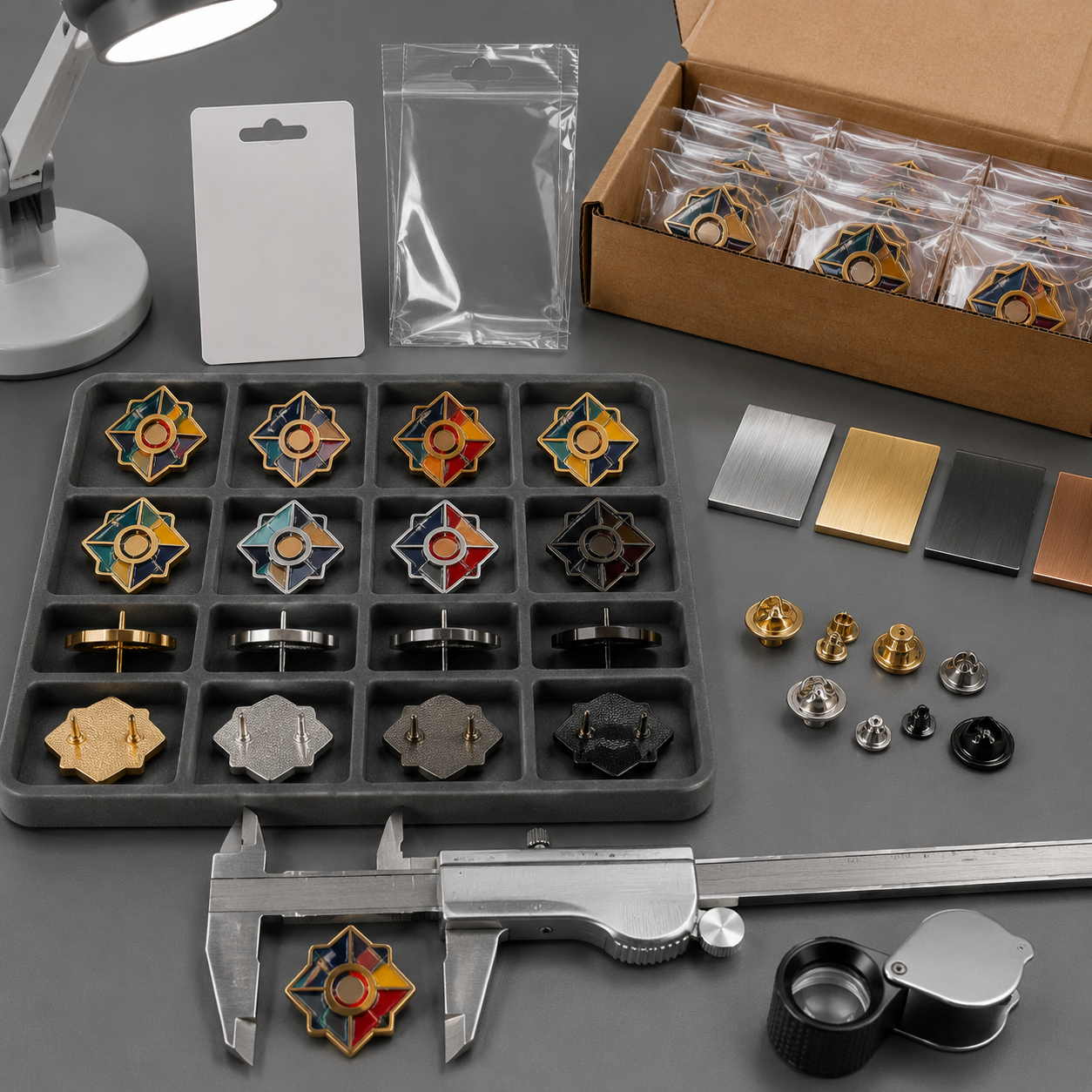
Decision summary: For a New Zealand B2B buyer, enamel pin OEM customization options become comparable only when each visual choice is converted into a controlled manufacturing requirement. Send bidders the same artwork revision, finished dimensions, construction, supplier-declared material, finish, colour map, reverse details, attachment, packaging specification, sample gate, QC requirements and delivery scope.
Treat a quote as decision-ready only when it:
- Identifies the artwork and specification revision being priced.
- Confirms each included customization operation and marks proposed exceptions.
- Separates unit, tooling, sampling, packaging, inspection, payment and freight charges.
- Names the quoting entity, manufacturing location, dispatch point and New Zealand delivery point.
- Defines the drawing, physical sample and acceptance records that will control production.
- States how substitutions, nonconformities and shipment release will be handled.
This keeps the buying decision tied to the specified enamel pin rather than catalogue terminology, general quality claims or unit price alone.
Enamel pin OEM customization options to lock before pricing
The BulkCustom commercial guide describes OEM work as manufacturing from a buyer-provided design and specification. It describes hard enamel as colour fill polished level with the surrounding metal lines and soft enamel as recessed colour fill below raised metal lines (BulkCustom). These descriptions provide attributed sourcing context; they do not prove that every supplier uses the same terminology or production controls.
Specify the required physical result, not just the category label:
| Customization decision | RFQ instruction | Required approval evidence |
|---|---|---|
| Enamel construction | State hard or soft enamel terminology and the intended level or recessed surface profile | Controlled proof plus face, edge and angled views of the physical sample |
| Finished geometry | Define width, height, longest dimension, orientation, measurement points and requested tolerance reporting | Dimensioned manufacturing drawing and measured sample results |
| Base material | State any buyer restriction or require a supplier-declared material proposal | Material or alloy declaration tied to the quoted SKU, drawing and sample |
| Plating or coating | Define finish colour, gloss or texture and coverage across the face, edge, rear and attachment components | Supplier finish reference and approved physical sample |
| Colour and detail | Supply a controlled colour map showing fill areas, exposed metal, gaps and visual effects | Revised production artwork and physical sample |
| Contour and reverse face | Define cut-outs, holes, edge treatment, rear artwork, relief, orientation and required marking | Front and rear drawings plus physical sample |
| Attachment | Define post position, clutch type, component material, assembly and the required functional check | Rear-view sample, component declaration and recorded check result |
| Unit packaging | Define protection, backing card or insert, closure, barcode position, assembly and carton pack-out | Approved packed sample and proposed carton configuration |
| Tooling and changes | Request tooling cost, ownership, storage, reuse, remake and revision terms | Quote and purchase-order terms tied to the controlled revision |
Require every proposed enlargement of a line, closure of a gap, movement of a post, colour adjustment, material substitution or packaging change to appear as a marked exception. Approval of one revision should not be treated as approval for an undisclosed production change.
Turn customization options into a comparable manufacturing quote
The following values are buyer-created example assumptions for one enamel pin SKU. They apply only as of the issue date of the supplier quote for that SKU and are not observed production data, market norms or supplier capabilities. Each value must be confirmed or replaced in the dated supplier quote.
| Example specification | Scope and verification requirement |
|---|---|
| 500 saleable finished units for the example SKU | Verify the quoted quantity and the treatment of overruns, underruns, shortages and rejected units |
| 30 mm across the longest finished dimension of each pin | Verify the drawing-defined measurement points, proposed tolerance and measurement method |
| 1.8 mm nominal body thickness per pin at the drawing-defined flat area | Verify whether plating, raised detail, enamel, rear relief and attachments are included or excluded |
| 4 distinct spot-colour fill areas on the face of each pin | Verify the controlled colour references, fill map and manufacturing adjustments |
| 2 rear posts on each pin | Verify post positions, clutch components, assembly and the proposed functional check |
A complete quote response should also return:
| Control block | Supplier response required |
|---|---|
| Project identity | Buyer entity, SKU, RFQ issue date, artwork revision, approval contacts and named New Zealand delivery point |
| Manufacturing scope | Manufacturing entity and location, subcontracted operations, proposed process, material, components and dispatch point |
| Proof and sample | Proof content, manufacturing drawing, physical pre-production sample, charges, sample freight and approval sequence |
| Quality plan | Production-lot definition, inspection stage, sample selection, acceptance and rejection rules, dimensional checks, cosmetic criteria and report format |
| Commercial scope | Quote currency, validity, unit price, tooling, sampling, packaging, inspection, payment fees, taxes and exclusions |
| Delivery scope | Delivery rule and edition if used, named place, freight service, insurance scope, carton data and schedule assumptions |
| Change control | Written approval process for changes to artwork, material, finish, component, process, subcontractor, manufacturing location or schedule |
| Remedies | Evidence and responsibility for shortages, nonconformity, reinspection, transit damage, rework, replacement or credit |
The manufacturing drawing should show where every critical dimension is measured. It should also state whether body thickness includes or excludes raised metal, recessed enamel, rear relief, plating and attachment components. Visual acceptance should identify the governing physical sample, inspection surfaces, viewing conditions and permitted exceptions. Attachment requirements should use a repeatable supplier-proposed check rather than undefined terms such as strong or secure.
Sample approval and manufacturing QC
BulkCustom presents artwork, specification, proof approval, sampling and production as stages in its described workflow (BulkCustom). That source context can help a buyer define contractual approval gates, but it does not establish another supplier's workflow or prove that a production lot will match a sample.
| Approval gate | Buyer decision | Release record |
|---|---|---|
| Digital proof | Approve represented layout, contour, colour assignment, dimensions, rear orientation and post position | Revision-controlled proof with written disposition of exceptions |
| Manufacturing drawing | Approve proposed geometry, material declaration, dimensional scheme and process-driven artwork changes | Supplier drawing tied to the quoted proof revision |
| Physical pre-production sample | Approve surface profile, finish appearance, edge condition, colour appearance, attachment assembly and packed presentation | Identified sample, photographs, measured results and dated approval |
| Production inspection | Decide whether the identified production lot meets the drawing, sample and quality plan | Lot identifier, sample-selection record, results, photographs and nonconformity disposition |
| Shipment release | Confirm accepted saleable quantity, packed condition, carton data and required shipment evidence | Written release tied to the inspected lot and shipment |
A digital proof records represented design intent but cannot physically demonstrate enamel relief, finish appearance, edge condition, attachment performance or packaging abrasion. Where these characteristics govern acceptance, require a physical pre-production sample using the supplier's proposed material, finish, components and process.
The purchase order should require written disclosure before any sample-to-production change affecting the process, manufacturing location, subcontractor, material, finish, component or packaging. Inspection records should identify the production lot, selection method, inspected characteristics, results and disposition of nonconforming units.
If a bidder names a standard, request its full title, edition, applicable clause and evidence showing how that clause applies to the quoted SKU. Keep a standard's requirements separate from the supplier's own inspection practice. Do not infer certification from a logo, marketing statement or undated file; request a current document identifying its issuer, holder, scope, date and applicable product or process.
New Zealand freight and documentation for customization quotes
The Signature Pins commercial sourcing guide discusses direct-factory and intermediary routes and identifies exchange rates, added fees and shipping methods as cost-comparison considerations (Signature Pins). These statements are used only to frame quote questions. They are not freight benchmarks, evidence of a bidder's manufacturing role or proof of costs for a New Zealand shipment.
Require each bidder to state:
- The legal entity issuing the quote and the entity receiving payment.
- The actual manufacturing location, subcontracted operations and dispatch point.
- The quote currency, issue date, validity date, payment method and payment-related fees.
- Whether tooling, samples, unit packaging, inspection, freight, insurance, clearance services and domestic delivery are included.
- Every excluded charge that could affect bid comparison.
- The delivery rule and edition if used, named place and proposed freight service.
- Schedule assumptions and dependencies, with estimates distinguished from commitments.
- Proposed carton dimensions, gross weight, net weight and saleable-unit count per carton.
- Draft commercial documents, origin information and proposed tariff classification before dispatch.
- The shipment-release evidence and the party authorised to approve release.
Illustrative quote calculation: The following amounts are buyer-created assumptions for one example shipment to a named New Zealand delivery point. They are not current prices, freight rates or forecasts and must be replaced with amounts from the supplier quote as of its issue date.
| Example cost | Assumed scope |
|---|---|
| NZD 1,250 | Finished goods charge for 500 saleable units of the example enamel pin SKU |
| NZD 150 | Tooling charge tied to that example SKU |
| NZD 200 | International freight for the example shipment to the named New Zealand delivery point |
| NZD 1,600 | Example shipment subtotal calculated as NZD 1,250 + NZD 150 + NZD 200 |
| NZD 3.20 per saleable unit | Example comparison value calculated by dividing the NZD 1,600 shipment subtotal by 500 saleable units |
The example excludes brokerage, import taxes, clearance, domestic delivery, inspection loss, insurance unless quoted and payment fees. Verify every inclusion, exclusion and quantity effect before comparing bids.
No official New Zealand customs or regulatory source is included in the supplied citations. This article therefore does not assign a mandatory tariff classification, tax treatment, import document, product test, marking requirement or standard to the enamel pin. Before shipment, the New Zealand buyer or appointed adviser should verify the proposed classification and origin information, current import treatment, documentary requirements and obligations arising from the intended use. Treat supplier-provided information as a proposal for verification rather than a customs or regulatory determination.
Enamel pin customization RFQ release checklist
- [ ] The buyer entity, approval contacts and named New Zealand delivery point are stated.
- [ ] The quoting entity, manufacturing location, subcontracted operations and dispatch point are disclosed.
- [ ] Front, rear and packaging artwork use the same controlled revision identifier.
- [ ] Enamel terminology is paired with the required physical surface profile.
- [ ] Dimensions, measurement points, nominal thickness and tolerance reporting are defined.
- [ ] Material, finish, colour map, edge treatment and reverse-face requirements are documented.
- [ ] Supplier-proposed artwork or manufacturing changes require written approval.
- [ ] Post layout, clutch type, component material and functional check are specified.
- [ ] Unit packaging, assembly, protection and carton pack-out are included.
- [ ] Saleable quantity and the treatment of overruns, shortages and rejected units are stated.
- [ ] Tooling ownership, storage, reuse, revision and remake terms are included.
- [ ] Proof, drawing, physical sample, production inspection and shipment-release records are identified.
- [ ] Quote currency, validity, payment fees, freight scope and exclusions are itemised.
- [ ] Draft commercial documents, origin information and proposed classification are requested before dispatch.
- [ ] New Zealand import, tax, documentation and intended-use obligations are assigned for local verification.
- [ ] Remedies address shortages, nonconformity, reinspection, transit damage, rework, replacement and credit.
Evidence method, source context and limitations
| Article use | Source context | Evidence boundary |
|---|---|---|
| OEM description and the observable distinction between hard and soft enamel | BulkCustom commercial guide | Used to frame construction fields; not treated as proof of any supplier's capability or terminology |
| Artwork, specification, proof approval, sampling and production workflow | BulkCustom commercial guide | Used to create buyer-controlled approval gates; not treated as another supplier's documented practice |
| Direct-factory and intermediary routes, exchange rates, added fees and shipping methods | Signature Pins commercial guide | Used only to frame quote-scope questions; not used as a price, freight or quality benchmark |
| Vincent Xi's identity and role as Editorial Author | ZheCraft author profile | Supports the visible byline and structured-data author identity only |
Method: Attributed statements were limited to the supplied source pages and separated from buyer-created RFQ controls, example assumptions and verification steps. The decision tables translate the sourced construction and workflow context into information that a New Zealand buyer can require from each bidder. All dimensional, quantity and cost figures are labelled as illustrative assumptions or calculations to verify in the dated supplier quote.
Author basis: The approved ZheCraft profile identifies Vincent Xi as Editorial Author. It does not document factory visits, physical product testing, laboratory work, manufacturing employment or customer outcomes, so no such experience claims are made.
Limitations and verification: This article is not supported by a factory audit, physical enamel pin test, laboratory report, current supplier quote, current freight rate, customs ruling or New Zealand regulatory determination. The cited commercial guides are not treated as independent technical standards or evidence of another supplier's practices. Before issuing a purchase order, verify the supplier's legal identity, manufacturing location, material declaration, process limits, tolerances, physical sample, quality plan, tooling terms, quote validity, freight scope, shipment records and remedies. Confirm current New Zealand customs, tax, documentation and product-compliance requirements with appropriately qualified local authorities or advisers for the specific intended use and shipment.
Discuss Your Requirements
Review our manufacturing capabilities, then share your specifications for a supplier-fit review.